
Short on time? Here is what matters:
- 🏆 Phoenix Art Museum was selected by readers as the top art museum in Metro Phoenix, reflecting its long-standing local relevance and broad appeal.
- 🎨 Its 21,000-plus-object art collection combines American, Asian, European, Latin American, Western American, fashion, photography, and contemporary works.
- 📱 A well-planned visit benefits from checking current museum exhibits, reserving enough time, and using clear audio interpretation to make large galleries easier to navigate.
- 💡 Wednesday pay-what-you-wish access and First Friday participation make the museum a practical cultural attraction for both residents and visitors.
Why Readers Chose Phoenix Art Museum as Metro Phoenix’s Top Art Museum
Phoenix Art Museum has earned readers choice recognition as the leading art museum in Metro Phoenix, a distinction that reflects more than a single popular exhibition or a well-known artwork. Readers responding to The Arizona Republic’s poll identified an institution that has remained connected to the region through changing demographics, artistic movements, and visitor expectations.
For a museum to become a must-visit destination, it needs to serve different audiences without making any of them feel overlooked. A first-time visitor may arrive looking for a recognizable modern masterpiece. A local family may want a reliable weekend activity. A student may seek visual references for a design project, while an experienced collector may be drawn to a focused exhibition. Phoenix Art Museum works because these needs can coexist within one visitor experience.
The museum’s position is also rooted in accessibility. Its downtown location at 1625 N. Central Avenue places it within the city’s cultural corridor, near public transportation, restaurants, performance venues, and other civic spaces. That proximity matters in a hot-weather destination where visitors often plan indoor activities around travel time, parking, and comfort. An art museum visit becomes easier to include in a wider day out when it is integrated into the urban environment rather than isolated from it.
Its public programming reinforces that accessibility. Pay-what-you-wish Wednesdays lower the financial barrier for community members who may not be ready to commit to full-price admission. Participation in downtown Phoenix First Fridays also gives the venue a role beyond conventional daytime museum attendance. These initiatives do not simply increase footfall; they allow audiences to form a habit of cultural participation.
Consider the example of Maya, a fictional visitor arriving in Phoenix for a three-day conference. She has only one free evening and wants an activity that offers substance without requiring extensive advance planning. A late Wednesday or Friday visit can offer an efficient, climate-controlled cultural stop. If she then returns on a future trip to see a different exhibition, the institution has successfully turned a one-time visitor into a repeat audience.
The recognition also acknowledges the museum’s ability to balance established collections with changing public interests. Some visitors are drawn to fashion and photography; others prefer painting, sculpture, or global art traditions. Instead of presenting a narrow identity, the museum offers multiple entry points. This breadth is especially valuable in a rapidly growing metropolitan area where residents arrive with different cultural backgrounds and expectations.
Local reputation is built through repeated positive interactions: welcoming staff, clear gallery circulation, compelling interpretation, educational programs, and exhibitions that give people a reason to return. Reviews and visitor planning information available through the Phoenix Art Museum visitor reviews can help travelers compare practical experiences before they arrive.
Reader recognition should not be interpreted as a claim that other Arizona institutions lack value. The Heard Museum, for example, remains essential for visitors seeking Native American art and cultural context. Yet Phoenix Art Museum’s readers choice result highlights its particular strength: it provides a wide-ranging, adaptable, and approachable art encounter in the center of the Valley.
The key point is simple: a top museum is not defined only by the number of objects it holds, but by how effectively it helps different people connect with them.
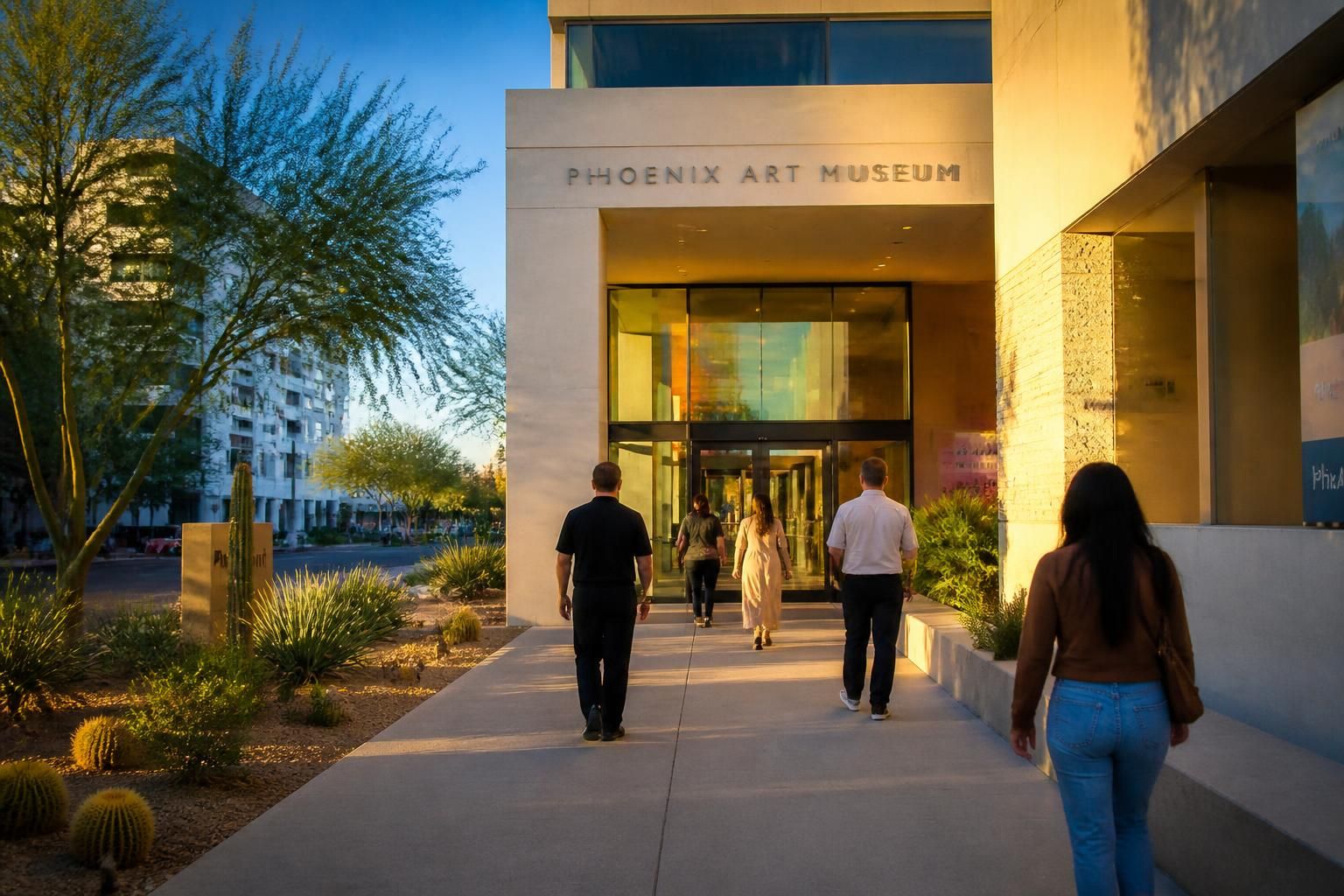
Explore a 21,000-Object Art Collection Without Losing the Visitor Experience
Phoenix Art Museum’s scale is one of the main reasons it stands apart as a major cultural attraction. The museum reports an art collection of more than 21,000 objects, giving visitors access to material that spans geography, media, and historical periods. For guests, however, size can be both an advantage and a challenge. A large collection promises discovery, but it can also create decision fatigue if the visit lacks a clear route.
The most productive approach is to treat the museum as a set of connected experiences rather than a checklist. A visitor does not need to see every room to have a meaningful afternoon. Instead, choosing two or three themes creates a manageable rhythm. One route might focus on fashion, photography, and contemporary installation. Another could move from American art to European painting and then toward works connected to the Southwest.
Use themes to make the galleries feel more personal
The museum’s collection includes American, Asian, European, Latin American, Western American, modern, and contemporary art, alongside fashion design and photography. This variety makes it possible for each guest to build an experience around genuine curiosity. A visitor interested in visual storytelling may spend more time with photography. Someone with an interest in material culture may find fashion galleries especially revealing.
Fashion exhibitions deserve particular attention because they demonstrate how clothing can be interpreted as design, social history, identity, labor, and technology. A garment displayed behind glass is not only an elegant object. It can show how textile innovation, changing body ideals, and cultural exchange shape everyday life. Clear labels, contextual images, and thoughtful audio content can help visitors move beyond surface-level appreciation.
Photography provides another accessible entry point. Images often create immediate recognition because visitors understand faces, streets, landscapes, and gestures before they understand artistic theory. This makes photography an effective route for younger audiences, multilingual groups, and people who feel intimidated by more formal gallery settings.
For cultural venues, this is where audio technology becomes useful. Instead of asking every visitor to join a fixed guided tour, museums can offer short, location-based audio segments on a smartphone. A platform such as this guide to leading art museums in the United States illustrates why institutions increasingly need to combine strong collections with practical digital interpretation. Audio content works best when it is brief, focused, and available at the moment the visitor needs it.
A well-designed stop might explain one artwork in 90 seconds: what the visitor is seeing, why it matters, and one detail worth noticing. That format respects autonomy. It avoids turning an art museum into a passive lecture while still helping guests develop confidence in front of unfamiliar works.
| Visitor goal | Useful collection focus | Practical approach |
|---|---|---|
| 🎨 First visit | Signature works and current museum exhibits | Choose two gallery areas and leave time for one special exhibition. |
| 👗 Design interest | Fashion and decorative arts | Look for materials, silhouettes, construction, and social context. |
| 📷 Visual storytelling | Photography and contemporary works | Compare subjects, framing, emotion, and historical setting. |
| 🌵 Regional perspective | Western American and local art connections | Pair gallery viewing with a walk through downtown Phoenix. |
The museum’s ability to accommodate both broad browsing and detailed study is central to its appeal. With approximately 250,000 annual guests, the institution must make its spaces work for people moving quickly as well as visitors who want to stay with one artwork for several minutes.
A large art collection becomes memorable when visitors are given practical ways to make choices, slow down, and notice details that would otherwise be missed.
Before a visit, a short video overview can help guests recognize the building, understand the gallery atmosphere, and identify which areas deserve priority. It is a simple preparation step that reduces uncertainty without replacing the value of seeing original works in person.
How Phoenix Art Museum Built Its Must-Visit Reputation Over Six Decades
Phoenix Art Museum did not emerge overnight as the most recognized art museum in Metro Phoenix. Its history is tied to civic ambition, volunteer leadership, collecting, education, and the growth of Phoenix itself. Understanding that development makes the current readers choice recognition more meaningful: the museum’s status rests on more than six decades of public operation and on cultural work that began much earlier.
The collection’s earliest foundation can be traced to the Phoenix Women’s Club, formed in 1915, just three years after Arizona statehood. The club’s art exhibition committee sought to improve the quality of artwork presented at the Arizona State Fair. Its commitment to purchase a new work each year created an early collecting framework that would later support the museum’s development.
In 1925, local civic leaders established the Phoenix Fine Arts Association. It brought together groups including the Collectors Club, Camera Club, Fine Arts School, and State Fair Exhibition Committee. Between 1926 and 1930, the association organized annual displays at the Arizona Museum. From 1931 through 1935, it collaborated with the Phoenix Women’s Club on exhibitions at a building on North Central Avenue.
These early activities reveal an important lesson for cultural organizations: museums are often built through long-term relationships before they are built through walls. Exhibitions, educational activity, collector advice, and public gatherings can create an audience long before an institution has a purpose-built gallery. Phoenix’s art ecosystem developed through exactly this kind of sustained local participation.
From civic plans to a permanent institution
In 1940, Phoenix planned a civic center on 6.5 acres near Central Avenue and McDowell Road, with a library, theater, and art museum included in the vision. World War II interrupted those plans. After the war, the concept was revived in another location, reflecting how civic priorities had changed alongside the city’s expanding population.
A brick house at 45 East Coronado Road opened in 1948 as the Civic Center House. It later became known as the Art Center because of its regular use for exhibitions, classes, and cultural activity. Two especially popular shows between 1953 and 1954—one focused on Western painting and another on architect Frank Lloyd Wright—drew record crowds. The response demonstrated that Phoenix audiences were ready for more ambitious programming.
That momentum supported a campaign for a comprehensive museum. In 1957, supporters launched a $1 million fundraising effort, and construction began in January 1959. Phoenix Art Museum opened on November 18, 1959. An east wing was later opened to the public on November 18, 1965, showing that expansion was already part of the institution’s identity.
This historical context explains why the museum has such strong local recognition. It grew alongside Phoenix rather than arriving as an external cultural import. The institution adapted from modest exhibition spaces to a major regional venue capable of presenting national and international shows. It also retained a public-service role through tours, lectures, classes, and programming.
For today’s visitor, that history can be used as a lens. The building is not simply a container for objects; it represents decades of decisions about what a city values. When a family views a contemporary installation, or a student attends an exhibition talk, they participate in a cultural system that local organizers began constructing more than a century ago.
The museum’s reputation rests on continuity: it has repeatedly responded to the needs of a growing city while maintaining art as a shared public resource.
Historical video material can add useful context before arrival, particularly for groups and educators. It helps visitors connect today’s galleries with the civic, architectural, and cultural choices that made the museum possible.
Plan a Smooth Phoenix Art Museum Visit: Hours, Admission, and Smart Timing
A successful museum visit depends on practical planning as much as artistic interest. Phoenix Art Museum’s reputation as a must-visit location is strengthened by its accessible central address, but guests should still prepare for the realities of Metro Phoenix: high temperatures, event traffic, changing exhibition schedules, and the time required to explore a substantial venue comfortably.
The museum is located at 1625 N. Central Avenue, Phoenix, Arizona. Its regular schedule has included opening from 10 a.m. to 8 p.m. on Wednesdays and Fridays, and from 10 a.m. to 5 p.m. on Thursdays, Saturdays, and Sundays. It is generally closed on Mondays and Tuesdays. Because opening times, ticket categories, and special-event access can change, visitors should confirm details through the official Phoenix Art Museum website before leaving.
Published general admission information has listed adult tickets at $25, admission for guests 65 and older at $22, student admission with valid ID at $20, youth admission for ages 6 to 17 at $15, and free entry for children age 5 and under. The museum’s Wednesday pay-what-you-wish model is particularly useful for flexible travelers, local residents, and families managing a cultural budget.
Choose timing that matches your energy and your goals
Morning visits work well for guests who want quieter galleries and a slower pace. They are also sensible during the hottest parts of the year, when indoor activities are an essential part of a balanced Phoenix itinerary. Friday evening access can suit visitors looking to combine art with dinner, a downtown walk, or another cultural event.
For example, a small tour operator could schedule a 10 a.m. arrival for a group of 12, begin with a concise orientation, provide wireless audio guidance through guests’ smartphones, and divide the visit into three thematic stops. This keeps the group together without forcing participants to crowd around a guide in every gallery. It also supports guests who need adjustable volume or prefer to listen at their own pace.
Smart tourism tools are especially valuable in museums because they solve simple operational problems. A guide can share live commentary, route cues, and short recorded clips without distributing dedicated receivers. Visitors use equipment they already understand: their phones and headphones. For institutions, that can reduce equipment handling while improving accessibility for multilingual or hearing-sensitive audiences.
Before arrival, it is useful to take these steps:
- 🗓️ Check the current exhibition calendar and any timed-entry requirements.
- 🎟️ Review admission options, including Wednesday pay-what-you-wish availability.
- 🎧 Bring charged headphones if you plan to use an audio guide or self-guided content.
- 👜 Travel light and verify the museum’s current bag, photography, and gallery rules.
- 📍 Choose two priority gallery areas rather than trying to see the entire building.
Visitors should also allow time for orientation. Rushing directly to the most photographed artwork often leads to a fragmented experience. A few minutes spent reviewing the floor plan, exhibition map, and accessibility services can save time later and make the day more comfortable.
For travelers comparing cultural stops across the city, the Visit Phoenix museum listing provides another practical starting point for location-based planning. It is particularly useful when combining the museum with nearby dining, lodging, or downtown attractions.
The most effective plan is not the longest itinerary; it is the one that leaves enough room for attention, rest, and genuine engagement with the art.
Make Museum Exhibits More Accessible With Audio, Local Art Context, and Digital Interpretation
Modern museum visitors expect flexibility. Some prefer to read every wall label, while others need a short explanation that helps them understand what they are looking at. Some travel with children, some attend with colleagues, and some visit independently with limited time. A leading art museum responds to these differences by designing interpretation that is clear, optional, and easy to access.
Audio is particularly effective because it can make visual art feel less distant. A visitor standing before a portrait may benefit from hearing why the sitter’s pose matters. Someone in a fashion gallery may understand a garment more deeply after learning about the designer’s construction technique. An audio guide should not repeat the wall text. It should point attention toward a visual decision, a historical tension, or a human story.
Build an audio route around attention, not technology
The best digital visitor experience is almost invisible. Guests should not need to download multiple tools, create complex accounts, or struggle to find the correct content. A QR code, direct web link, or guided group channel can be enough. The technology should remove friction, not create another task between the visitor and the artwork.
For example, a local guide leading a group through Phoenix could use a smartphone-based audio system to connect the museum visit with the city outside. Before entering, the guide could explain how Phoenix’s growth shaped its cultural institutions. Inside, a short segment could focus on one Western American artwork or one contemporary piece. Afterward, the group could discuss how local art and desert urban life influence each other.
This format is relevant for educators, destination management organizations, museum teams, and independent guides. It allows them to provide consistent information without sounding scripted. It also supports accessibility: participants can adjust volume, use their own headphones, and listen without being forced to stand near a speaker in a crowded room.
Interpretation should be designed carefully. A useful audio stop generally includes three elements: a direct description of what is visible, a concise explanation of why it matters, and a prompt that encourages visitors to look again. Questions such as “What detail changes when you step closer?” or “Whose perspective is missing from this image?” invite active observation without imposing a single correct response.
Digital content can also help visitors prepare before they arrive. A museum may offer a short preview route for first-time guests, family-friendly prompts, or an accessible sensory guide. These materials reduce uncertainty, especially for visitors who are unfamiliar with formal gallery environments. They can also make temporary museum exhibits easier to understand by providing context before the visitor reaches the first room.
There is a broader operational benefit. When a museum uses smartphone-based audio for guided groups, staff and guides can update routes more quickly when galleries change. A closed room, an artwork on loan, or a new special exhibition does not have to disrupt the entire experience. Updated guidance can be shared immediately, helping visitors avoid confusion.
Technology is not a substitute for curatorial expertise or human hospitality. It is a delivery method. The strongest cultural attraction combines knowledgeable staff, coherent displays, reliable wayfinding, and audio content that respects each visitor’s pace. The same principle applies across the sector, including institutions discussed in this overview of Massachusetts art museums: strong interpretation makes collections more approachable without reducing their complexity.
Phoenix Art Museum’s status as a top museum is strengthened when its physical galleries and digital tools work together to make every visit easier to understand, navigate, and remember.
Why was Phoenix Art Museum selected as Metro Phoenix’s top art museum?
Readers recognized Phoenix Art Museum for its broad collection, major exhibitions, long local history, educational programming, downtown location, and accessible community initiatives such as pay-what-you-wish Wednesdays.
How large is the Phoenix Art Museum art collection?
The museum holds more than 21,000 objects across areas including American, Asian, European, Latin American, Western American, modern and contemporary art, fashion, and photography.
When is Phoenix Art Museum open?
Regularly published hours include 10 a.m. to 8 p.m. on Wednesdays and Fridays, and 10 a.m. to 5 p.m. on Thursdays, Saturdays, and Sundays. It is generally closed Mondays and Tuesdays. Confirm current hours before visiting.
Is Phoenix Art Museum suitable for first-time museum visitors?
Yes. First-time guests can have a rewarding visit by selecting two or three gallery themes, checking current exhibits in advance, and using available maps or audio interpretation rather than attempting to see everything at once.
