
Taco Bell Drives Voice AI Expansion Across Nearly 900 Drive-Thrus
⚡ Taco Bell’s Voice AI expansion has moved beyond a limited experiment. By 2026, the chain’s automated ordering technology is active at more than 890 U.S. restaurants in 38 states, making it one of the largest Drive-Thru deployments in the quick-service restaurant sector. The program, supported by conversational AI specialist Omilia, reflects a practical shift: restaurants are treating automated voice ordering as part of daily operations rather than a showroom demonstration.
The significance is not simply that an AI voice now greets customers at the speaker box. Taco Bell operates in a demanding environment where guests make highly customized orders, combine items into meals, request substitutions, ask about sauces, and often change their minds halfway through a sentence. A usable Voice AI system must understand natural speech while linking every request to menu logic, current availability, pricing rules, and the restaurant’s point-of-sale infrastructure.
For a guest arriving during a lunch rush, the desired interaction remains simple. They want to place an order quickly, hear confirmation clearly, make one or two changes, and move forward without having to repeat everything. The technology is only valuable when it reduces friction instead of creating a new obstacle. This makes Customer Experience the central measure of success, not the novelty of the voice itself.
Taco Bell’s wider rollout shows that the brand sees value in delegating routine order capture to Automation. Team members can then concentrate on preparing food, solving exceptions, greeting customers at the pickup window, and handling situations where a human response genuinely adds value. This is particularly relevant in stores where a small team must manage a busy kitchen, delivery orders, lobby traffic, and a continuous Drive-Thru queue at the same time.
The operational case is straightforward. Taking orders requires concentration, menu knowledge, clear communication, and the ability to work through ambient noise. A speaker box can pick up engines, music, weather, passengers talking, or a customer placing an order while on the phone. Voice AI must therefore detect speech accurately, manage interruptions, and provide confirmations that prevent costly errors further down the service journey.
Coverage of Taco Bell’s expanding voice AI use has highlighted the scale of the rollout. Yet scale should not be confused with automatic performance. Deploying technology across hundreds of locations demands consistent menu integration, staff training, monitoring, local support, and a clear process for human takeover. A system that performs well in one calm suburban restaurant may behave differently at a high-volume urban site with more complicated traffic patterns.
For this reason, the current AI Expansion should be understood as an operational design project. The technology needs to work with people, not around them. A restaurant employee remains essential when the guest asks an unusual question, when a product is unavailable, when an accessibility need arises, or when the conversation is simply more complex than the automated flow can efficiently handle.
- 🎙️ Speech recognition: the system must understand accents, speed, interruptions, and background noise.
- 🍽️ Menu intelligence: it must process combinations, modifiers, dietary requests, and promotional offers.
- 🔄 Human handoff: employees need a fast, discreet way to take over without forcing the customer to start again.
- 📊 Operational visibility: managers need data on accuracy, intervention rates, service time, and repeat issues.
A useful way to view Taco Bell’s Acceleration is through the experience of a hypothetical franchise operator, Maya. Her objective is not to replace a skilled employee with a machine. Her objective is to prevent one employee from being permanently tied to a headset during peak periods. If the automated assistant can handle ordinary orders reliably, Maya can assign the team where human attention affects speed, accuracy, and guest satisfaction most directly.
The essential point is clear: a large rollout matters only when each restaurant can maintain a smooth, recoverable, and understandable ordering experience.
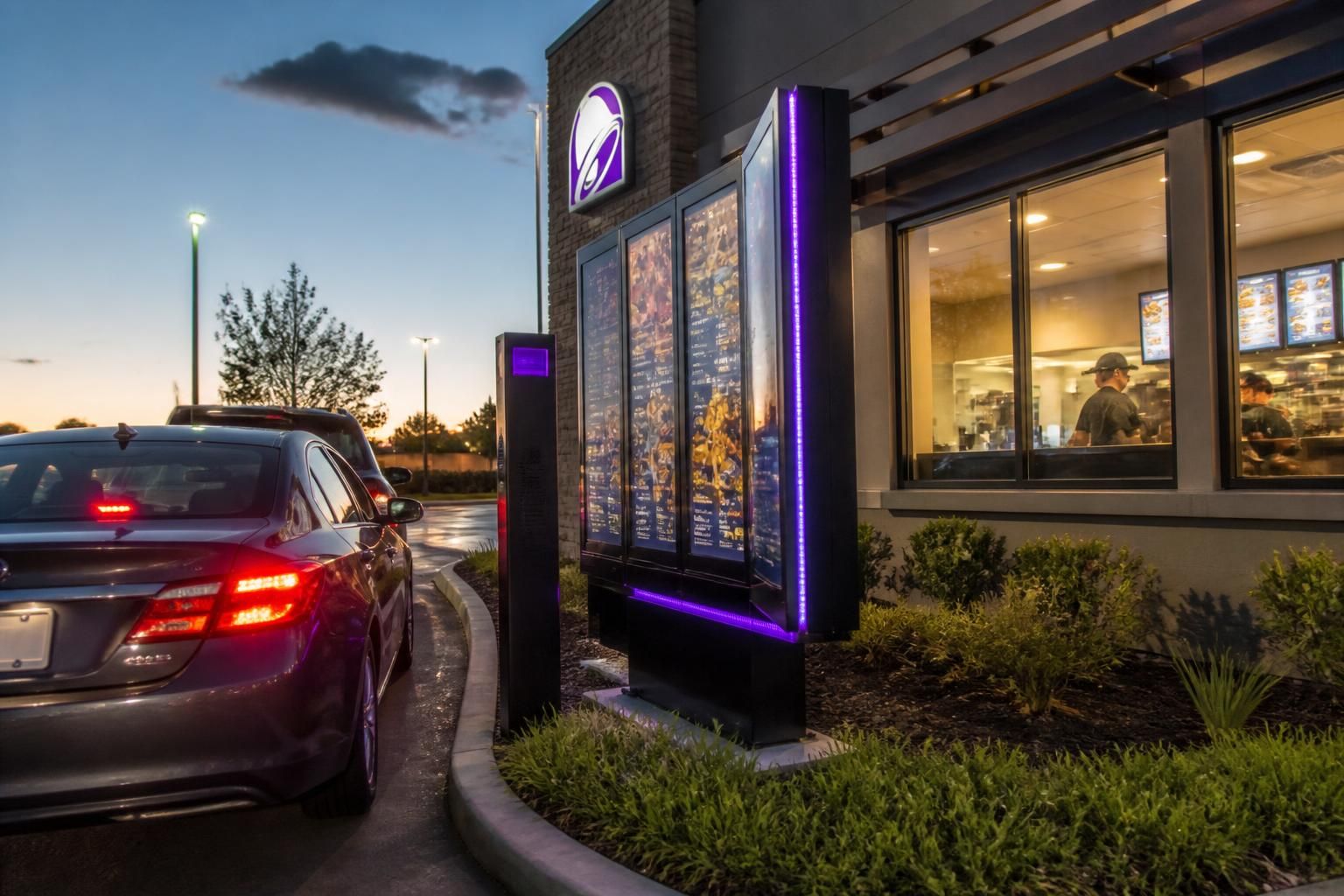
How Cutting-Edge Voice AI Improves Drive-Thru Order Efficiency
Voice AI is often described as a speed tool, but its more important role is to create dependable Order Efficiency during periods when restaurant capacity is under pressure. In a Drive-Thru, time is shaped by several connected moments: greeting the guest, listening to the order, confirming modifications, transmitting details to the kitchen, processing payment, preparing food, and completing handoff. Improving only one stage does not guarantee a better visit. The strongest systems support continuity across the full interaction.
A well-designed conversational interface begins with a short prompt and then listens. It should not force customers into rigid scripts such as “say yes or no” when they are accustomed to ordering naturally. Instead, it must identify intent. When someone says, “Can I get the combo, but swap the drink and make the tacos soft?” the system has to recognize the meal, the drink modification, and the item preference as separate but connected instructions.
This is where Cutting-Edge Technology becomes operational rather than decorative. Natural-language processing can identify products and modifiers, while menu-aware business rules determine whether a request is possible. Integration with restaurant systems allows the assistant to react when inventory changes or when a daypart promotion ends. Without that connection, an apparently intelligent conversation can create confusion at the kitchen screen and disappointment at the window.
Speed also depends on how the assistant handles uncertainty. A practical system does not pretend to understand every phrase perfectly. It asks a short clarification, repeats the relevant item, or transfers the exchange to a team member. This is preferable to silently recording an incorrect order. Customers generally accept a brief clarification when it is precise and respectful; they are far less tolerant of discovering an error after payment.
For restaurant teams, automation can reduce the cognitive load created by overlapping tasks. Consider a dinner rush in which a supervisor is coordinating food preparation while a team member handles a complex family order at the speaker. The AI order taker can manage routine requests and capture structured information, enabling staff to focus on quality control and problem solving. This can support faster throughput without setting unrealistic expectations for workers.
The following comparison illustrates why operators should examine multiple performance indicators instead of relying only on an announcement about deployment size.
| Measurement area | Why it matters for restaurants | What stronger performance can support |
|---|---|---|
| 🎧 Speaker clarity | Customers must hear prompts and confirmations without strain. | ✅ Fewer repetitions and a calmer interaction. |
| 🔁 Employee intervention rate | Frequent takeovers can indicate gaps in menu handling or recognition. | ✅ More staff time available for food and hospitality. |
| ⏱️ Service time | Speed affects queue length, capacity, and customer perception. | ✅ Better throughput during busy periods. |
| 🧾 Order accuracy | Incorrect modifiers can lead to waste, remakes, and complaints. | ✅ More reliable kitchen execution. |
| 🙂 Ease of interaction | Guests judge the experience as a whole, not as a technology test. | ✅ Greater willingness to use the Drive-Thru again. |
There is also a commercial dimension. Conversational ordering can present relevant add-ons, but suggestive selling must remain helpful. If the assistant interrupts a customer repeatedly with offers, it can feel slower rather than smarter. A better approach is to recommend one logical addition based on the order, then accept the response immediately. This respects the customer’s time while giving the restaurant a structured opportunity to increase basket value.
Restaurant operators can learn from audio-first services in other sectors. A guided-tour provider, for example, does not improve a visitor’s experience merely by adding a recorded voice. The audio must be clear, available at the right moment, and easy to control. The same user-centred principle applies at the speaker box. Resources examining the difference between voice AI and conversational AI help clarify why a spoken interface needs more than transcription: it needs context, dialogue management, and reliable fallback paths.
For Maya’s restaurant, a useful weekly review would not begin with “How many orders did AI take?” It would begin with “Where did customers hesitate, where did staff intervene, and which menu requests caused the most friction?” That framing turns operational data into a practical improvement cycle.
Order Efficiency improves when the automated conversation is short, accurate, connected to restaurant systems, and designed to yield gracefully when human expertise is needed.
Independent Testing Shows Why Voice AI Maturity Matters More Than Announcements
The growth of Fast Food Innovation has produced frequent headlines about artificial intelligence, but large numbers alone do not explain whether a deployment works well for guests or staff. The more valuable question is whether the technology remains reliable in real conditions: busy stores, shifting menus, regional accents, distracted customers, weather noise, and franchise networks with different operating habits.
Independent mystery-shopper research provides one useful perspective. Intouch Insight’s 2025 Emerging Experiences Study evaluated confirmed voice-enabled interactions at Bojangles, Taco Bell, and Wendy’s. Across 120 visits where Voice AI was known to be active, employees stepped in during 22% of interactions. That aggregate result is informative, but the contrast between implementations is more revealing than the average.
Bojangles recorded an employee intervention rate of 3% in the study, while Taco Bell recorded 30% and Wendy’s recorded 33%. Bojangles’ deployment used Hi Auto’s AI Order Taker. The findings should not be interpreted as a permanent ranking of restaurant brands, because deployments evolve, individual sites differ, and study samples represent a moment in time. They do, however, demonstrate that platform maturity and local execution can substantially influence the customer journey.
The study also found that 67% of Bojangles shoppers described their interaction as easy and smooth. The comparable figures were 57% for Taco Bell and 23% for Wendy’s. Bojangles additionally showed a 40-second wait-time improvement and full speaker clarity in the evaluated visits. These metrics underline a practical point: customers do not experience “AI strategy.” They experience whether they are understood, whether their order moves forward, and whether the exchange feels easy.
A 30% intervention rate is not automatically a failure. Some handoffs are appropriate and desirable. A guest may ask for a special accommodation, seek clarification about ingredients, or make a highly unusual request. The real concern arises when routine orders repeatedly require human rescue. In that situation, staff may lose the capacity benefits that justified the installation, while customers may feel delayed by a system that was supposed to simplify the process.
Technology maturity includes far more than speech recognition accuracy. It covers menu configuration, model tuning, audio hardware, integration with the point-of-sale system, escalation design, and ongoing quality assurance. For example, a platform may recognize “Baja Blast” accurately but still fail to process a sequence involving a meal swap, an extra sauce, and a change in portion size. The customer does not separate these technical layers; they simply notice whether the order is right.
Restaurant leaders should therefore distinguish between a successful pilot and a mature operating model. A pilot may take place in a limited number of locations with dedicated technical support and carefully selected staff. A scaled deployment must work when hundreds of managers are dealing with everyday realities. It must account for equipment outages, new menu launches, seasonal promotions, and the simple fact that customers rarely follow a clean conversational script.
At Taco Bell, the broad Omilia partnership is significant because it moves the discussion from trial activity toward continuous optimization. Details published by Omilia on the 890-drive-thru expansion place the rollout within a larger operating context. The next requirement is to measure not only coverage, but also the quality of each live interaction.
What restaurant teams should monitor after launch
Operators should establish a baseline before switching on automated ordering. Track average order time, errors, abandoned queues, remake rates, employee workload, and guest complaints. After launch, compare the same metrics by daypart, location type, and menu campaign. A broad average can hide a serious problem that occurs only during breakfast, late-night service, or major promotions.
Managers should also review a sample of anonymised conversation records or performance summaries. The goal is not surveillance for its own sake. It is to identify patterns: a product name the system confuses, a prompt that customers misunderstand, or a promotion that does not map cleanly to the ordering flow. Small corrections can make a measurable difference when repeated across hundreds of daily orders.
📌 The maturity gap is visible when technology handles ordinary complexity consistently, not when it performs well in a polished demonstration.
Automation at Scale Requires Strong Technology Partners and Human Handoffs
Behind the consumer-facing voice at a Taco Bell Drive-Thru sits a technology ecosystem that deserves as much attention as the restaurant brand. The provider must deliver resilient infrastructure, maintain integrations, update models as menus change, and support operators across different markets. This is why the next phase of Fast Food Innovation is increasingly defined by platform capability rather than by isolated announcements.
Hi Auto illustrates the difference between a single-brand implementation and a multi-market technology footprint. The company reports that its AI Order Taker operates across roughly 1,000 quick-service restaurant locations in the United States, United Kingdom, Australia, and New Zealand. It also states that its platform processes more than 100 million Drive-Thru orders annually. That type of volume creates exposure to varied accents, ordering styles, menus, store layouts, and operating conditions.
Accumulated volume alone is not a guarantee of quality, but it creates an important learning environment. A platform that encounters millions of real customer conversations can identify recurring sources of friction and refine its models. For restaurant operators, the practical question is whether those lessons are converted into better configuration, more reliable integrations, and shorter recovery paths when an order becomes complicated.
Bojangles recognised this operational contribution in 2025 when it named Hi Auto its Legendary Supplier of the Year. The distinction was notable because it marked the first time the restaurant chain had given the award to a technology partner. At that point, Bo-Linda, the chain’s AI Order Taker, had been deployed to more than 400 restaurants. The recognition suggests that a successful vendor relationship is not based solely on software features; it depends on shared accountability for restaurant outcomes.
For Taco Bell, Omilia’s role similarly extends beyond providing a synthetic voice. The provider must support a system that can understand highly variable orders while preserving brand-specific language and menu rules. A customer may use an official product name, a nickname, or an incomplete request. The ordering assistant must guide the interaction without sounding rigid, and it must avoid creating an awkward loop when the guest corrects a detail.
Human handoff remains a central part of responsible Automation. The ideal transfer should be fast and preserve context. If a staff member takes over, they should see or hear what has already been ordered so the customer does not have to repeat an entire meal. This is a basic usability requirement, similar to the expectations in travel support, museum audio services, or phone-based booking systems: a person should not be punished for needing help.
Consider Maya’s store during a sudden rainstorm. Cars are idling longer, speaker audio is less clear, and customers are speaking through closed windows. The AI assistant may handle straightforward orders, but an employee needs the ability to intervene immediately when conditions affect comprehension. The success metric is not zero interventions. It is the right intervention at the right moment, with no loss of order context.
Voice technology also introduces questions about trust and accessibility. Customers should be able to communicate in ordinary language, request a human when needed, and receive clear confirmation. Operators must maintain transparent practices around audio handling, data security, and system oversight. Accessibility includes more than volume: it concerns speech differences, hearing needs, language considerations, and the ability to complete an order without unreasonable effort.
The broader technology landscape is advancing quickly. Developments such as new infrastructure for voice AI systems show why latency, audio quality, and processing capacity increasingly matter in live conversations. In a Drive-Thru setting, even a short delay after every phrase can make an exchange feel unnatural. Restaurants should evaluate responsiveness under peak conditions, not only in quiet test environments.
Vendor selection should therefore include site visits, live testing, operational references, escalation procedures, and contractual service expectations. Restaurant leaders should ask how fast menu updates can be deployed, how the system handles outages, what data is available to franchisees, and how training is delivered. These practical details determine whether Cutting-Edge Technology becomes a durable service tool or an additional source of complexity.
🤝 The strongest AI deployments combine scalable platforms with clear human ownership, ensuring that automation expands capacity without reducing accountability.
Taco Bell’s AI Expansion Redefines the Next Stage of Fast Food Innovation
Taco Bell’s continued rollout signals a broader industry transition. The central question is no longer whether Voice AI can take a restaurant order under controlled conditions. The real question is which systems can sustain quality as they move across regions, brands, franchise groups, menu architectures, and service peaks. This is the stage where operational discipline becomes more important than a futuristic launch message.
In the quick-service sector, the Drive-Thru is a high-volume contact point where every weakness becomes visible. Unlike a mobile app, the interaction is live and cannot be paused easily. Unlike a dining room, the guest is often in a vehicle, under time pressure, and unable to inspect the menu closely. The ordering assistant must make the experience efficient while leaving room for the flexibility customers expect.
One important measure is how the technology supports staff retention. Taco Bell locations using automated ordering have reported stronger employee retention than locations without the system, according to available deployment reporting. This does not mean AI is a universal answer to workforce challenges. Pay, management, scheduling, training, and workplace culture remain decisive. Still, reducing repetitive headset work can help employees focus on tasks that feel more manageable and customer-facing.
Transaction time is another area where deployments must be assessed carefully. Data from Taco Bell’s Voice AI locations indicates that Drive-Thru transaction time is comparable to, and in some cases faster than, conventional human order-taking. That is a meaningful result because the goal should not be raw speed at any cost. Rushing a customer into an inaccurate order merely transfers delay to the window, the kitchen, or the complaint process.
The restaurant industry can borrow a useful principle from smart tourism and audio-guided experiences: clarity determines whether digital service feels helpful. A visitor using a smartphone audio guide should receive content that is easy to hear, relevant to their location, and simple to control. In the same way, a Drive-Thru guest expects a voice interface that is understandable, context-aware, and never needlessly demanding. Technology succeeds when it reduces mental effort for the person using it.
For franchisees, an effective evaluation framework should include both commercial and human outcomes. Throughput, average check value, error rates, and labour allocation matter. So do employee confidence, guest feedback, intervention quality, and accessibility. Measuring only one dimension can encourage poor decisions, such as maximising automated interactions even when a prompt human takeover would create a better result.
Restaurant operators can apply the following practical sequence when assessing a Voice AI deployment:
- 🔍 Map the current journey: identify where queues, repeated orders, and communication errors occur today.
- 🧪 Test real complexity: include modifiers, promotions, unclear audio, fast speakers, and changed orders.
- 📈 Set measurable thresholds: define acceptable levels for accuracy, intervention, service time, and customer ease.
- 👥 Train for collaboration: show employees how to monitor, assist, and recover interactions without disruption.
- 🔧 Improve continuously: review issue patterns after menu changes and during high-volume periods.
What does this mean for Taco Bell’s position? The brand’s AI Expansion gives it a meaningful base of real-world interactions from which to refine service design. Its scale also creates responsibility. A change affecting a voice prompt, product flow, or escalation rule can influence thousands of customer interactions across 38 states. Continuous testing and local feedback are therefore essential, especially when menus and promotional campaigns evolve quickly.
The competitive landscape will remain active. Wendy’s, Bojangles, Taco John’s, Zaxby’s, and other restaurant brands are pursuing their own approaches. Industry reporting on Taco Bell’s growing Omilia deployment places this move within a market where automated ordering is becoming a serious operating decision. The winners will not necessarily be the companies with the most dramatic claims, but those that consistently balance speed, accuracy, accessibility, and human service.
For customers, the desired outcome remains refreshingly ordinary: place an order, be understood, receive the right meal, and continue the day without friction. For restaurant teams, the goal is additional capacity rather than technological theatre. 🚗 Taco Bell’s drive-thru revolution will be judged by this everyday standard: whether AI makes the busiest part of the restaurant simpler for both guests and employees.
How many Taco Bell restaurants use Voice AI in 2026?
Taco Bell’s Voice AI ordering technology is deployed at more than 890 U.S. restaurants across 38 states. The rollout is part of its expanded partnership with Omilia.
Does Drive-Thru Voice AI eliminate restaurant jobs?
The operational purpose is to handle routine ordering so restaurant teams can focus on food preparation, hospitality, payment, exception handling, and guest support. Human intervention remains essential for complex or unusual requests.
What is an employee intervention rate in AI ordering?
It measures how often a restaurant employee must take over an automated ordering interaction. A lower rate can indicate that the system handles routine requests more independently, although appropriate human handoffs remain important for service quality.
What should restaurants measure after launching Voice AI?
Restaurants should monitor order accuracy, speaker clarity, transaction time, employee intervention, guest feedback, remakes, and performance during busy dayparts. Reviewing these measures together gives a more useful picture than tracking automation volume alone.
