
County Museum Workshop Builds a Stronger Ancestor Timeline
The Cattaraugus County Museum and Research Library will bring practical Genealogy methods to Machias through “Beefing Up an Ancestor’s Timeline,” a session designed to help researchers turn scattered discoveries into evidence they can evaluate. The program concludes the museum’s Summer at the Stone House series on Thursday, August 27, 2026, at the Stone House, 9824 Route 16.
Presented by educator, librarian, blogger, and professional genealogist Jeanette Sheliga, the event focuses on a frequent Family History problem: a person appears in a few records, yet the story between those records remains unclear. A birth certificate, a census entry, and a death record may establish basic dates, but they rarely explain moves, occupations, marriages, name changes, military service, or relationships with neighbors.
📍 The practical objective is not simply to collect more documents. It is to place every reliable clue in chronological order, identify gaps, and use those gaps to guide the next stage of Research. This is where a Timeline becomes more useful than a conventional family tree. A tree shows connections; a well-built chronology shows what happened, when it happened, and what sources support each claim.
Consider a fictional attendee, Margaret Ellis, researching her great-grandfather Samuel Reed. Her online Ancestry tree lists Samuel’s birth in Pennsylvania in 1872, marriage in New York in 1898, and death in Ohio in 1941. That appears complete at first glance. Yet a timeline quickly reveals a 26-year period with few verified events. Where did Samuel live before his marriage? Did he migrate for factory work? Was he listed under a nickname, a middle name, or a misspelled surname?
By arranging known evidence year by year, Margaret can see that Samuel was recorded in a Pennsylvania household in the 1880 census, appeared in a New York city directory in 1895, and married three years later. The missing years now become a focused Research question rather than an abstract dead end. She can look for tax rolls, school records, local newspapers, employment notices, land deeds, and church registers in likely locations.
The museum setting is particularly relevant to this work. County institutions hold context that broad databases may not surface prominently: local publications, regional directories, cemetery documentation, map collections, historical photographs, and reference materials that explain how communities changed. A name in a record is more meaningful when it is connected to the roads, industries, churches, schools, and migration patterns of the place where that person lived.
The museum’s event announcement provides useful details about the public presentation, while the County Museum program coverage confirms its role as the final Summer at the Stone House gathering of the season. For visitors planning a visit, following the Cattaraugus County Museum updates can help them check timely information about local programming.
Although the event is described as a presentation, its value is workshop-like: attendees can apply the approach directly to their own Ancestor. The most productive preparation is to bring a small, manageable case rather than an entire tree. A single person with a confusing move, an unexplained second marriage, or a gap between census records offers enough material to test the method without becoming overwhelming.
🧭 A reliable genealogy journey starts when dates become questions, and questions become a plan for locating Historical Records. The next step is learning which facts belong in that plan and how to document them carefully.
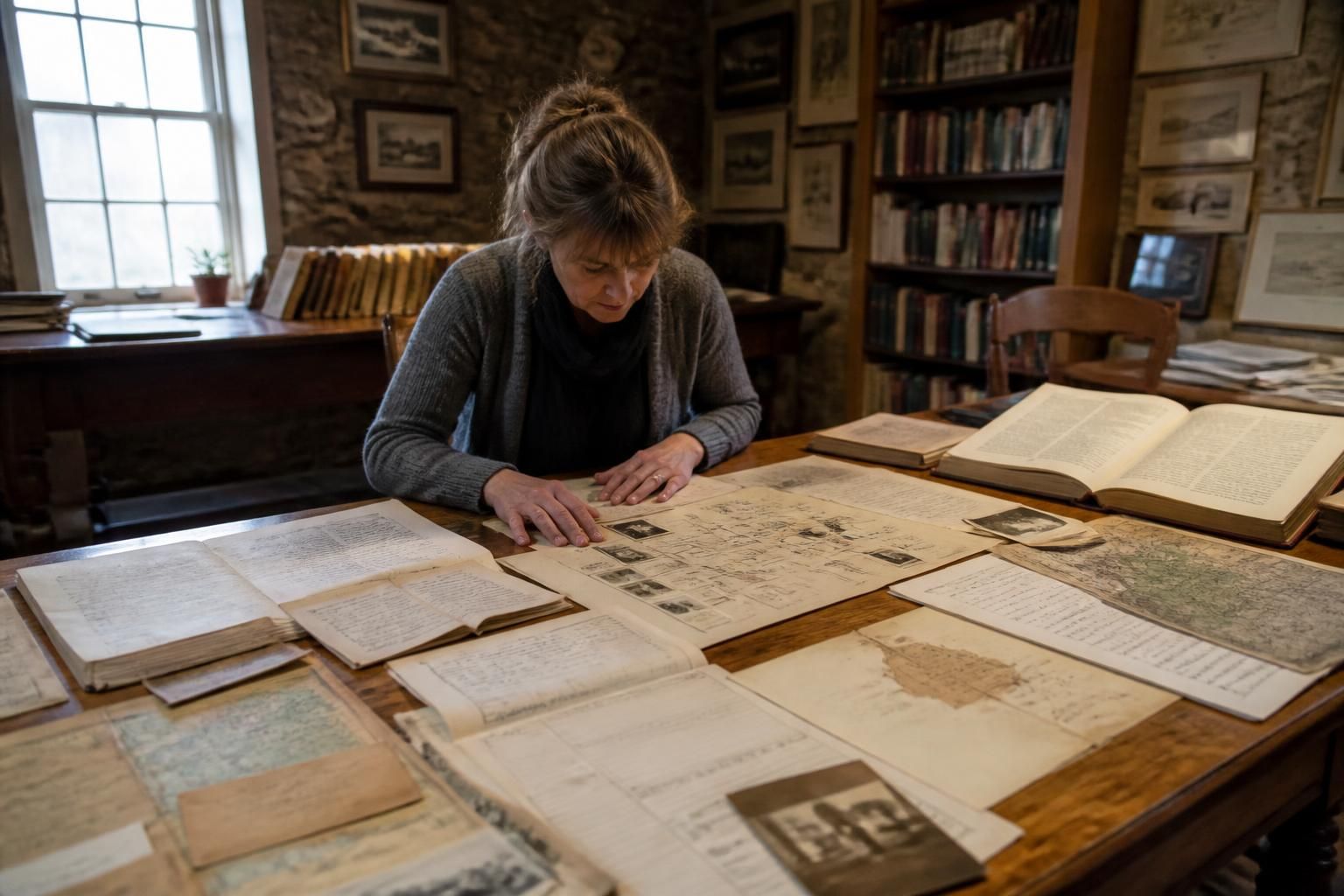
How Beefing Up an Ancestor’s Timeline Improves Genealogy Research
An effective timeline is an evidence-management tool. It gives every item a date, a place, a source, and a short interpretation. This structure prevents a common error in Genealogy: treating a hint from a database as if it were proven fact. An index may provide a plausible name or date, but the original image, a certified document, or a contemporaneous local record may tell a different story.
Start with facts that are supported by direct documentation. These may include a birth registration, baptism, marriage license, death certificate, probate file, military draft registration, passenger list, or census schedule. Each event should be entered in date order, even when the exact day is unknown. “Before June 1900,” “between 1910 and 1914,” and “circa 1886” are valuable entries when they accurately reflect the evidence.
For every event, record where the information came from. A timeline without citations may look organized, but it becomes difficult to audit later. Researchers should be able to return to the document, compare a transcription with the image, and distinguish a family story from a record created at the time of the event.
| Timeline element | What to record | Research value |
|---|---|---|
| 📅 Date or date range | Exact date where available; otherwise a carefully defined period | Shows gaps and tests whether events are chronologically possible |
| 📍 Place | Town, county, state, parish, district, or neighborhood | Directs you to the correct archive and jurisdiction |
| 📜 Record type | Census, deed, obituary, directory, probate, church register, and more | Reveals which record groups have already been searched |
| 🔎 Source and citation | Repository, collection, image reference, page, or URL | Allows findings to be checked and reused accurately |
| 💡 Interpretation | Short note explaining what the item may indicate | Separates evidence from a working hypothesis |
Suppose Samuel Reed appears in a city directory in 1895 as a machinist boarding on Water Street. That entry does not prove his exact birth date or parentage. It does, however, establish residence in a defined place and suggests where to search for an employer, union reference, tax assessment, newspaper advertisement, or local boarding-house record. A modest clue becomes operational when it is placed alongside other dated items.
Household members should be tracked as well. A spouse, child, sibling, witness, neighbor, executor, or godparent may be the person who unlocks a difficult case. If Samuel’s marriage witness was Thomas Reed, that individual belongs on the timeline. If Thomas is later found in an 1890s newspaper notice or deed transaction, his movements may clarify Samuel’s own path.
- ✅ Add known life events before searching for new material, so the existing evidence is visible.
- 🧾 Copy details exactly as written before creating an interpretation or standardized version.
- 🗺️ Note shifting county boundaries, changing street names, and alternate spellings of towns.
- 👥 Include associates whose names recur across records, not only direct relatives.
- ⚠️ Mark assumptions clearly, especially when several people share the same name.
Digital tools can make this process easier, but they should support critical thinking rather than replace it. A spreadsheet works well for sortable dates and source links. A shared document can help relatives contribute memories. A museum or local history organization can use a projected timeline during a public session, allowing attendees to understand how separate records relate to one another without requiring specialist software.
🧩 The best chronology does not hide uncertainty; it makes uncertainty visible enough to investigate. That disciplined approach naturally leads to a better question: which Historical Records can fill the most meaningful gaps?
Finding Historical Records That Fill Family History Gaps
Once a gap is visible, the goal is not to search every database at random. Researchers should select records based on what an individual was likely doing at that point in life. A young adult may appear in school registers, apprenticeship documents, city directories, or employment notices. A married person may appear in land transactions, tax rolls, voter lists, church records, and notices connected with children. An older adult may leave probate, pension, cemetery, or obituary evidence.
County-level repositories are valuable because many vital events were recorded locally. The Cattaraugus County Museum and Research Library’s location in the Stone House makes the workshop especially relevant for those working with western New York roots. Local collections often preserve context that allows a researcher to interpret a broader online result accurately, including community histories, local periodicals, maps, and reference resources.
A timeline should also account for the fact that an Ancestor may not have remained in one jurisdiction. County boundaries, town names, postal routes, and municipal addresses can change. If an 1880 census lists a household in one county while a later deed appears in another, the family may not have moved at all; the administrative boundary may have changed. Maps and local histories can prevent an expensive and time-consuming search in the wrong place.
For Margaret Ellis, the 1880-to-1895 gap in Samuel Reed’s life should be addressed with a sequence of precise searches. She might first inspect directories for nearby industrial towns, then compare railroad routes and factory locations. If Samuel’s occupation was machinery-related, she could search trade notices, labor news, and local business advertisements. If the surname is common, she should build a profile using age, occupation, associates, and address rather than relying on the name alone.
Use negative evidence without overstating it
Absence from a record can matter, but it must be used carefully. If Samuel is not in an 1890 directory, that may indicate a move, a temporary absence, an omission by the compiler, or a spelling variation. It is not proof that he died, left the country, or changed identity. The timeline should state what was searched, where it was searched, and what was not found.
This is one reason event education remains useful in a digital era. Search platforms offer access, but methodology determines whether the results are meaningful. Researchers can explore wider learning opportunities through the genealogy events calendar or review the 2026 genealogy conference guide when planning additional training beyond a local County Museum session.
Separate original evidence from later retellings
Family trees, memorial pages, and published biographies can offer leads, but they may repeat an early error across many websites. A death date copied into ten online trees remains one claim unless those trees cite distinct contemporary sources. Researchers should prioritize records created close to the event by people with direct knowledge, while still considering later materials as clues.
Newspapers are a good example. An obituary may identify a parent, former residence, church affiliation, surviving siblings, or military organization. Yet an obituary can also contain mistakes supplied by grieving relatives. Compare its details with a death certificate, cemetery register, probate file, and earlier census entries before treating every statement as established fact.
📚 Strong Family History research expands sideways as well as backward: places, associates, institutions, and local events often explain what a simple date cannot. Once sources are identified, organization becomes the safeguard that keeps the investigation usable.
Organizing Ancestry Evidence for a Clear, Verifiable Timeline
Collecting Historical Records is only useful when material can be retrieved and reviewed. A researcher who saves dozens of images with filenames such as “scan_0047” or “census-new” will eventually lose time and confidence. A clear naming system makes it easier to match a document to the appropriate row in the chronology.
A practical format can include the date, surname, person, place, and record type. For example: “1895_Reed_Samuel_AlleganyNY_CityDirectory.” The purpose is not perfection. It is to make files understandable months later, especially when a project is shared with relatives, a local historical society, or a museum volunteer group.
Each digital file should have a corresponding source note. Include the repository or website, collection name, publication details where appropriate, image or page number, access date for online material, and the key information found. This process may seem slow at the moment of discovery, but it prevents repeated searches and allows another person to verify the work.
Accessibility matters when organizations introduce digital Family History tools to the public. Not every workshop participant will use the same device, possess the same technical confidence, or be able to read small text easily. A museum can improve the learning experience by using large-screen examples, plain-language instructions, printed worksheets, and audio support for guided explanation. Digital innovation should reduce friction, not add another obstacle between visitors and the stories they are trying to preserve.
This principle is increasingly relevant for cultural organizations. Museums that create accessible digital interpretation around collections can connect visitors with place-based narratives before, during, and after a visit. Practical examples of this visitor-centered approach can be seen in discussions of the North Adams museum relocation and the role of digital mediation at the San Antonio African American Museum. Genealogy sessions can benefit from the same thinking: clear audio, short steps, and content that remains usable after the room empties.
For an attendee such as Margaret, a simple workflow could involve keeping a spreadsheet with one event per row, storing source images in matching folders, and writing a separate research log. The log is where she records searches that produced no result, such as “No Samuel Reed aged 18–25 found in 1891 directory under Reed, Read, Reid, or Rhead.” This prevents the same search from being repeated without purpose.
It is equally important to preserve the distinction between documented facts and analysis. A timeline note might read: “Possible match; age and occupation fit, but identity not confirmed.” That wording protects the integrity of the project. It also keeps a useful lead available without allowing it to become an unsupported conclusion.
For collaborative projects, give each contributor a clear role. One relative may transcribe letters, another may photograph headstones, and another may check newspapers. A shared reference system ensures that everyone works from the same source base. Museums can model this practice by showing both a polished result and the underlying evidence trail.
🔐 Good organization is not administrative clutter; it is what makes Genealogy claims transparent, shareable, and durable. With evidence in order, researchers can evaluate contradictions rather than avoiding them.
Testing Conflicting Genealogy Clues Before Updating Your Family Tree
Conflicting evidence is normal in Ancestry Research. Ages shift between census years, surnames are misspelled, and even official forms may contain information supplied by someone who did not know the facts. The response should not be to choose the most convenient answer. Instead, place each claim in the Timeline, identify the informant where possible, and assess which source is most likely to be accurate for that specific fact.
A death certificate, for instance, may be excellent evidence of a death date because the event was recorded at the time it occurred. It may be less dependable for a parent’s birthplace if the informant was an adult child with incomplete knowledge. A baptismal record may provide strong evidence of a child’s early identity, while a later census may be more useful for household structure and residence.
Samuel Reed’s age illustrates this challenge. The 1900 census suggests a birth in 1872, while his 1941 death certificate implies 1870. Neither statement should automatically be rejected. Margaret should place both on her timeline, then search for earlier records: baptism, 1880 census age, school enrollment, family Bible entry, cemetery inscription, draft card, or probate document. The earliest direct record may be strongest, but context still matters.
Names require the same disciplined treatment. An Ancestor may use a nickname, middle name, initial, translated name, or phonetic spelling. “Samuel Reed” could appear as Sam Reed, S. J. Reed, Samuel J. Read, or even a transcription error created decades later. Rather than treating each variation as a separate person, compare dates, places, occupation, household members, and recurring associates.
Turn contradictions into targeted questions
A contradiction becomes useful when it creates a precise next task. If two sources provide different birthplaces, search records that were created closest to birth. If two women with the same name appear in the same county, compare spouses, addresses, children, and witnesses. If a person disappears between censuses, examine probate, cemetery, military, institutional, and migration records before assuming a death or relocation.
Attendees at the “Beefing Up an Ancestor’s Timeline” Workshop can prepare by writing down two unresolved questions. Examples include: “Where was my great-grandmother between 1912 and 1918?” or “Are these two men with the same name actually the same person?” Questions framed this way give the event an immediate, practical purpose.
Professional education is especially helpful when a researcher encounters a so-called brick wall. Jeanette Sheliga’s broader Genealogy presentation topics show how focused methods can move a project beyond broad, unstructured searching. A local presentation also provides a valuable reminder that research progress often comes from process: reviewing assumptions, tracing associates, and returning to overlooked record sets.
The County Museum setting reinforces that Historical Records are not merely data points. They are traces of real lives shaped by community, work, travel, conflict, religion, and family responsibility. When a timeline shows an unexplained move, it may point to a local economic change. When a child’s name changes after a certain year, it may indicate remarriage, guardianship, or an evolving household structure.
🔍 The strongest family tree is not the one with the most names; it is the one whose claims can be followed back to evidence, context, and a carefully maintained timeline.
When and where is the County Museum genealogy presentation?
“Beefing Up an Ancestor’s Timeline” is scheduled for Thursday, August 27, 2026, at the Cattaraugus County Museum and Research Library in the Stone House, 9824 Route 16, Machias, New York.
What should participants bring to the workshop?
Bring details about one ancestor with an unresolved gap, such as known dates, locations, family names, copies of records, and a short list of questions. A focused case is easier to develop into a useful timeline.
What is the difference between a family tree and an ancestor timeline?
A family tree shows relationships between people. A timeline arranges documented events in chronological order, helping researchers identify missing periods, conflicting facts, and the most relevant records to search next.
Can beginners use timeline methods for genealogy research?
Yes. Beginners can start with birth, marriage, death, census, and residence entries. The method remains useful as research becomes more advanced because it keeps sources, interpretations, and unanswered questions organized.
