
Pompano Beach, Florida, now hosts an unusual cultural destination: a Museum where living Jellyfish are not a side attraction but the entire focus. Located close to the ocean pier, this immersive venue turns encounters with translucent Marine Life into an accessible experience for families, visitors, and tourism professionals.
⏱️ Short on time? Here is what matters:
- 🪼 The Jellyfish Museum in Pompano Beach is presented as the first US museum entirely devoted to jellyfish.
- 🎧 Its calm, visual format offers useful lessons for visitor flow, sound design, and inclusive cultural mediation.
- 🌊 Live displays should be approached as more than entertainment: they can make Aquatic ecosystems and Conservation issues easier to understand.
Why the First US Jellyfish Museum Creates a Captivating New Visitor Experience
The Jellyfish Museum in Pompano Beach offers a clear example of how a highly focused concept can create a memorable destination. Rather than presenting a broad collection of ocean animals, the venue concentrates on one family of Sea Creatures whose movement, color, and biology naturally slow visitors down.
This specialization matters in a tourism market where many attractions compete for limited time. A visitor can immediately understand the proposition: step inside, observe living jellyfish, and discover an underwater world that is usually difficult to see closely. The subject is simple, but the experience is layered.
Reports describe the private site as a two-story, approximately 20,000-square-foot attraction near Pompano Beach’s oceanfront area. It is believed to be the first Museum in the US solely dedicated to these invertebrates. An overview of the museum’s opening and concept highlights how this focused format has drawn national attention.
From a short stop to a deliberate cultural activity
Jellyfish have an advantage that many live exhibitions do not: they are instantly legible without extensive explanation. Their bell-shaped bodies pulse through water, their tentacles create delicate trails, and carefully controlled lighting makes subtle structures visible. Young visitors can react emotionally before reading a single label, while adults can move toward deeper questions about biology and the ocean.
That does not mean interpretation is unnecessary. On the contrary, a strong visitor route turns visual wonder into knowledge. A useful sequence starts with observation, continues with a concise explanation of anatomy or habitat, and then connects what guests see to wider Marine Life systems. This approach avoids overloading people with facts in the first minutes of the visit.
Consider a family arriving after a morning at the beach. The parents may be looking for a weather-proof activity, while children need something immediately engaging. A glowing aquarium can provide that entry point. Once attention is secured, an Exhibition can explain why some species thrive in cold water, why others inhabit warm seas, and how jellyfish differ from fish despite their familiar common name.
| Visitor need | Practical museum response | Experience benefit |
|---|---|---|
| 👀 Fast visual engagement | Illuminated live tanks at the start of the route | Immediate orientation without complex instructions |
| 🧠 Clear learning | Short labels and focused species stories | Information remains easy to retain |
| 🌿 Calm pace | Seating, dimmed spaces, and controlled circulation | More comfortable time with living displays |
| 📱 Shareable moments | Thoughtful photo points that do not disrupt animals | Organic visibility for the destination |
The Museum’s appeal also comes from contrast. Pompano Beach is associated with sunshine, waterfront activity, and outdoor leisure. A darkened indoor setting filled with drifting forms creates a distinct second act in a local itinerary. It extends a beach day without merely repeating the coastal setting outside.
A focused attraction succeeds when its theme is obvious, its route is frictionless, and its learning content respects the visitor’s attention span. That operational clarity is particularly valuable as the experience moves from spectacle toward education.
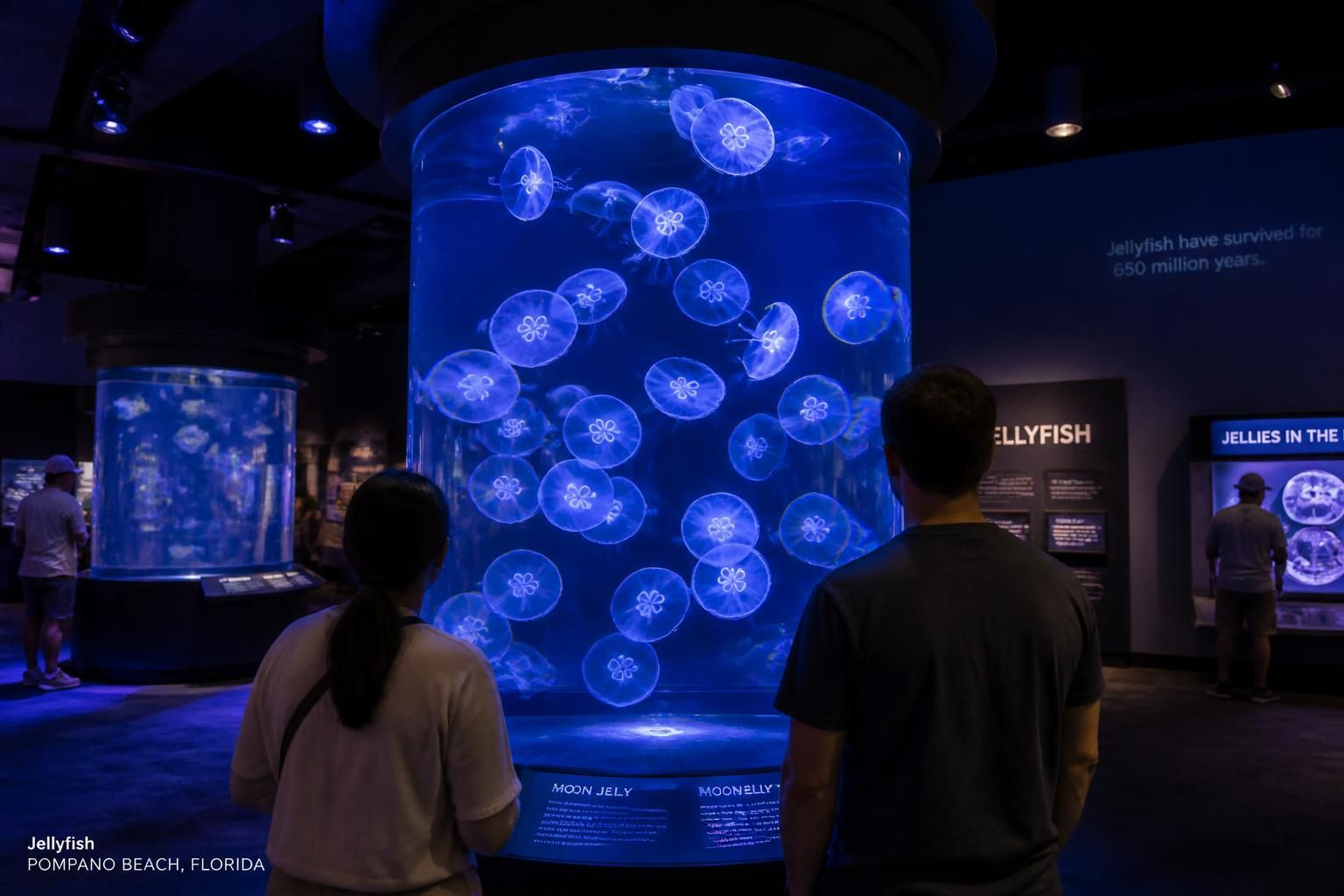
How Enchanted Jellyfish Displays Turn Marine Life into Accessible Learning
An Enchanted visual atmosphere can be powerful, but it needs educational structure to deliver lasting value. Jellyfish are among the oldest living animal groups, with lineages extending back hundreds of millions of years. They are also biologically surprising: they have no brain in the human sense, no bones, and bodies made largely of water.
These facts work best when connected to what visitors can see in front of them. Instead of beginning with a technical definition, interpreters can ask a direct question: how does an animal move through the sea without a skeleton? The answer becomes visible through pulsing bells, drifting tentacles, and the aquarium’s gentle current.
Designing interpretation around observation rather than terminology
For a live Jellyfish Exhibition, each display should answer one main question. A tank featuring moon jellies might explain their feeding behavior. A display of species from colder waters can introduce temperature adaptation. Another can show the life cycle, including the often-overlooked polyp stage.
Visitors do not need a marine biology degree to understand these ideas. They need short, accurate language and a chance to observe before being asked to interpret. For example, a panel could invite children to count rhythmic pulses for ten seconds, then explain that this movement helps propel the animal through water. The learning task is concrete and does not depend on long reading.
This is where audio can offer real operational value. A smartphone-based guide can provide optional layers of content without filling galleries with large text panels or competing loudspeakers. Visitors who want a 45-second explanation can access it; others can remain in silence and watch. Choice is an accessibility feature, not a luxury.
For museums considering this model, audio content should be segmented by exhibit and designed for headphones. A clear recording with natural pacing is more effective than a five-minute lecture. It can also support multiple languages, enabling international travelers to access reliable information without requiring the venue to duplicate every physical sign.
- 🎧 Start each audio stop with a visible detail: “Notice the slow pulse at the edge of the bell.”
- 🪼 Add one verified scientific fact that explains the behavior being observed.
- 🌊 Connect the specimen to a habitat, food web, or environmental condition.
- 📍 End with a simple direction, so visitors know where to look or go next.
Such design is useful beyond marine museums. A local guide leading a waterfront tour could use the same logic: introduce a visible element, explain it briefly, and connect it to the larger destination. Tools such as Grupem can help organizations provide this audio layer through visitors’ own smartphones, reducing the need for dedicated receivers while maintaining a professional listening experience.
Visual media can reinforce this learning before or after a visit. This BBC video showing jellyfish in the Florida museum demonstrates why moving images are so effective: rhythm and transparency are difficult to communicate through still photography alone.
Educational value grows when visitors leave with a practical mental model: jellyfish are not passive decorations, but animals shaped by currents, water temperature, prey availability, and habitat conditions. The most effective exhibit does not simply show a creature; it helps people notice how that creature lives.
Planning a Visit to the Pompano Beach Jellyfish Museum Without Friction
For travelers, a niche venue is most useful when it fits naturally into a wider itinerary. The Pompano Beach Jellyfish Museum is positioned near the coast, making it an easy indoor complement to beach time, a waterfront walk, or a meal in the surrounding area. Its location is part of the appeal, but timing still shapes the quality of the visit.
Before traveling, visitors should consult the Museum’s official visitor information for current opening hours, ticketing details, accessibility updates, and any special programming. Independent local guidance, such as this Pompano Beach hours and ticket planning guide, can also help travelers place the attraction within a Fort Lauderdale-area day.
Building a calm, realistic coastal itinerary
A practical schedule should avoid treating the Museum as a rushed photo stop. The visual environment invites slower movement, and guests may want time to compare species, read displays, or simply sit near a tank. Families benefit from arriving when children are not already tired from heat and outdoor activity.
A sample route can begin with an early beach walk, followed by lunch and an afternoon visit indoors. Alternatively, guests can visit the Museum first, then use what they learned to make a shoreline walk more meaningful. Seeing the Atlantic afterward can turn abstract information about currents and coastal ecosystems into something tangible.
- 🕒 Check timed-entry requirements and arrive early enough for a relaxed start.
- 🔇 Keep phones on silent and use headphones if digital audio is available.
- 📸 Follow photography guidance; flash can be disruptive in low-light galleries.
- 👨👩👧 Plan breaks for younger children rather than forcing a continuous route.
- ♿ Ask ahead about mobility access, seating, and sensory conditions if these are important to your group.
Visitor comfort should not be treated as an afterthought. Dark rooms, moving lights, and crowds can be stimulating for some guests and challenging for others. Clear pre-visit information is therefore essential: it lets individuals decide whether they need quieter times, a shorter route, or a companion to support the experience.
For group organizers, a digital audio channel can simplify coordination. Instead of gathering everyone around one person in a busy entrance space, an organizer can share a welcome message, route instructions, and meeting-point reminders directly through a phone-based system. The principle is straightforward: use technology to reduce uncertainty, not to add screens for their own sake.
A small case illustrates the difference. Imagine a hotel concierge recommending the attraction to a multigenerational group of eight. The best advice is not merely “go there.” It is: reserve ahead, divide the day between outdoor and indoor activity, allow unhurried viewing time, and confirm the needs of the oldest and youngest travelers. That recommendation is more likely to generate satisfaction than a generic attraction listing.
A successful visit begins before the ticket is scanned: accurate information, realistic timing, and respect for individual comfort create the conditions for genuine attention.
What the Jellyfish Museum Teaches Tourism Professionals About Immersive Exhibition Design
The rise of specialized attractions offers a useful lesson for museums, tour operators, destination offices, and cultural venues. Visitors increasingly remember experiences that have a clear identity and a coherent sensory logic. The Jellyfish Museum does not need dozens of unrelated themes to create interest; it builds its value through consistent focus.
That consistency should not be confused with repetition. An effective immersive Exhibition uses variation in scale, lighting, species, storytelling, and visitor interaction. One gallery can encourage quiet observation, while another can explore scientific discovery or the relationship between jellyfish and changing oceans.
Using technology where it improves the route
Digital tools are most useful when they solve a visible visitor problem. A QR code that opens a short audio story can help multilingual audiences. A mobile guide can prevent a guide’s voice from being lost in a crowded room. A simple digital map can reduce confusion in a multi-level venue.
Technology becomes counterproductive when it competes with the living exhibit. Large screens playing continuous video beside an aquarium may distract from the animals themselves. Similarly, loud background music can undermine the quiet concentration that makes jellyfish so Captivating. The exhibit is the primary medium; digital tools should support it discreetly.
Audio design deserves special attention. In a dark gallery, visitors often depend more heavily on sound cues for orientation. Short announcements can indicate transitions, explain where a route continues, or invite guests to pause. Yet these cues should be optional or localized, so they do not create constant noise in spaces intended for calm observation.
A reliable workflow for a venue begins with visitor testing. Invite a small group that includes families, older guests, international travelers, and people unfamiliar with museum technology. Observe where they stop, where they hesitate, and which explanations they actually use. Then adjust the route before scaling up the digital layer.
This approach is especially relevant to temporary cultural events. A pop-up exhibition may not have the budget for permanent equipment, but it can still offer well-produced smartphone audio. A guide can speak into a phone with a quality microphone, participants listen through their own devices, and organizers retain control over language, volume, and timing.
The key metric is not the number of digital features. It is whether people understand where to go, what they are seeing, and why it matters. A venue that achieves those three outcomes has already created a better visitor experience than one overloaded with interactive devices.
Immersion works when every element—light, route, language, and audio—supports the same purpose: helping visitors look more closely.
Why Jellyfish Conservation Gives the Museum Experience a Wider Purpose
Jellyfish can appear almost otherworldly, but they are deeply connected to real environmental systems. They respond to water conditions, food availability, currents, and temperature. A Museum dedicated to these animals has an opportunity to move beyond visual fascination and explain why healthy oceans require attention.
Conservation messaging should remain accurate and balanced. Jellyfish blooms can affect fisheries, coastal tourism, and infrastructure in some circumstances, yet jellyfish are also a natural part of marine ecosystems and food webs. Presenting them only as a problem would be misleading; presenting them only as decorative creatures would be equally incomplete.
Connecting live tanks to responsible ocean awareness
The most useful environmental interpretation links global themes to actions people can understand. Visitors may not be able to influence ocean temperature directly during their trip, but they can learn about reducing disposable plastic use, respecting wildlife at the shoreline, and choosing operators that follow responsible marine practices.
For example, a display about the life cycle of a jellyfish can lead into a short explanation of habitat quality. A nearby panel could show how debris moves through waterways into the sea. The message should be specific: litter dropped inland can eventually affect coastal environments through drainage systems and rivers.
Tourism organizations can extend this message outside the building. Hotels can provide refill stations and explain their purpose. Beach tour operators can include a 30-second marine stewardship note before departures. Visitor centers can promote reef-safe, place-appropriate behavior without turning every holiday moment into a lecture.
The strongest communication invites action without making unsupported promises. Saying that one reusable bottle will “save the ocean” oversimplifies a complex issue. Saying that refill systems reduce demand for single-use containers is factual, understandable, and practical. Credible Conservation communication respects both the visitor and the science.
There is also an emotional dimension. When people watch a jellyfish glide silently through illuminated water, they may feel curiosity before concern. That sequence is valuable. Curiosity can motivate learning, and learning can make responsible choices feel relevant rather than imposed.
For educators, the Museum can serve as a starting point for discussions about biodiversity, adaptation, and coexistence. For destination managers, it can anchor a broader coastal narrative: the beach is not just a backdrop for leisure, but part of a living Aquatic environment. For cultural professionals, it demonstrates that a single well-interpreted species group can open conversations about science, design, access, and public responsibility.
The lasting value of an Enchanted jellyfish encounter lies in what visitors notice afterward: the sea is beautiful, complex, and worth understanding with care.
Where is the Jellyfish Museum located?
The Jellyfish Museum is in Pompano Beach, Florida, near the oceanfront area and within easy reach of Fort Lauderdale. Check the official museum website before traveling for current directions and visitor details.
Why is this venue described as the first US museum devoted entirely to jellyfish?
The venue is presented as the first museum in the United States dedicated solely to jellyfish, with live species displays, immersive environments, and educational interpretation centered on these animals.
Is the Jellyfish Museum suitable for families?
Its visually engaging live tanks can suit families well. Parents should still check current admission policies, opening times, sensory conditions, and accessibility information before arrival.
How can museums use audio technology in live marine exhibitions?
Short, optional smartphone audio segments can provide multilingual interpretation, navigation cues, and deeper science content without adding noise or clutter around sensitive live displays.
