
Jensen Huang’s AI Spending Defense: What Nvidia’s Infrastructure Bet Means for Buyers
Jensen Huang’s argument for sustained AI investment rests on a practical proposition: businesses need more computing capacity as artificial intelligence moves from experimental demonstrations into everyday operations. For Nvidia, that transition creates demand not only for chips, but also for networking, software and the systems required to operate large deployments.
The relevant distinction is between training a model and running it repeatedly for customers. A tourism organization using automated translation, visitor support and content generation consumes computing resources whenever those services operate, even if it never develops its own model.
Coverage supplied for this discussion describes Huang defending infrastructure expansion while arguing that the market undervalues the opportunity ahead. The reported executive positions across the Mag 7 illustrate how strongly suppliers and platform operators are positioning themselves around that demand.
Nvidia’s Reported Buyback Does Not Replace the Need for Returns
The supplied reporting describes an additional $150 billion share-repurchase authorization, bringing remaining authorization to $235 billion through fiscal 2028. Those figures concern permission to repurchase shares, rather than a commitment to spend the entire amount immediately.
A buyback authorization also differs from infrastructure expenditure. Repurchasing stock changes capital allocation and potentially the share count; purchasing servers, securing power and constructing facilities expands operating capacity. Combining these categories produces a misleading picture of technology spending.
The same reporting attributes to Nvidia an expectation of selling approximately twice as many chips in the following year. That is a forward-looking expectation, not a completed shipment result, and its calendar meaning depends on the date of the original statement.
For buyers, the important question is less dramatic: will additional capacity improve availability, response times or service pricing? Greater supply can help, but the benefit depends on energy costs, utilization, competition and the margins retained by intermediaries.
Translate Big-Tech Spending Into a Visitor-Service Business Case
Consider Harbor Museum, a hypothetical regional institution preparing multilingual guided visits. Its operations manager, Maya, wants faster content preparation and clearer support for international visitors, not a share in the infrastructure arms race.
She should calculate the full cost of delivering a usable service: subscription fees, editorial review, mobile connectivity, staff training and support. A low price per generated response does not guarantee a low cost per successfully assisted visitor.
Suppose an automated answer saves two minutes of reception work but requires three minutes of correction. The apparent efficiency disappears. Conversely, a well-reviewed translation reused across hundreds of visits can create value without continuous generation.
📌 Investment scale is a supplier signal; operational savings are the buyer’s evidence. Your evaluation should connect technical capability to a measurable task rather than assume that larger infrastructure budgets automatically produce better experiences.
Huang’s reported defense of model distillation raises another procurement issue. Using one system’s outputs to help improve another can support competition, but the legal and contractual position depends on licenses, access methods, protected material and applicable law.
Calling an activity competitive does not establish that every implementation is permitted. Ask suppliers how they obtained training material, whether third-party conditions apply and how they handle rights-sensitive cultural content.
The infrastructure argument therefore matters most when it translates into dependable services at an acceptable total cost. More computing capacity creates possibilities; disciplined product selection determines which possibilities are useful.
Sundar Pichai Pushes Google Gemini Forward: Test Capability Before Committing
Sundar Pichai’s emphasis on moving quickly while maintaining safeguards captures the central challenge for Google Gemini: new capabilities must become useful without making accuracy, privacy or reliability secondary. Product velocity matters, but organizations need to distinguish announced ambitions from functions they can actually deploy.
The supplied coverage refers to a proposed “Gemini 4 Argon” release and attributes a safety-conscious launch position to Pichai. That reported product name should be treated as an announcement claim, not evidence of generally available features, a confirmed release date or independently demonstrated performance.
For tourism professionals, the actionable question is straightforward: what does the version available to your organization do reliably today? A forthcoming model should not become a dependency in a service scheduled to open before its availability and contractual conditions are established.
Google Gemini’s Value Depends on the Workflow Around It
Multimodal tools can potentially support tasks involving text, images and audio, although supported functions vary by product and deployment. A museum might use an available system to draft an accessible description from approved curatorial notes or help organize multilingual visitor questions.
At Harbor Museum, Maya tests a narrow task: producing a plain-language description of a maritime instrument. She provides verified historical information and asks the tool to distinguish documented facts from interpretive suggestions.
The first evaluation is not whether the paragraph sounds polished. It is whether dates, terminology, cultural context and accessibility choices remain correct. Fluent wording can conceal a fabricated detail, particularly when an artifact has limited documentation.
A useful assessment therefore compares generated material against an approved reference. The reviewer records factual errors, omitted context, reading difficulty and the time needed to produce a publishable version.
What happens when a visitor asks about an object outside that reference? The system should either retrieve an approved source or explain that the information is unavailable. An invented answer can damage trust more quickly than a clear, appropriately bounded response.
Build a Gemini Evaluation Set Around Real Visitor Needs
Your test collection should contain ordinary questions and difficult cases. Include ambiguous place names, noisy speech, mixed-language requests, unsupported historical claims and questions about services that change seasonally.
For example, “Is the upstairs gallery accessible?” cannot be answered safely from an old brochure if a lift is temporarily unavailable. Operational information needs a maintained source and a clear update process, regardless of the model’s sophistication.
Compare performance using the same inputs across candidate tools. Record response time, correction effort and the frequency with which the system appropriately declines to answer, rather than selecting the most impressive demonstration.
Accessibility must remain part of the assessment. Clear text, usable controls, readable transcripts and understandable audio matter more than conversational novelty for visitors navigating an unfamiliar venue.
Voice processing introduces additional requirements: consent where necessary, suitable retention settings and protection for recordings that contain personal information. Grupem’s coverage of voice AI infrastructure and deployment considerations offers a related starting point for examining how audio services fit into a broader technical stack.
Maintain a fallback for essential information. Opening hours, emergency instructions and access arrangements should remain available through approved text or recordings even when an external service is unavailable.
The strongest reason to adopt a faster model is a verified improvement in your workflow—not the speed of its launch announcement. That distinction becomes even more important when assistants begin taking actions rather than simply drafting answers.
Satya Nadella’s Microsoft Copilot Strategy: Govern Actions, Not Just Answers
Satya Nadella’s reported description of Copilot as a new operating layer for work signals a shift from assistance toward execution. Microsoft’s opportunity is to place automated capabilities inside familiar business processes, where they can retrieve information, prepare documents and coordinate tasks.
The comparison with an operating system is a strategic framing, not a technical claim that Copilot replaces the software underpinning every workplace. Its practical significance is that an assistant may increasingly sit between employees, organizational data and business applications.
That position creates a different risk profile from a standalone writing tool. A poor draft can be corrected before publication; an incorrectly executed action can change a booking, expose confidential information or send an unauthorized message.
Separate Drafting Permission From Execution Permission
At Harbor Museum, Maya considers an agent that prepares group-visit proposals. Reading public ticket information is low risk, while changing capacity limits or approving a discounted invoice requires tighter control.
The right design separates these permissions. The agent can assemble a proposal, explain its assumptions and submit it for review without gaining authority to confirm a booking or alter financial records.
That distinction reflects Nadella’s reported emphasis on keeping agent actions subject to company policy. Governance must be enforced through access controls and approval rules, not merely written as a polite instruction inside a prompt.
For example, telling an assistant “never disclose private contact details” is weaker than preventing it from retrieving those details when they are unnecessary. Least-privilege access limits what a system can do even when its reasoning fails.
Existing document permissions also deserve attention. If employees have accumulated overly broad access over several years, adding an intelligent search interface can make previously obscure information much easier to discover.
Before deployment, review shared folders, sensitive files and inherited permissions. An assistant does not repair an untidy information environment; it can magnify the consequences of one.
Make Agent Behavior Observable and Reversible
A useful action log should identify the initiating user, the information consulted, the proposed operation and the approval obtained. Staff need enough context to reconstruct an incident without collecting unnecessary personal data.
Reversibility matters as well. Updating a draft itinerary is easy to undo; sending an external email or deleting a record may not be. Higher-impact actions require stronger checks and, where possible, an opportunity to cancel before execution.
Test failures deliberately. Ask what happens if an agent finds conflicting opening hours, receives a malicious instruction inside a document or loses access to a scheduling system midway through a task.
The desired behavior is controlled interruption, not improvisation. An incomplete operation should be visible to the responsible employee, with a clear explanation of what was completed and what remains pending.
Measure the complete workflow rather than the assistant’s response speed. At the hypothetical museum, the relevant metric is the time required to prepare an accurate, approved group proposal, including review and correction.
A faster first draft is valuable only if it does not increase downstream work. Similarly, broader automation is useful only when responsibilities remain clear to the people who supervise it.
Begin with a low-impact process, establish a baseline and expand permissions only after consistent performance. An agent becomes a dependable workplace tool when its authority is bounded, its actions are traceable and its mistakes are recoverable.
The Magnificent Seven’s AI Safety Signals: Look Beyond Voluntary Pledges
The Magnificent Seven are not following one uniform artificial intelligence strategy. Nvidia, Microsoft, Alphabet, Amazon, Meta, Apple and Tesla occupy different positions across infrastructure, software, consumer devices, advertising and automation, so their incentives and deployment risks differ.
The supplied reporting describes Nvidia, Alphabet and Meta signing a voluntary White House safety agreement. It also describes Microsoft and Amazon attending the associated event without signing, and Apple as absent from the attendees.
Those reported participation decisions are political and corporate signals, not a complete assessment of each company’s safeguards. Attendance does not demonstrate compliance, and non-signature does not establish the absence of internal controls.
The material also attributes a signature to Elon Musk representing xAI and describes a corporate relationship with SpaceX. That representation should not be treated as a Tesla commitment: the identity of the legal entity matters more than an executive’s overlapping roles.
Understand What a Voluntary Agreement Can Establish
As described in the supplied material, the one-page agreement calls for internal controls, independent auditing and board-level review of audit findings. It does not specify implementation deadlines or penalties.
These measures can support accountability, but their effectiveness depends on detail. An audit covering only one product or a narrow category of risk provides different assurance from a recurring review of deployed systems and incident responses.
A board committee can improve oversight when it receives meaningful evidence and has authority to require corrective action. Its existence alone says little about the quality of testing or the speed at which identified problems are resolved.
Similarly, a pledge characterized as morally binding is not equivalent to enforceable legislation. Buyers must still examine contractual duties, applicable legal requirements and the remedies available when a supplier fails to meet them.
For a museum or tourism office, the useful procurement question is therefore not “Did the supplier sign?” It is “Which safeguards apply to the specific service being purchased, and how can those safeguards be demonstrated?”
Meta’s Enterprise Ambition Adds Another Procurement Choice
The reporting also presents Mark Zuckerberg as positioning a Meta enterprise platform as a major growth opportunity. That strategic ambition suggests interest in business workflows beyond the company’s established consumer-facing services.
It does not, by itself, establish product readiness, support quality or suitability for cultural institutions. Evaluate available capabilities and contract terms separately from an executive’s growth narrative.
A platform that performs well for promotional content may require additional controls before processing visitor inquiries, employee records or unpublished collection research. Different tasks justify different levels of access and scrutiny.
Harbor Museum can make this distinction concrete by separating public information from restricted operational material. A vendor may be approved for drafting event descriptions while remaining excluded from access to visitor contact lists.
Grupem’s discussion of practical AI safeguards beyond a simple shutdown mechanism connects this issue to layered protection. Prevention, permission controls, monitoring and recovery serve different purposes; none should be mistaken for a complete substitute for the others.
Ask for evidence proportionate to the risk: retention settings for routine text generation, documented access controls for internal search, and tested approval mechanisms for consequential actions. Requirements should become stricter as the potential impact increases.
A public commitment is a useful starting signal, but dependable assurance comes from product-level evidence and enforceable responsibilities. The same evidence-based approach should shape the financial decision.
Turn Mag 7 AI Investment Into a Practical Technology Spending Plan
The business case for your organization should not imitate the capital budgets of the largest technology companies. Their spending supports global infrastructure and competitive positioning; your budget should support a clearly defined service outcome.
Market commentary for 2026 includes aggregate infrastructure estimates around $700 billion or more. The analysis of the projected AI capital-expenditure race provides context for that debate, but such estimates are not interchangeable with audited expenditure.
Before comparing totals, establish which companies are included and whether the figures refer to calendar years, fiscal years, forecasts or completed purchases. Broader data-center expenditure may also include capacity supporting services other than generative applications.
Large commitments can create pressure to monetize new facilities, but they do not prove that every customer will receive better value. Your procurement process should remain grounded in service quality, contractual flexibility and the cost of an approved output.
Compare Suppliers by Operational Fit
At Harbor Museum, Maya uses the executive strategies as context rather than a purchasing shortlist. She needs to determine whether a proposed tool solves content preparation, internal coordination or visitor delivery—and whether existing systems already cover part of that need.
| Strategic signal | Practical buyer question | Evidence to request |
|---|---|---|
| ⚙️ Nvidia infrastructure expansion | Will the service remain available during peak demand? | Capacity commitments, latency measurements and service terms |
| 🌐 Google Gemini development | Does the available version improve multilingual work? | Task-specific tests and documented product availability |
| 🔐 Microsoft agent workflows | Can actions remain within staff authority? | Permission controls, approval records and recovery procedures |
| 🛡️ Voluntary safety commitments | Which protections cover this particular deployment? | Audit scope, retention settings and contractual obligations |
This comparison prevents a common mistake: treating a strong position in one layer as proof of excellence in every layer. Infrastructure leadership, model quality, workflow integration and visitor usability are related but separate considerations.
Run a Bounded Pilot Before Expanding the Budget
Choose one measurable workflow and establish its current performance. For instance, track how long staff need to prepare and approve a five-minute multilingual tour segment before introducing a new drafting tool.
- 🎯 Define the outcome: reduce preparation time while preserving historical accuracy and accessibility.
- 🧪 Use representative material: include specialist terminology, sensitive context and difficult translations.
- ⏱️ Measure total effort: count editing, review, troubleshooting and publication time.
- 🔒 Limit access: exclude personal records and unnecessary internal documents.
- 📱 Test actual delivery: check listening clarity, device compatibility and visitor navigation.
- 🔄 Preserve an exit route: retain usable exports and approved source material.
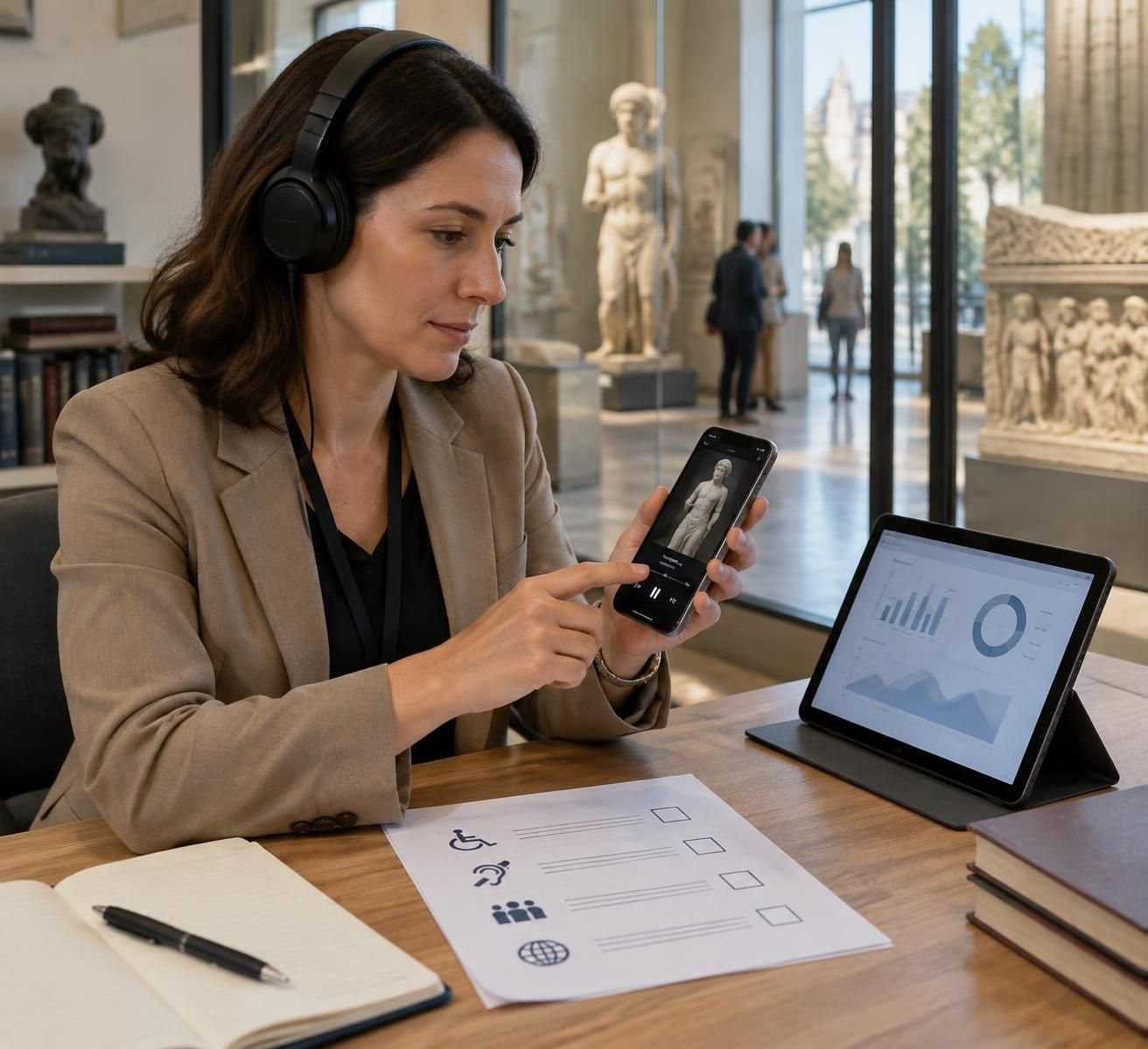
A smartphone-based audio-guide service such as Grupem belongs in the delivery layer of this assessment. Evaluate how approved content reaches visitors, how clearly they can listen and how easily staff can operate the service, without assuming that generative capabilities are required for every task.
The production workflow can use separate tools for research, translation, review and delivery. Keeping those responsibilities distinct helps your team replace one component without rebuilding the entire visitor experience.
Set a review date and explicit expansion criteria. A pilot should proceed only when measured benefits survive real operating conditions, including busy periods, staff changes and imperfect connectivity.
The useful response to the Mag 7’s spending race is not a larger budget by default; it is a better-defined purchase backed by operational evidence.
Why does Jensen Huang defend large AI infrastructure budgets?
His argument links expanding computing capacity to growing demand for training and operating AI services. For buyers, the relevant test is whether that capacity produces dependable availability, useful performance and acceptable total costs.
Should an organization wait for the next Google Gemini release?
Evaluate the capabilities available under your current contract. Do not make a scheduled service depend on an announced model until availability, performance, pricing and safeguards are established.
What is the main governance issue with Microsoft Copilot agents?
Agents may take actions rather than merely generate text. Restrict their permissions, require approval for consequential operations, retain useful action logs and define recovery procedures before deployment.
Does signing a voluntary AI safety agreement guarantee a safe product?
No. A public pledge is distinct from enforceable obligations and product-level controls. Examine the audit scope, data handling, incident procedures and safeguards that apply to the service you intend to purchase.
How should tourism organizations measure an AI pilot?
Compare the complete workflow before and after deployment, including preparation, correction, approval and delivery. Track factual accuracy, accessibility, staff effort and visitor usability rather than response speed alone.
