
Lee Krasner and Jackson Pollock: An Artistic Partnership Built on Difference
When Lee Krasner and Jackson Pollock became closely acquainted in New York in 1941, both were developing artistic languages that challenged conventional painting. Their relationship grew within an experimental community shaped by European modernism, public art projects, political uncertainty, and the search for an independent American visual identity.
Krasner brought substantial training and a disciplined understanding of composition. She had studied with Hans Hofmann, whose teaching emphasized the dynamic relationships between color, shape, and pictorial space. Her familiarity with Cubism gave her tools for dismantling recognizable subjects without abandoning structure.
Pollock arrived at abstraction through a different route. His experience with Thomas Hart Benton, interest in Mexican mural painting, and engagement with Surrealist ideas contributed to work that initially contained figures, mythic imagery, and turbulent symbolic forms. His later poured paintings emerged from this development rather than appearing as an unexplained act of rebellion.
How Love Created a Space for Serious Artistic Exchange
Love provided attention, encouragement, and sustained proximity, but the exchange between the two painters was more demanding than simple emotional reassurance. Each encountered someone who understood that painting could be a consuming intellectual and physical activity. Looking at unfinished work, discussing influences, and questioning decisions became part of their shared life.
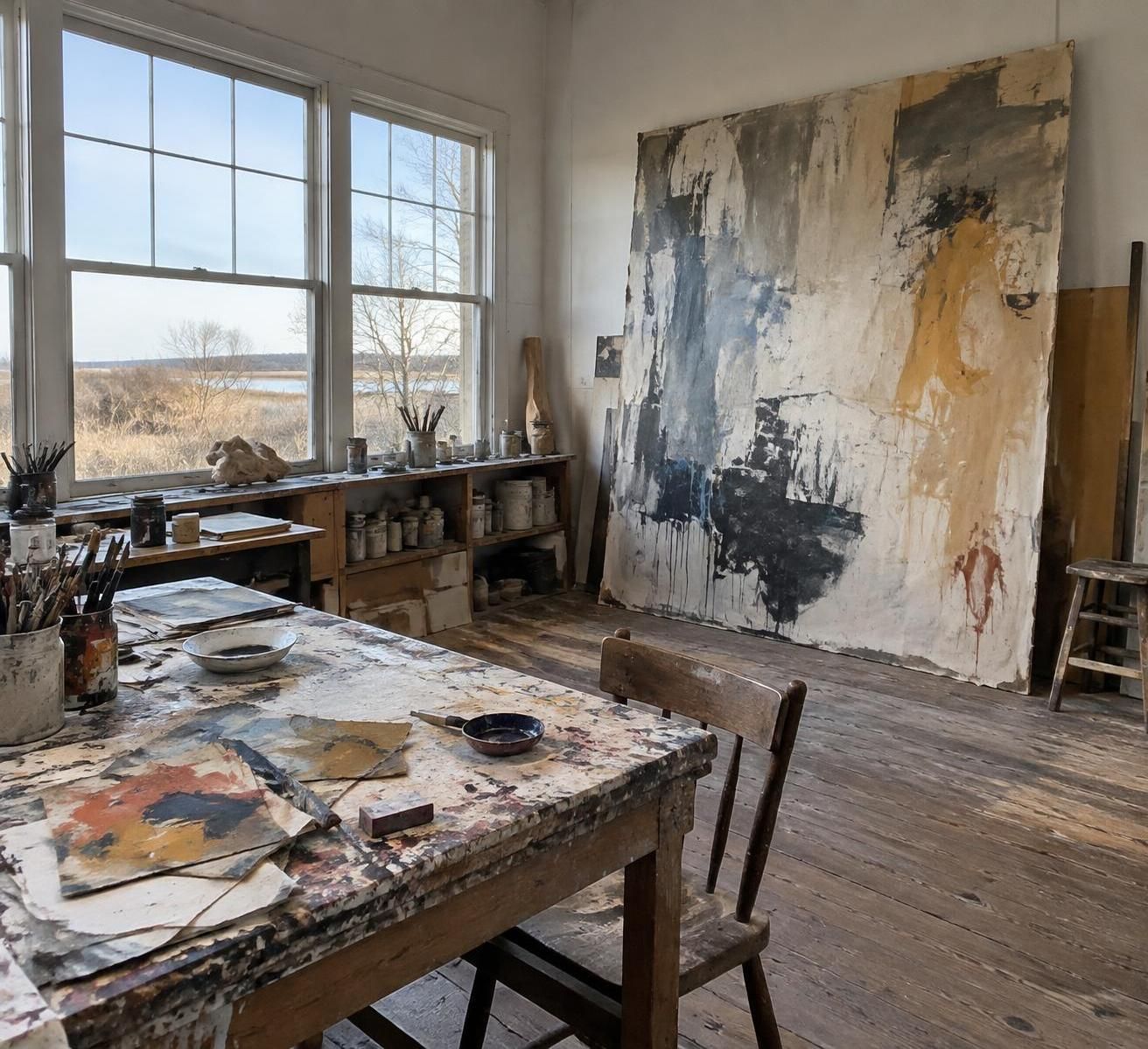
They married in 1945 and moved to Springs, on Long Island. The house and surrounding landscape offered distance from Manhattan, while their professional connections kept them involved in its artistic networks. Domestic space, however, was not automatically equal working space: the barn became his studio, while she initially worked in a smaller room inside the house.
That arrangement matters because scale changes artistic possibilities. A large floor allows a painter to move around a canvas, reach across it, and work with the whole body. A restricted room encourages different relationships among surface, gesture, and viewing distance, although it does not mechanically determine what an artist can achieve.
Consider a hypothetical museum guide, Maya, preparing a paired-work tour. Instead of opening with the couple’s reputation for turbulence, she asks visitors to compare the physical conditions in which they worked. The question redirects attention from celebrity biography toward the practical circumstances that shaped their choices.
Why Rage Should Not Become an Explanation for Everything
Rage is a useful thematic lens, not a diagnosis of every brushstroke. Frustration, alcoholism, insecurity, and marital conflict affected their lives, but visible intensity cannot establish precisely what either painter felt while making a particular picture. An agitated surface may involve careful revision; a restrained composition may emerge during personal upheaval.
This distinction protects the work from a familiar misunderstanding: the belief that emotional distress automatically produces artistic innovation. Neither artist’s achievement can be reduced to suffering. Training, historical knowledge, experimentation, material decisions, and persistent labor supplied the means through which feeling could become form.
The Metropolitan Museum of Art’s publication on their intersecting careers provides a framework for considering the years before their relationship, their shared life, and her subsequent development. That broader chronology prevents marriage from becoming the sole organizing principle of either career.
Their artistic partnership joined two distinct practices rather than creating one collective identity. Understanding those differences makes the emotional story more meaningful: affection enabled exchange, while disagreement exposed the limits of shared experience and pushed each painter toward separate formal solutions.
How Krasner and Pollock Transformed Emotion into Abstract Expressionism
Abstract Expressionism was not a single technique or a shared emotional formula. It brought together artists who used abstraction to explore scale, gesture, color, and the relationship between a painted surface and a viewer. Within that broad movement, these two painters developed markedly different ways of organizing intensity.
His mature poured works displaced the familiar image of an artist standing before an upright easel. With canvas laid on the floor, paint could be dripped, poured, or directed across its surface using various implements. This method expanded movement, but it also required decisions about viscosity, speed, distance, density, and stopping points.
Jackson Pollock’s Gesture Was More Than Uncontrolled Expression
In Autumn Rhythm (Number 30), painted in 1950, overlapping lines establish an intricate field without a conventional central subject. Looking closely reveals differences between broad passages, fine threads, open intervals, and concentrated knots. The eye travels through the composition rather than settling immediately on a single dominant figure.
Calling that surface chaotic misses its internal relationships. One mark crosses another; a dark line changes the apparent weight of a pale area; exposed canvas allows dense passages to breathe. The painting holds spontaneity and adjustment together, demonstrating that improvisation can involve judgment rather than the absence of it.
For visitors, a useful exercise is to select one line and follow it until it disappears beneath another layer. Maya uses this approach in her hypothetical tour because it gives audiences a concrete task before introducing specialist vocabulary. What first resembles a tangle becomes a sequence of movements and interruptions.
Lee Krasner’s Repetition Created a Different Kind of Energy
Her Little Images paintings of the late 1940s offer another model of abstraction. Repeated marks accumulate into compact, rhythmically organized fields, sometimes suggesting writing without providing readable language. Their visual force depends on the relationship between individual units and the larger pattern they establish.
These paintings invite close attention to variation within repetition. A small change in spacing, pressure, or color can disturb an apparently regular arrangement. Instead of treating their scale as evidence of lesser ambition, viewers can recognize how concentrated surfaces create an intense encounter at a different viewing distance.
The comparison also complicates any simple division between an intuitive male artist and an analytical female counterpart. Both used bodily movement, both made structural decisions, and both engaged with earlier visual traditions. Their differences concern the organization of those resources, not a fixed opposition between feeling and thought.
- 🎨 Start with marks: compare a continuous poured line with a cluster of repeated strokes.
- 👁️ Change viewing distance: examine the whole composition, then return to one small passage.
- 🔍 Look for decisions: identify spacing, layering, interruptions, and areas left relatively open.
- 🧭 Delay emotional labels: describe visible evidence before calling a painting angry, joyful, or anxious.
These exercises make revolutionary art understandable without reducing it to a trick. A visitor does not need to reproduce the technique to recognize how it changed painting. The important shift lies in how marks occupy a surface and how the viewer’s attention moves among them.
The avant-garde dimension of their work therefore rests on more than scandal or unconventional tools. They challenged inherited expectations about composition, finish, and subject matter while maintaining demanding relationships among visual elements. Emotional intensity became artistically consequential because it acquired an organized, material form.
Creative Conflict, Unequal Recognition, and the Making of a Modern Art Reputation
The couple’s professional story exposes an uncomfortable distinction between artistic influence and public recognition. Both contributed to the development of postwar abstraction, yet Jackson Pollock became a cultural celebrity while Lee Krasner’s achievements received far less attention. Their marriage operated within institutions that did not offer women equivalent opportunities or critical standing.
His success depended on more than striking paintings. Gallery representation, critical advocacy, collectors, photography, and magazine coverage helped establish a recognizable public figure. Peggy Guggenheim’s support was especially important during an earlier phase of his career, while later attention helped circulate the image of the groundbreaking American painter.
How Lee Krasner Supported a Career Without Disappearing as an Artist
She understood the artistic community and took his work seriously before broad public recognition arrived. Her conversations, professional relationships, and practical support contributed to conditions in which his career could develop. Those contributions deserve attention without turning her into an accessory whose significance depends entirely on another person’s achievement.
The essay How Lee Krasner Made Jackson Pollock a Star examines her role alongside the critic Clement Greenberg. Its subject helps reveal that an apparently solitary artistic breakthrough can depend on sustained advocacy. Recognition is produced through networks as well as through objects hanging on gallery walls.
Yet support was not evidence of artistic agreement on every issue. Shared ambition can generate friction when one person’s visibility grows faster than the other’s. Creative conflict includes arguments about work, but also competition for time, space, credibility, and the right to be judged independently.
This is where the romantic language of a “power couple” becomes inadequate. It can make unequal access to resources sound glamorous and obscure the labor required to maintain a household, navigate professional relationships, and protect a developing practice. Affection does not cancel these pressures, and sacrifice is not a neutral measure of devotion.
Why the Myth of the Tormented Genius Distorts Both Careers
Pollock’s alcoholism and destructive behavior should not be presented as proof of authenticity. Such framing converts harm into artistic prestige and encourages audiences to treat instability as the price of greatness. His paintings merit attention because of their formal achievements, not because suffering confers automatic cultural authority.
The corresponding distortion positions his wife as endlessly resilient, valuable chiefly because she managed difficulty. That account may appear sympathetic, but it still restricts her identity. It replaces discussion of composition, experimentation, and artistic development with admiration for endurance.
A more balanced gallery label separates three kinds of evidence: what an artwork visibly does, what historical documents establish, and what later interpretation proposes. Maya applies that distinction when discussing a painting beside a photograph of the couple. The photograph documents a moment; it does not explain every decision on the canvas.
For cultural institutions, this approach also improves accessibility. Visitors receive a clear route into complex material rather than a sensational story that demands emotional allegiance. A short explanation of who secured exhibitions, who attracted reviews, and who obtained working space can reveal structural inequality more effectively than vague claims about being “overshadowed.”
Modern art history becomes more accurate when reputation is treated as something constructed, not simply discovered. Their relationship illuminates the gap between making influential work and receiving recognition for it. That gap remained consequential as her practice continued beyond the shared household and beyond his lifetime.
Lee Krasner After Jackson Pollock: Grief, Reconstruction, and Independent Innovation
Pollock died in a car crash in 1956, at the age of forty-four. Another passenger, Edith Metzger, also died, while Ruth Kligman survived. Naming the wider human consequences prevents the event from becoming merely a dramatic turning point in the biography of a famous painter.
His death changed the circumstances of his wife’s life, but it did not create her artistic identity. She had already developed significant bodies of work and pursued demanding experiments. The years that followed involved grief alongside expanded working possibilities, changing ambitions, and a career that continued for almost three decades.
Why Lee Krasner’s Paintings Cannot Be Read as a Grief Diary
Viewers often search her later canvases for direct evidence of mourning. That impulse is understandable, yet it risks making every gesture illustrate a predetermined emotional story. Autobiographical significance does not mean that a painting supplies a transparent record of a particular feeling.
Prophecy, begun in 1956 before the fatal accident, is especially important here. Its compressed, bodily forms and unsettling energy cannot simply be explained as a response to his death. The chronology interrupts an attractive but inaccurate interpretation and returns attention to developments already underway in her practice.
Later, moving into the barn studio gave her access to the larger workspace he had occupied. This changed the practical relationship between movement and scale. It also demonstrates why biography must include material conditions: an available room can influence artistic possibilities as concretely as an emotional event.
Her large paintings from the later 1950s and early 1960s often deploy sweeping gestures and restricted palettes. They show an artist testing the reach of her body, the tension between individual strokes, and the capacity of a surface to hold forceful movement. These are formal problems, even when personal experience contributes to their urgency.
Collage and Revision Made Destruction Productive
Her use of collage offers a particularly clear example of reconstruction. During the 1950s, she cut and reused earlier material, including painted fragments, to generate new compositions. A discarded work could become a resource rather than an endpoint, separating dissatisfaction with an existing image from the abandonment of its possibilities.
This process gives the article’s theme a tangible meaning without requiring psychological speculation. Cutting disrupts an established arrangement; recombination builds new relationships. The result is not simply anger made visible, but a method through which rejection can produce an alternative structure.
Combat, painted in 1965, demonstrates her command of expansive scale and forceful interaction among forms. Its title invites associations with struggle, but the work also requires attention to color, movement, and compositional tension. The National Gallery of Victoria’s discussion of Krasner’s Combat places the painting within her broader achievement rather than treating it as an isolated emotional document.
For Maya’s hypothetical tour, the practical lesson is to place an early work beside a later one and ask visitors to identify both continuity and change. Repetition may give way to broader gestures, while an interest in rhythmic relationships persists. This comparison makes development visible without imposing a neat narrative of recovery.
Her continued experimentation resists the expectation that an artist must settle into one immediately recognizable signature. Different phases can represent sustained inquiry rather than inconsistency. The strongest account of her later career recognizes grief as part of its context while allowing innovation, revision, and ambition to remain its subjects.
Interpreting Rage and Love Through Accessible Museum and Audio Experiences
A compelling account of this relationship should help audiences see more, not merely feel closer to famous personalities. For museums and guides, the challenge is to connect biography with visual evidence without allowing drama to dominate. Thoughtful interpretation can preserve complexity while remaining clear to visitors encountering abstraction for the first time.
The Metropolitan Museum of Art’s Krasner and Pollock: Past Continuous exhibition page is a relevant institutional reference for planning this subject. Before promoting a visit, organizers should check the venue’s published dates, access arrangements, and available visitor resources. Exhibition information should never be inferred from a headline or an undated search excerpt.
Build an Audio Stop Around One Observable Difference
In the hypothetical tour, Maya designs a paired-work stop with a simple sequence: orientation, observation, context, and a question. She first identifies the two objects and their dates, then directs attention toward a visible contrast. Only after visitors have looked does she explain the relevant working methods or biographical circumstances.
For example, the narration might ask listeners to compare a continuous line with repeated compact marks. A short pause gives them time to examine the surfaces. The historical explanation then becomes useful because it answers something they have already noticed, rather than arriving as an uninterrupted stream of names and terminology.
This structure also accommodates different levels of prior knowledge. Experienced visitors can investigate complex relationships among marks, while newcomers receive a manageable starting point. Accessible interpretation is not simplified history; it is history organized around an achievable viewing task.
| Interpretive focus | Visitor activity | Evidence to prioritize |
|---|---|---|
| 🎨 Painting technique | Follow one line or compare several repeated marks. | Layering, spacing, surface, and visible changes in density. |
| 🏠 Shared working life | Compare the demands of a small room and a larger studio. | Documented spaces, dimensions, and working arrangements. |
| ⚖️ Unequal recognition | Distinguish artistic production from public reputation. | Exhibitions, reviews, representation, and professional networks. |
| 🔄 Later experimentation | Identify what changes and what persists across two works. | Dates, materials, scale, and recurring compositional concerns. |
Use Digital Tools Without Replacing Close Looking
A smartphone-based audio service such as Grupem can form part of a modern guided-visit workflow, but technology should serve the interpretation rather than become its main attraction. Organizers should assess the actual operating setup, test speech intelligibility in the intended space, and provide clear joining instructions before the group begins moving.
Recorded content should offer transcripts where possible, while live sessions benefit from brief, well-signposted explanations. Avoid background music that competes with speech or encourages an unsupported emotional reading of a painting. Quiet intervals are valuable because looking requires attention that continuous narration can interrupt.
Image descriptions should begin with observable features: dimensions, dominant colors, distribution of marks, and the relationship between dense and open areas. An interpretation such as “this expresses rage” belongs later, clearly separated from description. That distinction supports blind and low-vision visitors while improving accuracy for the entire audience.
The same discipline applies to promotional materials. A dramatic title can attract interest, but the visitor experience should explain why these artists matter beyond their marriage. Their contributions to revolutionary art become clearer when audiences encounter choices about gesture, scale, reconstruction, and composition alongside the pressures of their shared life.
Before delivering the tour, Maya tests one stop with listeners unfamiliar with the subject and asks what they actually noticed in the painting. Their responses reveal whether the narration supported observation or merely supplied memorable biography. A successful audio experience leaves visitors better equipped to look independently.
How did Lee Krasner and Jackson Pollock influence each other?
They exchanged ideas, examined work, and participated in overlapping artistic networks. Their influence was reciprocal, but their practices remained distinct: her rhythmic repetition and collage experiments differed from his increasingly expansive poured compositions.
Did rage directly cause their artistic breakthroughs?
Emotional conflict formed part of their lives, but it does not explain individual paintings on its own. Training, experimentation, materials, working space, and compositional judgment were essential to their innovations.
Why should Lee Krasner be studied independently of her marriage?
Her career began before their relationship and continued for decades after his death. The Little Images, collages, and large later paintings demonstrate a sustained practice that cannot be reduced to supporting or responding to her husband.
What is the most useful starting point for a guided visit about these artists?
Begin with an observable comparison, such as poured lines versus repeated marks. Give visitors time to look, then connect that difference to working methods and historical context. Biography should deepen the encounter with the artwork rather than replace it.
