
Gladia and OVH Groupe Strengthen Europe’s Sovereign Voice AI Infrastructure
⚡ Key point: The integration of Gladia into OVH Groupe places speech recognition, audio intelligence, and European cloud infrastructure within a more unified technology stack. For organisations handling spoken interactions, this can reduce the distance between audio capture, transcription, data processing, and secure hosting.
OVH Groupe’s acquisition of Gladia is more than a typical startup transaction. It reflects a strategic effort to reinforce Europe’s capacity to develop and operate advanced Voice AI services without relying exclusively on non-European cloud providers. Gladia, founded in Paris in 2022, built its reputation around speech-to-text technology capable of transforming live or recorded audio into structured, searchable, and usable information.
Its platform supports real-time and asynchronous transcription across more than 100 languages. This matters in practical settings: a museum can transcribe visitor interviews, a tourism office can produce multilingual summaries of guided walks, and an event organiser can turn a conference recording into accessible content shortly after the session ends. Audio is no longer only a format to listen to; it can become operational data.
Through this Technology Collaboration, OVH Groupe brings Gladia’s speech models closer to OVHcloud’s hosting capabilities and its OVHai artificial intelligence environment. The stated objective is to create a more complete European offering for multimodal and agentic Artificial Intelligence, where voice is treated as a central input rather than an isolated feature.
Why the acquisition matters for Data Sovereignty
For public bodies, cultural institutions, and tourism organisations, Data Sovereignty is increasingly concrete. A recorded guided tour may include visitor comments, school-group questions, names, voices, or commercially sensitive project details. A contact centre recording can contain booking information and private data. Sending this content across multiple external systems makes governance more difficult.
A sovereign approach does not mean that every organisation must build its own infrastructure. It means knowing where information is processed, under which legal framework, who operates the infrastructure, and how access can be controlled. OVH Groupe’s European footprint gives Gladia a stronger foundation for customers seeking clearer control over their audio data lifecycle.
The official announcement of the completed acquisition confirms that the deal brings Gladia’s technology and team into the OVH Groupe ecosystem. Gladia continues as a product line under its own brand, preserving its API-led approach and direct relationships with users while benefiting from larger infrastructure resources.
Consider “Heritage Routes Europe,” a fictional regional tourism network operating tours across France, Italy, and Germany. It records guide training sessions, produces accessible transcripts for visitors with hearing impairments, and analyses recurring visitor questions to improve future routes. Before using a voice platform, its team must determine where recordings are stored, whether the service processes data outside Europe, and how deletion requests are handled. A European Cloud Computing environment can simplify these decisions, though it does not remove the need for sound governance.
- 🔐 Controlled processing: organisations can align voice workflows with European hosting and compliance requirements.
- 🎙️ Structured audio: recordings can become transcripts, chapters, summaries, and searchable content.
- 🌍 Multilingual delivery: language coverage helps cross-border tourism and international events.
- 🧩 API integration: developers can connect transcription capabilities to existing applications rather than replace every system.
The strategic value is therefore not simply “European technology for European customers.” It is the possibility of building dependable audio workflows in which infrastructure, AI services, and governance requirements are addressed together. That is the practical core of Sovereign Innovation: useful technology that remains manageable when deployed at scale.
For organisations that already use digital audio guides or remote interpretation tools, the next question is not whether voice will become a data source. It is how safely and efficiently those spoken interactions can be transformed into services that visitors and teams genuinely use.
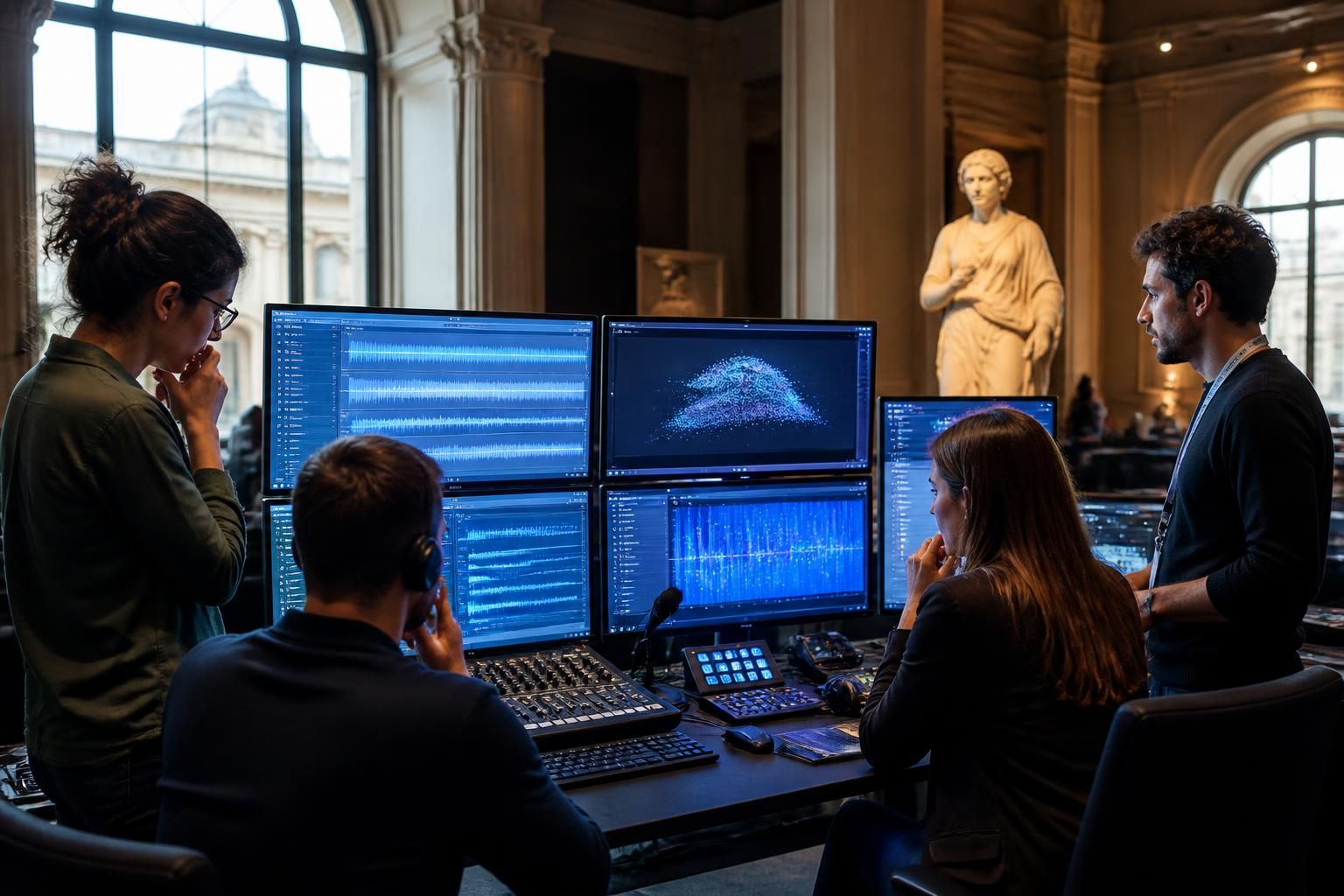
How Gladia Voice AI Turns Spoken Content into Useful Tourism and Cultural Data
🎧 Audio quality is no longer a secondary operational detail. In tourism, events, museums, and guided experiences, spoken content carries interpretation, safety guidance, local stories, and visitor feedback. If it cannot be heard, searched, translated, or adapted, much of its value disappears once the experience is over.
Gladia’s core proposition is to convert speech into structured information through a single API. Transcription is the most visible function, but the operational potential goes further: language identification, speaker separation, timestamping, summarisation, and extraction of useful insights can all support better content workflows. The exact features selected should always match a real use case rather than follow a technology trend.
For a guide working with a multilingual group, the first benefit may be simple transcription of a live talk to create an accurate written archive. For a museum, speaker diarisation can help distinguish a curator from an interviewer in recorded oral-history material. For an event venue, structured transcripts can support post-event reporting and make sessions easier to repurpose for newsletters, training, or accessibility services.
Designing a workflow around the visitor experience
A strong Voice AI workflow begins with the journey, not the model. Take the example of “Coastal Stories,” a fictional destination-management organisation preparing walking tours in Brittany. Its team wants to record local fishermen, historians, and residents discussing the coastline. They do not need a generic transcript sitting in a folder. They need a repeatable process that turns recordings into useful visitor assets.
First, the team records each interview with clear consent and basic sound discipline: a calm environment, a suitable microphone, and a short test recording. Second, the audio file is sent to a transcription service. Third, a content editor checks place names, regional vocabulary, dates, and personal references. Fourth, approved extracts are transformed into audio-guide scripts, captions, or short thematic clips.
This human review stage is essential. Automatic speech recognition can accelerate production, but a transcript is not automatically publishable. Historic place names, family names, dialects, and technical vocabulary deserve careful verification. In cultural mediation, a wrongly transcribed name can change the meaning of a story or weaken public confidence in the institution.
| Workflow stage | Voice AI contribution | Tourism or cultural benefit |
|---|---|---|
| 🎤 Audio capture | File preparation for transcription | Preserves expert interviews and guide commentary |
| 📝 Speech-to-text | Time-coded multilingual transcript | Makes spoken material searchable and reusable |
| 👥 Speaker identification | Separates participants in a discussion | Improves editing of panels and oral histories |
| 🔎 Content review | Supports faster editorial verification | Protects factual quality and local accuracy |
| 📱 Visitor distribution | Feeds captions, scripts, or app content | Improves accessibility and engagement |
The distinction between speech technology and a conversational assistant should also remain clear. A transcription engine processes spoken language into data; a conversational layer may interpret intent, answer questions, or generate responses. Organisations planning visitor-facing services can explore this distinction in this practical overview of Voice AI versus conversational AI. Choosing the wrong layer can lead to an expensive service that does not solve the actual visitor need.
Gladia’s integration into OVH Groupe can make these workflows more attractive to organisations that need both high-performing speech capabilities and a coherent hosting strategy. Yet technology alone will not create a better tour. The useful outcome comes from combining accurate audio, editorial oversight, accessible delivery, and a clear purpose for every captured recording.
The practical insight is straightforward: spoken content becomes valuable when it is designed to move from recording to action, not when it is merely converted into text.
OVH Groupe and Gladia Create a European AI Partnership Beyond Speech-to-Text
The importance of the Gladia and OVH Groupe AI Partnership lies in its wider technical direction. Speech-to-text is a key capability, but the strategic ambition is broader: voice can become one component in multimodal Artificial Intelligence systems that work with audio, text, documents, images, and business data.
In this model, a spoken question at a visitor desk could be transcribed, classified, matched with approved knowledge-base content, and routed to a human team member when needed. A recorded public meeting could become a time-coded transcript, a summary of key decisions, and a list of follow-up actions. The value is not in automating every exchange; it is in reducing repetitive manual work while keeping human judgement where it matters.
From voice data to agentic operational support
Agentic AI is often described in broad terms, but its useful application depends on tightly defined tasks. In a tourism setting, an agent should not invent historical interpretations or provide unchecked safety information. It can, however, help staff retrieve approved answers from a maintained content library, label incoming requests, or prepare a first draft of a post-event summary for review.
Imagine a city museum receiving hundreds of voice messages during a popular exhibition. Visitors ask about opening hours, accessibility, ticket changes, and workshop availability. With consented recordings and appropriate privacy controls, speech recognition can transform these messages into text. An operational system can then identify the most frequent questions and show staff where website information is unclear.
This is a more realistic use of AI than replacing visitor relations with a generic chatbot. The system highlights friction. The museum then decides whether to revise its booking page, add a clearer audio instruction, or assign staff support at a particular time. Technology becomes a listening tool for service improvement.
- 🧭 Define the decision: identify what staff need to know, such as common questions or recurring booking problems.
- 🎙️ Capture only relevant audio: avoid collecting spoken data simply because it is technically possible.
- 🛡️ Set privacy rules: establish consent, retention periods, user access, and deletion procedures before deployment.
- ✍️ Review outputs: ensure a human validates summaries, translations, and public-facing information.
- 📊 Measure the effect: track reduced response times, improved accessibility, or fewer repeated queries.
The reported transaction also illustrates a European industrial response to a market long shaped by large American and Asian cloud platforms. According to reporting on OVH Groupe’s Gladia acquisition, the move supports the company’s effort to deepen its AI capabilities through voice technology developed in Europe. The relevance is particularly strong for regulated sectors and public-interest services, where provider location and technical accountability influence procurement choices.
Still, sovereignty must be assessed through evidence rather than branding. Decision-makers should examine data location, encryption practices, contractual commitments, subcontractor arrangements, model training policies, technical documentation, and support procedures. A provider being European is useful, but it is not a substitute for due diligence.
For cultural operators, the strongest case is not built around fear of foreign technology. It is built around resilience: the ability to select tools that respect local obligations, integrate with existing services, and remain understandable to the teams expected to operate them.
Voice AI becomes more credible when it supports a defined operational decision, rather than acting as an impressive but disconnected feature.
Deploying Sovereign Voice AI Responsibly in Museums, Tours, and Events
Deployment quality determines whether Voice AI helps an organisation or creates additional complexity. A small museum, independent guide, convention centre, or regional tourism office does not need a full-scale AI laboratory. It needs a controlled pilot with a clear audience, a manageable volume of content, and success criteria that staff can evaluate.
Gladia’s developer-first API model is relevant because it allows technology teams to connect speech capabilities to their own applications. For many operators, however, the best path is through a platform partner or a specialist provider that can package the service into an understandable workflow. The technical layer should remain reliable without forcing every guide or cultural mediator to become a data engineer.
Start with an accessible, measurable use case
A suitable pilot might involve transcribing ten recorded guided tours and using the transcripts to create captions and searchable internal training notes. Another might involve identifying the most common questions asked at an international event, then updating pre-arrival information in three languages. These projects are limited enough to manage but meaningful enough to reveal whether the tool creates value.
“Northern Gate Tours,” a fictional operator running architecture walks in Rotterdam, offers a useful example. Its guides use smartphones for audio delivery and record short debriefs after tours. The team initially considered a visitor-facing AI assistant. It instead began with a simpler use case: turning guide debriefs into shared notes about route disruptions, visitor questions, and accessibility issues.
After four weeks, the operator discovered that visitors repeatedly asked where to find accessible toilets and sheltered waiting areas. Rather than investing immediately in a conversational interface, the team updated its route briefings and booking confirmations. This is an important lesson: the best technology outcome may be a clearer human service, not a more complex digital product.
Audio-guide platforms can play a complementary role here. A tool such as Grupem helps organisations distribute clear tour audio to participants’ own smartphones, avoiding the logistical burden of dedicated receiver equipment. When paired with responsibly reviewed transcripts and multilingual editorial content, mobile audio delivery can make tours more inclusive without removing the guide’s role.
Before connecting any transcription or generative system, teams should establish a practical checklist:
- ✅ Identify which recordings have a legitimate business, educational, or accessibility purpose.
- ✅ Inform participants when audio is being captured and explain how it will be used.
- ✅ Decide whether raw files, transcripts, or both need to be retained.
- ✅ Restrict access to approved staff and document responsibilities.
- ✅ Test performance with accents, local vocabulary, background noise, and multiple speakers.
- ✅ Create an editorial process before publishing AI-assisted material.
Accessibility must remain a priority rather than an afterthought. Transcription can provide the foundation for captions, readable summaries, and translations, but each output must be adapted for the intended audience. A word-for-word transcript of a lively tour may be difficult to read on a phone. Breaking content into short sections, highlighting locations, and providing an easy replay option creates a far better user experience.
There is also a financial discipline to maintain. A pilot should include the real cost of storage, processing, integration, staff time, review, and ongoing support. Cheap transcription without a review process can create hidden costs later. Conversely, a well-designed limited deployment can help an organisation build internal confidence before expanding.
Responsible deployment starts small, protects participants, and measures a service improvement that people can actually notice.
What Europe’s Sovereign Innovation Means for Future Audio Experiences
Europe’s Voice AI market is moving beyond basic dictation. The next stage is likely to involve richer combinations of secure Cloud Computing, multilingual speech analysis, real-time assistance, and mobile audio experiences. The Gladia and OVH Groupe combination is significant because it addresses several layers at once: voice intelligence, infrastructure, developer access, and the strategic demand for European-controlled services.
For tourism and culture, this evolution could improve how content is created, delivered, and maintained. A historic site could update an audio tour more quickly after a new archaeological discovery. A convention organiser could provide session captions while preparing a reviewed post-event resource library. A destination could analyse anonymised themes in visitor feedback to identify where wayfinding, transport advice, or accessibility information needs improvement.
Keeping human expertise at the centre of audio innovation
None of these applications should treat speech as a commodity detached from people. Voice carries accent, identity, emotion, regional language, and cultural context. A local guide explaining a neighbourhood does more than transmit facts; they give visitors a sense of place. Technology should preserve and amplify that value, not flatten it into generic synthetic content.
This is especially relevant for lesser-used languages and regional expressions. Automatic models may improve coverage, but they should be tested with actual local speakers before publication. A heritage association documenting oral traditions, for example, should involve community members in reviewing names, expressions, and translations. The result will be more accurate and more respectful than relying on automation alone.
There is also an opportunity to improve continuity across the visitor journey. Before arrival, travellers may receive a short audio orientation. During the visit, they may access location-based commentary on their own phones. Afterwards, they may receive a captioned recap or curated list of resources. A secure voice infrastructure can support parts of this journey, while a platform designed for guided audio delivery ensures the experience remains simple for the participant.
The broader lesson of this European AI Partnership is that infrastructure decisions are becoming experience decisions. If an organisation cannot trust how audio data is handled, it will hesitate to innovate. If its tools are too difficult for staff to use, valuable content remains locked in recordings. If automated outputs are not reviewed, public trust can be damaged quickly.
OVH Groupe’s investment in Gladia therefore deserves attention from more than cloud specialists. It signals that voice is becoming a strategic interface for services, knowledge management, accessibility, and customer experience. Europe can compete in this area by combining technical performance with reliable governance, transparent deployment choices, and use cases grounded in daily operational needs.
For guides, museums, tourism offices, and event teams, the immediate action is modest: map one recurring audio task that currently consumes too much manual effort. It may be note-taking after a tour, preparing captions, documenting an interview, or analysing common visitor questions. Define the desired outcome, test a controlled workflow, and keep a human reviewer accountable for quality.
🔎 The strongest future for sovereign Voice AI is not louder automation; it is clearer, more accessible, and more trustworthy communication.
What does Gladia bring to OVH Groupe?
Gladia adds speech-to-text, audio intelligence, and voice-processing capabilities to OVH Groupe’s cloud and AI ecosystem. This supports a more integrated European offering for organisations that need to process spoken content securely.
Why is sovereign Voice AI important for European organisations?
Sovereign Voice AI can help organisations maintain clearer control over where audio data is hosted and processed, which is particularly relevant for public services, cultural institutions, and regulated activities handling personal information.
Can speech-to-text replace human editors for tourism content?
No. Speech-to-text can accelerate transcription and content preparation, but editors and subject experts should review names, historical facts, local expressions, translations, and public-facing text before publication.
What is a practical first Voice AI project for a museum or guide?
A manageable first project is transcribing a limited number of recorded tours or interviews, reviewing the output, and using it to create captions, internal training notes, or accessible visitor content.
