
⚡ Key points at a glance: Epic Games is preparing a major shift in how Fortnite creators build character-driven islands. AI Voices, defined personas, and LLM-based dialogue will allow selected NPCs to react to player input in a more natural way. The opportunity is significant, but successful Interactive Conversations will depend on clear gameplay goals, careful voice design, and practical safety controls.
Fortnite AI Voices Give NPCs a More Consistent Identity
Fortnite is extending its creator ecosystem with a conversations system designed to make NPCs feel less like static quest terminals and more like responsive characters. Epic Games has assigned consistent voices and personas to 36 Fortnite characters, creating a foundation for creators who want dialogue that can adapt to a player’s actions rather than follow a single prewritten path.
This Game Innovation matters because a voice does more than deliver a line of text. It signals mood, authority, urgency, humour, and familiarity within seconds. A recognisable character such as Fishstick, Agent Jones, or Cuddle Team Leader can establish context before a player has even selected a dialogue option. When personality, language style, and Voice Technology are aligned, the character becomes easier to understand and more memorable.
The planned publishing availability from July 30 moves the feature beyond a technical demonstration. Creators using Unreal Editor for Fortnite can build islands where a player asks for help, investigates clues, negotiates access to an area, or receives a mission through speech-based exchanges. Epic Games describes the capability in its announcement on publishing islands with LLM conversations, which positions conversational characters as tools that can actively drive gameplay.
Consider a fictional creator island called “Harbour Signal.” Players arrive in a storm-hit coastal district and meet an NPC acting as a radio operator. Instead of repeating “Find three batteries,” the operator could respond to what the player has already completed: “You restored power to the west pier, but the lighthouse signal is still down.” The information is familiar in function, yet it sounds contextual because it refers to the player’s real progress.
That distinction is essential. Artificial Intelligence should not be added merely because it can generate speech. In an effective Gaming Experience, the character needs a clear role. A detective NPC should help players understand evidence. A shopkeeper should provide trade-related information. A guide should orient visitors through a complex environment. If a character is permitted to discuss everything without reliable boundaries, the experience becomes vague and can distract from the island’s purpose.
How Personas Connect Voice, Tone, and Gameplay
A persona acts as an operational brief for the character. It may specify the NPC’s role, expertise, attitude, vocabulary, knowledge limits, and conversational priorities. This avoids a common problem with generative dialogue: a character who begins with a convincing tone but becomes inconsistent after several exchanges. A tactical commander should not suddenly sound like a comedian, while a playful mascot should not give cold, formal instructions during a lighthearted minigame.
Creators can think of a persona as they would a museum audio-guide narrator. The speaker does not need to explain every object in the building. They need to explain the right object, in a voice appropriate to the visit, at the moment when the audience needs it. The same approach makes Player Interaction more useful in Fortnite: short, relevant answers are often stronger than long, impressive-sounding monologues.
- 🎙️ Define one job: navigation, mission briefing, trading, storytelling, or support.
- 🧭 Set knowledge boundaries: identify what the NPC knows and what it must redirect.
- 🎭 Match voice to context: an urgent survival scenario requires different pacing from a social hub.
- 🎮 Link dialogue to an action: each exchange should reveal, unlock, confirm, or guide something.
The practical value of AI Voices is therefore not unlimited improvisation. It is the ability to make a well-designed character feel attentive without requiring a creator to record every possible sentence. A believable NPC begins with a defined purpose, not with an unlimited script.
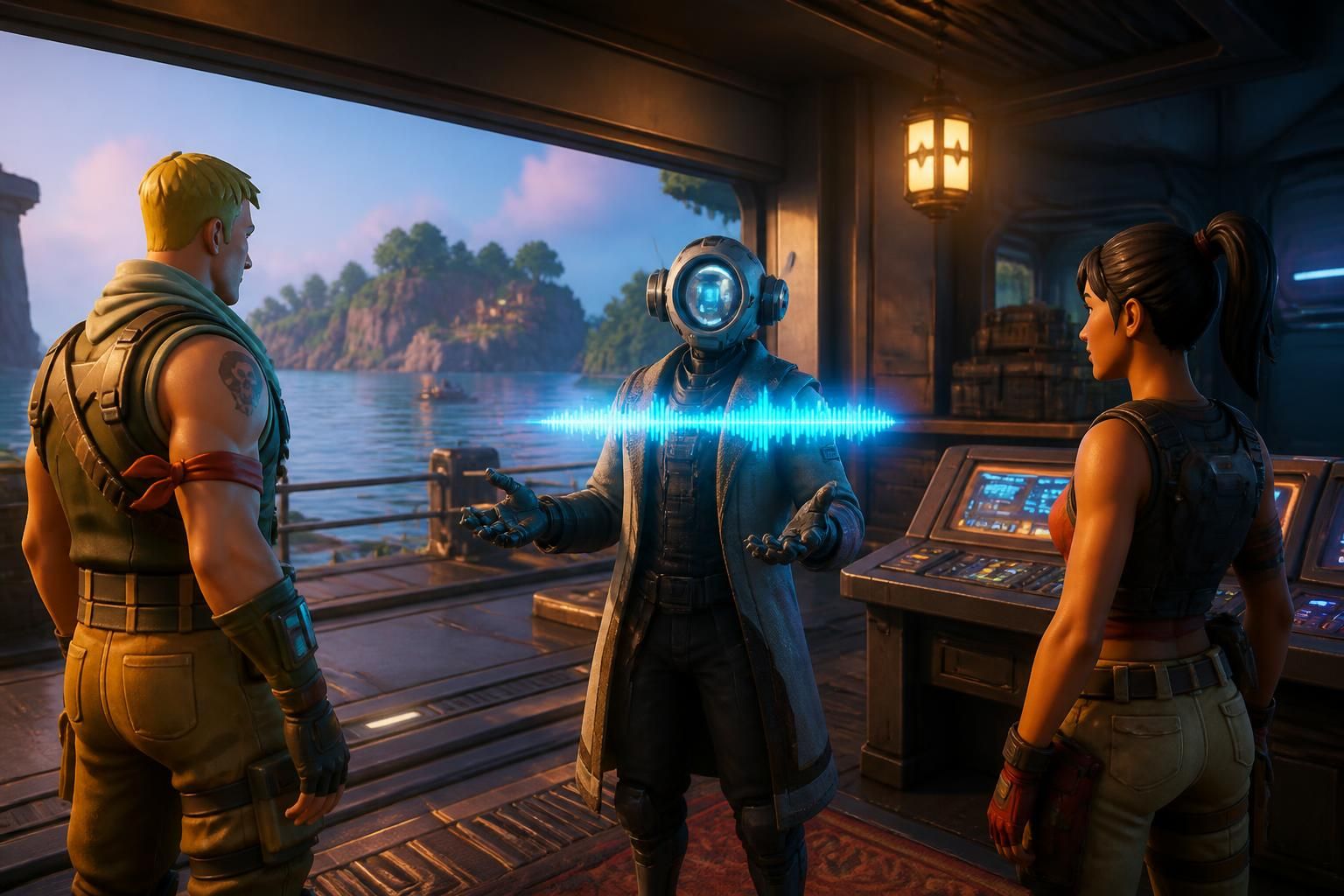
Interactive Conversations Can Improve Fortnite Player Interaction
Traditional NPC dialogue is efficient when a game needs a precise answer: accept a quest, receive an item, or view a fixed explanation. However, players do not always approach an objective in the expected order. They may discover a location early, fail a challenge repeatedly, or return after completing a related task. Interactive Conversations can make these moments easier to manage by allowing characters to acknowledge context instead of recycling the same generic line.
For island creators, this opens a more flexible way to deliver guidance. A player who asks, “Where is the generator?” might receive an answer shaped by current game state. If the player has not found the map, the NPC can direct them to it. If the generator has already been repaired, the character can point toward the next mission. The exchange can feel conversational while remaining anchored to a practical set of game variables.
This approach is particularly relevant for experiences designed around exploration, role-playing, education, or community events. A mystery island can use an investigator character to help players revisit clues. A historical-themed map can use a fictional curator to explain a location’s context. A team-building island can employ a host character who clarifies objectives without forcing every participant through the same dialogue tree.
There is also an accessibility benefit. Players may understand instructions more easily when they can ask for a clarification in everyday language rather than interpret a dense screen of text. Spoken responses can support orientation, particularly in complex spaces where visual attention is already divided between movement, combat, menus, and other players. Accessibility still requires captions, readable text alternatives, and sensible audio levels, but responsive voice can reduce friction for many audiences.
Designing Conversations That Support Rather Than Delay Play
The strongest conversational design follows a simple principle: the player should leave the interaction knowing what to do next. That does not mean every character should reveal solutions immediately. In a puzzle experience, the NPC may provide a hint rather than an answer. In a competitive setting, it may explain rules but avoid tactical advantages. The creator controls the role of dialogue within the wider game loop.
Imagine “Metro Relay,” an island where a four-player squad must restore communication nodes. One player asks a station engineer for help after a failed attempt. The engineer should not generate an unrelated story about the city. It should say something useful: “The north relay only activates after the south panel is calibrated. Check the blue indicators.” This retains character flavour while respecting the team’s time.
| Conversation goal | Useful NPC behaviour | Player benefit |
|---|---|---|
| 🗺️ Navigation | Points to a relevant zone based on mission status | Fewer lost-player moments |
| 🔍 Investigation | Recaps discovered clues without revealing undiscovered ones | Clearer progression |
| ⚔️ Rules support | Explains a mechanic in concise, contextual language | Faster onboarding |
| 🎭 Narrative role-play | Responds in a stable character voice and tone | Stronger immersion |
Creators should test real player questions rather than only ideal prompts. People will ask vague questions, repeat themselves, use slang, and try to break the character’s role. Testing reveals whether the NPC delivers a useful response, directs players back to the objective, or produces unnecessary dialogue. Good Player Interaction is measured by clearer decisions, not by the number of spoken words.
Voice Technology Requires Clear Creative and Technical Controls
AI-generated speech can make an island feel active, but it also introduces new production responsibilities. Voice Technology affects how players perceive trust, character identity, and quality. A convincing voice that uses the wrong tone at the wrong time can damage immersion faster than a plainly written text box. For this reason, creators should treat audio direction as a central design discipline rather than a final decorative layer.
Consistency is especially important when Fortnite characters already have an established identity. Players bring expectations based on previous appearances, community culture, visual design, and existing lore. A persona needs to preserve that recognition while remaining useful to the creator’s individual island. The challenge is not simply “make the NPC talk.” It is “make this specific character communicate in a way that still feels credible in this setting.”
The wider debate around synthetic speech also deserves attention. Voice cloning and impersonation can create real risks when identity, consent, and provenance are unclear. Teams building public experiences should understand the difference between platform-provided character voices and unapproved imitation of real people. A practical reference on AI voice spoofing risks highlights why audiences need transparency and why voice identity should be handled with care.
For creators, transparency does not mean breaking immersion with technical explanations in every interaction. It means using approved tools, respecting platform rules, avoiding deceptive representations, and ensuring the player can understand what the character is for. If a voice collects input or triggers game actions, those actions should be predictable. A conversational NPC should never obscure an important mechanic behind confusing or misleading phrasing.
Practical Audio Quality Checks for AI Voices
Audio quality shapes perceived quality. Even an excellent dialogue system can feel unreliable if speech is too quiet, clipped by music, poorly paced, or difficult to understand in a busy multiplayer scene. A creator should test dialogue using common headphones, television speakers, mobile listening conditions, and the full sound mix of the island. What sounds clear in a quiet editor environment may disappear during combat or crowd noise.
Creators can adopt a compact quality-control process before publishing:
- 🎧 Test whether critical instructions remain understandable under gameplay sound effects.
- 📝 Provide captions or text reinforcement for mission-critical information.
- ⏱️ Keep urgent lines brief, especially during timed events or combat.
- 🔁 Check whether repeated questions produce useful, stable answers.
- 🛑 Build fallback responses for requests outside the character’s intended knowledge.
Audio teams in visitor experiences often use the same discipline. A guide’s voice must be intelligible in a street, gallery, bus, or crowded venue, not only in a recording studio. In Fortnite, the equivalent challenge is a dynamic soundscape: gunfire, vehicles, emotes, other players, and music can all compete with speech. The answer is not louder dialogue by default; it is careful mixing and prioritisation.
Anyone evaluating synthetic speech quality can also review the practical differences between AI voices and human speech. The most relevant question is whether the voice supports the listener’s task. Clear audio, stable identity, and predictable behaviour are the foundations of responsible conversational design.
Artificial Intelligence Changes How Fortnite Creators Build Narrative Islands
The arrival of conversational characters changes production planning as much as it changes dialogue. Previously, creators often had to choose between fully scripted exchanges, which provide control but require extensive writing, and minimal NPC interactions, which keep development lean but reduce narrative flexibility. Artificial Intelligence introduces a third option: guided dialogue that can respond to varied player input within a carefully defined design space.
That does not eliminate writing. It changes the work. Instead of producing hundreds of isolated lines for every possible branch, a team can focus on character rules, mission facts, prohibited topics, style guidance, fallback wording, and key narrative beats. The creator becomes a conversation designer. This role combines game design, user experience, audio direction, and editorial discipline.
A small studio creating a fantasy rescue island, for example, might establish three key NPCs: a scout who knows routes, a mechanic who explains equipment, and a mayor who frames the story stakes. Each character receives a narrow knowledge domain. Players can ask natural questions, but the scout should not explain machinery and the mechanic should not reveal late-game plot developments. That division produces a world that feels coherent rather than generically talkative.
The system can also reduce barriers for creators who lack access to voice actors or large recording budgets. Yet it should not be treated as a replacement for deliberate creative work. A weak character brief will not become compelling because the output is spoken. A confusing mission will not become clear because it is delivered by an expressive voice. The technology amplifies the quality of the underlying direction.
Building an Efficient Workflow for LLM-Powered NPCs
A practical workflow starts with the gameplay map, not the model. First, identify the moments where players need information, emotional context, or a response to their choices. Then define what the NPC is permitted to do at each moment. Only after those decisions should the team write persona instructions and test sample conversations.
For “Harbour Signal,” the radio operator could be given four states: first meeting, power restoration in progress, lighthouse unlocked, and emergency failure. In each state, the character has different priorities and recommended answers. This makes the conversation system easier to test because the team can confirm whether the correct information is delivered for each stage.
Creators should also plan for edge cases. What happens when a player asks about a feature not included in the island? What if they use offensive language? What if a group of players tries to use the NPC simultaneously? A robust design provides short redirections, retains the character’s tone, and returns players to available actions. This is more useful than attempting to make the NPC answer every imaginable request.
Epic’s earlier explanation of AI-powered NPC conversations makes clear that dialogue can be connected to reactions and gameplay events. That connection is where the real value lies. A character that speaks but cannot affect, acknowledge, or guide the world soon feels ornamental. The most effective Game Innovation connects language to a visible player outcome.
Responsible Fortnite AI Voices Depend on Player Trust and Accessibility
Interactive systems are increasingly judged not only by novelty but also by whether players can use them comfortably and safely. In Fortnite, that means conversational NPCs should be understandable, optional where appropriate, and respectful of the wide variety of audiences that use creator-made islands. Trust grows when a system behaves consistently: players know what it can do, what it cannot do, and how it relates to the goals of the experience.
Accessibility begins with choice. Some players prefer audio guidance because it is faster or more immersive. Others rely on written cues, captions, visual markers, or simplified task descriptions. A well-designed island does not force a single mode of interaction. If an NPC gives an essential clue aloud, the clue should also appear in a readable form or be available again through an accessible prompt.
Language is another consideration. Short sentences, concrete directions, and limited use of idioms make voice-driven instructions easier to follow across different levels of language proficiency. This does not mean character writing must become bland. It means that gameplay-critical messages need a clear core: location, action, sequence, and consequence. Humour and personality can sit around that core without replacing it.
For public-facing digital experiences, this is a familiar practice. A smart audio guide succeeds when visitors can hear, understand, and act on the information without losing the rhythm of the visit. The same principle applies to a multiplayer island. An NPC should help a player remain part of the action, not isolate them in a long exchange while teammates move ahead.
What Creators Should Monitor After Publishing
Publishing is the beginning of evaluation, not the final step. Creators should monitor where players initiate conversation, which prompts they repeat, whether they abandon interactions, and which missions produce the most requests for help. This information can reveal unclear level design, inaccessible instructions, or a persona that is entertaining but not operationally useful.
Feedback should be sorted into practical categories: comprehension, audio clarity, timing, relevance, and trust. If players say an NPC “does not help,” the cause may be a missing game-state connection rather than weak voice generation. If they say a character is “annoying,” the issue may be frequency, line length, or interruption timing. Separating these factors leads to better updates.
It is also sensible to establish a small moderation and update process. Review a sample of unexpected inputs, refine fallback responses, and confirm that changes preserve the intended personality. The aim is not to chase every unusual player request. The aim is to protect a reliable experience for the largest number of users while maintaining the creative identity of the island.
Fortnite’s move toward AI Voices and Interactive Conversations gives creators a new narrative interface, but the strongest results will come from restraint and user-centred testing. When NPCs speak with purpose, players spend less time decoding instructions and more time playing together.
When can Fortnite creators publish islands with LLM conversations?
Epic Games has indicated that conversations leave the Experimental phase for island publishing on July 30. Creators should still review the latest official Fortnite Creator documentation and applicable publishing requirements before release.
How many Fortnite characters have AI Voices and defined personas?
Epic Games has announced consistent voices and personas for 36 existing Fortnite characters used as NPCs, with further additions expected over time.
Can AI-powered NPCs replace all scripted dialogue?
No. Scripted dialogue remains useful for exact story beats, legal notices, tutorial instructions, and moments requiring total author control. AI-powered exchanges work best when they add contextual responses around clearly designed gameplay states.
What is the most important accessibility practice for voiced NPC interactions?
Provide a clear alternative to audio-only information. Captions, readable text prompts, visual objective markers, and repeatable instructions help ensure that essential progress does not depend on hearing a generated voice.
