
Blue Angels Low Pass at Pensacola Beach Turns an Air Show into a National Spectacle
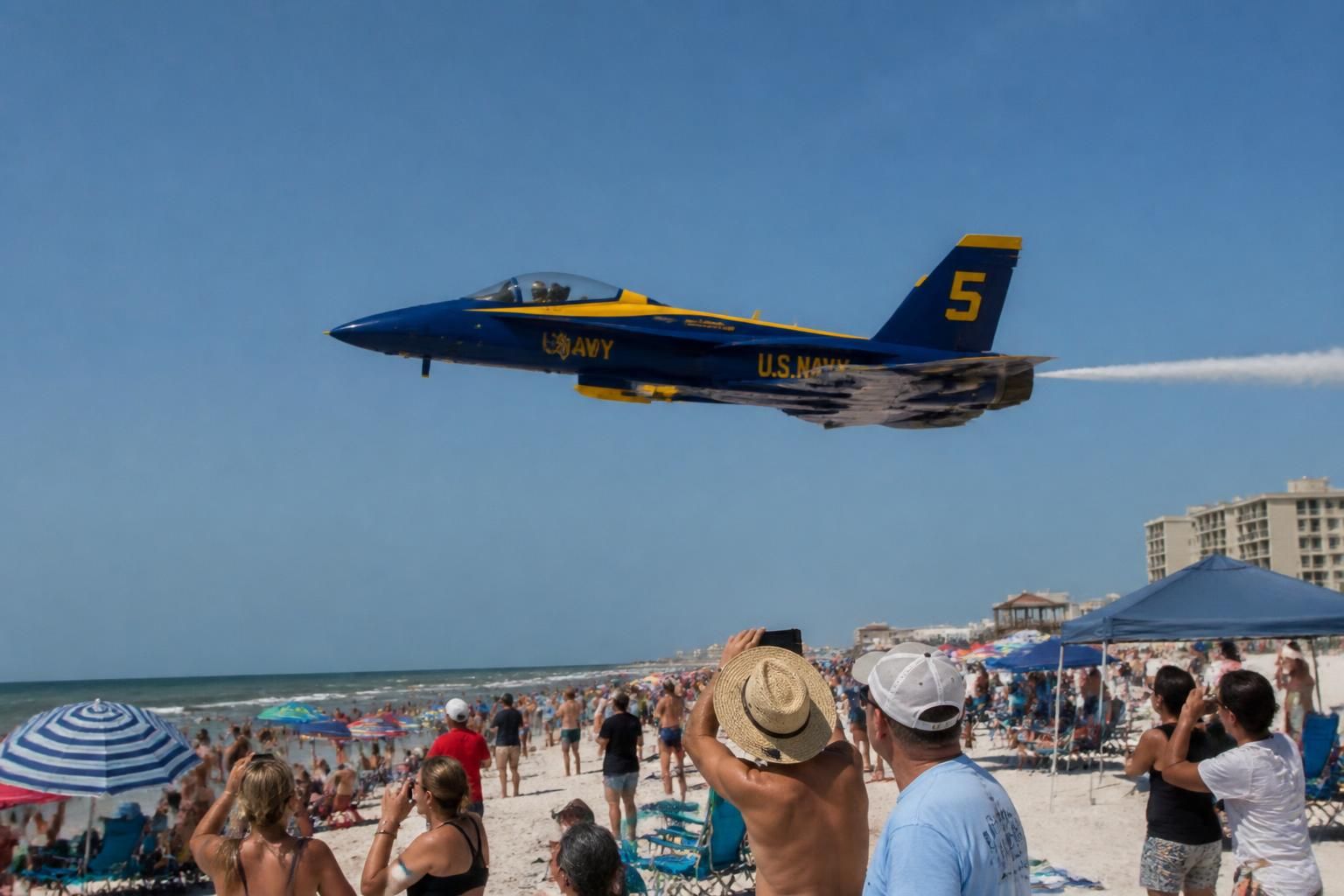
The Blue Angels drew intense attention during Pensacola Beach’s annual air show week after a dramatic low pass placed one of the team’s jets remarkably close to the shoreline crowd. The maneuver occurred during “Breakfast with the Blues,” the morning event that traditionally opens the wider Pensacola Beach Air Show program and helps the team establish visual references for later demonstrations.
For spectators, the moment delivered the kind of aviation experience that cannot be replicated through a screen: a fast-moving aircraft, a sudden rise in engine sound, and the physical force of turbulent air reaching the beach seconds later. Video shared online showed umbrellas shifting, lightweight chairs tumbling and tents lifting as the aircraft passed. Some beachgoers crouched instinctively, while others reacted with cheers.
⚠️ The defining feature of the incident was not simply the aircraft’s altitude, but the effect of its wake on a densely occupied public beach. A high-performance jet creates powerful disturbed airflow behind it. On an open shoreline, where temporary structures are often lightly anchored in sand, that airflow can move objects much more easily than visitors expect.
The Blue Angels are based at Naval Air Station Pensacola, giving the event an unusually strong local identity. Their appearances are not perceived only as military demonstrations; for many residents, they are part of the region’s tourism calendar, civic culture and summer routine. This connection explains why the low pass generated both concern and enthusiasm. It was an unexpected moment in a familiar tradition.
National reporting framed the event differently depending on the outlet. Some coverage focused on the exhilaration of seeing precision aviation from close range, while other reports highlighted questions about crowd separation and safety review procedures. Footage of the event can be compared with video showing the low beach flyover, which captures the speed and visual proximity that made the moment so widely discussed.
Pensacola’s air show environment also makes operational context important. The beach is not a closed stadium. It is a changing public space shaped by tides, wind, family groups, vendor areas, boats offshore and informal viewing zones. Even when spectators know an aerial display is planned, they may not anticipate a low pass that produces a physical reaction at ground level.
A useful way to understand the incident is to separate three experiences happening at once: the pilots’ planned flight activity, organizers’ crowd-management responsibilities, and visitors’ real-time perception. A maneuver may be technically executed within an operational framework, yet still surprise people positioned beneath or near its path. That gap between planning and public perception is where event communication matters most.
- ✈️ For aviation fans: the pass demonstrated the speed, precision and visual impact associated with Blue Angels aerobatics.
- 🏖️ For beach visitors: it showed why loose equipment needs to be secured before aerial demonstrations begin.
- 📱 For organizers: it reinforced the value of timely alerts that explain what people may hear, see and physically feel.
- 🎧 For tourism professionals: it highlighted the need for accessible information beyond signs and loudspeaker announcements.
Consider a fictional visitor, Maya, attending Pensacola Beach with two children and a rented umbrella setup. She may have checked the show schedule but not understood which activities were rehearsals, which were official display segments, or where aircraft would be most visible. A short smartphone alert stating that jet activity could create strong noise and wind effects would not diminish the thrill. It would let her secure belongings and decide where her family feels most comfortable.
🎯 The event’s lasting lesson is straightforward: spectacular aviation remains more enjoyable when audiences receive practical context before the sound, speed and wake arrive.
How the Pensacola Beach Air Show Balances Thrill, Crowd Safety and Public Communication
A major beach air show depends on more than a precise flying program. It requires a coordinated visitor experience that begins before the first aircraft becomes visible. At Pensacola, the Blue Angels are the central attraction, but the operational challenge extends to police, emergency services, hospitality businesses, beach staff, transportation providers and local media.
The low pass during “Breakfast with the Blues” brought this wider system into focus. A flyover can create a powerful emotional response because spectators sense the energy of the aircraft directly. Yet a public event must account for people who are unfamiliar with military aviation, sensitive to sudden noise, managing mobility needs, or responsible for young children near water and crowds.
After video of the maneuver circulated, the team conducted a review. Reporting indicated that the flight debrief was completed and that Acting Navy Secretary Hung Cao said there would be no reprimands connected to the event. The official response matters because it distinguishes a review process from an assumption of misconduct. The public can reasonably expect an assessment after a widely shared incident, particularly when objects were visibly disturbed near spectators.
✅ A review is a useful operational tool when it examines not only aircraft performance, but also what spectators understood before the pass occurred. Crowd safety is never limited to whether a fence, rope line or marked boundary exists. It includes how effectively visitors receive, understand and act on instructions.
For event teams, communication should be designed around real visitor behavior. Beach audiences are moving, taking photographs, swimming, buying food, talking in groups and managing belongings. A single static notice at an entrance is rarely enough. Information has to appear in multiple formats, at relevant moments and in language that makes the expected action obvious.
| Visitor need | Useful communication method | Practical outcome |
|---|---|---|
| 🔊 Sudden jet noise | Audio alerts and push notifications before scheduled activity | Visitors can prepare children, hearing protection and pets |
| 🌬️ Wake turbulence effects | Clear instruction to lower umbrellas and secure chairs | Fewer loose objects near crowded viewing areas |
| 📍 Best viewing locations | Interactive map with accessible routes and quieter zones | More even crowd distribution across the beach |
| 🚑 Emergency changes | Real-time official messaging through a mobile event channel | Faster response without relying solely on public-address systems |
The table reflects a broader smart-tourism principle: information should reach people where they already are. During an air show, many visitors have a smartphone in hand to record footage or check schedules. A mobile channel can therefore provide value without asking the public to learn a complex new system.
Audio technology is especially valuable in environments where screens compete with sunlight, movement and visual distractions. A concise alert through headphones or a phone speaker can explain that low-level demonstration activity is approaching and remind visitors to keep an eye on loose equipment. The aim is not to overload the audience with technical aviation language. It is to give them a clear instruction at the right time.
For organizers, the most effective messages are specific. “Please be aware of aircraft activity” is weaker than “Secure umbrellas and lightweight chairs now; jet passes may produce strong wind and sound.” The latter tells visitors what to do, why it matters and when action is needed.
Pensacola’s event economy benefits when this communication works. Guests who feel informed are more likely to stay longer, visit local restaurants, book accommodation and return for future programming. Conversely, confusion can turn a memorable air show into a stressful experience, even where no injury occurs.
📣 The strongest crowd-management strategy does not reduce the Blue Angels thrill; it makes the spectacular experience easier for every visitor to enjoy safely.
Blue Angels Aviation Heritage Gives Pensacola a Distinctive Tourism Identity
The Pensacola Beach Air Show is part of a larger aviation story. The Blue Angels have long been connected to the city through Naval Air Station Pensacola, a place often described as the cradle of naval aviation. That local relationship gives the beach demonstration a cultural weight that differs from an ordinary seasonal attraction.
When spectators watch the team’s formation flying, they are engaging with a living public expression of naval aviation history. The blue-and-gold aircraft, close formations and coordinated maneuvers are designed to demonstrate discipline, skill and teamwork. In Pensacola, those ideas connect directly to a community shaped by military families, flight training and aviation museums.
The National Naval Aviation Museum remains a major part of that heritage landscape. Its extensive exhibition space and collection tell a broader story than any single air show can communicate. However, access has been affected in recent years by base security restrictions, emergency closures and changing operational conditions. Before 2019, the museum was regularly attracting close to one million visitors annually; subsequent disruptions changed both access patterns and visitor expectations.
🏛️ For destination managers, the opportunity is to connect the short burst of an air show with year-round aviation discovery. A visitor who arrives for the Blue Angels may also be interested in cockpit design, military history, flight simulators, restoration work or the human stories behind aviation service.
This is where guided interpretation becomes practical rather than decorative. A museum, visitor center or local tourism office can offer themed audio walks that explain how Pensacola’s coastline, naval base and aviation institutions relate to one another. Visitors do not need to join a large group at a fixed time to benefit from well-structured interpretation.
Mobile audio guidance can make these stories more accessible for families, international visitors and independent travelers. Instead of reading long panels in direct sun or waiting for a scheduled tour, they can listen at their own pace. A clear voice track can explain why a particular aircraft mattered, how aerobatics differ from combat operations, or why operational security affects public access to certain sites.
For institutions looking for comparable inspiration, this overview of aviation museums in Upstate New York shows how aviation heritage can be approached as an engaging visitor journey rather than a simple display of machines. The principle transfers well to Pensacola: objects, places and stories become more memorable when audiences understand the connections between them.
A useful hypothetical example is the “Blue Coast Aviation Route.” A local tourism office could create a phone-based route linking a beachfront viewing area, aviation heritage points, downtown hospitality venues and museum information. Each stop could include a two-minute audio segment, practical accessibility details and directions to the next location. During air show week, temporary alerts could advise visitors about road closures, crowd density or program changes.
This type of service supports visitors without replacing guides or museum professionals. Guided groups still benefit from personal interpretation and questions. Independent travelers gain a reliable alternative when a group tour is unavailable or when a site has limited opening hours.
The same model can support cultural discovery beyond aircraft collections. For example, a resource on lesser-known museums in Louisiana illustrates how digital interpretation can bring attention to regional sites that visitors might otherwise overlook. Pensacola has similar potential in its military, maritime and coastal history.
✈️ The Blue Angels create the immediate spectacle, but Pensacola’s long-term tourism value comes from helping visitors understand the aviation heritage behind the sound and color.
What the Spectacular Low Pass Teaches Event Organizers About Accessible Audio Information
The Pensacola Beach moment offers a practical case study for any organizer working with large outdoor audiences. Whether the event features aerobatics, a concert, a parade, a sports celebration or a maritime demonstration, guests need information that is timely, understandable and usable in difficult conditions.
Beach events are particularly demanding. Wind can make loudspeaker announcements hard to hear. Sunlight can make screens difficult to read. Cellular networks can become congested when thousands of people upload video at once. Visitors may be spread across a wide area, with some standing near the official event zone and others watching from hotels, balconies, boats or less formal beach access points.
🎧 Audio-first communication solves part of this problem because it reaches people without requiring them to stare at a screen. It can also support visitors with visual impairments, guests carrying children or equipment, and people who are unable to read an update while moving through a crowd.
A modern approach does not mean replacing all physical signs with an app. It means creating a layered system. Physical signage establishes rules and landmarks. Staff offer human assistance. Social media supports broad awareness. A mobile audio guide or event channel adds location-aware, detailed and repeatable information that visitors can access when needed.
- 📍 Build an official event map that identifies viewing zones, first-aid points, accessible paths and transport stops.
- 🔔 Schedule short alerts before high-noise or high-impact segments, using plain language and a single clear action.
- 🪑 Explain how to secure beach gear, including tents, umbrellas, chairs and strollers.
- 🧭 Provide an audio version of essential information for visitors who prefer listening over reading.
- 📊 Review feedback after the event to identify where messages were unclear or arrived too late.
The strongest event notifications are restrained. Sending too many alerts causes people to ignore them. Organizers should reserve push messages for schedule changes, safety instructions, weather updates, transportation disruptions and other decisions that require action. A visitor should feel assisted, not interrupted.
Imagine an event coordinator named Daniel preparing the next Pensacola aviation weekend. He uses a simple digital communication plan: an early-morning welcome message, an alert 15 minutes before prominent jet activity, and a final transport reminder before traffic restrictions take effect. He also records a short audio explanation for families that describes why aircraft noise may feel intense and where quieter viewing areas are located.
Such a plan would be useful even if the flying program changes. The value lies in the channel, the writing and the staff workflow. When a sudden update is needed, the team is not creating messages from scratch under pressure. It is using prepared templates checked by operational and accessibility staff.
Platforms such as Grupem can support this approach by turning visitors’ own smartphones into practical audio receivers. For cultural and tourism professionals, the key advantage is not novelty. It is the ability to distribute clear spoken content without investing in a large stock of dedicated receivers, while keeping tours and event guidance flexible.
Privacy and consent should also be part of the workflow. Visitors should understand what they are signing up for, how notifications can be turned off, and where to find information without downloading unnecessary tools. Accessible technology earns trust when it is transparent and optional.
In the context of an air show, sound is both the attraction and the communication challenge. The aircraft’s roar creates excitement, but it can briefly overwhelm spoken announcements. Pre-event audio, captions, maps and concise alerts therefore work together to maintain clarity.
🔊 A well-informed audience is not a less spontaneous audience; it is an audience that can focus on the aviation display instead of reacting to preventable confusion.
Pensacola Beach Air Show Planning After the Blue Angels Crowd Reaction
The public conversation around the low pass should be viewed as a planning opportunity for future Pensacola Beach Air Show editions. The event remains a major draw because it combines elite aviation, coastal scenery and a deep local connection to the Blue Angels. Maintaining that appeal requires organizers to treat visitor comfort, clear communication and local economic coordination as central parts of the program.
During the 2026 season, the team’s 80th anniversary added significance to the Pensacola appearances. It also coincided with the broader national attention surrounding America’s 250th anniversary. These milestones naturally increase interest, attendance and media coverage. They also raise the operational stakes: more first-time visitors may be present, and more footage can travel nationally within minutes.
Reports noted that the No. 3 Blue Angels jet, associated with the low pass, did not fly in a later air show performance. The pilot did appear at a July 17 reception for the team, while supporters online discussed the absence and praised personal accountability. This sequence demonstrates how quickly an operational detail can become part of a public narrative when an event is highly visible.
🧭 Clear, factual updates help prevent speculation from becoming the main visitor information source. Organizers do not need to comment on every online discussion. They do need an official channel where guests can find accurate schedules, viewing guidance, transport information and safety reminders.
Local partners have a role as well. Hotels can provide arrival guidance and event-day notifications at check-in. Restaurants can display transit advice during peak hours. Rental companies can remind beach guests how to secure equipment. Tourism offices can publish downloadable maps and audio itineraries that direct visitors toward appropriate access points.
For example, a Pensacola hotel could send a concise message the evening before major air show activity: “High-noise flight demonstrations are expected tomorrow morning. Please allow extra travel time, secure balcony items, and consult the official event map for viewing and road information.” This type of update is calm, practical and valuable. It does not attempt to dramatize the event.
Accessibility should remain visible in every plan. Some visitors will need routes that avoid soft sand, quieter observation areas, seating options, captioned program information or audio guidance. Families may need stroller-friendly paths and clear meeting points. Older guests may require accurate walking-distance information rather than vague directions such as “near the main crowd.”
Event planners can measure performance through simple indicators: how many people opened alerts, which questions staff received most often, where crowd bottlenecks appeared, and whether visitors could find accessible facilities without assistance. These findings should influence the next event plan, not remain in a post-event report that no one uses.
The wider Pensacola tourism picture also deserves attention. News that a privately financed Reverb by Hard Rock Hotel and Rhythm Lofts development is expected to move forward near Community Maritime Park suggests continued investment in the city’s visitor infrastructure. Projects of that scale can increase accommodation capacity and extend visitor activity beyond the beach, especially when event organizers share itineraries that connect aviation attractions with downtown culture.
Future programming can also encourage guests to arrive early or stay later through museum visits, waterfront walks, local dining and guided heritage experiences. This reduces pressure on a single beach viewing window while creating more value for local businesses. It is an effective way to transform an air show visit into a fuller destination stay.
🌊 Pensacola’s advantage is not only that it hosts spectacular Blue Angels aerobatics; it can connect that moment to a well-managed, accessible and informative coastal visitor experience.
What happened during the Blue Angels low pass at Pensacola Beach?
During Breakfast with the Blues, a Blue Angels jet made a notably low flyover near the Pensacola Beach crowd. The jet wake disturbed lightweight beach items, including chairs, umbrellas and tents, while spectators reacted with both surprise and excitement.
Was the Pensacola Beach flyover reviewed by the Navy?
Yes. The Blue Angels conducted a flight debrief after the widely shared low-pass footage. Reporting on the review indicated that no reprimands were issued in connection with the maneuver.
How can visitors prepare for a beach air show?
Visitors should secure umbrellas, tents, chairs and other loose belongings; bring hearing protection where appropriate; check official schedules; allow additional travel time; and use verified event alerts for weather, transport and program updates.
Why are audio alerts useful at outdoor aviation events?
Audio alerts can reach visitors who are walking, standing in bright sunlight or unable to read a phone screen. They are especially useful for explaining imminent noise, schedule changes, accessible routes and practical safety actions.
