
⏱️ Short on time? Here is what matters:
- ✅ The Civic Center Board of Managers’ vote determines whether the South Bend Museum of Art begins a three-year transition away from Century Center.
- 🏛️ The decision is not only about a building: it affects museum funding, downtown activity, visitor access, and the future of a long-established cultural institution.
- 🎧 A relocation period can become an opportunity to improve accessibility, audience engagement, and digital interpretation rather than simply reproduce the existing venue elsewhere.
South Bend Museum of Art Vote Could Trigger a Three-Year Relocation Process
The South Bend Museum of Art has been part of Century Center for nearly five decades, making the upcoming vote by the Civic Center Board of Managers a significant moment for the city’s cultural landscape. The board is expected to consider a resolution that would formally begin the end of the museum’s lease arrangement. If approved, the institution would receive a three-year period to identify, prepare, and move into a new location.
This timeline matters because a museum relocation is rarely a simple real-estate transaction. Artworks require secure packing, climate-controlled transport, collection assessments, insurance coordination, and a clear plan for exhibitions while the move is underway. The operational task is substantial, but so is the public dimension. Residents, members, artists, educators, visitors, and downtown businesses all have a stake in what happens next.
Coverage of the proposed lease action has emphasized that the resolution would give the city and museum time to collaborate rather than demand an immediate departure. The reported lease vote at Century Center places the discussion within a longer downtown planning process. City leaders are evaluating how a roughly 50-year-old facility should evolve, whether through renovation, redevelopment, altered uses, or a combination of approaches.
For the art museum, a three-year transition can provide enough time to protect its public value. It allows the organization to test potential sites, assess transportation access, analyze visitor flows, and establish a realistic capital plan. It also gives the museum a window to explain clearly why its collection, education programs, and exhibitions remain essential regardless of the address on the door.
Why a formal vote carries more weight than a routine lease matter
A lease decision involving a public-facing institution is also a community decision. Century Center is not merely a venue; it is part of South Bend’s downtown identity. The museum’s galleries have helped connect convention visitors with regional art, brought school groups into the center of the city, and offered residents a place for recurring cultural experiences.
When local government reassesses a civic building, the choices can influence travel patterns and perceptions of the destination. A successful move could place the museum closer to daily pedestrian activity, restaurants, transit connections, campuses, or other attractions. A poorly coordinated change could temporarily reduce visibility and make the institution more difficult for families and tourists to find.
The distinction between an administrative board resolution and a public vote also deserves precision. The Civic Center Board of Managers is making the formal governance decision, rather than placing a ballot directly before all residents. Yet the outcome functions like a public vote in its consequences: it shapes how municipal resources, downtown space, and cultural priorities are allocated.
That is why transparent communication should accompany every stage. The museum can share anticipated milestones, while the city can explain how the Century Center plan supports wider public goals. Clear information prevents people from interpreting a relocation as a closure or a reduction in commitment to the arts.
🧭 The key point is practical: a three-year notice period is long enough to plan carefully, but short enough that governance, fundraising, site selection, and public communication must begin immediately.
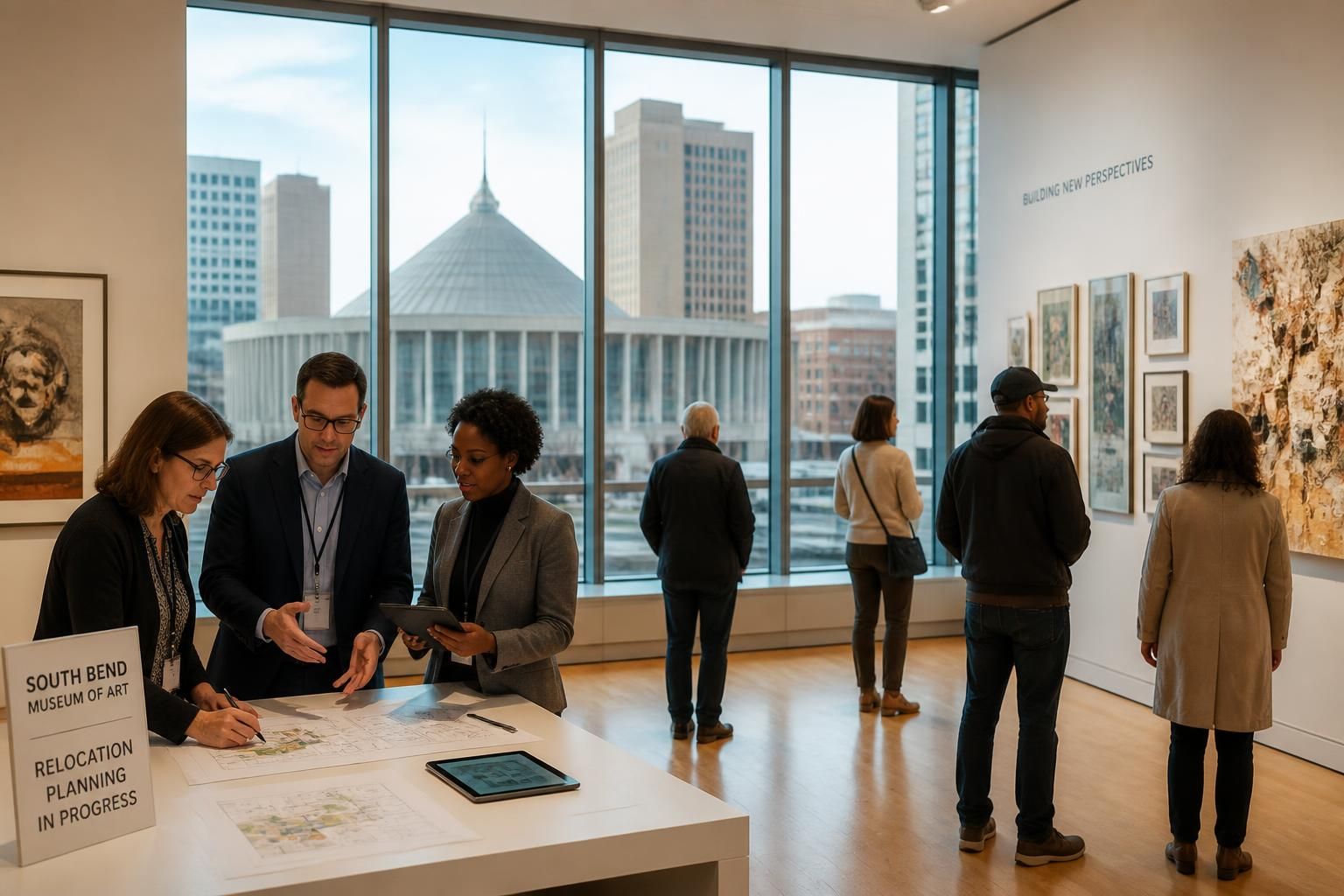
Century Center’s Future Makes the Museum Relocation a Wider Downtown Issue
The future of the South Bend Museum of Art cannot be separated from the future of Century Center. The convention facility has served South Bend for decades, but city leaders are considering what its next version should be. That may involve major renovation, redevelopment, changed spatial needs, or decisions about which functions should remain in the current footprint.
For a convention center, physical flexibility is central. Event organizers expect adaptable meeting rooms, reliable technology, accessible circulation, and spaces that can support conferences, performances, community gatherings, and tourism activity. If the city believes major changes are needed, the museum area may no longer fit the preferred long-term plan for the complex.
That does not reduce the value of the museum. It creates a planning question: can a separate site give the institution a stronger public presence while freeing Century Center to respond to its own operational requirements? Museum leadership has indicated that it has already spent years considering what its next home and role might look like. That preparation is valuable because it shifts the conversation from emergency reaction to deliberate design.
Balancing venue redevelopment with cultural continuity
South Bend’s downtown development strategy must account for visitors who arrive for different reasons. A business traveler attending a convention may discover an exhibition during a break. A family visiting a festival may extend its stay when a museum offers a compelling program. A local resident may choose downtown for a weekend because cultural activity makes the district feel active beyond standard retail hours.
These interactions are difficult to measure through ticket sales alone. They contribute to dwell time, restaurant visits, repeat trips, and civic identity. For this reason, an art museum should be treated as visitor infrastructure, not as an isolated tenant. The best cultural planning connects exhibition programming with walkability, hospitality, public transit, schools, and neighborhood participation.
One useful comparison is the evolving debate around other museum projects in the Midwest and beyond. The discussion around major museum development and cultural destination planning shows why architecture, location, collections, and visitor experience must be planned together. A building can be visually impressive, but it still needs intuitive access, operational resilience, and reasons for local people to return.
For South Bend, relocation planning can examine several models. The museum could become an anchor within a mixed-use district, occupy a renovated historic building, join a cultural campus, or operate from a purpose-built facility. Each option produces different costs and benefits. A central property could increase spontaneous visits, while a larger site might improve storage, classrooms, and exhibition flexibility.
| Planning area | What decision-makers should assess | Potential public benefit |
|---|---|---|
| 🏙️ Location | Walkability, parking, transit, nearby attractions | Higher visitor convenience and downtown spending |
| 🎨 Gallery capacity | Exhibition scale, collection storage, loading access | More ambitious displays and safer collections care |
| ♿ Accessibility | Step-free routes, clear signage, sensory-friendly design | Broader participation across age and ability |
| 📱 Digital services | Wi-Fi, audio tours, mobile content, multilingual tools | More independent and inclusive visits |
| 💰 Sustainability | Energy use, maintenance, funding commitments | More stable long-term operations |
🏛️ A rebuilt Century Center and a relocated museum do not have to be competing outcomes. With coordinated planning, each can serve a clearer purpose and strengthen the overall appeal of downtown South Bend.
Community Decision-Making Must Protect the Art Museum’s Public Role
A museum’s value is often most visible through its exhibitions, but its public role extends much further. It provides learning opportunities for schools, supports regional artists, offers gathering spaces, preserves local creative history, and introduces visitors to stories that may otherwise remain unseen. When an established cultural institution faces relocation, protecting these services should be as important as choosing the next building.
The upcoming election language surrounding the vote reflects the intensity of public interest, even though the board’s resolution is not a citywide electoral contest. Residents understandably want assurance that the museum will remain accessible and active. Questions about the process are practical: Will exhibitions continue during the transition? Will members retain benefits? Will school partnerships continue? Will a future site be reachable without a car?
These questions should be answered through published milestones, open meetings, and regular updates. A relocation dashboard, for example, could show the planning stages: site evaluation, funding strategy, design, collection preparation, community consultation, and opening timeline. This does not require revealing confidential property negotiations. It simply gives the public an understandable view of progress.
How consultation can produce stronger cultural outcomes
Community participation is most useful when it moves beyond a single listening session. The museum and local government can seek input from educators, disability advocates, neighborhood groups, hospitality businesses, artists, students, and tourism organizations. Each group experiences the museum differently, and each can identify barriers that may not be obvious from attendance data.
Consider a hypothetical visitor called Maya, a teacher who brings students to downtown South Bend twice a year. Her priorities may include reliable bus access, safe group drop-off areas, clear lunch arrangements, affordable entry, and gallery interpretation that matches classroom curriculum. A local artist may prioritize flexible exhibition opportunities and professional networking. A visitor attending a convention may value extended evening hours and quick, self-guided experiences.
Designing for all three users does not mean creating a confusing facility. It means establishing clear service standards. The new museum could provide timed group arrivals, an accessible entry route, concise visitor maps, a quiet room, and mobile interpretation for people who prefer to explore independently. These choices make a visit easier without diminishing curatorial quality.
Public confidence also depends on language. It is better to state that the museum is entering a planned transition than to leave residents with vague phrases about “change.” The museum’s confidence in having time to find a new home is meaningful because time enables consultation, fundraising, and responsible collection management.
Museum leaders should also explain which decisions are fixed and which remain open. If the lease ends after three years, that is a defined condition. The site, visitor services, operational model, partnerships, and interpretive approach may still be open for discussion. Separating facts from possibilities helps the community participate constructively.
🤝 The strongest relocation plan is not one announced fully formed; it is one that turns public concerns into design requirements and operational priorities.
Museum Funding and Local Government Support Will Shape What Happens After the Vote
A relocation decision creates immediate financial questions. The South Bend Museum of Art will need resources for planning, architectural services, moving collections, temporary storage if needed, technology, construction or renovation, reopening communications, and program continuity. The city may also face significant costs connected with Century Center’s future. Responsible planning must recognize that these are separate but interconnected funding challenges.
Museum funding generally works best when it combines several sources rather than relying on one. Local government support can help protect public access and validate the museum’s civic role. Private philanthropy can fund capital projects, endowments, exhibitions, and education programs. Corporate sponsorships may support visible visitor services, while grants can assist accessibility, preservation, and technology upgrades.
The key is to define what each source supports. Donors are more likely to respond when they understand whether a gift funds a gallery, conservation equipment, school transport, a digital guide, or free-admission days. Likewise, public funds should be linked to measurable community outcomes such as educational participation, visitor volume, local employment, and equitable access.
Building a funding plan that residents can understand
A clear capital strategy can be organized around phased decisions. The first phase should establish site criteria and a cost range. The second can secure commitments for design and due diligence. The third can focus on construction or adaptation, collection transition, staffing, and opening programs. This sequence avoids announcing ambitious features before basic infrastructure is financially secure.
- 📍 Set the site criteria: identify required gallery space, collection storage, loading capacity, accessibility, and transportation needs.
- 📊 Publish cost categories: distinguish acquisition, renovation, equipment, moving, contingency, and operating costs.
- 🏫 Protect continuity: reserve funding for school programs, exhibitions, staff retention, and public communication during the transition.
- 🎧 Include visitor technology early: plan audio content, connectivity, digital wayfinding, and multilingual access before final construction choices.
- 🧾 Report outcomes regularly: show how public and private investments translate into access, learning, and visitor use.
Technology should not be treated as an optional final layer. A new venue can avoid expensive retrofits by integrating reliable Wi-Fi, charging points, acoustic planning, hearing support, and flexible content systems from the beginning. Smartphone-based audio tours are especially useful because they can deliver expert interpretation without requiring a large fleet of dedicated hardware.
For example, a family entering a gallery may scan a QR code and select a short route designed for children. A visitor with limited time may choose a 20-minute highlights tour. A returning member may access deeper commentary about a temporary exhibition. These options help the museum serve different audiences using the same collection.
Relevant examples from the sector show why financial planning and engagement tools must work together. The story of grant-backed museum development in Memphis illustrates how targeted support can build institutional capacity when funding objectives are clearly connected to public benefit.
💰 A credible funding strategy does not promise a perfect building overnight. It demonstrates how every investment protects collections, supports staff, and improves the experience for the people the museum exists to serve.
Digital Visitor Experience Can Make the South Bend Museum of Art More Accessible in Its Next Home
A new location offers the South Bend Museum of Art the opportunity to modernize how visitors discover and understand its collection. Digital tools should not distract from art. Their purpose is to remove friction: help visitors find the museum, choose a route, hear interpretation clearly, access content in their preferred language, and engage at a comfortable pace.
Audio is particularly important. In a traditional guided visit, one educator or guide speaks to a group while visitors compete with room noise, distance, and uneven acoustics. A mobile audio system allows each participant to listen through their own smartphone and headphones. The experience can remain social while ensuring that every visitor hears the same content clearly.
Practical smart-tourism tools for a relocated museum
Before opening a new venue, the museum can map the complete visitor journey. This begins before arrival: a mobile-friendly page can explain transport options, parking, opening hours, accessibility features, and available tours. At the entrance, simple signs and QR codes can direct people to audio content without forcing account creation or complicated downloads.
Inside the galleries, content should be short, accurate, and optional. A 60- to 90-second audio stop can explain the context of a painting without overwhelming the visitor. Longer segments can be offered for those seeking more depth. The same platform can support educator-led groups, self-guided tourists, and temporary exhibition trails.
Accessibility requires more than adding a transcript at the end of the process. The museum should plan captioned video, readable text sizes, high-contrast interfaces, audio descriptions for visually impaired visitors, and quiet alternatives for people who may find busy galleries difficult. A good digital guide offers choice rather than imposing one route or one learning style.
Data can also improve operations when used ethically. Anonymous information about which stops are most played, which language options are selected, and where visitors leave a route can help staff refine signage and content. It should never replace human observation or turn a cultural visit into a surveillance exercise. The goal is better service, not intrusive tracking.
The future site could also use audio interpretation beyond the galleries. A walking route might connect the museum with public art, historic downtown locations, restaurants, and partner institutions. This approach supports smart tourism by turning the museum into a starting point for a broader South Bend experience. It can encourage visitors to stay longer and explore more of the city on foot.
Researching how other institutions sustain relevance can support this work. The discussion of public support for Detroit museums demonstrates the importance of linking cultural access to visible public value. Visitors and taxpayers respond more positively when institutions show how programs improve education, inclusion, and the visitor economy.
For South Bend, the immediate action is straightforward: include a digital accessibility and audio-tour specification in every potential-site brief. This ensures that the next home is designed for clear interpretation from day one, not retrofitted after opening.
🎧 A museum move becomes more valuable when the new address delivers not only more space, but also a clearer, more inclusive way for every visitor to experience art.
What is the South Bend Museum of Art vote about?
The Civic Center Board of Managers is considering a resolution that would formalize the end of the museum’s Century Center lease and begin a three-year relocation timeline.
Will the museum close immediately if the resolution passes?
No. The proposed arrangement provides three years for planning and moving, giving the museum time to identify a new home and maintain public programs during the transition.
Why is Century Center part of the decision?
The museum occupies space within Century Center, and the city is evaluating the convention facility’s longer-term redevelopment, renovation, and operational needs.
How can a new museum location improve visitor access?
A future site can be selected around walkability, transit, accessible design, galleries, education areas, and smartphone-based audio interpretation for self-guided visits.
