
George Lucas Museum Opening: A New Cultural Landmark in Exposition Park
Short on time? Here is what matters:
- 📅 The Lucas Museum of Narrative Art is scheduled to open on September 22, 2026.
- 🎨 The Museum will present more than 1,200 objects from a founding collection exceeding 40,000 works.
- 🎟️ Entry is timed, so visitors and group organisers should plan arrival, transport, and ticketing well ahead.
- 📱 A clear mobile-audio strategy can make a large, visually rich Museum easier to explore without creating crowding.
The George Lucas Museum of Narrative Art is preparing to become one of Los Angeles’ most visible new cultural destinations. Located in Exposition Park, near major institutions and sports venues, the Museum brings a broad definition of visual Storytelling into one purpose-built public space. Its opening is not simply a milestone for George Lucas and Mellody Hobson, who co-founded the institution. It is also a significant moment for museums seeking to connect traditional collections with Film, illustration, photography, comics, digital imagery, and popular Culture.
The official opening date is September 22, 2026. This date follows a long development process that included construction delays and a highly anticipated public launch. Visitors can review the institution’s published details through the Lucas Museum opening announcement, which confirms the date and outlines the Museum’s narrative-led mission.
What makes this project distinctive is its scale. The building offers around 300,000 square feet and sits within an 11-acre campus. Rather than operating as a narrow tribute to the creator of Star Wars and Indiana Jones, it presents visual works that explain, document, dramatise, or question human experience. The collection moves from ancient depictions of gods and myths to contemporary graphic stories and cinematic material. This approach places blockbuster Cinema beside other forms of Art that have shaped public imagination for centuries.
For tourism professionals, the site matters because it combines landmark architecture, a high-profile founder, a family-friendly subject, and an accessible location. These factors can create very high demand in the first months. Opening-day tickets reportedly sold out quickly, while later dates retained more availability. Timed admission is therefore not a minor operational detail: it is central to the visitor journey. A group that arrives late may lose part of a tightly planned cultural itinerary, particularly if it is also visiting nearby Exposition Park attractions.
The Museum’s location also supports a wider day out rather than an isolated visit. A tour operator could pair the experience with a walking route around Exposition Park, a discussion of Los Angeles as a Film-production capital, or a session on public architecture and landscape design. For families, the subject offers an unusually broad entry point. A child may engage with comics, a teenager with manga or science fiction, and an adult with documentary photography or American illustration. The strongest programmes will not assume that every visitor is interested in the same references.
Imagine a guide leading a mixed group of 18 visitors: two film students, a family with young children, several international travellers, and local residents. A one-size-fits-all lecture would quickly lose part of the group. A better experience uses a shared theme—such as heroism, home, conflict, or adventure—then links it to works that each visitor can recognise. This is where an audio guide delivered through a smartphone can support the human guide rather than replace one. It gives each participant a reliable listening channel while allowing the guide to shape the pace and interpret the objects in context.
The key operational insight is simple: the Lucas Museum opening will reward organisations that treat ticketing, arrival, audio, and audience segmentation as one connected visitor experience.
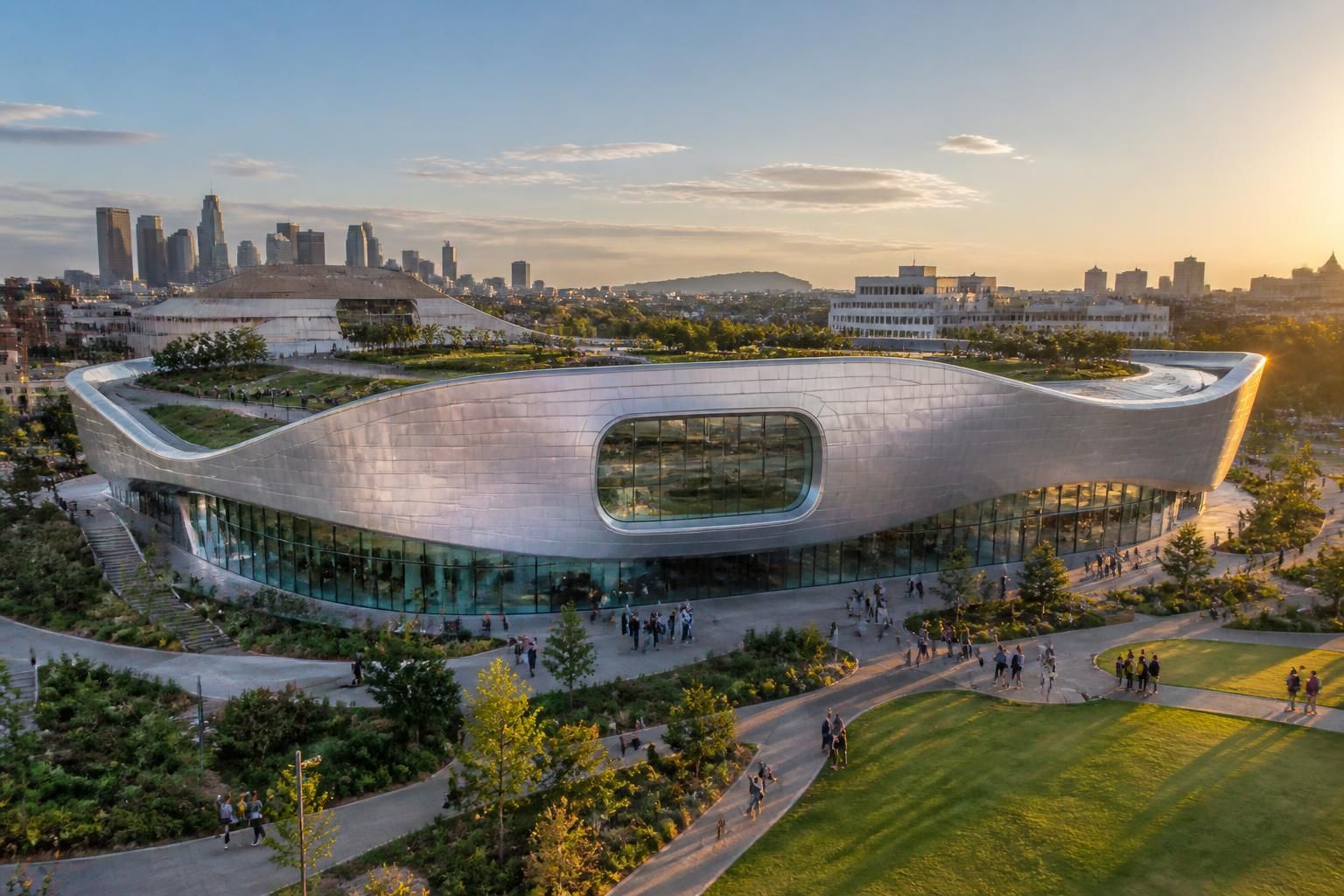
Lucas Museum Architecture and Visitor Flow Around Ma Yansong’s Futuristic Design
The physical design of the Lucas Museum is likely to be one of the first stories visitors encounter. Designed by Ma Yansong of MAD Architects, with Stantec involved in the project, the building has been widely compared to a spacecraft, a cloud, and a sculptural canopy. These comparisons are understandable, but they should not distract from its practical purpose. The architecture is designed to create a public cultural environment, not merely a photogenic object for social media.
The structure rises above the landscape with curved, metallic surfaces and a large central opening. Beneath and around it, the Museum connects to gardens, pathways, and gathering areas. Landscape architect Mia Lehrer and Studio-MLA designed the campus as a layered public park. This relationship between building and open space is important for visitor management. Large attractions often generate queues, meeting points, school-group arrivals, café demand, and moments of rest that galleries alone cannot absorb. Outdoor areas provide essential breathing room before and after the Exhibition experience.
The rooftop garden covers approximately 1.5 acres and is expected to include the Skywalker Grill restaurant. For visitors, this creates a destination within the destination. For organisers, it creates an itinerary decision: should the meal happen before entry, after the galleries, or as a separate booked stop? The right answer depends on group size, ticket time, dietary needs, and the amount of walking planned for the day. A school group, for instance, may need a clear lunch window before entering the galleries. An adult cultural group may prefer to finish with the rooftop view and a discussion of the collection.
The visual identity of the building is also an excellent example of how architecture can support Narrative Art. The exterior signals imagination, motion, and speculative futures before visitors have viewed a single work. Yet the Museum’s content reaches much further than science fiction. The building can be used as a starting point for discussing how architecture itself tells stories: who commissions a building, what materials it uses, how it frames a city, and how its pathways influence behaviour.
| Visitor touchpoint | Practical planning need | Useful action |
|---|---|---|
| 🚶 Arrival at Exposition Park | Groups may arrive from different transport modes. | Set a precise outdoor meeting point and a 15-minute buffer. |
| 🎟️ Timed Museum entry | Late arrival can disrupt the visit. | Distribute tickets before travel and confirm the group leader’s booking. |
| 🌳 Campus and rooftop garden | Visitors need breaks without blocking circulation. | Schedule a short pause before the final gallery section. |
| 🎧 Gallery interpretation | Ambient noise and large groups can reduce attention. | Use individual smartphone audio with a guide-led route. |
Visitor flow should be considered early, especially by guides and cultural event organisers. A large building with more than 30 galleries can feel liberating for independent visitors but confusing for groups with limited time. The goal is not to cover everything. It is to make deliberate choices. A 90-minute route might focus on illustration, photography, and comics; a second route could centre on myth, Film, and science fiction. Both can be meaningful if the transitions are clear.
Digital orientation can reduce friction without forcing visitors to stare at screens. A short welcome audio before entry can explain the meeting point, basic route, accessibility notes, and the day’s main theme. During the visit, geolocated or numbered audio stops can offer concise interpretation at key artworks. The result is a more fluid experience: the guide speaks to the group when shared discussion matters, while guests use their own devices for close-looking moments or optional content.
Architecture is therefore not just an impressive backdrop. It is part of the route, the timing, and the emotional rhythm of the Museum visit.
Narrative Art Exhibition Highlights Beyond Star Wars and Hollywood Cinema
The name George Lucas naturally brings Star Wars, Indiana Jones, visual effects, and modern Cinema to mind. The Lucas Museum, however, has a broader purpose. It is not being positioned as a franchise museum. Its central subject is Narrative Art: works that use images to communicate stories, values, memories, conflicts, or imagined worlds. This framework lets a prehistoric drawing, a Renaissance painting, a comic page, and a photograph share the same institutional conversation.
The Museum defines narrative imagery through a long cultural history. Stories have been carried through cave paintings, religious scenes, murals, hieroglyphics, manuscripts, prints, sculpture, newspaper illustrations, Film, and digital media. The medium changes, but the underlying question remains familiar: how do images help people understand what happened, what might happen, and what matters? This makes the Museum’s programme relevant not only to art historians, but also to educators, guides, families, and media-literate audiences.
The inaugural displays are expected to use more than 1,200 objects across roughly 100,000 square feet of gallery space. Rather than presenting one linear account of art history, many galleries will be organised around themes. Visitors may encounter visual accounts of childhood, family, love, work, school, play, community, sport, motherhood, civic life, and historical events. This thematic method is practical because it allows guests to connect personal experiences with works from different eras and places.
One visitor may stop at Dorothea Lange’s Migrant Mother, the 1936 photograph that has become an enduring image of hardship during the Great Depression. Another may be drawn to E. H. Shepard’s illustrations of Christopher Robin, which use delicate line and colour to turn children’s literature into a visual world. N. C. Wyeth’s dramatic book illustration for Robinson Crusoe demonstrates how adventure can be conveyed through composition, gesture, and atmosphere before a reader reaches the next page.
The Museum is also expected to feature works by Thomas Hart Benton, Maxfield Parrish, Norman Rockwell, Beatrix Potter, Jacob Lawrence, Leo Politi, and other artists whose work has entered public memory through books, magazines, prints, and classrooms. Treating illustration seriously is one of the institution’s most important choices. Illustration has often been treated as secondary to “fine art,” even though it has shaped how generations imagined heroes, families, landscapes, and national identity.
Its comics and graphic stories holdings expand that argument. Visitors will encounter American and European creators including Mœbius, Marie Severin, Jack Kirby, Alison Bechdel, Jim Lee, Frank Miller, R. Crumb, and Rafael Navarro, as well as manga and anime. This inclusion recognises that sequential Art has developed sophisticated visual languages for pacing, point of view, dialogue, silence, and time. A comic panel can ask viewers to infer movement between images; a Film edit does something related through sound and motion.
For a guided route, an effective method is to compare forms instead of separating them. A guide could ask visitors to consider how a mural by Diego Rivera, a documentary photograph by Gordon Parks, and a comic sequence by Jack Kirby each direct attention. Which image makes the viewer pause? Which uses scale? Which relies on facial expression? These questions turn the Museum into an active exercise in visual literacy rather than a passive collection of famous names.
The reported September 2026 opening plans also underline how unusual the project is within Los Angeles. It gives popular visual media a permanent institutional home while placing them in dialogue with older artistic traditions. The strongest visit is not about identifying every reference; it is about noticing how images build meaning across time.
Planning Tickets, Group Visits, and Accessible Audio at the Lucas Museum
Visitor demand around a major Museum opening can create unnecessary stress when planning begins too late. The Lucas Museum uses timed admission, which is a sensible approach for managing gallery capacity but requires clear communication. Adult tickets are listed at $25, while visitors aged 65 and over pay $21. Children, members, and active-duty military personnel are admitted free, subject to the Museum’s booking conditions. Each purchase is limited to nine tickets, a detail that matters for families, schools, agencies, and groups travelling together.
For small parties, the booking process is straightforward: select a date, choose a time, save the tickets, and arrive with sufficient time for security and orientation. For larger groups, the process should be more structured. A cultural association planning a visit for 27 people, for example, should not rely on three separate buyers purchasing tickets without coordination. It needs a named organiser, a shared guest list, a backup contact, a transport plan, and an agreed meeting point outside the venue.
Opening-day enthusiasm is understandable, but it is not always the best choice for a relaxed cultural programme. The first days of a new attraction can involve media attention, high attendance, longer navigation times, and visitors who want to photograph the architecture extensively. Later dates may offer more flexibility. A weekday morning can be particularly suitable for education groups, senior visitors, or international tour groups working with tight Los Angeles schedules.
Accessibility should be considered at the same planning stage as tickets. Large galleries can be tiring, and visually dense exhibitions can overwhelm visitors if interpretation is delivered only through long spoken commentary. Good accessibility does not mean reducing the intellectual level of a tour. It means giving visitors multiple ways to engage: spoken explanation, readable text, images, pauses, rest points, and optional deeper content.
Smartphone audio is especially useful when used with restraint. A platform such as Grupem can help a guide transmit live commentary directly to participants’ own phones, reducing the need for traditional receiver equipment and helping visitors hear clearly in busy public spaces. The technology works best when the route has been prepared in advance. A guide should identify the essential stops, estimate walking time, test mobile connectivity, and write short backup notes in case the group needs to adjust its pace.
Practical audio workflow for a guided Museum visit
- 📲 Send participants a simple joining instruction before departure, not at the Museum entrance.
- 🎧 Ask visitors to bring charged phones and wired or wireless earphones where appropriate.
- 🗺️ Build a route around six to ten meaningful stops rather than attempting every gallery.
- 🧑🤝🧑 Separate essential live commentary from optional audio extras for visitors who want more depth.
- ⏱️ Leave time for independent looking, photographs, restrooms, and the exit route.
This model respects the fact that Art viewing requires space. Visitors do not need a voice speaking continuously in their ear. They need concise context before looking, silence while observing, and a clear next step when the group moves on. A guide can discuss a photograph’s historical setting, then allow 45 seconds of quiet looking before asking one focused question. That small pause often produces more engagement than an additional five minutes of facts.
Family groups can apply the same principle. The Museum’s wide range of imagery makes it suitable for intergenerational visits, but children benefit from a route built around choice and participation. A parent can ask a child to find an image of adventure, identify a character’s emotion, or compare a comic panel with a Film poster. Resources on planning a family-friendly museum visit offer useful ideas that can be adapted to a narrative-focused setting.
A successful Lucas Museum visit starts before the first gallery: ticket timing, audio preparation, and a realistic route protect the quality of the cultural experience.
How the Lucas Museum Can Connect Film, Public Art, and Los Angeles Culture
Los Angeles is globally associated with Film, but its cultural identity cannot be reduced to Hollywood. The city is also shaped by photography, murals, comic publishing, design, animation, migration, music, and public space. The Lucas Museum can create meaningful connections between these fields because its collection is built around how stories travel through images. Its opening therefore offers a practical opportunity for guides, museums, schools, and destination managers to design richer cultural routes across the city.
Consider the Museum’s planned focus on murals and public narrative. Works linked to artists such as Judith F. Baca, Diego Rivera, and JR can introduce discussions about whose stories become visible in shared urban environments. Unlike a small drawing viewed in a gallery, a mural operates in public space. It can be encountered on a commute, become part of neighbourhood identity, or provoke civic debate. This makes mural Art especially valuable for visitors who want to understand Los Angeles beyond studio tours and celebrity landmarks.
The planned Civic Life galleries add another layer. Visual representations of courthouses, polling places, political headquarters, and public institutions can help visitors explore how democracy, authority, and social change are pictured. These works may not provide one objective account of history. Instead, they reveal how artists frame events and emotions. A photograph may convey urgency through one face in a crowd; an illustration may simplify a conflict for a mass audience; a painting may turn a historical episode into a national myth.
The Western Stories gallery is equally relevant in California. Images of frontier towns, wagon trains, shoot-outs, and open landscapes have helped construct powerful myths of the American West. Yet visual culture also gives guides a way to question these myths. Who appears in the image? Who is absent? What does the landscape suggest about ownership, expansion, or conflict? These questions are useful because they move the visitor from recognition to interpretation.
For Film-focused audiences, material from the Lucas Archives—including props, costumes, posters, and documentary content—will provide an obvious attraction. But this material can be framed within the Museum’s larger purpose. A costume is not only a piece of memorabilia. It communicates character, status, mood, historical inspiration, and genre. A poster is not merely advertising: it is a compressed promise of a story. Visitors can compare how a Film poster uses colour and scale with how a comic cover or book illustration captures attention.
Schools and tourism boards can use this approach to create programmes that support media literacy. A teenager who sees visual stories every day on video platforms, games, and social networks may not immediately see the connection to an early twentieth-century illustration. A guided comparison makes it visible. Both may use framing, contrast, fantasy, and familiar archetypes. Both ask audiences to read images quickly, emotionally, and often collectively.
The Museum’s proximity to other Exposition Park destinations supports combined programming, but organisers should avoid packing too much into one day. A better model is a focused itinerary: a morning Museum visit, a lunch break, and one nearby activity that extends the theme. For example, an architecture group could examine the building and landscape in detail. A media-studies group could focus on comics, animation, and Cinema. A community group could connect murals, documentary photography, and civic storytelling.
The Lucas Museum’s lasting value will come from this connective power: it can help visitors see that popular images, historic artworks, and contemporary media all participate in the cultural work of telling stories.
When does the George Lucas Museum of Narrative Art open?
The Lucas Museum of Narrative Art is scheduled to open to the public on September 22, 2026, in Exposition Park, Los Angeles.
Is the Lucas Museum only about Star Wars?
No. Although George Lucas co-founded the Museum, its focus is Narrative Art across painting, illustration, comics, photography, murals, film, digital media, and popular visual culture.
How much are Lucas Museum tickets?
Timed tickets are listed at $25 for adults and $21 for visitors aged 65 and over. Children, members, and active-duty military personnel are free, subject to the Museum’s current booking policies.
What can visitors expect to see in the opening exhibitions?
The inaugural programme is expected to include more than 1,200 objects, with works ranging from historic sculpture and Renaissance painting to comics, book illustration, documentary photography, murals, and Lucas Archives material.
How can groups improve their Museum visit?
Book timed entry early, create a focused route, allow time for breaks, and use a clear audio solution so every participant can hear the guide without crowding around a speaker.
