
Letters to the Editor: Readers Question How the Lucas Museum Explains Its Art
One reader’s first impression of the Lucas Museum of Narrative Art begins with an apparent contradiction. The museum presents illustration as art worthy of sustained attention, yet, in this reader’s view, it gives visitors too little information to understand why particular works matter. That distinction is important: displaying an object invites visitors to look; interpreting it helps them ask better questions.
In a letter responding to coverage of the museum, Dave Bryant of Woodland Hills compares George Lucas’s approach with Marcel Duchamp’s challenge to conventional definitions of art. Duchamp’s readymades asked audiences to reconsider whether an ordinary object could become art through an artist’s choice and its placement in a gallery. Bryant sees a similar provocation in a museum devoted to narrative images traditionally associated with publishing, comics and popular entertainment. The difference, he argues, is that the Lucas Museum does not do enough to explain its proposition once visitors are inside.
That argument does not require every gallery label to deliver a lecture on art history. It calls for enough context to make an unfamiliar work legible. A visitor encountering underground comix, for example, may not know what distinguished that publishing scene from mainstream comics, how its creators circulated their work or why its visual language remains influential. Likewise, a gallery containing works by several members of the Wyeth family could leave a newcomer wondering whether those artists shared a style, a subject or simply a surname.
Consider a guide accompanying a group with mixed interests. One guest recognizes an illustrator immediately; another has never heard the artist’s name. A short account of the work’s original audience, production method and cultural setting gives both guests a starting point. Without it, the knowledgeable visitor supplies a private explanation while the newcomer moves on. The collection may be equally visible to both, but the opportunity to engage with it is not equally accessible.
This is where Bryant’s criticism becomes useful feedback for museum professionals rather than simply a negative review. Interpretation can take several forms: concise labels, guided conversations, accessible audio, printed routes or optional digital material. None needs to dictate what a visitor should think. Good interpretation identifies what can be observed, supplies relevant background and leaves room for disagreement. The goal is not to settle whether illustration is fine art, but to help visitors examine the claim.
Audio can be especially effective when a work needs a little more explanation than a wall label can comfortably hold. A guide might offer a brief recording about an illustrator’s commission, followed by an optional account of the social setting in which the image appeared. A smartphone-based tool such as Grupem can support that layered approach without requiring every visitor to carry dedicated hardware. Clear navigation and captions or written equivalents still matter; a digital option should expand access, not replace the essentials on site.
Letters to the editor often expose a gap between an institution’s stated purpose and a visitor’s actual experience. Bryant’s perspective does not establish that every gallery lacks explanation, nor does it invalidate the collection. It identifies a question worth testing on the floor: Can someone unfamiliar with these artists explain what they have seen and why it was brought together? The answer depends as much on mediation as on the artworks themselves.
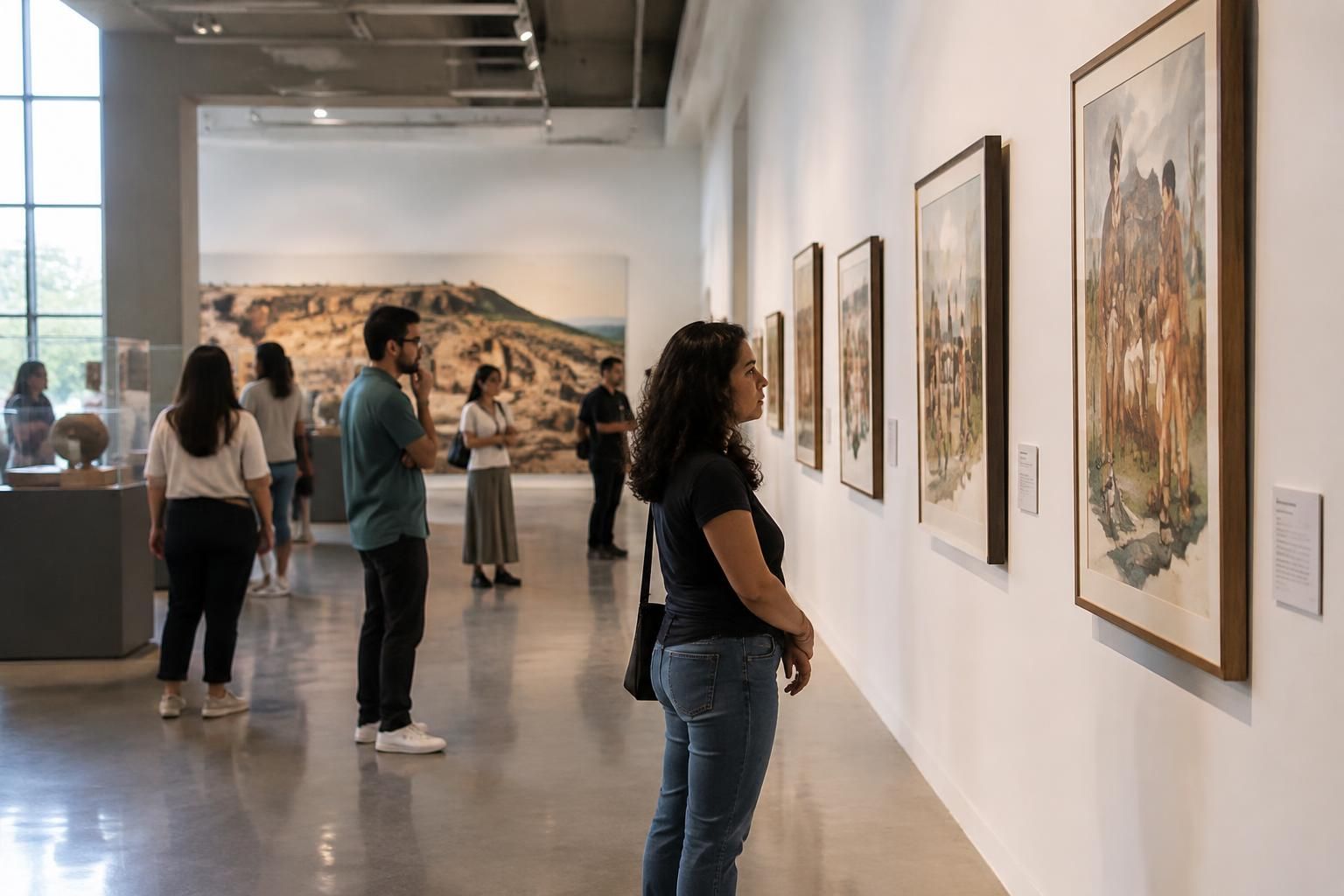
Readers’ First Impressions Highlight the Appeal of a Museum Built Around Stories
A very different letter treats the building and the visit as parts of the same story. Bill Spitalnick of Newport Beach describes a futuristic exterior that sets expectations before anyone reaches the galleries. Inside, works from different periods and film-related materials offer a change of pace: visitors move from the striking architecture into images and objects with their own histories. His enthusiastic response shows why first impressions cannot be reduced to a judgment about labels.
For many people, a museum visit begins well before the first artwork. The approach through a public space, the shape of an entrance and the ease of finding a route all influence what follows. A memorable building can create anticipation; it can also raise expectations that the displays must meet. Spitalnick’s account suggests that, for him, the Lucas Museum’s architecture strengthens rather than distracts from the experience.
He also points to the breadth of what visitors may encounter. His letter describes galleries, film archives, costumes, artwork and artifacts associated with Lucas’s filmmaking, alongside theaters, dining and retail facilities. Those details convey the scale of a possible day out, but they serve different visitor needs. Someone interested in illustration may plan a focused gallery route. A family with limited time may choose a screening and a smaller selection of displays. A film enthusiast may look for production materials first.
Such diversity of expectations presents an operational question for any large cultural venue: how can visitors understand their choices without feeling obliged to see everything? A practical answer starts with routes based on available time and interests. A clearly marked 45-minute path, for instance, could introduce several kinds of narrative art without suggesting that everything else is secondary. A longer route might connect illustrations with film objects through a shared theme, such as character design or the depiction of movement.
Hospitality spaces contribute to that planning. A café can provide a pause that makes a lengthy visit manageable, while a restaurant may become part of the destination for visitors who want to stay longer. Neither compensates for confusing galleries or unclear access information. Professionals assessing the complete visitor journey should consider seating, wayfinding, reservation details and the distance between amenities, as well as the artworks. Coverage of the Lucas Museum restaurant and visitor experience offers a useful reminder that dining plans work best when they fit the visit rather than interrupt it.
Spitalnick’s excitement is also a reminder that popular culture can be an effective point of entry into art. A familiar film object may draw someone through the door; an unfamiliar painting nearby may prompt the more lasting question. That connection requires careful presentation, not an assumption that recognition alone produces understanding. When staff or interpretive tools make the relationship visible, a visitor can move from a cherished screen memory to a closer examination of color, composition or storytelling technique.
A vivid exterior and a varied collection may give readers reason to make the trip. The stronger experience comes when the route through that variety is as thoughtfully designed as the building itself.
Visitor accounts are most useful when enthusiasm and criticism can be considered together, rather than treated as competing verdicts.
Letters to the Editor Show Why Positive Feedback Can Still Identify a Gap
Mitch Perliss of Sherman Oaks offers a third kind of response. He and his wife, whom he describes as founding members, enjoyed an early visit, and he recalls hearing similarly positive reactions from other people in the galleries. Yet one omission stood out: he did not find cars or even images from American Graffiti. His letter illustrates how a visitor can leave satisfied while still identifying a specific expectation that was not met.
That distinction matters for institutions collecting feedback. A question such as “Did you enjoy the visit?” may record a positive result while missing what people expected to see. A more revealing prompt asks what visitors looked for, whether they found it and how easily they understood its absence. Perliss’s comment does not mean that the museum must exhibit every film associated with Lucas. It does indicate that some audiences connect his career with more than the franchise most prominently associated with his name.
American Graffiti occupies a particular place in that career. Its account of young people and car culture made it a notable part of Lucas’s filmmaking history before Star Wars became a global phenomenon. For a visitor who knows that trajectory, the film may seem a natural point in a museum devoted to stories and their images. For someone encountering Lucas primarily through later work, its absence may not register at all. The discrepancy is precisely why a varied sample of visitor opinions is valuable.
There are practical ways to respond without promising an object the collection cannot display. A museum could publish a searchable guide to films represented in its galleries and archives. If a familiar title is not on view, the guide could say so plainly and direct visitors toward related material, such as a display about production design, youth culture or the development of Lucas’s visual storytelling. An audio guide could answer a commonly asked question in less than a minute. Clear expectations prevent a missing favorite from becoming an avoidable disappointment.
The same principle applies beyond film museums. A family visiting a music collection may expect to hear recordings that copyright or conservation constraints keep off the public floor. Visitors at a local history exhibition may look for a neighborhood that falls outside the current display’s scope. In each case, the institution can acknowledge the interest, explain the curatorial choice and offer a relevant next step. Silence is rarely the most helpful form of interpretation.
To make use of this kind of community feedback, staff need not create an elaborate survey program. A brief question at the exit, a review of recurring inquiries at the information desk and a shared log for guides can reveal patterns. One isolated request may reflect an individual preference; repeated questions about the same missing topic may reveal a communication problem. The useful measure is not whether a comment is complimentary or critical, but whether it describes an experience the institution can investigate.
Perliss’s account resists a simple positive-versus-negative label. Enjoyment and disappointment coexist in a single visit. For cultural venues, that combination often provides more actionable insight than an overall rating.
Diverse Reader Opinions Offer a Practical Test for Museum Interpretation
Placed together, the three letters describe different ways people judge a museum. Bryant asks whether the displays explain their artistic argument. Spitalnick responds to the architecture, range of material and pleasure of spending time there. Perliss assesses the visit against a specific piece of film history he hoped to encounter. None of these perspectives cancels the others. Each looks at a different part of the visitor journey.
That diversity makes letters to the editor particularly useful when they are read as accounts of experience rather than votes for or against an institution. A gallery team could turn the responses into testable questions. Do unfamiliar terms receive enough explanation? Can visitors choose a route suited to their time? Do published materials describe what is on view accurately? Those questions are narrower than “Is the museum good?” and much easier to act upon.
The table below translates the readers’ first impressions into possible checks. It does not claim that any suggested change has been adopted by the museum; it shows how cultural organizations can move from public discussion to observation.
| Reader perspective | What to check on site | Practical response |
|---|---|---|
| 🔎 More context needed | Can a newcomer explain key terms and connections? | Test short labels and optional deeper interpretation. |
| 🏛️ A rewarding full-day visit | Can guests find routes, breaks and facilities easily? | Offer time-based plans and clear wayfinding. |
| 🎬 A missing expected film | Do visitors know which subjects are represented? | Publish an accurate, searchable “on view” guide. |
A useful evaluation would involve people with different levels of familiarity. Ask a first-time visitor, a film fan and an art specialist to take the same short route, then invite each to describe what was clear and where they stopped to seek help. Their answers will differ, and that is the point. If all three struggle to find a gallery, the issue is likely wayfinding. If only newcomers cannot follow a label, the language may assume specialist knowledge.
Digital interpretation can help address these differences when it remains optional and straightforward. One visitor may want a 30-second explanation; another may want a longer account of an artist’s technique. A mobile audio route can provide both without crowding a wall with text. Before deploying one, a venue should test sound clarity in busy spaces, ensure visitors can locate the correct stop and provide an accessible alternative for people who prefer not to listen. The lesson from immersive exhibition design is practical: technology should make a story easier to follow, not become another puzzle to solve.
Editors also have a role in keeping the discussion useful. Publishing sharply different reactions, as the Lucas Museum reader letters demonstrate, allows audiences to see what a single review might miss. Each account remains subjective, so readers should distinguish a reported encounter from a comprehensive audit of the venue. A visitor who did not find an object is describing a real disappointment, but that alone does not establish everything held in an archive or planned for future display.
Public opinion becomes most valuable when specific observations lead to specific questions. That approach respects disagreement while giving museum teams a workable path from comment to improvement.
Different cultural venues face the same challenge: making space for personal reactions while giving visitors reliable information before and during a visit.
How Cultural Venues Can Use Reader Perspectives to Improve the Visitor Experience
The letters point to a simple working principle for guides, museums and tourism offices: listen for the experience beneath the verdict. “There was not enough context” may indicate an interpretation problem. “There was so much to see” may signal a need for clearer routes. “A favorite work was missing” may reveal an expectations gap. Responding to those underlying needs is more productive than treating every comment as either praise or complaint.
A small team can begin with a focused review of one visitor route. Choose an entrance, three stops and a departure point. At each stage, ask what someone needs to know to continue comfortably. At the entrance, that might be the location of accessible facilities and the time required for the route. At an artwork, it might be one sentence explaining its original use. At the final stop, it might be a clear indication of related displays for anyone who wants to continue.
- 🗣️ Ask what visitors expected: A missing object or subject may matter even when the overall visit receives positive feedback.
- 🎧 Offer interpretation in layers: Pair concise on-site text with optional audio or longer reading, rather than making one format carry every detail.
- 🧭 Test routes with real users: Invite people unfamiliar with the collection to find key stops without staff intervention.
- 📝 Record recurring questions: Repeated requests at a desk or during a tour can reveal where public information needs revision.
These actions are deliberately modest. A team does not need a new exhibition to improve a confusing label or correct an online description. Nor should it assume that an app alone will solve a weak route. A smartphone audio guide, including a solution such as Grupem, is most useful when content has been written for listening, stops are easy to identify and staff know how to help someone begin. If the visitor must navigate several screens before hearing the first explanation, the tool risks adding friction.
Accessibility should be part of that initial design, not an adjustment after launch. Audio benefits visitors who prefer listening while they look, but a transcript supports those who cannot use it or who visit in a noisy setting. Simple language helps people encountering an unfamiliar artistic tradition. Clear directions help anyone balancing a limited schedule, mobility needs or a group with different interests. Useful technology widens the ways people can engage; it does not require everyone to engage in the same way.
Reader discussion across publications shows that this exchange extends beyond a single museum. The Washington Post’s reader letters and the New York Times letters archive demonstrate how responses can keep an issue open after the original coverage appears. For a cultural institution, that continuing conversation is a reason to track themes over time rather than issue a hurried reply to every individual opinion. A repeated concern about access or clarity deserves a closer look; a singular preference deserves acknowledgment without automatically changing the whole display.
The Lucas Museum letters offer a particularly useful range of experiences: an intellectual challenge, a delighted response to the setting and a favorable visit with one pointed reservation. Professionals can put that range to work immediately by testing a gallery label, checking a visitor route and comparing the objects people expect with the information available before arrival. A visitor’s first impression may be personal, but the question it raises can often be tested.
Why do readers disagree about the Lucas Museum?
The letters focus on different parts of the visit: interpretation of art, the building and overall experience, and expectations about particular films. Those concerns can coexist rather than contradict one another.
What was the main criticism about interpretation?
One reader argued that visitors need more context for subjects such as underground comix and artists from the Wyeth family to understand the museum’s case for narrative illustration as art.
How can a museum respond when visitors expect an object that is not on view?
It can state clearly what is currently displayed, explain relevant curatorial choices where helpful, and direct visitors to related works or resources without promising a future display.
Can audio guides improve a visit without replacing gallery labels?
Yes. Short, optional recordings can add detail while concise labels remain available to everyone. Clear navigation and written alternatives are important for accessibility.
