
Hammer Museum’s New Director Builds on a Strong Foundation in Los Angeles
Zoë Ryan’s ambition to make the Hammer Museum an anchor for a Westside arts district begins with an institution already transformed by her predecessor. Ann Philbin, who retired in 2024 after roughly a quarter-century of leadership, expanded its public profile through adventurous exhibitions, artist-centered programming and a substantial redevelopment of its campus.
Ryan brings experience spanning architecture, design and contemporary art. Before arriving in Los Angeles, she led the Institute of Contemporary Art at the University of Pennsylvania and previously served as chair and curator of architecture and design at the Art Institute of Chicago.
Those appointments matter because the proposed district involves more than exhibition planning. Connecting buildings, public spaces, educational services and neighborhood destinations requires museum leadership that understands both cultural programming and the practical experience of moving through a city.
How Zoë Ryan’s leadership connects institutional continuity with change
UCLA’s announcement of Ryan’s appointment describes a background in developing exhibitions and building partnerships with universities and arts organizations. That experience provides a useful foundation for an institution seeking stronger connections across its surrounding neighborhood.
Her early tenure also brought an immediate crisis. The January 2025 Palisades and Eaton fires affected employees and their families, requiring attention to evacuation, personal safety and community support before longer-term ambitions could take center stage.
Board chair Eric Esrailian described Ryan’s response as empathetic and focused on the people around the institution. The episode illustrates an important principle: community engagement starts with responsibility toward staff and neighbors, not with a new campaign or visitor-facing technology.
Continuity has been another defining feature. Artist Tala Madani, co-chair of the museum’s artist council, has described an approach centered on listening rather than dismantling established programs, while LACMA chief executive Michael Govan has emphasized the robust infrastructure Philbin left behind.
This makes the leadership transition particularly relevant for other cultural institutions. A successor does not always need to announce a dramatic break; the more demanding task can be identifying which existing strengths deserve wider reach, better coordination or sustained investment.
Turning the Westside arts district ambition into operational priorities
Reported financial figures place the institution’s annual operating budget at approximately $30.4 million and its endowment at about $150.3 million. These figures describe institutional scale, but they should not be interpreted as money already allocated to a district-wide project.
Ryan’s stated priorities include annual support for free admission and programming, alongside fundraising to sustain staff positions. That distinction matters: opening a welcoming public space is one commitment; funding the people who animate it year after year is another.
Consider Maya, a hypothetical cultural-program coordinator organizing a neighborhood visit for a local community group. For her, a compelling leadership vision becomes useful only when it produces dependable opening information, clear arrival instructions, accessible activities and a realistic itinerary.
Her planning questions are straightforward. Can participants enter without a complicated booking process? Is there somewhere to pause? Does the program welcome people who have never visited an art museum, rather than assuming familiarity with exhibition language?
These everyday questions translate institutional strategy into observable service standards. They also help distinguish a functioning cultural destination from a collection of prominent names on a promotional map.
The opportunity for Ryan is therefore not simply to increase visibility. It is to make an established platform work more effectively across education, public space and neighborhood partnerships. A credible arts district begins with reliable institutional practice, then extends that reliability beyond the building.
Putting Learning Beside Contemporary Art at the Hammer Museum
One of Ryan’s most consequential priorities is to place education and public engagement on comparable footing with exhibitions. That changes how an institution allocates attention: learning becomes part of its central purpose, rather than an additional service attached to the curatorial calendar.
The leadership team reflects this direction. Michael Wellen joined as chief curator, while Regan Pro took the newly created position of chief of learning, engagement and research; Naoko Takahatake, director and chief curator of the Grunwald Center for the Graphic Arts, also contributes to the institution’s artistic and educational work.
Pro’s role is especially significant for professionals managing cultural experiences. A dedicated senior position creates a clearer route for coordinating school partnerships, visitor research, interpretation and public programs instead of leaving those responsibilities dispersed across separate departments.
Why Hammer Museum school partnerships can extend cultural access
The longstanding classroom-in-residence program allows fourth- through sixth-grade classes to spend a week at the institution. Sustained contact gives pupils time to revisit objects, develop observations and become comfortable expressing interpretations without needing a single correct answer.
Under Ryan, a classroom partnership pilot added a different delivery model: yearlong professional development for teachers in Title I schools. Educators bring museum-developed arts curricula into their own classrooms, extending engagement beyond groups able to travel to Westwood.
The two approaches address different constraints. Residency offers immersion, while teacher development can reach pupils repeatedly through existing school routines; neither should be judged solely by how many people pass through the galleries.
For example, a teacher might use an abstract composition to ask students how lines suggest movement, tension or balance. A later visit can then deepen an existing discussion rather than introducing unfamiliar vocabulary and expectations all at once.
The practical value lies in continuity between classroom and collection. When teachers receive usable resources and opportunities to exchange feedback, an exhibition can become a sustained learning tool rather than a one-day excursion.
Designing Hammer Museum interpretation for different audiences
Maya’s hypothetical group includes a retired resident, a parent visiting with a teenager and an adult learning English. Delivering the same dense explanation to everyone would make the activity easier to administer but less effective for those participating.
A better approach offers layers: a short orientation, a focused observation prompt and optional deeper commentary. Visitors can choose how much information they need while remaining part of the same shared experience.
- 🎨 Start with observation: ask participants what they notice before introducing specialist terminology.
- 🎧 Keep audio optional: pair spoken interpretation with readable text and clear instructions.
- ♿ Plan for different access needs: identify seating, quieter areas and routes before the session.
- 🏫 Support classroom continuity: give teachers an activity they can adapt before and after visiting.
- 📝 Evaluate usefulness: collect feedback on understanding and comfort, not attendance alone.
These are recommended practices, not a description of a confirmed district-wide service. Their usefulness comes from reducing friction without requiring every visitor to download an application or learn a new interface.
For group facilitators, smartphone-based audio tools such as Grupem belong in this planning conversation when they fit the activity. Any deployment should first test speech intelligibility, device compatibility, accessibility and the availability of a non-digital alternative.
The same discipline applies to evaluation. Teachers may value adaptable lesson materials more than elaborate production, while visitors may prefer a clear two-minute explanation to a long recording.
Education gains equal standing when it influences staffing, content design and success measures—not merely the number of events offered. That principle also shapes how the building itself welcomes people.
Making the Hammer Museum a Welcoming Westwood Gathering Place
The physical transformation completed under Philbin gives Ryan a substantial platform for her public-space ambitions. A two-decade renovation led by Michael Maltzan Architecture represented approximately $90 million in investment, increased gallery space by 60% and added an outdoor sculpture terrace.
These are historical redevelopment figures, not a newly announced construction budget. Their current significance is operational: the expanded campus creates more possibilities for lingering, meeting, learning and experiencing art without treating every visit as a tightly scheduled exhibition tour.
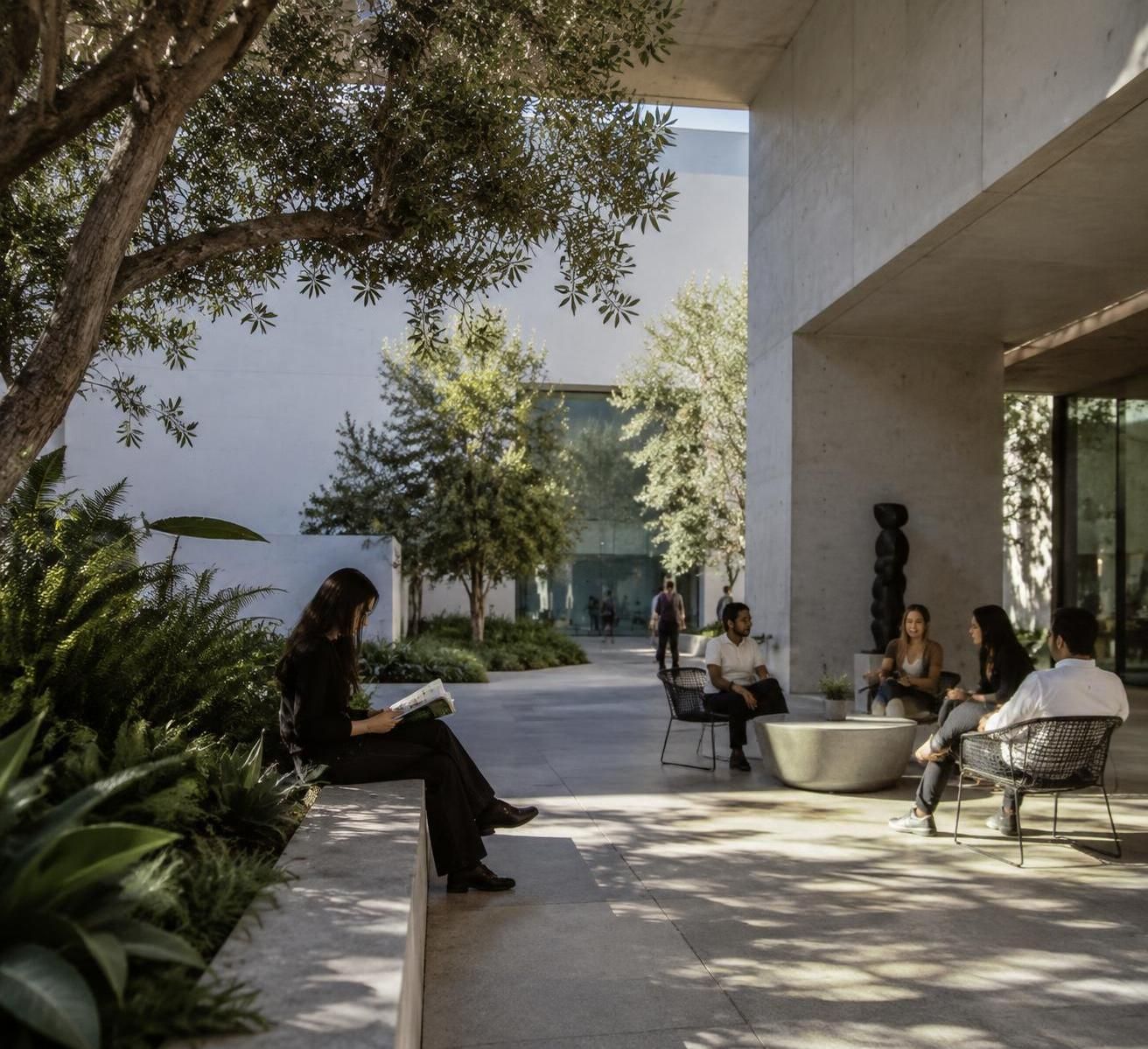
Ryan has described a desire for the courtyard and surrounding spaces to function as a town square. Her idea of a “radical welcome” shifts attention toward how people use the institution, including those who arrive to read, study or spend time with others.
How the Hammer Museum courtyard can support community engagement
The Nook, a ground-floor room for making art, reading or studying, offers a concrete expression of that approach. It gives visitors a reason to enter that does not depend on already knowing an artist, understanding a curatorial theme or purchasing something.
Lulu restaurant, which opens onto the courtyard, contributes another kind of activity. Food and conversation can help a cultural campus feel socially active, although a genuinely public environment also needs comfortable places where spending money is not expected.
That distinction is important for free-admission destinations. Removing an entry charge does not eliminate every barrier: transport costs, uncertainty about acceptable behavior, limited seating and unclear signs can still discourage participation.
Grupem’s guide to free museum visits in Los Angeles offers a complementary planning resource for readers comparing cultural outings. For organizers, the useful question is not only which venues are free, but how to make the complete journey manageable.
Imagine Maya bringing her group into the courtyard after a short gallery session. A designated meeting point, visible seats and a clearly explained break would help participants feel comfortable; simply telling everyone to “explore” could leave some unsure where to go.
Connecting Westwood public space with practical visitor services
Public-space programming works best when responsibilities are explicit. Staff need to know who handles group arrivals, who updates accessibility information and how an outdoor activity changes if heat, smoke or other conditions make the original plan unsuitable.
| Visitor need | Practical response | Useful indicator |
|---|---|---|
| 🧭 Finding the entrance | Consistent directions across booking messages and on-site signs | Fewer arrival-related questions |
| ♿ Taking a comfortable break | Clearly identified seating and accessible meeting points | Feedback on comfort and ease of movement |
| 🎧 Following a group explanation | Tested audio delivery with a text alternative | Reported listening clarity |
| 🎨 Joining without prior art knowledge | Low-pressure activities with plain-language instructions | Participation by first-time visitors |
| 🌤️ Responding to outdoor conditions | An indoor fallback and timely visitor updates | Successful changes without avoidable confusion |
These measures turn a broad aspiration into manageable tasks. They also reveal whether increased foot traffic is improving the experience or placing pressure on facilities and staff.
Technology should support this work rather than dominate it. A concise mobile orientation can explain where an activity begins, but it cannot compensate for an inaccessible route, missing seating or a confusing welcome.
For museum leadership, the most useful test is whether a newcomer can participate confidently without insider knowledge. A town-square model succeeds when people understand that they are welcome to stay, not merely permitted to enter. Extending that welcome across neighboring destinations introduces a larger coordination challenge.
Connecting Westside Cultural Institutions Without Overpromising an Arts District
Ryan’s broader vision links the Hammer with UCLA and a network of Westside destinations. Institutions mentioned in that ambition include the Fowler Museum, Nimoy Theater, Getty Center and Skirball Cultural Center, alongside the Westwood Village and Bruin theaters.
Conversations about creating or formally naming an arts district should be distinguished from a completed designation. The reported proposal is a developing partnership vision, not evidence that every participating venue already shares a budget, booking system or coordinated visitor program.
This distinction protects the credibility of the project. Visitors need to understand what they can actually do today, while civic and cultural partners need room to negotiate governance, resources and responsibilities.
Building a Westside arts district around realistic visitor journeys
The proposed network contains destinations at different distances from one another. A compact Westwood outing and a broader regional itinerary are therefore different products; describing both as a single walkable route would create misleading expectations.
Maya’s hypothetical planning illustrates the difference. For a short visit, she might choose a gallery session and a nearby performance, subject to schedules; for a full day, she would need to account for travel, meal breaks and each venue’s entry requirements.
A useful shared directory would explain location, approximate visit duration, accessibility information and transport choices. It should also distinguish a general admission policy from special-event reservations, since those details can change independently.
A Metro D Line station planned near the neighborhood supports Ryan’s gateway ambition. Its value for cultural access depends on the actual opening timetable, pedestrian connections, wayfinding and the ease of reaching individual entrances—not simply proximity on a map.
For urban development professionals, this is a last-mile problem as much as a cultural one. A transit arrival becomes a successful museum visit only when the remaining journey is legible and comfortable.
Making district partnerships useful for Los Angeles residents
Cooperation does not have to begin with expensive infrastructure. Partners could first agree on a maintained calendar, consistent location descriptions and a small number of clearly defined itineraries that respect opening hours and realistic travel time.
These are practical possibilities rather than announced commitments. Starting with limited, testable services would help participating organizations identify where collaboration saves effort and where different policies require separate treatment.
Audio interpretation could add value along appropriate routes by explaining architecture, public art or neighborhood history. However, recordings should be short, location-aware and easy to pause, with transcripts available for visitors who cannot or prefer not to listen.
A guide using Grupem for a scheduled group could assess whether smartphone delivery improves audibility without adding unnecessary equipment. The choice should follow a real-world test, including street noise and participant support needs, rather than an assumption that digital delivery is automatically better.
Privacy also matters. Useful visitor services do not require collecting precise location histories or forcing an account registration; the simplest solution that delivers the necessary information is often the strongest.
UCLA’s profile of Ryan’s vision provides additional context for her institutional ambitions. For district partners, the operational task is to translate that ambition into maintained services with named owners and realistic funding.
How would success look beyond increased attendance? More confident first-time visits, repeat participation by nearby residents and fewer preventable travel problems would offer meaningful evidence.
A vibrant Westside cultural network needs coordinated journeys, not just coordinated branding. Its lasting value also depends on the artists and programs that give people a reason to return.
Supporting Los Angeles Artists While Preparing for Made in L.A. 2027 and LA28
Ryan’s district ambition sits alongside a continuing commitment to artists. The institution’s role in contemporary art depends not only on attracting visitors, but on deciding whose work receives sustained research, exhibition space and collection support.
The Mohn Art Collective, known as MAC3, provides one mechanism for collaboration. More than 400 works donated by Jarl and Pamela Mohn are jointly owned and managed by the Hammer, LACMA and the Museum of Contemporary Art.
This arrangement connects three major cultural institutions around stewardship of a shared collection. Its importance goes beyond acquisition announcements: coordinated care, research and display can create opportunities for audiences to encounter works in different contexts.
How collaborative collecting supports a broader Los Angeles art scene
Jarl Mohn has recounted an early acquisition discussion in which Ryan encouraged the directors to reconsider the collective’s commitment to supporting a broad range of local artists. Alongside a work by Edgar Arceneaux, the group acquired a piece by photographer Shaniqwa Jarvis.
The example demonstrates how mission statements affect practical choices. Supporting an artistic community means examining who enters major collections, rather than relying exclusively on names whose institutional visibility is already secure.
Acquisition breadth and exhibition depth are complementary responsibilities. Buying work can provide recognition, while a carefully researched survey gives audiences the context to understand an artist’s development and influence.
Ryan’s approach also reconnects with participants from earlier editions of Made in L.A. Huguette Caland appeared in the 2016 biennial, and Joey Terrill in the 2023 edition; returning to such artists allows an initial presentation to develop into a fuller investigation.
The reported surveys of Caland and Jamaican-born geometric abstractionist Mavis Pusey similarly draw attention to women whose contributions have not always received proportionate institutional recognition. Their relevance lies in expanding art-historical understanding, not merely diversifying a seasonal schedule.
For educators, this creates richer interpretive possibilities. A visitor can examine how an artist’s materials, visual language or social context evolved, rather than encountering an isolated object without a sense of the larger practice.
Planning Made in L.A. 2027 and the LA28 Cultural Olympiad responsibly
The next Made in L.A. biennial is scheduled to open on October 10, 2027, with Michael Wellen working alongside MOCA curator José Luis Blondet. The pairing demonstrates cross-institutional collaboration at the level of curatorial decision-making, not just marketing.
Ryan is also planning the institution’s contribution to the LA28 Cultural Olympiad accompanying the 2028 Olympic and Paralympic Games. That work offers an opportunity to connect international attention with local artistic production, provided programming remains useful to residents as well as temporary visitors.
A large event can expose operational weaknesses quickly. Multilingual information, accessible booking, staff capacity and clear transport guidance should therefore be developed before demand rises, rather than treated as emergency additions.
Maya’s hypothetical group would benefit from those improvements even outside an Olympic period. A better arrival message or an accessible interpretation format remains valuable long after a major event ends.
Funding decisions should follow the same long-term logic. Grupem’s coverage of a Metal Museum grant in Memphis offers a related resource for professionals considering how cultural investment connects with institutional capacity.
At the Hammer, support for free admission, public programming and permanent staff positions addresses different parts of that capacity. An endowment is not interchangeable with unrestricted annual revenue, and a highly visible event does not automatically pay for ongoing educational work.
Useful evaluation would therefore track artistic outcomes alongside visitor services: sustained relationships with participants, teacher use of resources, accessibility improvements and the ability to maintain programs after a high-profile season.
The strongest legacy of a Westside arts district would be durable support for artists and audiences—not a temporary concentration of attention.
Who is the Hammer Museum’s new director?
Zoë Ryan succeeded Ann Philbin following her retirement in 2024. Ryan previously led the Institute of Contemporary Art at the University of Pennsylvania and held a senior architecture and design role at the Art Institute of Chicago.
Is the Westside arts district already formally established?
The reported vision involves conversations about creating or formally naming a district anchored by the Hammer Museum. It should not be treated as an already completed designation or a unified booking and transport service.
Which cultural destinations feature in the proposed Westside network?
The vision includes the Hammer, UCLA’s Fowler Museum and Nimoy Theater, the Getty Center, Skirball Cultural Center, and the Westwood Village and Bruin theaters. These destinations have different travel requirements, so visitors should not assume they form one continuous walking route.
How is the Hammer Museum expanding its educational work?
Alongside its classroom-in-residence program, the institution has piloted yearlong professional development for Title I school teachers. A new senior role overseeing learning, engagement and research supports the ambition to give education comparable importance to exhibitions.
When is the next Made in L.A. biennial scheduled?
Made in L.A. 2027 is scheduled to open on October 10, 2027, with Michael Wellen and José Luis Blondet collaborating as curators. Visitors should check the museum’s current information before arranging travel or group visits.
