
James May Tests Tesla’s Grok-Powered AI Voice Assistant in a Model 3
⚡ Key point: James May’s test of Tesla’s Grok-powered AI Voice Assistant is useful because it shifts attention away from novelty and toward a practical question: does conversational Artificial Intelligence make driving simpler, safer, and less distracting?
Known to many viewers through Top Gear and later automotive programmes, James May has long combined technical curiosity with a healthy resistance to overengineered gadgets. That makes his experience in a Tesla Model 3 particularly relevant. Rather than treating the system as an automatic breakthrough, he tested how it spoke, responded, and behaved during a real journey.
In the video published on his channel, May speaks with Tesla’s assistant using the “Ara” personality. The interaction reveals the central promise of this new generation of in-car systems: drivers can ask conversational questions without navigating nested touchscreen menus. They can seek information, request entertainment, or explore a topic while keeping their hands on the wheel.
Yet his reaction was notably mixed. May described some attempts at human-like delivery as “insincere and phony,” while also calling the broader experience “slightly odd.” That distinction matters. He was not simply rejecting Voice Control; he was questioning whether a machine needs to perform friendliness in a way that imitates human conversation too closely.
A detailed report on James May’s Tesla test highlights this balance between curiosity and criticism. The former presenter appears interested in what the tool can do, but less convinced by its theatrical manner. For product teams, tourism operators, and vehicle manufacturers, that is valuable feedback: usefulness should come before personality.
The development is also part of a larger change in Automotive Technology. Earlier vehicle voice systems were usually command-based. A driver might say “call home,” “navigate to airport,” or “set temperature to 21 degrees.” These commands could be useful, but the wording had to be precise and the system often failed when drivers used natural language.
Grok changes the model by bringing a generative AI layer into the dashboard. Rather than matching a request to a small library of predefined commands, the assistant can interpret context, answer open questions, and maintain a more flexible conversation. In principle, a driver could ask about a destination, explain an unfamiliar warning light, or request a concise overview of a local landmark.
That capability is especially relevant to Electric Vehicles. EV drivers frequently need information while travelling: charging options, route planning, climate settings, range considerations, or vehicle features. An AI Voice Assistant could reduce screen interaction when it is designed to answer clearly and when it avoids adding unnecessary conversational friction.
Consider a hypothetical guide named Daniel travelling between heritage sites in a Tesla. He needs a quick route adjustment, wants to check the likely arrival time, and is preparing a short story about the next location for his group. A capable voice system could handle the first two requests hands-free. However, if it responds with overly familiar jokes, lengthy disclaimers, or artificial enthusiasm, the benefit disappears.
May’s test therefore exposes a practical design principle. 🚗 A voice interface earns trust through clarity, speed, and predictable controls—not through an exaggerated imitation of a human companion. The next question is whether Grok’s conversational style can become genuinely useful without becoming distracting.
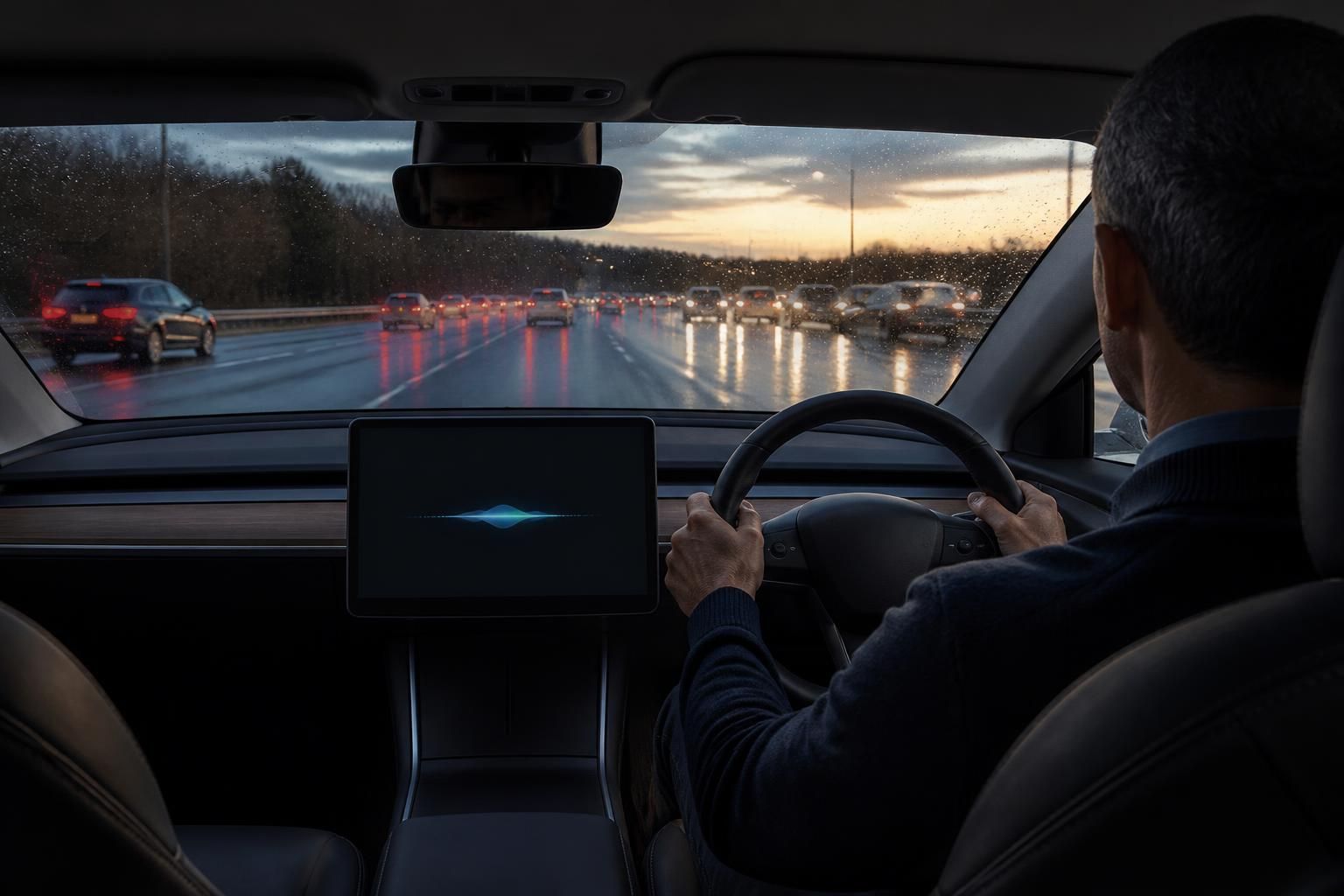
Why Tesla’s Grok AI Voice Assistant Sounds Different from Traditional Voice Control
Tesla’s integration of Grok reflects the move from simple command recognition to conversational Artificial Intelligence. This is not a minor software update. It changes what drivers may expect from Smart Cars, because the vehicle is no longer limited to executing direct functions: it can also participate in a dialogue.
Traditional Voice Control operates like a remote control expressed aloud. The driver gives an instruction, the vehicle confirms it, and the task is completed. This model remains effective for high-priority actions such as adjusting cabin temperature, opening a charging-port door, calling a contact, or setting a destination.
Conversational systems have a wider role. They are designed to interpret intent even when the exact phrasing changes. A driver could ask, “Will I need to charge before reaching the museum?” rather than manually searching through energy screens. The assistant may then combine route, distance, current battery level, and charging data into a simple answer.
That flexibility is where Grok can feel more capable than a standard automotive assistant. It is also where expectations must be controlled. A chat-oriented system may provide engaging responses, but driving is not a setting where entertainment should override attention management. The best answer is often short, factual, and easy to understand on the first listen.
Useful requests versus conversational performance
James May’s criticism of the Ara personality draws attention to an important product choice. A voice may sound warm without pretending to have emotions, preferences, or personal chemistry. When an assistant performs excessive excitement or artificial empathy, it risks sounding less trustworthy rather than more approachable.
For example, a driver asking for the nearest available rapid charger needs three things: where it is, whether it is operational, and how the route affects arrival. A response such as “I have found a rapid charger 11 minutes away, with four stalls available” is helpful. A longer, character-led answer can create cognitive noise at exactly the wrong moment.
The same principle applies beyond driving. Museums, guided-tour operators, and visitor centres increasingly use voice-enabled tools to make information easier to access. Users generally appreciate natural language, but they also expect the technology to respect their time. An audio guide does not need to impersonate a friend to explain why a historic building matters.
The most useful design choices for a vehicle assistant can be grouped clearly:
- 🗣️ Use plain language: accept everyday requests instead of forcing drivers to memorise rigid commands.
- 🧭 Prioritise task completion: deliver navigation, charging, media, and climate controls without unnecessary dialogue.
- 🔊 Keep answers audible and concise: the driver should not need to look at the screen to confirm a result.
- 🛑 Respect driving context: avoid long exchanges when traffic, weather, or road complexity demands attention.
- 🔒 Explain boundaries clearly: state what the assistant can control and when driver confirmation is required.
A useful reference on Tesla AI voice assistant features and practical use cases shows why voice-first interaction is increasingly central to the connected-car experience. The major opportunity is not to turn every trip into a conversation. It is to remove small sources of friction that cause drivers to touch screens or search through menus.
In practical terms, a Tesla owner should test Grok with simple recurring requests first. Ask for a route, adjust a setting, request a concise factual answer, and observe whether it responds promptly and accurately. This approach reveals whether the assistant fits everyday driving rather than only performing well in a demonstration.
🎙️ The strongest AI Voice Assistant is not the one that speaks the most; it is the one that allows the driver to do more while listening less.
The difference between a useful spoken command and a distracting conversation becomes even clearer when the interaction is assessed through road-safety and accessibility standards.
Assessing Grok in Tesla Smart Cars Through Safety, Accessibility, and User Experience
Any evaluation of Grok inside Tesla Smart Cars should begin with safety. A dashboard assistant can reduce distraction if it replaces visual interaction, but it can also introduce a new kind of distraction when it encourages lengthy exchanges. The system’s quality is therefore not defined only by how intelligent its responses sound.
Drivers manage several simultaneous tasks: observing road conditions, interpreting signs, anticipating other vehicles, monitoring speed, and reacting to unexpected hazards. A voice interface must fit around that workload. It should be available when needed, silent when not needed, and capable of being interrupted immediately.
This is particularly important for Electric Vehicles because their central displays often control a large share of vehicle functions. Tesla has helped normalise touchscreen-led interiors, which makes Voice Control a meaningful accessibility layer. A driver who can adjust a setting verbally may avoid taking their eyes away from the road.
However, replacing touch with speech is not automatically safer. If the driver has to repeat a question three times, interpret an ambiguous reply, or correct a mistaken action, the mental demand rises. A successful interaction must be brief, accurate, and easy to cancel.
A practical framework for evaluating in-car Artificial Intelligence
Fleet managers, mobility providers, and everyday owners can assess an AI assistant using a simple operational framework. The test should take place on familiar routes and should focus on frequent actions rather than unusual requests. This gives a more realistic result than asking novelty questions while parked.
| Evaluation area | What to test | Practical indicator |
|---|---|---|
| 🧭 Navigation | Request a destination change during a normal route | Does it confirm the correct place and route quickly? |
| 🔋 EV support | Ask whether charging is needed before arrival | Does the answer clearly explain range and charging options? |
| 🔊 Audio clarity | Use the assistant with road and passenger noise | Can the driver hear and understand the reply immediately? |
| 🛑 Interruption | Cancel or change a request mid-response | Does the system stop without creating confusion? |
| ♿ Accessibility | Use natural phrasing and varied speech patterns | Does it understand without requiring scripted wording? |
For Daniel, the travelling guide, this framework makes the decision concrete. If the assistant can reroute around congestion, find a suitable charger, and play a selected briefing playlist without screen taps, it supports his workday. If it requires repeated clarification or creates distracting banter, he will revert to manual controls.
Accessibility also deserves more attention than it usually receives in automotive discussions. Voice systems can be useful for drivers with limited mobility, visual fatigue, temporary injury, or difficulty using small on-screen controls. They can also make a vehicle more approachable for people who are not confident with complex touchscreen interfaces.
Still, inclusive design requires more than simply adding a microphone. Systems should understand varied accents, permit slower speech, handle interrupted instructions, and provide confirmation that does not depend solely on visual cues. The ability to choose a calmer voice and a lower-information response style can be as important as the language model behind it.
James May’s reaction to a voice that feels overly performative is relevant here. A neutral, transparent interface is often more accessible because it lowers ambiguity. It helps people understand what the system is doing, what it heard, and what will happen next.
✅ Safety and accessibility improve when the assistant behaves like a reliable tool, not like a personality demanding attention. This leads directly to the issue that determines whether drivers accept such systems over time: trust.
James May’s “Insincere” Critique and the Trust Problem in Automotive Technology
James May’s description of Tesla’s Grok voice as “insincere and phony” may sound like a personal preference, but it identifies a wider trust issue in Automotive Technology. When a machine adopts a strongly human tone, users do not only judge its voice. They judge whether its confidence, charm, and conversational style are appropriate to the task.
In a car, trust has unusually high stakes. A navigation mistake can mean a missed appointment. Inaccurate charging information can disrupt a trip. A misunderstood voice command can distract a driver in traffic. The assistant does not need to sound emotionally convincing; it needs to be dependable when it matters.
Grok is designed as a generative AI system, which gives it a more flexible conversational character than earlier vehicle tools. This can make information requests more natural. A passenger might ask for background on a historic site, a simple explanation of an engineering topic, or ideas for a nearby stop during a longer journey.
The challenge appears when the assistant’s social behaviour suggests a level of understanding or judgement that users should not assume exists. Natural-sounding speech can create the impression that a tool has human awareness. Product design should counter that effect through clear boundaries, transparent confirmations, and an option to keep the voice neutral.
Personality should remain optional, not compulsory
There is a place for a distinctive AI persona. Some drivers may enjoy a lively tone on a long motorway journey, particularly when passengers are present. Voice character can make an interface less intimidating, much like a well-designed museum audio guide can make specialist content more welcoming.
But there should always be a practical alternative. Tesla users should be able to choose response length, tone, and level of conversational detail. A “driving mode” could prioritise single-sentence answers and functional controls, while a “passenger mode” could allow longer explanations and more open-ended discussion.
This choice matters for professional travel as well. A guide transporting visitors between destinations may want a calm information source, not a system that tries to dominate the atmosphere of the vehicle. In contrast, a family on a holiday road trip may choose a more playful experience. The technology should adapt to the journey rather than imposing one style on every user.
Coverage of May’s reaction to Tesla’s Ara assistant underlines this tension. His comments are not a rejection of innovation or Electric Vehicles. They are a reminder that believable interaction is not necessarily better interaction.
For organisations developing voice experiences, the lesson is transferable. In tourism, audio information should be clear about what is automated, where data comes from, and when the visitor should consult a human professional. In cars, the same approach helps drivers understand the difference between a system that controls vehicle functions and a model that generates conversational content.
Trust is reinforced through modest, observable behaviours. The assistant should acknowledge uncertainty in a direct way, avoid inventing details, confirm significant actions, and refrain from pretending to have feelings. When it cannot complete a request, it should offer the next sensible option rather than filling the silence with scripted personality.
For drivers evaluating Tesla’s feature set, the sensible question is not “Does Grok sound human?” It is “Does it reduce effort without creating a false sense of capability?” 🔍 A trustworthy voice experience is transparent, interruptible, and proportionate to the driving situation.
Once trust and safety are established, the broader opportunity becomes clearer: voice interfaces can make journeys more informative without forcing drivers or passengers to navigate complicated screens.
What Tesla Grok Can Teach Tourism and Mobility Professionals About Voice-First Journeys
Tesla’s experiment with Grok is relevant beyond the car market. It illustrates how voice-first systems may support travel, visitor information, and mobility services when they focus on real needs. For tourism professionals, the value is not in copying a vehicle assistant’s personality. It is in understanding how audio can provide timely information with minimal friction.
A modern journey often combines several layers: transport, charging, parking, accommodation, ticketing, navigation, and cultural discovery. Each step can involve a screen, an app, an email, or a physical sign. A well-designed voice service can reduce that fragmentation by giving people a fast way to access the next useful piece of information.
Imagine Daniel arriving with a small group at a regional heritage route. His Tesla has guided him to the correct parking area and helped identify a charging stop for the return journey. Once the group is on foot, participants use their smartphones to hear location-based content through a professional audio-guide platform rather than gathering around a single guide’s raised voice.
The continuity is important. In the car, the driver needs concise operational assistance. On site, visitors need clear cultural interpretation, multilingual options, and a pace that suits their movement. These are different experiences, but both benefit from the same principle: audio should serve the user’s context.
Building voice experiences around action, not novelty
For museums, destination marketing organisations, guides, and local authorities, the growing visibility of AI Voice Assistant features creates an opportunity to review their own visitor journeys. The immediate goal is not necessarily to deploy a generative voice agent. It is to identify where spoken information can remove a genuine barrier.
- 📍 Map the visitor’s key moments: identify where people are lost, waiting, driving, or unable to read a screen comfortably.
- 🎧 Prepare concise audio content: write for listening, with short sentences, clear landmarks, and one idea at a time.
- 🌍 Plan for accessibility: offer adjustable volume, transcripts where appropriate, language options, and content that works on a personal smartphone.
- 🧪 Test in real conditions: check audio outdoors, in crowds, in vehicles, and on different devices before public deployment.
- 📊 Measure useful outcomes: review completion rates, support questions, visitor flow, and qualitative feedback rather than focusing on novelty.
This is where solutions such as Grupem’s mobile audio-guide approach are particularly practical. They allow organisations to deliver professional audio through visitors’ own smartphones, avoiding the logistics of dedicated receivers while maintaining a clear, controlled listening experience. The underlying lesson from Tesla is similar: technology is valuable when it makes an interaction simpler at the point of need.
Professionals interested in the wider market can compare the growing range of voice AI systems being developed by automakers. Each brand is exploring how spoken interaction may support navigation, entertainment, assistance, and connected services. The differences in tone and technical approach matter, but consistent user-centred design matters more.
Voice services should also avoid making unverified claims about local conditions, schedules, prices, or safety instructions. In a tourism setting, inaccurate information can harm visitor confidence just as quickly as an incorrect route can disrupt a drive. Content teams should define approved sources, update schedules, and preserve a route to human support.
Grok’s role in Tesla Smart Cars demonstrates that Artificial Intelligence is becoming a visible layer of everyday mobility. James May’s scepticism provides the necessary counterweight. The future of voice technology should not be built around simulated companionship; it should be built around 🎧 intelligible audio, relevant answers, accessible controls, and respect for human attention.
What did James May say about Tesla’s Grok AI Voice Assistant?
James May tested the Grok-powered assistant in a Tesla Model 3 and criticised its human-like manner as insincere and phony, while also describing the experience as slightly odd. His comments focus mainly on the voice personality rather than rejecting voice control itself.
What is Grok’s role in Tesla vehicles?
Grok adds conversational Artificial Intelligence to Tesla’s voice experience. It can support more natural spoken requests and general information queries alongside conventional vehicle functions such as navigation, media, and selected controls.
Does an AI Voice Assistant make driving safer?
It can reduce visual distraction when it handles tasks accurately, quickly, and hands-free. Safety depends on concise responses, reliable recognition, simple cancellation, and avoiding long conversations during demanding driving conditions.
Why does voice personality matter in Smart Cars?
A personality can make a system feel approachable, but an overly human or performative tone may reduce trust and distract users. Drivers should ideally be able to choose a neutral, concise response style.
How can tourism professionals apply these lessons?
They can design audio services around practical moments of need, such as navigation, site interpretation, accessibility, and multilingual support. The priority is clear, reliable information delivered through an easy listening experience.
