
Why Readers Name the Musical Instrument Museum a Leading Phoenix Family Attraction
🎵 Key point: Readers have identified the Musical Instrument Museum, commonly known as MIM, as Arizona’s standout family-friendly Museum experience. The recognition reflects more than a large collection: it highlights a venue designed around curiosity, movement, listening, and shared discovery across generations.
Located in northeast Phoenix, the Musical Instrument Museum brings together more than 12,000 instruments and related objects from nearly 200 countries and territories. That scale makes the venue relevant to visitors interested in music, design, global traditions, and local Tourism, yet its appeal for families comes from the way those subjects are presented. Instead of asking children to simply look at objects in cases, the museum turns sound into a practical route into Culture and Education.
The reader-driven distinction matters because family attraction rankings often reward usability as much as prestige. Parents and caregivers assess whether a place can hold a child’s attention, accommodate different ages, offer a manageable visit length, and leave everyone with a memorable experience. MIM succeeds because music is immediately understandable. A child may not yet know the History of a distant country, but they can react to a drum rhythm, recognize a guitar sound, or notice how a familiar instrument differs in shape and material elsewhere in the world.
The museum’s founding idea also explains its broad reach. Robert J. Ulrich, formerly chief executive of Target Corporation, was inspired by a visit to an instrument museum in Brussels. Rather than replicating a primarily Western classical model, he envisioned an institution that could represent musical traditions from communities around the globe. Working with museum specialist Marc Felix, Ulrich began collecting in 2005, and the Phoenix destination opened to visitors in April 2010.
That decision gave the venue a clear identity. The galleries do not frame musical instruments as decorative objects alone; they connect them to makers, performers, celebrations, faith traditions, migration, craft, and everyday life. A family can move from a display of string instruments to an audiovisual presentation of a performer using that instrument in its cultural setting. The result is an Exhibition model that gives objects context rather than leaving visitors to infer why they matter.
Music gives different age groups a shared starting point
Consider a typical visit by a family such as the fictional Ramirez group: two adults, a teenager who enjoys pop music, and an eight-year-old who is learning percussion at school. The teenager may be drawn to artist instruments or recorded performances, while the younger child may respond first to the visual forms of drums, horns, and keyboards. The adults can connect both reactions to larger questions about geography, craftsmanship, and cultural exchange.
This is one reason the venue has become a reliable Phoenix Family Attraction. It does not require every member of a group to enjoy art in exactly the same way. A strong family museum makes room for individual interests while creating moments to discuss together, and sound provides that bridge naturally.
- 🎧 For younger visitors: sound offers an immediate sensory connection before they have the vocabulary for music history.
- 🌍 For school-age children: global galleries support learning about countries, communities, and traditions through a concrete object.
- 🎸 For teenagers: contemporary artists, performance clips, and instrument design can make cultural learning feel relevant.
- 👨👩👧 For adults: the collection provides depth without excluding visitors who arrive without specialist musical knowledge.
The recognition reported in coverage of Arizona readers’ choice of the leading family museum therefore reflects a practical standard. Families are not only choosing a place to fill an afternoon. They are selecting a setting where learning is approachable, conversations develop naturally, and every visitor can participate at a comfortable level.
🎯 The essential insight is simple: MIM’s family appeal comes from making global music tangible, audible, and relevant to people with very different ages and expectations.
How MIM Turns a Global Instrument Collection into Accessible Family Education
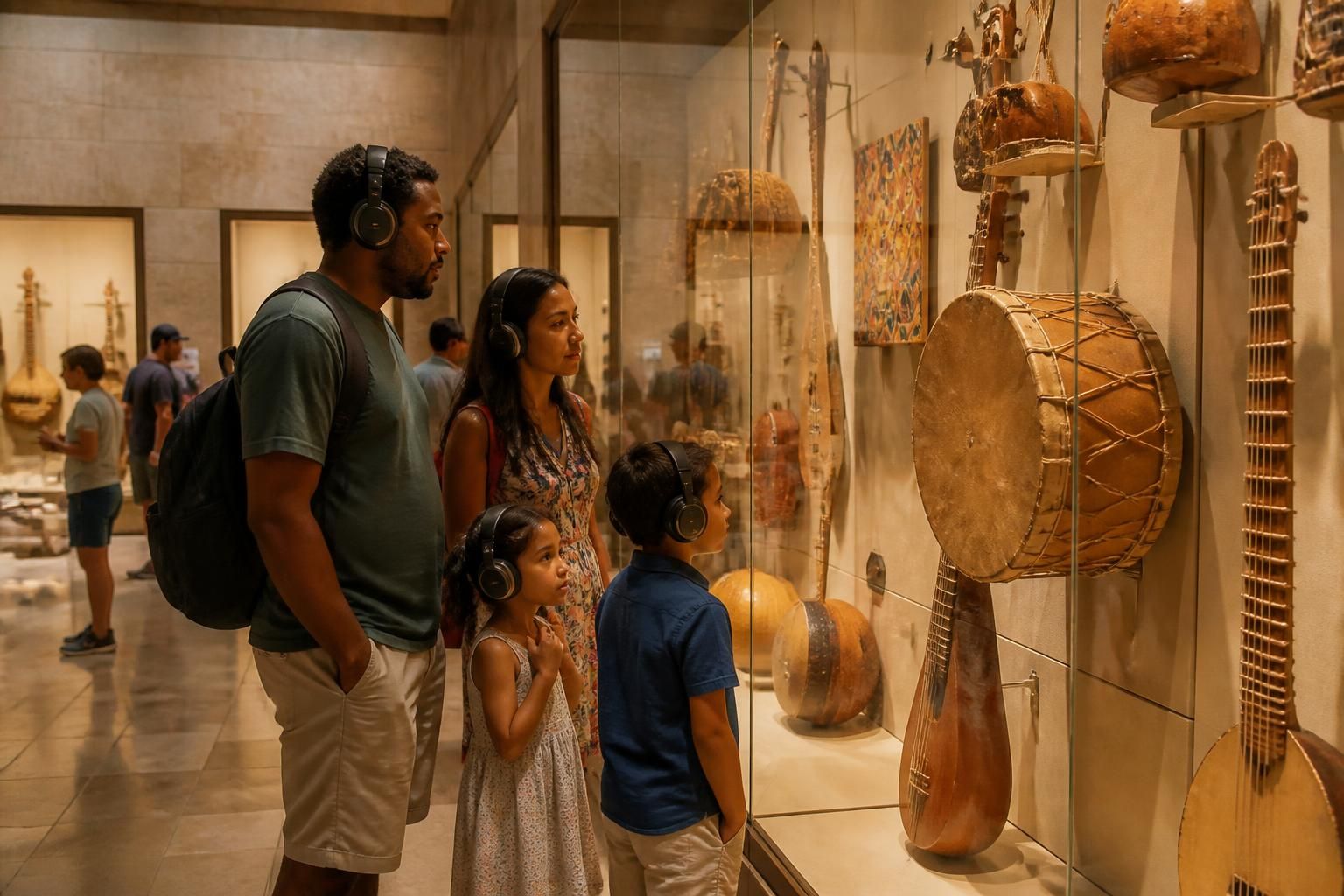
A collection of 12,000 objects could easily become overwhelming, particularly for visitors arriving with children. The Musical Instrument Museum avoids that risk by treating guest experience as part of its core museum practice. The galleries use interactive technology and performance-based interpretation to help visitors understand not only what an instrument is, but how it sounds, who plays it, and where it belongs within a living tradition.
This approach is especially valuable in 2026, when families increasingly expect cultural destinations to provide clear, flexible, and inclusive ways to engage. Digital tools are most useful when they remove friction rather than add screens for their own sake. At MIM, audio and visual interpretation can shorten the distance between a static display and the human story behind it.
Context transforms an object into a learning moment
A carved lute, a regional drum, or a small wind instrument can seem unfamiliar to a visitor. Once that visitor hears the instrument played and sees it in performance, the object becomes easier to remember. The sound explains details that a label alone may not communicate: the function of the shape, the energy of a musical style, and the relationship between instrument and performer.
For families, this method supports spontaneous learning. A child might ask why one drum is tall and narrow while another is wide and shallow. That question can lead to a discussion about materials, acoustics, climate, local resources, or the role of music in ceremonies and social life. The museum does not need to turn every visitor into a musicologist; it needs to make the next question worth asking.
The value extends to school groups and tourism professionals. A teacher can connect a gallery visit with geography, social studies, language arts, visual art, and music. A guide or visitor-services team can prepare guests by offering a simple route based on interests: instruments from a family’s heritage, galleries linked to a school topic, or spaces with especially strong audiovisual content.
| Family need | Museum response | Practical benefit |
|---|---|---|
| 🎧 Different attention spans | Audio-led interpretation and varied displays | Visitors can pause, listen, and move at their own rhythm |
| 🌎 A clear global perspective | Instruments representing nearly 200 countries and territories | Culture becomes specific rather than abstract |
| 🎓 Learning beyond textbooks | Performance context, objects, and programming | Education connects visual observation with sound |
| 🎭 A reason to return | Concert activity and dynamic events | Families can experience the venue beyond a single daytime visit |
Accessibility also means recognising that families do not all arrive with the same confidence, language background, or prior museum experience. A well-designed interpretive environment gives visitors permission to explore without fear of “doing it wrong.” Music is particularly effective because listening does not demand expert knowledge. People can begin with recognition, surprise, or emotion, then choose how deeply they want to investigate.
Smart Tourism practices can strengthen this type of visit further. For example, a group coordinator could share a short mobile audio route before arrival, allowing participants to understand basic navigation and select a few must-see zones. During the visit, personal smartphones can support accessible listening without gathering a group around a single guide’s device. Tools such as Grupem are useful in this context because they help guides and institutions distribute clear audio content while preserving each guest’s freedom of movement.
A strong digital layer should remain discreet. It should tell visitors where to start, clarify the significance of a display, and offer optional depth for those who want it. It should never compete with the instruments, the performance recordings, or the conversations happening between family members.
Parents considering other cultural stops can compare MIM’s sound-centred experience with the broader visual-art offer described in this Downtown Phoenix Art Museum visitor overview. The comparison shows why a city benefits from varied institutions: visual art, regional history, hands-on play, and music all serve different routes into learning.
🔎 The practical lesson for museums is that technology works best when it gives every visitor a clearer path into the story, not another task to complete.
Planning a Smooth Visit to Phoenix’s Reader-Selected Family Museum
Good family visits are rarely accidental. A museum may have excellent content, but the experience depends on timing, pacing, comfort, and realistic expectations. The Musical Instrument Museum is open daily from 9 a.m. to 5 p.m. at 4725 E. Mayo Boulevard in Phoenix. Because schedules, programming, and ticket conditions can change, visitors should verify current details directly with the museum before leaving home.
The published admission structure has included adult tickets at $20, admission for teenagers aged 13 to 19 at $15, children aged 4 to 12 at $10, and free entry for children aged three and under. These figures provide a useful planning reference, but a family should still check the official site for current pricing, special exhibitions, timed-entry requirements, accessibility information, and event-specific conditions.
Build a visit around energy, not around completing every gallery
A common mistake is treating a large Museum as a checklist. With a collection of this size, attempting to see everything in one visit can make children tired and adults rushed. A better approach is to identify two or three priorities, leave time for unexpected discoveries, and accept that a future visit may be the best way to explore another region or theme.
The Ramirez family provides a useful example. Before arriving, they choose one gallery linked to a grandparent’s country of origin, one area focused on instruments they have never seen before, and a performance-related stop for the teenager. This creates a simple structure without forcing the day into a rigid timetable. If the eight-year-old becomes absorbed by a percussion display, the schedule has enough flexibility to follow that interest.
- 🗓️ Confirm current hours and ticket options: review the museum’s official information before travel, especially during school holidays or event periods.
- 🎵 Choose a shared theme: select a country, musical genre, instrument family, or performance question that everyone can investigate.
- ⏱️ Set a realistic pace: plan breaks and avoid making gallery coverage the only measure of success.
- 📱 Use a simple mobile route: keep directions, meeting points, and optional interpretation accessible on personal devices.
- 💬 End with one question: ask each child which sound, object, or story they would tell someone else about.
For visitors travelling from elsewhere in Arizona, MIM can fit into a broader Phoenix itinerary without requiring an overloaded day. Families may pair it with an outdoor activity in the morning or reserve an evening for a concert when one is scheduled. The museum’s theatre, which hosts public performances after museum hours, adds a live dimension that distinguishes it from institutions focused only on gallery viewing.
Comfort matters as much as content. Families should review transport, parking, food options, sensory considerations, stroller needs, and access requirements in advance. These small operational details influence whether a cultural day feels welcoming or stressful. For tourism organisations, sharing this information plainly on an itinerary, confirmation email, or mobile guide is a service rather than an administrative extra.
Planning also benefits from honest communication with children. Instead of saying “we are going to learn about instruments,” a parent could frame the trip as a mission: find the instrument that looks most surprising, listen for an unfamiliar rhythm, or identify an object made from an unexpected material. That language turns observation into participation without making the outing feel like homework.
Families who want a concise background resource before their visit can use this guide to the Musical Instrument Museum’s family appeal to understand why its galleries work well for mixed-age groups. It can be particularly useful for tour planners designing a short, focused stop rather than a full-day programme.
✅ A successful MIM visit is not defined by seeing every object; it is defined by leaving with a few sounds and stories that remain vivid after the day ends.
Why Live Performance Makes This Arizona Museum More Than a Daytime Exhibition
The Musical Instrument Museum’s collection is central to its identity, but its theatre adds another layer to the visitor experience. Concerts held after standard museum hours connect instruments on display with the living practice of performance. This matters because musical heritage is not frozen in a case. It is carried by artists, audiences, techniques, venues, and evolving communities.
For a Family Attraction, live programming offers a useful option: it can turn a planned museum visit into a wider cultural occasion. Some families may prefer the daytime galleries, while others may organise a return trip for an age-appropriate concert. The important distinction is that the venue offers both object-based interpretation and a setting where music can be experienced as an event shared in real time.
Performance reinforces the human story behind the collection
When visitors see an instrument in a gallery, they learn about its physical form and origin. When they attend a performance, they can understand presence, timing, volume, gesture, and the relationship between musician and audience. These are elements that cannot be fully conveyed by a display label. Together, the gallery and stage create a fuller picture of what music means within a community.
This combination has value for children and teenagers. Young audiences often understand cultural differences more readily when they see people actively creating rather than only viewing historic material. A concert can also create a personal memory that anchors later learning. A child who hears a particular string instrument in a live programme may be more likely to notice and remember its related display on a future visit.
There is a wider lesson for cultural venues across Arizona. Dynamic programming gives visitors reasons to return, but it must be connected to the institution’s purpose. A concert schedule should not feel like a separate entertainment product detached from the museum’s collection. At MIM, the relationship is clear: performances extend the museum’s commitment to global musical traditions and the ways people encounter them.
Institutions can improve this connection through simple visitor pathways. A ticket confirmation might recommend a related gallery before a concert. A mobile audio guide could provide a five-minute context piece on the performer’s musical tradition. A family worksheet could ask children to listen for one instrument or rhythmic pattern during the show. These are modest interventions, yet they make the cultural experience more coherent.
Audio quality is particularly important in this setting. Visitors should hear a guide, performance introduction, or interpretation clearly without needing to cluster around a speaker. Smartphone-based group audio can support this objective when used thoughtfully, enabling guides to provide context outdoors, in a lobby, or while moving between locations without creating a disruptive volume level.
For example, a local tour operator arranging a Phoenix Culture itinerary could use an audio system to introduce the MIM’s global collection during the journey to the museum. Guests would arrive with a clear purpose, perhaps looking for instruments from the Andes, West Africa, East Asia, or the American Southwest. The guide can then reserve in-person explanations for questions that arise naturally on site.
Live events also help Tourism professionals extend visitor dwell time in a meaningful way. Rather than simply adding another stop to a crowded schedule, a museum concert can create a calm evening anchor after a day of desert landscapes, public art, or downtown exploration. That is beneficial when it respects audience needs, travel times, and appropriate age guidance.
🎭 The strongest museum programming does not merely add activity; it connects gallery objects, performance, and visitor memory into one continuous cultural experience.
What Phoenix Museums Can Learn From This Family Attraction Recognition
The readers’ choice for MIM offers useful insights beyond one institution. Phoenix has a varied museum landscape, including major art collections, specialised cultural sites, regional History venues, and hands-on experiences aimed at younger visitors. The lesson is not that every Museum should imitate a music-focused model. It is that every venue should identify the most direct route between its collection and the real needs of families.
A successful family offer balances intellectual value with practical usability. It respects children’s need to move, notice, and ask questions. It also respects adults’ wish for an outing that feels worthwhile rather than merely distracting. When readers name a destination as a preferred Arizona family experience, they are often recognising that the institution has achieved both outcomes at once.
Design for participation, not passive endurance
Families respond well when cultural interpretation offers choices. One visitor may prefer a short route with high-impact displays; another may want deeper historical context; a third may need a quiet pause. Signage, staff guidance, digital content, and seating should support those different patterns of use. This is visitor-centred design in practical form.
For museums without MIM’s collection size, the principle still applies. A small regional Exhibition can offer a “three objects in fifteen minutes” route. A historic house can provide audio stories told from several perspectives. An art museum can invite children to compare colour, texture, and mood in two works rather than asking them to absorb an entire wing. The objective is not to oversimplify Culture, but to provide an accessible first step into it.
Phoenix Art Museum demonstrates another important branch of the local cultural offer, with a collection exceeding 21,000 objects and exhibitions spanning multiple periods and regions. Families considering that experience can review Phoenix Art Museum ticket and visit information before planning their day. Comparing institutions helps visitors choose the environment that best matches their group, rather than assuming there is only one correct type of museum outing.
The same logic applies to regional identity. Arizona visitors may be interested in museums that foreground Indigenous history, desert landscapes, migration, local art, or the state’s distinctive communities. A reader-selected family destination should be viewed as part of this wider ecosystem. Each institution can provide a different entry point into the place, people, and stories that shape the state.
Digital interpretation should support that ecosystem. A tourism office could create a multi-stop audio itinerary that links MIM with public art, food districts, and nearby cultural venues. A family could choose a themed route around sound, design, or world traditions. A guide could use a simple app to keep a mixed group connected while allowing guests to listen through their own headphones.
Such tools are especially helpful when they remain optional and easy to use. Visitors should not have to download several platforms, create complicated accounts, or follow a rigid sequence to benefit. Clear instructions, accessible audio, and concise content are usually more valuable than an overloaded digital experience.
There is also a reputation benefit. Museums that consistently make families feel considered earn repeat visits, positive recommendations, and stronger community relationships. That reputation is built through ordinary details: friendly orientation, accurate information, thoughtful programming, inclusive language, and a genuine understanding of how visitors use a space.
🌟 The lasting value of this Phoenix recognition is not simply a ranking. It is evidence that thoughtful interpretation, operational clarity, and meaningful participation can turn cultural institutions into places families choose repeatedly.
Which Phoenix museum did readers identify as Arizona’s leading family attraction?
Readers selected the Musical Instrument Museum in Phoenix as a leading family-friendly museum destination. Its global collection, interactive interpretation, and performance programming contribute to its appeal for mixed-age groups.
How large is the Musical Instrument Museum collection?
The collection includes more than 12,000 musical instruments and related objects representing nearly 200 countries and territories. The galleries connect these objects with cultural and performance context.
Where is the Musical Instrument Museum located?
MIM is located at 4725 E. Mayo Boulevard in Phoenix, Arizona. Visitors should check the museum’s official website before travelling for current opening hours, admission details, and programme information.
Is the Musical Instrument Museum suitable for children?
Yes. Music provides an accessible entry point for children, while audiovisual interpretation, varied displays, and the global scope of the collection give adults and teenagers substantial depth to explore.
How can tour organisers make a museum visit easier for families?
Organisers should confirm logistics in advance, select a short themed route, allow flexible pacing, and use clear mobile audio guidance where useful. The aim is to reduce friction while leaving room for personal discovery.
