
Dallas New Museum Charter School Brings Outdoor Learning Into Daily Education
The Museum School of East Dallas has opened with a clear proposition: children should not experience culture, nature, and public spaces only as occasional rewards after classroom work. At this tuition-free Charter School, those environments are designed to become part of the learning process itself. The approach places Dallas institutions, gardens, galleries, and neighborhood resources alongside books, writing exercises, mathematics, and state-required instruction.
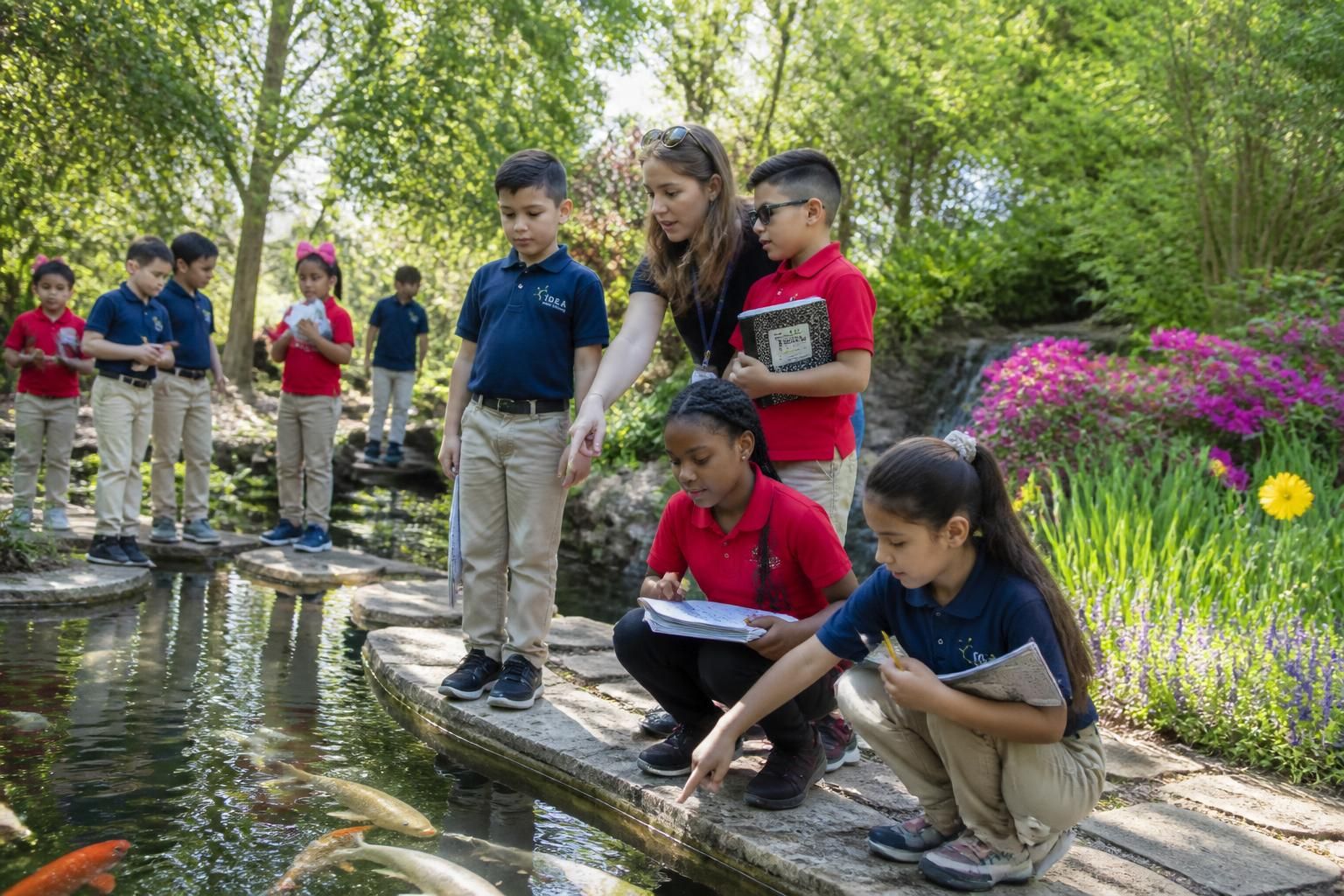
For fifth-grade student Tripp McNeil, the first week did not begin with a conventional classroom orientation. It began at the 66-acre Dallas Arboretum and Botanical Garden, where he met classmates, played group games, watched koi move through a pond, and explored the landscape. His reaction was simple: it was the most enjoyable first week of school he had experienced. That response matters because Student Engagement is not separate from academic learning; it is often the condition that makes sustained learning possible.
The New Museum Charter School serves children from kindergarten through eighth grade. Its museum-based model uses structured visits, called learning expeditions, to connect lessons to real places and real objects. Rather than treating a painting as a flat image on a presentation slide, pupils can encounter it in person at the Dallas Museum of Art. Rather than discussing ecosystems only through worksheets, they can observe plant life, water, insects, weather, and visitors’ behavior in a botanical setting.
This is not simply a field-trip-heavy version of traditional schooling. The model is based on preparation before the visit, active observation during the experience, and reflection afterward. A class studying visual storytelling, for example, might examine artworks in a museum, identify how color and composition guide viewers, then return to school to write descriptions, create a small exhibition, or present a visual narrative. The destination becomes evidence for the lesson rather than a diversion from it.
- 🌿 Outdoor Learning: gardens, parks, and public landscapes offer direct encounters with living systems and changing environments.
- 🖼️ Cultural access: museums make abstract historical, artistic, and scientific topics concrete through objects and exhibitions.
- 🧭 Experiential Education: students gather observations, ask questions, and return with material that can be analyzed in class.
- 👥 Social development: travel, group tasks, and shared discoveries require collaboration, listening, and responsibility.
The school’s stated purpose also responds to an access issue. Dallas has a dense cultural ecosystem, but proximity does not automatically mean participation. Some families may not know how to plan museum visits, may see arts venues as inaccessible, or may lack the time and transportation needed to attend. The school’s leadership argues that regular, guided contact can reduce that gap and help students see local cultural institutions as places where they belong.
That ambition is visible in the school’s public mission, which describes an educational environment built around exploration, discovery, and community adaptation. Families can review the school’s stated approach through the Museum School of East Dallas website, where the emphasis is on a K–8 experience that links rigorous academics with community-based learning.
Outdoor environments are especially useful because they create productive complexity. At an arboretum, a child can notice a flowering plant, a maintenance worker, a sign, an irrigation system, a map, and a group of tourists within minutes. A skilled teacher can turn those observations into language, science, geography, design, or civic questions. What makes the model valuable is not merely leaving the building; it is the disciplined framing of what students see once they arrive.
For museum and visitor-experience professionals, the Dallas experiment also illustrates a broader shift. Cultural venues increasingly serve as active Education partners, not only destinations for one-time school visits. The same logic appears in projects that use narrative design to make collections more approachable, such as this overview of the Lucas Museum of Narrative Art and its public-facing storytelling potential.
The essential point is practical: a learning expedition only becomes transformative when teachers connect it to a precise question, an accessible activity, and a meaningful follow-up task. That requirement leads directly to the school’s teaching methods and accountability framework.
How Experiential Education Supports Innovative Teaching and Student Engagement
The Museum School of East Dallas uses the museum model to organize teaching around experiences that students can investigate. In practice, this means that a visit begins before anyone boards a bus. Teachers identify the Texas Essential Knowledge and Skills standards connected to a unit, define the questions students should explore, and prepare activities suited to their age. Afterward, children are expected to process what they observed through discussion, writing, research, artistic work, or a presentation.
This structure distinguishes Experiential Education from unplanned enrichment. An unstructured outing may be enjoyable, but it can leave students with unequal memories and no shared academic thread. A well-designed expedition, by contrast, gives every learner a role. One pupil may record visual details, another may measure, map, interview, sketch, classify, or formulate questions. The visit produces usable material for later instruction.
Second-grade teacher Brooke Perry has described student exhibitions as a central part of the process. Several times each year, students can share work with families through a dance, sculpture, game, installation, or another format appropriate to the unit. This approach gives children a reason to refine their work because they are not producing it only for a teacher’s grade. They are preparing something that an audience will encounter.
That public-facing dimension can be particularly effective for young learners. Consider a hypothetical fourth-grade class studying water systems after visiting the arboretum. One group might build a simple model of irrigation. Another might write short explanatory labels in the style of a museum panel. A third might create an audio guide describing how water supports specific plant species. The academic targets remain visible: vocabulary, explanatory writing, measurement, sequencing, scientific observation, and oral communication.
Turning visits into a repeatable learning workflow
For a school attempting this model, consistency is more important than novelty. Teachers need a workflow that makes experiences manageable rather than exhausting. The following table shows how a learning expedition can connect classroom goals with the realities of a cultural or outdoor venue.
| Learning stage | Practical activity | Value for students | Example indicator |
|---|---|---|---|
| 🗺️ Before the visit | Introduce key vocabulary, maps, images, and a focused question. | Students arrive with context rather than uncertainty. | 🧠 Each learner can explain what they are looking for. |
| 🔎 During the visit | Use observation prompts, roles, sketches, or short interviews. | Attention shifts from passive viewing to evidence gathering. | 📋 Completed field notes or documented observations. |
| ✍️ After the visit | Debrief, compare findings, and create an assessed response. | Experience is linked to standards and memory is reinforced. | 📚 Writing, presentation, model, or quiz aligned with the unit. |
| 🎤 Public sharing | Build an exhibition, performance, or family presentation. | Students practice ownership and communication. | 🌟 Clear explanation of what was learned and why it matters. |
Technology can strengthen this workflow when it removes friction instead of adding screens for their own sake. A smartphone-based audio guide, for instance, can help a teacher deliver short instructions at multiple points in a venue, provide multilingual context for families, or support students who need to revisit information at their own pace. Clear audio is particularly useful in gardens, galleries, and busy public environments where a large group may struggle to hear one adult.
However, digital tools should not replace direct observation. A child standing in front of a large artwork or watching insects move through a garden is learning through attention, scale, sound, movement, and social conversation. Audio content works best when it guides attention toward those details. It should say, in effect, “look here, listen for this, compare what you notice,” rather than overwhelm learners with facts.
The school’s approach has a national precedent. Museum schools have been operating in several parts of the United States, and the National Association of Museum Schools identifies at least 50 schools using related principles. One important influence is the Museum School of Avondale Estates near Atlanta, founded in 2010. Its partnerships have included organizations such as the Atlanta Botanical Garden, the Atlanta History Center, and the Georgia Aquarium. During one recent school year, that school reported more than 164 expeditions or on-campus programs.
The Dallas school should not be judged solely by whether children enjoy their visits. Enjoyment is valuable, but Innovative Teaching must also demonstrate that curiosity turns into knowledge, skill, and academic confidence. This is where Texas standards, teacher certification, and assessment requirements become central to the model.
School Transformation Requires Academic Discipline, Not Just Memorable Field Trips
The phrase School Transformation can suggest a complete rejection of conventional instruction. That is not what the Museum School of East Dallas is designed to do. Students still need explicit reading instruction, writing practice, mathematical fluency, feedback from qualified teachers, and opportunities to work quietly and independently. The distinctive element is the school’s attempt to make those foundations more relevant by connecting them to authentic experiences.
Families considering the program should understand that it remains a public charter school. It receives public funding and does not charge tuition, but it operates independently from Dallas ISD. Like other open-enrollment charter schools in Texas, it can enroll students regardless of academic ability. Its curriculum must align with state standards, and pupils must take the State of Texas Assessments of Academic Readiness, commonly known as STAAR.
These obligations matter because they provide a common reference point. When a school promises a more engaging model, the question is not whether it looks different from a conventional campus. The stronger question is whether students develop the knowledge and skills expected at their grade level while benefiting from the added relevance of community-based instruction.
The Museum School opened with more than 150 enrolled students and seven certified teachers. Its founder and superintendent, Loren Colman, brings roughly two decades of experience in roles including teaching, principalship, and school leadership. Before launching the school, she participated in a fellowship from Build. Excel. Sustain., a national nonprofit that supports prospective school founders. Her planning included visits to schools around the country and a two-week stay at the museum school near Atlanta that helped shape the Dallas concept.
For educators, the key design challenge is balancing flexibility with coherence. If every class visits a different venue without a shared planning system, teachers can become overloaded and families may struggle to understand the academic purpose. A more durable model creates a calendar of partnerships, recurring learning routines, risk-management processes, and clear curricular links. The goal is not to make every day an excursion. It is to make selected experiences powerful enough to improve what happens on ordinary school days.
What quality control should look like in a museum-based Charter School
A responsible accountability approach should look beyond a single testing cycle. STAAR results will be important, particularly because the school is new and community members want evidence that academic standards are being met. Yet test performance needs to be read alongside attendance, student retention, literacy growth, teacher stability, access for students with disabilities, family satisfaction, and the quality of exhibitions or student work.
For example, a third-grade student may visit a local museum to study objects connected to Texas history. The assessment should not merely ask whether the child enjoyed the visit. It can ask the student to compare primary and secondary sources, write an evidence-based paragraph, identify chronology, or explain why museum labels shape interpretation. In that form, the experience becomes academically visible.
The school’s model can also offer useful lessons to institutions outside formal Education. Museums often want to attract young audiences but may underestimate the operational needs of school groups. A partner venue must provide clear booking systems, appropriate arrival instructions, accessible restrooms, quiet areas, staff contacts, and materials that work for different reading levels. Audio interpretation can complement the visit, especially where educators need an alternative to shouting over crowds or traffic.
There is already a broader conversation about museum learning through hands-on science programming. The example of the CBT Museum’s flight education approach shows how objects, demonstrations, and guided explanation can turn technical subjects into approachable learning moments. Dallas cultural partners can apply similar principles by designing activities that let students observe, test, describe, and create rather than only consume information.
At the same time, assessments should protect against a common risk: a model can become visually impressive while failing to serve students who need structured support. Children with language needs, learning differences, mobility constraints, or anxiety may require alternate formats, predictable schedules, visual prompts, or quiet spaces. Equity is not achieved by offering the same outing to every student; it is achieved by making meaningful participation possible for every student.
The next issue is therefore not educational philosophy alone. It is operational capacity: transport, permissions, venue costs, physical access, and the facility constraints that currently limit the school’s ability to welcome more families.
Dallas Charter School Challenges Include Funding, Transportation, and Accessible Space
The Museum School’s strongest idea—bringing students into the community—also creates practical demands that conventional classrooms do not face as frequently. Every off-site learning experience requires planning: permission forms, adult supervision, transportation, schedules, risk procedures, venue coordination, weather contingencies, meals, accessibility, and communication with families. None of those details are glamorous, but they determine whether Outdoor Learning is genuinely inclusive and sustainable.
Parents may be asked to contribute toward excursions as well as transportation. School leaders have said that families unable to pay can receive reduced costs or full support. That commitment is essential. If recurring visits depend on household income, the model could unintentionally deepen the access gap it intends to address. A school founded on public participation in Dallas cultural life must ensure that no child misses core learning because of an unpaid fee.
Transportation is an especially important issue in a large city. Dallas has major cultural resources, but distance, traffic, and bus availability can change a simple museum visit into a complex logistical operation. Public school districts can draw on systems, facilities, and financial mechanisms that a newer charter operator may not have. Charter schools cannot access local property-tax revenue in the same way traditional districts can access bond funding for large construction needs.
The current facility challenge is direct and concrete. The school is housed in a church building undergoing renovations. It has unused space on the second floor, but an elevator repair is needed before that area can be accessed. Until that work is funded, the school cannot fully use available classrooms, even while families remain on a waitlist. This is not a minor maintenance detail: physical accessibility affects enrollment capacity, safety, and the credibility of an inclusive school model.
Operational priorities that protect the learning model
For a school built around expeditions, facility and finance planning should be treated as part of academic planning. The most effective priorities are not necessarily the most visible ones. A reliable elevator, clear transport budget, adaptable scheduling system, and accessible communication process may do more for student participation than a high-profile promotional campaign.
- 🚍 Create a transparent transportation plan that identifies recurring destinations, travel times, supervision ratios, and backup options.
- ♿ Fund accessibility improvements before expanding enrollment, so all available learning space can be safely used.
- 💳 Establish a confidential support process for excursion costs, avoiding any situation in which students are publicly identified by financial need.
- 📅 Build long-term agreements with museums, gardens, and community sites to stabilize programming and costs.
- 🎧 Use clear mobile audio and digital information tools to streamline on-site guidance without requiring expensive specialist equipment.
For cultural venues, partnerships with schools should also be planned as a service design question. Can teachers receive material in advance? Is there an arrival point for buses? Are instructions available in several languages? Can students use their own devices for age-appropriate audio content? Is there an indoor alternative if weather interrupts a garden activity? These are not peripheral questions. They are the conditions that allow the educational intention to survive contact with reality.
A useful comparison can be found in public outdoor exhibits, where site interpretation needs to work for visitors who arrive with different levels of prior knowledge. The principles outlined in this look at a Portland museum outdoor exhibit are relevant: concise storytelling, clear orientation, and accessible content help visitors make sense of a place without needing an expert beside them at every moment.
The Dallas school also faces a common start-up tension. There are families on a waitlist and interest in expansion, but faster growth can strain staffing, supervision, and building capacity. A careful pace is not a sign of weak ambition. It may be the more responsible route when the core promise involves frequent experiences beyond the school walls. Each new class requires enough teachers, enough seats on buses, enough venue capacity, and enough preparation time to preserve quality.
Parents should be able to see how money is used, how excursions are selected, and how the school measures whether they are educationally valuable. Clear reporting can reduce uncertainty and allow the public to distinguish between genuine School Transformation and costly activity without academic returns.
The practical insight is straightforward: outdoor and cultural learning becomes equitable only when funding, accessibility, and logistics are designed with the same care as the lesson plan. Those questions are inseparable from the community debate surrounding the school’s launch.
Community Concerns Test Whether the New Museum Charter School Can Deliver Lasting Value
The opening of the Museum School of East Dallas has divided opinion within the surrounding community. Supporters see an additional public option for families seeking a nontraditional learning environment. Critics question whether a new Charter School is necessary in an area where existing Dallas ISD campuses are already performing well and where district programs already connect students to arts and science venues.
The debate is not abstract. Five Dallas ISD schools sharing the Museum School’s ZIP code have received B ratings. Critics argue that public education funding is limited, so each new charter campus can compete for students, teachers, and resources that neighborhood schools need. More than 30 East Dallas parents reportedly signed a letter objecting to the opening, with concerns ranging from staff movement to the potential fragmentation of a closely connected school community.
One concern is particularly understandable: a compelling model can attract families because it appears fresh, responsive, and enjoyable, even before it has accumulated long-term evidence. A child visiting gardens, museums, and cultural venues may appear more engaged than one sitting at a desk, but the public still deserves proof of academic progress, responsible financial management, and equitable access. The school will need to earn trust through results rather than branding.
Questions have also been raised about Build. Excel. Sustain. and the outcomes of charter proposals involving fellows from the organization in Texas. Reviews of recent years have noted mixed outcomes across related efforts, including applications that were not approved, a network that closed after financial difficulty, and another that received a low state rating. School leaders have responded that the Museum School should be assessed on its own leadership, governance, and performance rather than assumed to follow another institution’s path.
That distinction is fair, but it increases the importance of transparent measurement. The Texas Education Agency reviews charter schools for academic and financial performance. The school must meet state expectations, administer STAAR assessments, and demonstrate that its operations are viable. Families and local stakeholders can also follow the school’s early planning history through reporting on its community-built museum model presented to TEA.
What the first years should prove
The school’s first years should answer several practical questions. Are students reading and calculating at expected levels? Do learning expeditions support retention of knowledge? Are families from different income levels able to participate fully? Can the school maintain certified staff and safe operations while expanding? Does the model strengthen the local cultural ecosystem without weakening nearby public schools?
Supporters point to families such as the McNeils, who tried private school and homeschooling before finding a better fit in the Museum School’s values. Another parent described relief after her kindergarten-aged child, unhappy in a prior setting, began returning home eager to recount the day’s activities. Those experiences should not be dismissed. For some children, a conventional environment does not provide the right mix of pace, context, or hands-on engagement.
Yet individual satisfaction and system-level accountability are different forms of evidence. Both matter. A successful school should be able to show that children feel connected to learning while also demonstrating measurable progress. It should be open about problems, including facility limits or transportation costs, and explain what actions are being taken. It should also make room for community criticism without treating every question as hostility.
Dallas already has wide-ranging Education options, including Montessori, STEM, dual-language, and leadership-focused programs. A philanthropically supported district initiative also sends tens of thousands of elementary students to institutions such as the Perot Museum of Nature and Science and the Dallas Arboretum. The Museum School’s task is therefore not merely to prove that museums are educational. It must show that its integrated, frequent, and curriculum-linked approach produces a distinct and reliable benefit.
For museum partners, this moment offers a useful reminder. Schools do not need more entertainment disguised as learning. They need accessible programs with clear objectives, capable educators, thoughtful interpretation, and routes for every student to participate. Smart audio tools, well-designed routes, and short contextual stories can support that work, but the human relationship between teacher, learner, family, and venue remains decisive.
The most credible measure of this Dallas experiment will be sustained evidence: engaged students, inclusive access, sound operations, and academic outcomes that match the school’s ambitious promise.
What is the Museum School of East Dallas?
The Museum School of East Dallas is a tuition-free public charter school serving kindergarten through eighth grade. It uses a museum-school model that combines classroom instruction with learning expeditions to gardens, museums, and community institutions.
Do students still take Texas academic assessments?
Yes. As a Texas open-enrollment charter school, it must align instruction with state learning standards and administer STAAR assessments. Its outdoor and museum experiences are intended to support, not replace, required academic learning.
Why are some East Dallas families concerned about the school?
Some parents and education leaders worry that a new charter school could draw students, teachers, and public resources away from nearby Dallas ISD campuses. Others want evidence that the museum-based model will deliver strong long-term academic outcomes.
How does the school address field-trip costs for families?
Families may be asked to contribute to excursion and transportation costs. School leadership has said that discounted rates or full financial support can be provided when a family cannot afford the expense.
What operational challenge currently limits enrollment?
The school operates in a church building under renovation and needs funding for elevator repairs before it can use second-floor classroom space. That accessibility and capacity issue contributes to the current waitlist.
