
How Block’s Voice AI Learns From Speech Without Text
Block’s Dessa is described as a conversational system trained directly on human speech, rather than on written language. The distinction matters because a voice carries more than words: hesitation, emphasis, rhythm, laughter, and the small acknowledgments that keep a conversation moving. A system learning from recordings can potentially learn these signals together instead of reconstructing them after a text-based exchange.
The supplied reports describe text-free training from scratch, without an underlying pretrained language model. These are claims about the development process, not independent evidence of every capability. For deployment decisions, Block’s Dessa project page should be checked for current technical documentation, access conditions, and demonstrations.
What text-free training actually means for voice modeling
“Without reading a single word” is an accessible description, but it needs a precise interpretation. Spoken recordings still contain words and linguistic information; the reported difference is that written transcripts and text-based pretraining were not used to teach the conversational model.
Conventional assistants often connect speech recognition, a text-processing model, and speech synthesis. That arrangement is useful because it produces an inspectable transcript and can connect readily to databases, search tools, and business systems. Its weakness is that some vocal information can disappear when speech becomes a sequence of written sentences.
Direct audio learning takes a different route. In a general self-supervised learning approach, a system derives training signals from the recordings themselves rather than requiring a person to label every example. This explains the broader research direction; it does not establish Dessa’s exact training objective, which requires technical documentation.
Imagine a fictional institution, Riverside Museum, evaluating an interactive audio guide. A visitor asks, “That painting is original?” with surprise rather than skepticism. Preserving the vocal delivery could help the assistant choose a suitable conversational response, although tone alone cannot reliably reveal what someone thinks or feels.
Separate conversational fluency from dependable knowledge
A natural exchange is not proof of historical accuracy. A model may deliver an engaging answer about a painting while confusing its date, provenance, or restoration history. For a museum, those errors matter more than whether the response includes a convincing pause.
Riverside therefore needs two separate evaluations. One should measure conversational behavior, including interruptions and intelligibility; the other should verify factual answers against approved collection records. A system that performs well on the first assessment must not automatically pass the second.
The same distinction applies to claims about training efficiency. Reports that compare the amount of speech heard with the number of words used by large language models do not establish equal knowledge, equal reasoning ability, or equivalent coverage. Training data volume, compute requirements, and task performance are different measurements.
For tourism professionals, the useful question is not whether audio training replaces every other method. It is whether learning directly from conversation improves a specific visitor interaction without weakening accuracy, accessibility, or operational control. That question leads naturally to the feature most likely to change the experience: how the system handles turns.
Listening-based learning describes how a model is trained; trustworthy visitor assistance depends on what it can reliably do afterward.
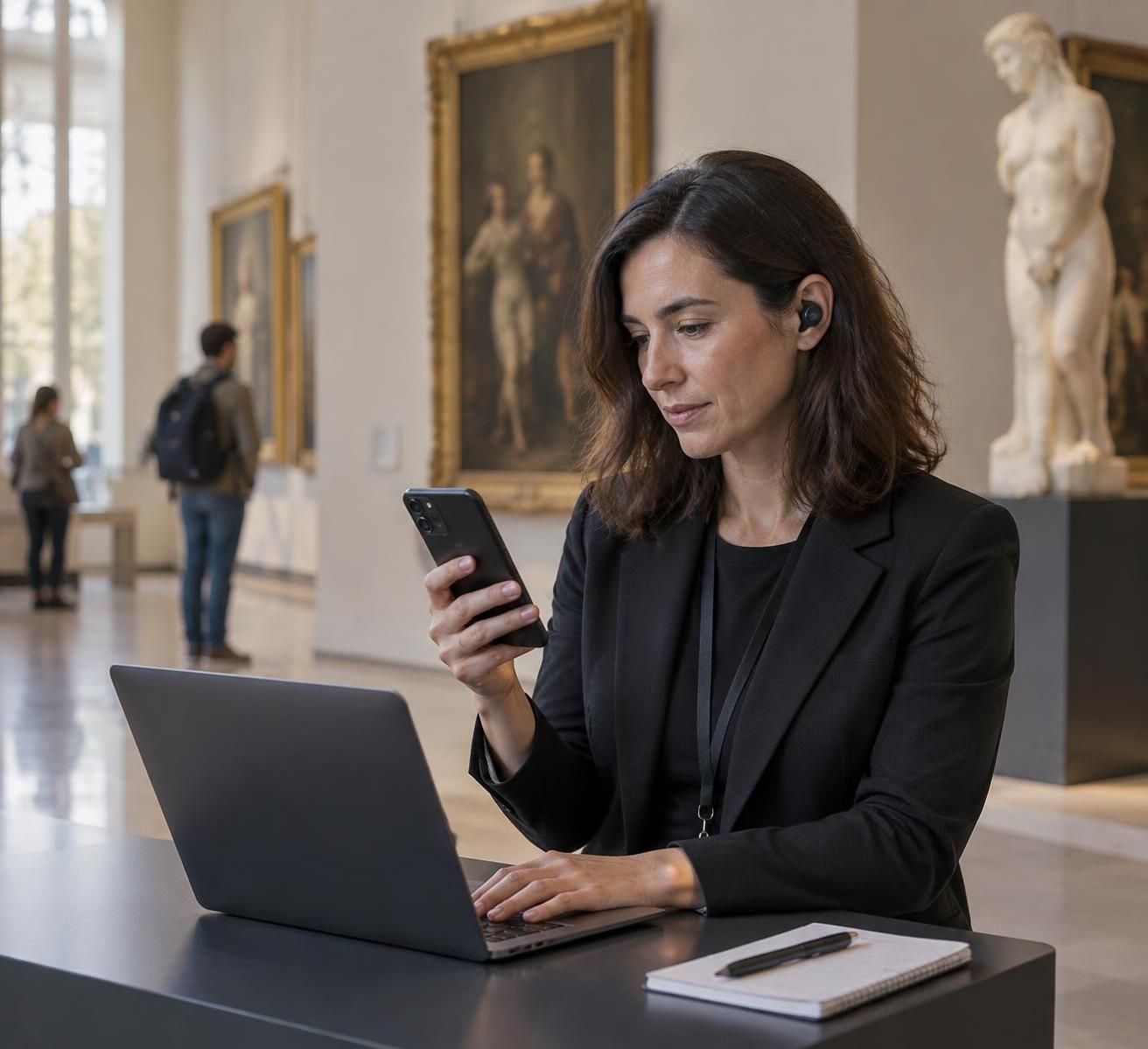
Why Full-Duplex Voice AI Could Make Visitor Conversations Easier
Full-duplex interaction means a system can process incoming speech while producing its own audio. This differs from the familiar pattern in which an assistant waits for silence, generates a response, and then becomes difficult to interrupt. Reports about Dessa emphasize overlapping speech, acknowledgments, and more flexible turn-taking.
For a visitor, these mechanics can determine whether an assistant feels useful or obstructive. Someone who asks about an exhibition may realize halfway through the answer that they meant another room. Being able to say “the upstairs gallery” immediately is more practical than waiting through an irrelevant explanation.
Test interruptions rather than judging a polished demonstration
At Riverside Museum, a visitor asks about a ceramic vessel. The assistant begins describing its manufacture, but the visitor adds, “Sorry, who donated it?” A successful interaction stops or redirects appropriately, recognizes the new question, and avoids continuing the abandoned explanation underneath the visitor’s voice.
That sequence involves several distinct judgments. The system must detect meaningful incoming speech, distinguish an interruption from background conversation, and decide how much of its unfinished response remains relevant. Simply allowing simultaneous audio input and output does not guarantee that these decisions are correct.
Small acknowledgments also deserve scrutiny. A quiet “right” can signal that the assistant is following the visitor, but repeated interjections may become distracting. In a reflective gallery or memorial setting, an enthusiastic conversational style could be inappropriate even when it sounds technically impressive.
- 🎧 Interrupt mid-answer: check whether playback stops promptly and the revised request is understood.
- 🗣️ Use brief acknowledgments: test whether “yes” and “mm-hmm” incorrectly cancel an explanation.
- 🔊 Add realistic background sound: include nearby conversations, reverberation, and footsteps.
- ♿ Vary speaking patterns: include longer pauses, quieter voices, and different speech rates with participants’ consent.
Record the conditions for each trial rather than relying on an overall impression. The same assistant may work well through a close microphone in a quiet room and fail when the phone rests on a bench. Acoustic conditions are part of the product experience, not an incidental technical detail.
Measure conversational recovery and visitor control
A useful measure is recovery success: after an interruption, does the assistant answer the corrected question without requiring a complete restart? Another is false interruption frequency, which captures how often unrelated noise or another person’s speech disrupts the exchange.
Response timing should also be interpreted carefully. An immediate acknowledgment is not the same as an immediate useful answer. Riverside should separately measure the first audible reaction, the start of relevant information, and the time needed to complete the visitor’s task.
Visitors also need visible controls. A stop button, adjustable playback speed, and a straightforward way to repeat an answer remain valuable even with sophisticated turn-taking. Voice-only control can exclude people who cannot speak comfortably or do not want to speak aloud in a public space.
The benefit of full-duplex conversation is not more human-like chatter; it is less effort when visitors clarify, interrupt, or change direction.
What Local Dessa Deployment Would Mean for Museum Operations
Reports describe Dessa running locally on a MacBook Pro with an M4 Max chip or better. That is a hardware claim, not evidence that the system runs on an ordinary visitor smartphone. Operators should distinguish a research demonstration on a powerful laptop from a supported service deployed across a venue.
The distinction is especially important for mobile audio experiences. A smartphone may capture speech and play responses while processing happens elsewhere. Alternatively, selected functions may run on the device itself. Those arrangements have different implications for connectivity, battery life, maintenance, and the movement of visitor recordings.
Compare local processing with the complete service architecture
At Riverside, the technology team considers placing a dedicated computer near an information desk. Local inference could reduce reliance on an external network for the conversational component. Yet the complete experience might still require online access for ticketing, collection updates, monitoring, or software licensing.
The team should therefore request an architecture diagram showing every data exchange. “Runs locally” does not automatically mean “works entirely offline,” and neither phrase establishes that recordings are never retained. Storage policies and external dependencies must be examined separately.
CellCog’s discussion of Block’s text-free speech model provides another account of the reported approach. For purchasing decisions, however, secondary coverage should lead to questions for the supplier rather than replace supported specifications, contractual commitments, or a reproducible deployment test.
| Operational question | Evidence to request | Visitor-facing consequence |
|---|---|---|
| 💻 Where does processing happen? | Documented hardware and network requirements | Service availability and device suitability |
| 🔒 What happens to recordings? | Retention, deletion, and access policies | Privacy and informed participation |
| ⏱️ How many sessions are supported? | Concurrent-load measurements | Waiting times during busy periods |
| 🛠️ How is failure handled? | Recovery procedure and fallback design | Continuity when the assistant stops working |
Hardware suitability also depends on sustained operation. A short demonstration does not establish performance during a full opening day, with multiple visitors and changing room temperatures. Test startup time, memory use, thermal behavior, and recovery after a power interruption under the intended operating conditions.
Budget for operations, not just a successful first conversation
Costs extend beyond access to a model. A venue may need microphones, managed devices, secure installation, staff training, content maintenance, and technical support. If a dedicated workstation serves several visitors, capacity planning becomes as important as the quality of any individual answer.
Riverside can compare three practical configurations: a supervised desk installation, a staff-operated demonstration, and a visitor-facing mobile service. Each should be evaluated against its own requirements rather than treated as a smaller or larger version of the same deployment.
For a related deployment perspective, Grupem’s coverage of air-gapped Voice AI offers a relevant topic to explore. The operational principle remains specific: verify isolation, connectivity, and data handling for the actual configuration being considered.
A local demonstration becomes an operational advantage only when its hardware, capacity, dependencies, and support requirements match the venue.
Making Text-Free Voice AI Accessible and Safe for Cultural Visits
Text-free training must not become a text-free visitor experience. An assistant can learn from audio while the service still provides captions, readable instructions, and alternative input methods. The training approach and the accessibility of the finished interface are separate design decisions.
At Riverside, some visitors prefer reading, others use hearing aids, and others are navigating in a second language. An audio-first interaction may help certain people while creating a new barrier for others. Accessibility therefore needs testing with representative participants rather than assumptions about a typical visitor.
Keep alternatives available without making them second-class
A visitor who cannot hear an answer should be able to access its essential content through another channel. If live captions require an additional speech recognition component, the implementation needs its own accuracy assessment. The presence of a conversational audio model does not automatically provide a reliable written equivalent.
Input alternatives matter just as much. Visitors should be able to select common questions, type where appropriate, or ask a member of staff. These options should remain visible before a voice interaction fails, rather than appearing only after repeated unsuccessful attempts.
Consider a visitor who pauses for several seconds while forming a question. An assistant optimized for rapid exchanges might assume the turn has ended and start answering too early. Testing longer pauses and providing an explicit push-to-talk option can reveal whether the interface allows different communication styles.
Multilingual support requires equally careful verification. A convincing response in one language does not establish dependable performance in another, particularly for place names, artists’ names, dialects, or specialist vocabulary. Riverside should prepare approved pronunciation examples and factual checks for each language it intends to offer.
Manage trust when synthetic speech sounds convincing
Natural laughter, hesitation, and sympathetic phrasing can make a system appear more perceptive than it is. Visitors should receive a clear disclosure that they are interacting with automated software. The interface should not imply human understanding, professional judgment, or personal confidentiality that the service cannot guarantee.
Historical interpretation adds another layer of responsibility. A conversational reconstruction of an artist’s voice could be mistaken for an authentic recording unless it is clearly identified. Permission, attribution, and editorial review are necessary considerations before voice modeling is used to represent a real person.
Riverside should also define topics that require a controlled response. Evacuation instructions, medical concerns, safeguarding issues, and requests for help should route visitors to approved information or human assistance. A fluent answer is not an acceptable substitute for a dependable escalation process.
Privacy notices should explain what is captured, why it is processed, and whether it is stored. Local processing may reduce some transfers, but it does not remove the need for a lawful, transparent approach to personal data, especially where children or incidental bystanders may be recorded.
Accessible conversational design gives visitors meaningful alternatives and clear boundaries, rather than asking everyone to adapt to the same voice interface.
How to Pilot Block-Inspired Voice AI Without Disrupting Guided Tours
A narrowly defined pilot is more useful than an unrestricted conversational launch. Riverside Museum can begin with a supervised information point answering a limited set of exhibition questions. This creates a manageable environment for evaluating usefulness while keeping staff responsible for interpretation and visitor support.
The pilot should not assume that Dessa is commercially available, supported for the intended use, or integrated with existing tourism software. Access conditions and deployment rights need confirmation first. Until then, the reported research can inform an evaluation framework without becoming a procurement commitment.
Choose a task that has a measurable visitor benefit
“Make the museum more innovative” is not a testable objective. “Help visitors identify which gallery contains an accessible route to the current exhibition” is more specific. It provides a defined information source, a clear success condition, and an obvious human fallback.
Riverside should start by documenting how the task works without automation. Staff can record common questions and recurring misunderstandings without collecting unnecessary personal information. That baseline helps determine whether the proposed tool solves an existing problem or merely adds another interface.
Next, prepare a small approved knowledge set and a set of challenging questions. Include ambiguous wording, incorrect assumptions, changes of mind, and requests outside the system’s scope. The desired behavior for an unsupported question should be established before visitors encounter it.
Where external knowledge retrieval or business-system integration is needed, treat it as an additional capability requiring verification. A speech-to-speech demonstration alone does not prove that a model can reliably consult collection records, authenticate a user, or complete a booking.
Keep live guiding and automated assistance in distinct roles
During a guided tour, clear delivery from the human guide may provide more value than an automated conversation. A smartphone-based audio-guide application such as Grupem belongs in that operational discussion: the priority is helping participants hear and follow the visit, not introducing automation for its own sake.
There is no basis here to assume a Dessa integration with Grupem. A sensible division of roles could instead keep the guided experience human-led while testing an independent question-answering point before or after the visit. This avoids competing voices and preserves the guide’s control over timing.
For a broader view of the field, Grupem’s coverage of conversational voice technology provides a related reading route. Compare emerging capabilities against the venue’s actual needs: intelligibility, accessible controls, reliable information, and straightforward staff operation.
Before public testing, assign an owner for content corrections and a separate owner for technical incidents. Staff need a simple way to stop the system, report a problematic answer, and direct visitors to an alternative. These responsibilities should fit normal working practices rather than depend on a specialist being present.
Set acceptance criteria before reviewing the results. Track task completion, factual correctness, interruption recovery, accessibility problems, and requests for human help; also document the conditions in which failures occur. A smaller successful scope is preferable to broad access with unresolved weaknesses.
The strongest pilot proves one useful interaction under real visitor conditions, with a clear fallback and someone accountable for every failure.
Did Block’s Dessa really learn without reading text?
The supplied reports describe training from human speech without written transcripts or a pretrained text model. Spoken recordings still contain language, so text-free means the training medium was audio, not that the system learned without words or linguistic information.
How is speech-to-speech AI different from a conventional voice assistant?
A conventional assistant often converts speech to text, processes the text, and generates spoken output. A direct speech-to-speech system models audio interactions more directly, potentially preserving conversational timing and vocal cues. The exact architecture and supported functions require verification.
Can Dessa run directly on a visitor’s smartphone?
The supplied reports describe local operation on a MacBook Pro M4 Max or better, not ordinary smartphone deployment. Mobile compatibility, hardware requirements, concurrent capacity, and distribution rights should be confirmed before planning a visitor-facing service.
Does natural-sounding Voice AI guarantee accurate museum information?
No. Conversational fluency and factual reliability are separate qualities. Museum deployments need approved information sources, tested answers, clear limits, and an effective route to human assistance.
What should a tourism operator test first?
Choose one narrow visitor task and test factual correctness, interruption handling, background-noise performance, accessibility alternatives, and recovery after failure. Compare results with the existing service before expanding access.
