
Philip Simmons House Museum Roof Repairs Require Immediate Attention
A punctured roof threatens more than the fabric of a small Charleston cottage. At the Philip Simmons House Museum, water entering the building puts the setting of an exceptional artisan’s life—and the materials used to interpret that life—at risk.
According to Charleston City Paper’s October 2026 report on the repair needs, a fallen tree limb pierced the roof in September, allowing rainwater into a bathroom. The foundation responsible for the property estimated the immediate repair costs at less than $15,000, although the published account does not provide a complete contractor’s scope or an itemized budget.
The timing is particularly difficult. Recognition through the National Register of Historic Places has brought attention to the property at 30½ Blake Street, but recognition does not automatically provide the cash needed to stop a leak.
Separate emergency roof protection from longer-term building restoration
For a small heritage organization, the first task is to distinguish urgent stabilization from the broader maintenance program. Temporary weather protection, assessment of damaged roof components, and examination of the affected bathroom should precede cosmetic improvements.
This sequence matters because moisture can travel beyond the point where it becomes visible. A stain on a ceiling does not establish the full extent of damage, and fresh paint cannot resolve an active water pathway.
Consider a hypothetical museum coordinator preparing a contractor visit. Rather than requesting a general “roof fix,” the coordinator assembles dated photographs, records where water appeared, and asks the contractor to distinguish temporary protection, permanent repair, and any recommended investigation of concealed materials.
That approach creates a usable record for the board, insurers, prospective donors, and preservation advisers. It also reduces the risk of comparing quotations that cover different work.
- 🛠️ Stop further water entry: have qualified professionals assess safe temporary protection and permanent roof repairs.
- 📷 Document the affected areas: record visible damage without disturbing potentially fragile historic materials.
- 💧 Assess interior moisture: determine whether drying, material repair, or specialist treatment is necessary.
- 📋 Define the repair scope: separate urgent work from the access ramp, exterior painting, and other outstanding tasks.
The neighboring tree introduces a separate issue. Foundation chair Elmer Gilliam Jr. told the newspaper that the limb came from an adjoining property and that efforts to secure the neighbor’s cooperation had been difficult, including earlier discussions about trimming.
That account does not establish legal liability. The practical response is to preserve correspondence, obtain appropriate insurance and legal advice, and avoid making essential protection dependent on resolving the dispute.
For visitors, the operational question is straightforward: can the property be accessed safely while work proceeds? Any affected room or route should be assessed before access is offered, with temporary arrangements explained clearly rather than left for visitors to discover on arrival.
⚠️ Critical maintenance should follow the path of risk: keep water out, assess what it reached, and document what must happen next. Once that immediate sequence is established, the foundation can make stronger decisions about the historic fabric it is protecting.
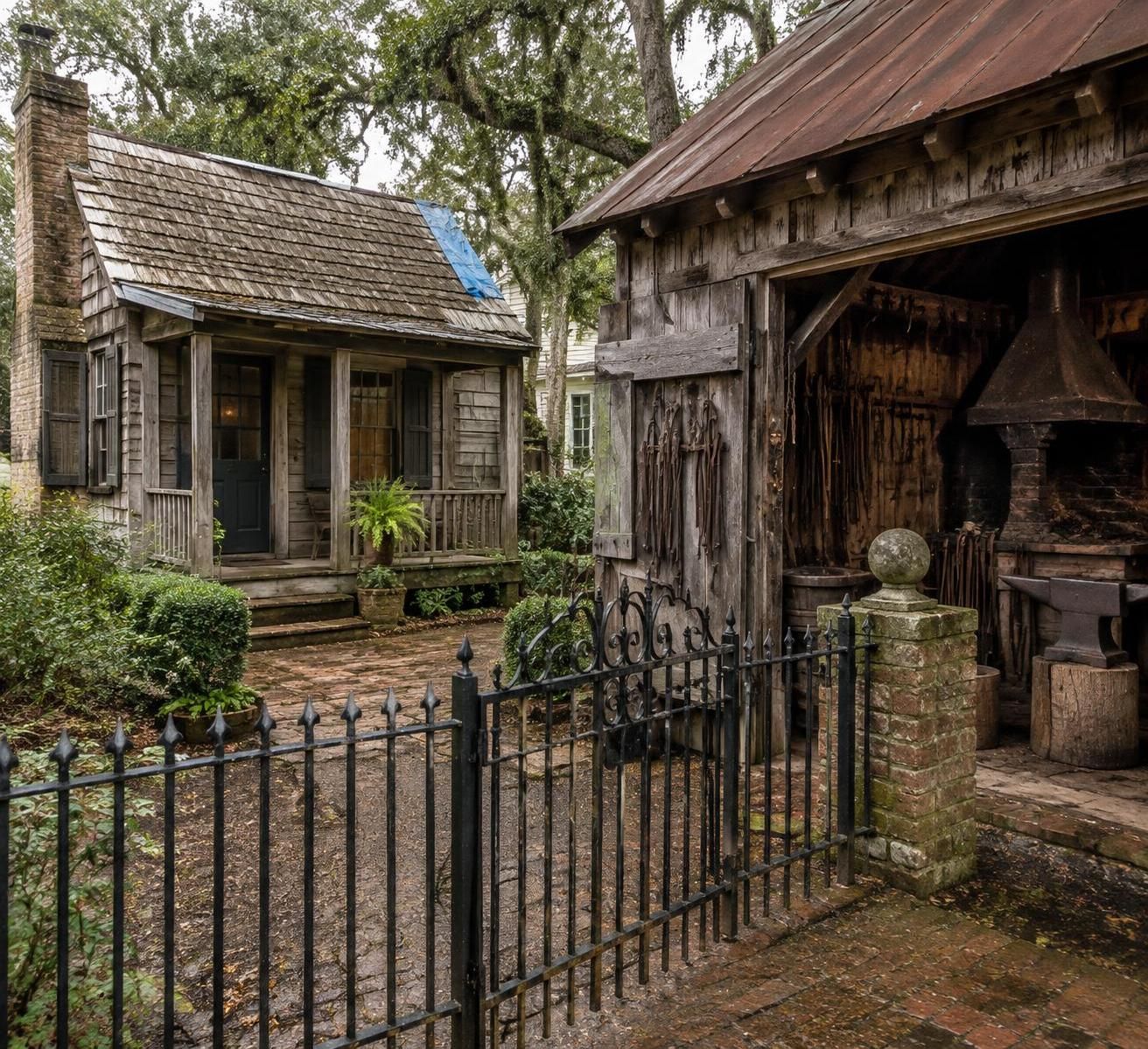
Protecting Charleston’s Historic Architecture and Philip Simmons’s Working Legacy
Philip Simmons’s importance cannot be understood through the cottage alone. The neighboring forge, surviving ironwork, and relationship between domestic life and skilled labor explain why this modest property is a cultural landmark rather than simply an old building requiring attention.
Simmons, who lived from 1912 to 2009, developed a 77-year career in ironwork. His decorative gates, railings, and related commissions became part of Charleston’s streetscape, giving residents and visitors repeated encounters with his craftsmanship beyond the museum itself.
He purchased the two-bedroom cottage in 1959. Today, the building serves as a small museum and gift shop beside the workshop associated with his working life.
Preserve the relationship between the cottage, forge, and ironwork
The Philip Simmons Foundation’s description of its mission emphasizes documentation, exhibition, and education. That combination gives building restoration a clear purpose: protecting the physical setting so that people can continue learning from the work and the circumstances in which it was made.
For example, a visitor examining a gate inside a conventional gallery might appreciate its curves and joinery. Encountering comparable work beside a forge adds questions about heat, tools, physical effort, workshop organization, and the knowledge passed between craftspeople.
Those relationships should guide repair decisions. Where historic material remains serviceable, a preservation specialist can assess whether repair is preferable to replacement; where replacement is necessary, its compatibility and documentation matter.
This does not mean assuming every surface dates from Simmons’s occupancy or that every alteration must be retained. It means establishing significance before removing material, particularly where evidence of workshop use or earlier construction may survive.
Evaluate fundraising sales without weakening the collection
The October reporting describes original iron pieces, including gates and window grilles, near the museum entrance. Project administrator Rossie Colter proposed auctioning some pieces to raise money, while Gilliam noted that cleaning and repainting would be needed first.
A proposed sale is not the same as an approved disposal plan. Before any transaction, the foundation should establish ownership, provenance, collection status, and whether restrictions apply.
Conservation advice is equally important. Cleaning or repainting can change evidence of manufacture, historic finishes, and condition; treatment should therefore follow an assessment rather than a desire to make an object more immediately attractive.
For the hypothetical coordinator, a practical inventory would connect each object to photographs, dimensions, known history, condition notes, and its role in interpretation. A gate with a documented connection to the workshop may carry educational value that an auction estimate does not capture.
Alternative fundraising options could include sponsorship of conservation work, commissioned contemporary pieces, or donations linked to specific repair milestones. These are possibilities to evaluate, not existing programs or guaranteed substitutes for a sale.
The American College of the Building Arts offers another connection between preservation and use. Students temporarily used the shuttered workshop as a classroom in 2025, and provost Christina Rae Butler has expressed interest in its continuing role as a learning laboratory.
Any future teaching arrangement would require suitable safety, access, supervision, and operating agreements. The strongest preservation outcome keeps the place meaningful as well as standing: its buildings, objects, and educational uses should reinforce one another.
What National Register Recognition Means for African American Heritage
The National Register of Historic Places brings a different kind of visibility to the property. It places the site within a documented account of historical significance, helping explain why a small East Side address deserves sustained attention.
The supplied October 2026 reporting describes the nomination as accepted by the National Park Service, while noting that the final edited documentation had not yet appeared on the agency’s website. Earlier coverage concerned state-level nomination approval, a preceding stage rather than an interchangeable description of federal listing.
That distinction matters when preparing grant applications, donor materials, or visitor information. Public communications should use the designation and documentation available for the relevant date, rather than blending separate stages into one announcement.
Interpret Rosetta Simmons alongside the celebrated blacksmith
The property’s significance also includes Rosetta Simmons, whose civil rights activity encompassed the 1969 Charleston hospital workers strike. That history broadens the interpretation beyond individual artistic achievement to include organizing, labor, and community life.
The strike is an important reference point in Charleston’s civil rights history. Presenting it alongside the blacksmith’s career helps visitors understand that African American heritage includes both renowned creative work and the collective struggles that shaped everyday opportunities.
A thoughtful visit would not treat Rosetta’s story as a brief addition at the exit. It would give her activities an identifiable place in the interpretation, supported by reliable sources and clearly distinguished from stories centered on Philip.
For example, a short audio segment could explain the strike’s context before inviting visitors to examine an authorized photograph or document. The sequence should distinguish verified historical evidence from later recollections and avoid implying that an event occurred inside the cottage unless documentation supports that claim.
Professionals planning comparable interpretation can use the questions raised by Grupem’s coverage of a Boston Black history museum as a starting point for considering how institutional care, public access, and historical representation intersect. Local research must still determine the content presented in Charleston.
Treat designation as a funding tool, not a repair guarantee
National Register recognition does not automatically finance restoration. It may support eligibility for particular incentives or strengthen an application, but each program has its own rules, review procedures, and financial requirements.
State historic tax credits were identified in the reporting as a potential avenue. For a nonprofit steward, however, eligibility does not establish that a credit will translate into usable project funding; ownership, tax status, qualifying expenditure, and applicable program structures require specialist review.
The same caution applies to grants. Some programs reimburse approved spending rather than providing money upfront, while others require matching funds or restrict work undertaken before authorization.
The hypothetical coordinator should therefore maintain a funding file containing the designation record, ownership documents, project photographs, estimates, and a clear account of the proposed treatment. This makes the site easier to assess without suggesting that every opportunity will fit.
Why devote time to paperwork while a roof needs attention? Because a well-defined project can be explained consistently to preservation officers, funders, and contractors, reducing avoidable delays between interest and a decision.
Historical recognition establishes a stronger case for care; operational preparation turns that case into a project others can support.
Building a Practical Funding Plan for Roof Repairs and Critical Maintenance
The reported estimate of less than $15,000 gives supporters a tangible starting point, but it should not become a promise that the entire property can be restored for that amount. The bathroom, access ramp, exterior finishes, and workshop needs represent distinct responsibilities.
A credible appeal separates an immediate weatherproofing objective from subsequent rehabilitation. Donors can then understand whether their contribution supports emergency protection, a defined construction package, or longer-term stewardship.
Gilliam indicated that a broader campaign could begin as early as spring 2027. That prospective timetable should not be presented as a confirmed launch, and it does not remove the need to identify interim resources for urgent work.
Match each repair package to a realistic source of support
South Carolina’s Department of Archives and History administers a State Grant Fund supporting eligible historic-building repair and rehabilitation. The South Carolina Preservation Toolkit also identifies grants, tax incentives, and revolving loan arrangements as possible tools.
These options are not interchangeable. A loan requires repayment capacity, a grant may require a match, and an incentive may depend on conditions that do not suit the ownership or project.
References to a federal funding pause and changing administrative rules should also be checked against the specific program’s current guidance. A previous notice is not a reliable basis for assuming that every federal opportunity remains unavailable—or that an application will be accepted.
| Work package | Potential support | Decision to establish first |
|---|---|---|
| 🛠️ Roof stabilization and permanent repair | Unrestricted gifts, a focused appeal, applicable insurance | Confirmed scope, safe access, and coverage conditions |
| 💧 Bathroom assessment and repair | Project donations or an eligible rehabilitation grant | Extent of moisture damage and required treatment |
| ♿ Access ramp improvements | Accessibility-focused support or designated contributions | Compliant design compatible with the historic setting |
| 🏛️ Wider property rehabilitation | Preservation grants, suitable incentives, staged fundraising | Eligibility, matching requirements, and ongoing upkeep |
Ken Battle, founder of the Black Heritage Trail of the Lowcountry, offers a potential community connection. The reporting says he intended to raise money during his one-year presidency of the Exchange Club of Charleston, although he had not yet discussed the proposal with Gilliam.
That distinction should remain visible: an expressed intention is not a finalized fundraising partnership. Before promoting an event, the parties should agree on the beneficiary, payment route, permitted expenses, and how results will be reported.
Nearby precedents can help demonstrate that patient organizing has value. The reported $250,000 state award for Mount Pleasant’s Long Point Schoolhouse illustrates one preservation outcome, but its amount and eligibility cannot be transferred to this project.
Likewise, the National Trust’s reported $13.5 million in support for historically Black churches concerns a particular funding category. It signals broader investment in heritage without establishing that a house museum qualifies for the same awards.
For useful operational comparisons, Grupem’s discussion of museum recovery at Pass-a-Grille offers a related topic to examine when planning how to communicate disruption and recovery. The Charleston foundation still needs its own costed priorities and approvals.
A donor update should state what has been raised, what has been contracted, and what remains unfunded. Transparent milestones turn a general appeal for help into an accountable maintenance program.
Maintaining Visitor Access Without Distracting From Building Restoration
Repair work can interrupt a visit, but interpretation does not have to disappear while contractors address the building. The challenge is to maintain a useful public connection without drawing people into unsafe spaces or spending emergency funds on unnecessary technology.
For tourism professionals, the first requirement is accurate operational information. Before promoting a stop at the Philip Simmons House Museum, confirm current opening arrangements, accessible routes, group limits, and whether any indoor areas are unavailable.
A map listing or old social-media post may outlast a temporary closure. The foundation’s own current communications should therefore guide visitor instructions, supported by consistent updates wherever the site is promoted.
Use smartphone audio to explain what visitors can safely see
A small, mobile-friendly audio experience could connect the cottage, workshop, and publicly accessible examples of Simmons’s ironwork. This is a proposed interpretation approach, not a claim that the museum currently operates a digital tour.
A smartphone-based tool such as Grupem can be evaluated for guided delivery where its available functions match the organization’s needs. The decision should begin with audience size, connection requirements, staff capacity, and accessibility—not with an assumption that a new app will solve the maintenance problem.
For the hypothetical coordinator, a restrained pilot might contain three short stops: the relationship between home and forge, the craft behind a documented ironwork example, and Rosetta Simmons’s place in the site’s history. Each recording would need source checking and a clear reason for being heard at that location.
Location matters acoustically as well as historically. Street traffic, nearby groups, and outdoor conditions can make otherwise clear narration difficult to follow, so test recordings in the setting where visitors will actually listen.
Digital interpretation should supplement the place, not pretend to replace access to it. A recording can explain a closed workshop, but it cannot reproduce the scale, material detail, or atmosphere of standing inside an authentic working environment.
Make accessibility and permissions part of the first draft
Every audio segment should have a readable text equivalent. Visitors who are Deaf or hard of hearing, people who prefer reading, and those without suitable headphones should receive the same essential historical information.
Access also involves navigation. If the ramp needs work, online descriptions should explain the verified temporary arrangements rather than relying on a broad claim that the museum is accessible.
Permissions require equal care. Historical photographs, recorded interviews, music, and commissioned narration may have separate rights, so inclusion in an educational project does not automatically authorize publication.
Artificially imitating Simmons’s voice would introduce another problem: visitors could mistake a generated performance for an archival recording. Clearly identified narration is a more responsible way to explain his life unless a carefully governed project establishes an appropriate basis for another approach.
The pilot should be tested by someone unfamiliar with the property. Ask whether the route is understandable, the text is legible, the audio is intelligible, and the distinction between historical fact and present-day commentary remains clear.
Measure practical results: fewer confused arrivals, better understanding of temporary restrictions, and manageable staff support demands. Listening figures alone do not demonstrate a successful experience.
For a site facing urgent repairs, the appropriate digital investment is modest and reversible. A useful visitor service explains the heritage clearly, respects current access limits, and leaves the preservation budget focused on protecting the building.
What caused the damage to the Philip Simmons House Museum roof?
Charleston City Paper reported in October 2026 that a tree limb had punctured the roof the previous month, allowing rainwater into a bathroom. The foundation said the limb came from a neighboring property; that account does not by itself determine legal liability.
How much money is needed for the repairs?
The foundation’s reported estimate was less than $15,000 for the immediate repair needs. That figure should not be treated as a complete budget for the access ramp, exterior painting, workshop, and all longer-term rehabilitation.
Does National Register recognition pay for restoration?
No. Recognition can support eligibility for certain preservation programs and incentives, but funding requires separate applications and compliance with each program’s conditions. Tax credits also require an assessment of whether they are financially usable by the property’s owner.
How can supporters help responsibly?
Contact the Philip Simmons Foundation through its official channels to confirm current priorities, donation arrangements, and authorized volunteer opportunities. Do not begin building work, clean historic ironwork, or organize a fundraiser in the foundation’s name without approval.
Can visitors enter the museum while repairs are underway?
Confirm current arrangements directly with the foundation before traveling or scheduling a group. Access may depend on construction activity, safety assessments, and the availability of an appropriate visitor route.
