
Key points at a glance: ✅ The UK Museum states that the Bayeux Tapestry is Virtually Unchanged after its transport from France. ✅ French Concerns focused on two thread breaks and slight tears, but the joint assessment identifies no major Damage. ✅ This exceptional loan demonstrates why rigorous Preservation, documented monitoring, and clear visitor communication are essential for any Historical Artifact on display abroad.
UK Museum Confirmation places the Bayeux Tapestry condition in context
The British Museum has stated that the Bayeux Tapestry remains “virtually unchanged” following its arrival in London. The Museum Confirmation responds directly to concerns raised in France after two broken threads were reported on the nearly 70-metre embroidered work. For a Cultural Heritage object that is approximately a thousand years old, even a minor observation naturally attracts public attention. Yet conservation vocabulary matters: a tiny thread break is not automatically evidence of a damaging transport event.
The reported finding concerns two breaks measuring only a few millimetres. French Culture Minister Catherine Pégard explained that specialists inspected the textile with exceptional care, proceeding centimetre by centimetre. This is an important detail for museums, heritage venues, and guided-tour operators: the slower and more precise the assessment, the more likely it is that specialists will identify pre-existing weaknesses, minute changes, and areas requiring future observation.
The British Museum’s position is based on a draft condition report comparing the tapestry before and after its journey. The report has not yet been finalised or jointly approved by British and French conservators. However, the preliminary evidence strongly indicates that its overall state has not materially changed. The museum also noted that thread breaks of this scale may have occurred at any point after the “before” photographs were taken at Bayeux Museum in September 2025.
This distinction protects the public debate from a misleading binary: either “perfectly untouched” or “damaged in transit.” Fragile textiles do not work that way. Their condition is assessed through a detailed record of fibres, stitches, linen support, previous repairs, surface tension, folds, humidity response, and visible distortion. A conservation team does not simply look for a dramatic tear. It establishes whether a difference is meaningful, attributable, and likely to affect the object’s stability.
Why two broken threads triggered French Concerns
French Concerns are understandable because the Bayeux Tapestry is not an ordinary exhibit. The linen embroidery narrates the events leading to the Norman Conquest of England in 1066, including the Battle of Hastings and William the Conqueror’s invasion. It is widely associated with English production before its long-term presence in Bayeux, France. Its loan to Britain therefore carries historical, emotional, diplomatic, and technical significance.
The work is believed to be leaving France for the first time in more than nine centuries. It also represents its first move in over 40 years. With so few comparable journeys, the public expects extremely high standards. A single conservation detail can quickly become a headline, particularly when it involves a work that is both famous and visibly fragile. The responsible response is not to minimise the observation, but to explain its scale and its place within the full condition record.
For visitor-facing teams, this episode is a useful example of transparent mediation. A museum educator, guide, or audio-tour producer should avoid framing the situation as a dispute between France and the United Kingdom. The more accurate story is one of shared oversight: French and British specialists are reviewing the same material evidence and working toward a jointly agreed final report.
A practical audio-guide segment could explain that textiles age differently from stone or metal. Their visual continuity depends on thousands of fibres and stitches, some of which may already be weak because of age, past display methods, or earlier handling. This helps visitors understand why Conservation is a continuous process rather than a single transport decision.
- 🧵 Observed issue: two thread breaks only a few millimetres long.
- 🔍 Assessment method: a detailed centimetre-by-centimetre examination by specialist teams.
- 📷 Comparison point: photographs recorded before transport in September 2025.
- 🏛️ Current finding: no visible alteration was initially reported, while the later draft assessment indicates an object that is virtually unchanged overall.
- 🤝 Next step: British and French conservators must agree the final condition report.
The central lesson is straightforward: a high-profile object can be carefully monitored without turning every minute change into proof of failure. Accurate language is itself part of good heritage stewardship, and it prepares audiences to understand the transport safeguards behind the exhibition.
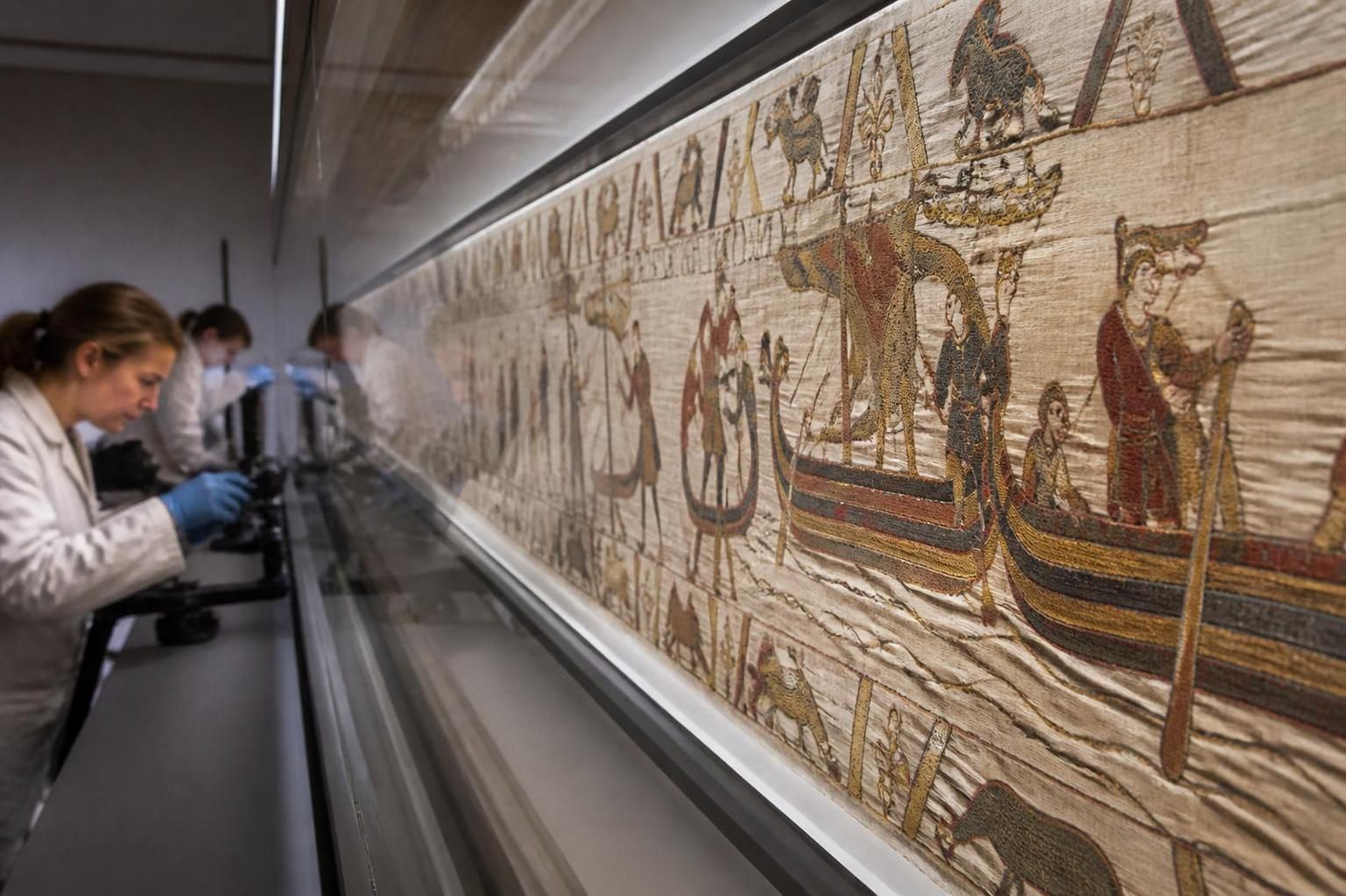
Bayeux Tapestry Preservation depended on controlled transport and documentation
Moving the Bayeux Tapestry required much more than careful packing. The Historical Artifact travelled to London inside a specially engineered double case designed to reduce vibration and maintain stable temperature and humidity. Those safeguards address the main risks facing aged embroidery: mechanical stress, abrupt climate variation, accidental movement, and excessive exposure during loading or unloading.
For a linen textile, vibration can be particularly problematic because movement affects not only the visible stitches but also the support fabric underneath. A case that isolates shocks reduces the risk of repeated micro-movements. Stable relative humidity is equally important. Air that is too dry may increase brittleness, while rapid humidity rises may affect tension and encourage deformation. Temperature control supports the same objective: keeping the object in a predictable environment throughout the journey.
The July arrival assessment was described as the first complete examination of the tapestry since 2020. That gap does not mean the work had been ignored; it highlights the scale of a full condition survey for a 68-metre embroidery. Such an undertaking needs time, consistent lighting, high-resolution reference images, and conservators trained to distinguish long-standing features from recent changes.
From pre-loan checks to post-arrival comparison
Professional Preservation begins before an object leaves its usual location. The lending institution records its known vulnerabilities, including loose fibres, prior repairs, areas of thinning, creases, and existing stains. It then supplies a reference record that the receiving museum can use upon arrival. This process creates accountability without assuming that every difference has a single or immediate cause.
| Preservation stage | Purpose for the Bayeux Tapestry | Visitor-facing value |
|---|---|---|
| 📷 Pre-transport imaging | Creates a precise baseline for identifying changes. | Shows why claims of Damage require comparison, not speculation. |
| 📦 Double protective case | Limits vibration and supports stable climate conditions. | Explains that transport is a controlled technical operation. |
| 🔎 Arrival examination | Checks the embroidery and linen after the journey. | Builds confidence through evidence-based Museum Confirmation. |
| 📝 Joint final report | Aligns findings between French and British specialists. | Demonstrates shared responsibility for Cultural Heritage. |
For smaller museums and travelling exhibitions, the same principles apply at a more modest scale. A local archive lending a delicate costume or embroidered banner may not have a bespoke double case, but it can still create a photographic baseline, use a padded crate, monitor environmental conditions, limit handling, and designate one person responsible for the handover record. The method is scalable.
Consider a hypothetical municipal museum in Kent preparing to lend a nineteenth-century textile sampler. Its project manager photographs each edge, logs prior damage, agrees handling rules with the host venue, and checks that the display case is stable before delivery. These actions are not bureaucratic extras. They make it possible to distinguish a known loose fibre from a new concern, just as the Bayeux Tapestry assessment relies on comparison material.
Visitors often see only the final display. Smart interpretation should make the invisible work visible through concise audio content, touchscreen timelines, or staff-led explanations. The public does not need every laboratory detail, but it benefits from understanding that safety begins with documentation and continues throughout the loan period. Reliable Conservation is built on evidence collected before, during, and after movement.
Those planning a visit can also consult practical information about the Bayeux Museum tapestry loan to understand the wider significance of this rare cross-Channel collaboration. The next question is how an institution can display such a fragile work without compromising either access or care.
Displaying a fragile Historical Artifact without compromising access
The Bayeux Tapestry loan creates a demanding balance: the public should be able to experience a landmark of medieval storytelling, while the object must be protected from avoidable stress. Display is never neutral for textiles. Light exposure, visitor proximity, ambient fluctuations, mounting methods, and the length of the exhibition can all affect long-term stability. This is why the journey and the gallery environment must be treated as one continuous Preservation plan.
The work is scheduled to be displayed at the British Museum from the following week until July of the next year, according to the announced loan timetable. A display period of this kind requires more than an impressive room. It requires stable environmental control, appropriate lighting levels, physical barriers, trained gallery staff, and contingency planning for any change detected during regular checks.
The choice of a long, linear presentation also affects visitor experience. At 68 metres, the Bayeux Tapestry cannot be absorbed in a single glance. Visitors need orientation: where should they start, what episodes should they notice, and how can they follow the narrative without causing congestion? The answer is not necessarily more signage. It is an experience design question involving pace, accessibility, and clear interpretation.
Audio interpretation supports protection as well as engagement
A well-designed audio guide can reduce the need for groups to cluster around a single label or a guide holding up a visual aid. Visitors can receive location-based commentary, use headphones, and move at a comfortable pace. This is especially valuable around fragile Cultural Heritage displays where the museum needs to maintain a respectful distance between people and the object.
For example, a guide could divide the tapestry into concise narrative stops: Harold’s oath, the preparations for invasion, the Channel crossing, the Battle of Hastings, and the aftermath. Each stop can include a clear visual cue, such as a distinctive horse, ship, or embroidered figure. That approach lets visitors look carefully instead of straining to hear a crowded group explanation.
Accessibility should also be considered from the beginning. Audio descriptions can help visitors with visual impairments understand composition and detail. Captioned transcripts support deaf and hard-of-hearing audiences. Multiple language versions are valuable for international visitors, particularly for an object whose identity spans England, Normandy, France, and Britain’s shared history.
Digital interpretation should not overload the gallery. A visitor does not need a screen at every metre of fabric. The strongest approach is selective: offer essential context before entering, deliver short explanations at key points, and make deeper content available on demand. This keeps the focus on the artifact itself rather than on the device.
- 🎧 Begin with orientation: explain the tapestry’s length, chronology, and the recommended direction of travel.
- 🧭 Use short narrative stops: connect major scenes to recognisable visual details.
- ♿ Provide accessible formats: include transcripts, audio description, and language options.
- 🚶 Support visitor flow: encourage individual pacing rather than crowding around one point.
- 📱 Keep technology discreet: use the smartphone as a guide, not as a distraction from the embroidery.
Tourism professionals can apply this model without expensive proprietary receivers. A smartphone-based system such as Grupem allows guides and venues to provide clear live audio while helping groups remain distributed and attentive. The operational benefit is tangible: better listening quality can mean fewer people pressing forward near delicate displays.
The Bayeux Tapestry is a powerful reminder that access is not the opposite of care. When interpretation is thoughtfully designed, it can protect the object, improve comprehension, and make a complex historical narrative easier to follow. A quieter, better-informed visitor journey is often a safer one for the collection.
French Concerns and British Conservation show the value of shared stewardship
The conversation around the tapestry’s condition has a diplomatic dimension, but it should first be understood as a practical example of cross-border Conservation. France remains the lender and guardian of the work’s long-standing home in Bayeux. The British Museum is the host institution responsible for safe display in London. Both sides have a legitimate duty to scrutinise the condition report closely.
French officials have not described catastrophic deterioration. Catherine Pégard stressed that the issues were minor, while a report cited by La Croix referred to no major damage and mentioned slight tears in two areas of the linen canvas. The British Museum, meanwhile, has emphasised that the draft findings point to a tapestry that is virtually unchanged. These descriptions can coexist: a very old textile may contain small vulnerabilities while its overall condition remains stable.
This is where public communication needs precision. Saying “no major damage” is not identical to claiming that every fibre is exactly as it was. Saying “virtually unchanged” acknowledges that minor observations can exist without altering the work’s general state or exhibition viability. That nuance is not evasive language. It is the appropriate language for a complex object whose condition includes centuries of history.
Trust requires evidence, not ceremonial reassurance
King Charles III described the loan as a precious sign of trust during a period when trust between nations can seem scarce. President Emmanuel Macron expressed hope that the two countries would strengthen their bond as closely as the threads of the embroidery. These statements are symbolically important, but their credibility ultimately depends on technical practice: agreed protocols, transparent records, joint review, and a willingness to communicate findings accurately.
Heritage loans often become national stories because they involve identity as well as logistics. The Bayeux Tapestry depicts a decisive moment in English history but has been preserved in France for centuries. Its temporary display in London is therefore not simply a change of venue. It invites visitors to examine how historical narratives move across borders, how collections acquire meaning in different places, and why ownership, custody, and access can be distinct concepts.
A useful case study for cultural venues is a partnership between a regional French museum and a UK city museum. Before a loan is announced, both teams should agree on the vocabulary they will use if a condition issue is detected. “Observation,” “change,” “damage,” “treatment need,” and “display restriction” should not be used interchangeably. Staff should know who can speak publicly, when the lender will be notified, and what evidence will be published.
This level of preparation avoids a common mistake: letting social media or incomplete reports define the story before conservators complete their work. A short, factual update is usually more helpful than either silence or excessive reassurance. It can identify what has been observed, explain what remains under review, and state what protective measures are in force.
For guides and visitor-services teams, the right tone is equally important. They should not dismiss questions about Damage, nor should they speculate about responsibility. A clear explanation can state that both teams performed careful inspections, that the draft report is still awaiting agreement, and that the available assessment finds no significant change to the tapestry’s overall condition.
The outcome offers a standard worth retaining: shared Cultural Heritage requires shared evidence, shared decisions, and shared accountability. This principle extends far beyond one medieval embroidery, especially as international exhibitions become more ambitious and audiences expect institutions to be transparent.
Planning a responsible Bayeux Tapestry visitor journey in London
For visitors, the most meaningful response to the Museum Confirmation is neither alarm nor complacency. It is preparation. The tapestry’s exceptional status is likely to generate strong interest, timed-entry demand, and a gallery experience that rewards patience. Planning ahead helps visitors spend more time understanding the work and less time navigating queues, noise, or incomplete information.
Start with practical access details. Visitors should confirm dates, entry conditions, accessibility services, and any guidance on bags, photography, or group arrangements before travelling. Because loan exhibitions can have specific operational requirements, it is sensible to rely on the host museum’s current information rather than assumptions based on other galleries. Those looking for planning guidance can review Bayeux Tapestry ticket information before organising a visit.
The visit itself benefits from a simple narrative plan. The embroidery is often described as a record of the Norman Conquest, yet it is also a sophisticated work of visual communication. Its scenes combine figures, animals, ships, inscriptions, borders, gestures, and episodes of violence. Visitors who approach it only as a historical timeline may miss the way the makers used repetition and symbolism to direct attention.
Turning a famous display into an informed, accessible visit
A school group, for instance, can be assigned three observation tasks before entering: identify a scene of preparation, locate a moment of conflict, and find an image in the border that changes the meaning of the central action. This gives pupils a clear purpose without asking them to read every label. Adults benefit from the same principle. One or two focused questions create a more memorable encounter than a rush from one end to the other.
Guides should also manage sound carefully. In a busy exhibition, raising one’s voice is ineffective and can disturb other visitors. Smartphone audio systems allow a guide to speak at a normal volume while participants listen through their own devices. They can also deliver a brief opening briefing before the group approaches the display, reducing the need to stop at narrow points along the visitor route.
For museum teams, the experience should extend beyond the gallery. A pre-visit page can clarify the historical context and expected duration. A post-visit audio track can revisit selected scenes and connect them to Bayeux, Norman history, and the wider story of Anglo-French relations. This layered approach respects different attention spans while giving interested audiences a route to deeper learning.
It is also useful to distinguish this major heritage presentation from the broader range of British Museum programming. Visitors interested in current cultural activity can explore information related to the British Museum’s Pink Ball event, while keeping exhibition schedules and ticket conditions separate. Clear information architecture prevents confusion and supports a smoother visitor experience.
The Bayeux Tapestry demonstrates that historic displays do not need to feel distant or inaccessible. With concise interpretation, practical preparation, and respectful pacing, visitors can engage with every layer of the story: medieval warfare, artistic technique, cross-Channel history, and the modern work of Preservation. The best visit combines close looking with a clear understanding of why this fragile object is being protected so carefully.
Did the Bayeux Tapestry suffer major damage during transport to London?
No major damage has been reported. French specialists identified two very small thread breaks and slight tears in two areas of linen, while the British Museum says the draft condition report indicates that the tapestry is virtually unchanged overall.
Why is the final condition report still important?
The draft report must still be agreed by both British and French conservation teams. A jointly validated report ensures that the condition assessment is evidence-based and accepted by the lender and host museum.
How was the Bayeux Tapestry protected during its journey?
It travelled under tight security in a specially designed double case intended to reduce vibrations and keep temperature and humidity stable throughout transport.
What does virtually unchanged mean for a thousand-year-old textile?
It means the overall condition is considered materially stable when compared with the pre-transport reference record. Tiny thread breaks or pre-existing fragile areas can be documented without amounting to significant new damage.
