
Hollywood Stars Debate AI Voice Cloning Technology and Digital Identity
🎬 The central issue is no longer whether synthetic voices can sound convincing. In Hollywood, the pressing question is who has the authority to create, approve, sell, and withdraw a digital version of a performer’s voice. AI Voice Cloning Technology can now reproduce tone, rhythm, accent, and vocal texture from relatively limited recordings. That technical progress is creating new opportunities for localisation, accessibility, games, audiobooks, and virtual assistants, but it is also exposing major weaknesses in consent and copyright systems.
The Hollywood Debate is especially visible because a voice is not simply an audio asset. For a Celebrity, it is part of public identity; for a working performer, it is often the core tool used to earn a living. A recognisable voice can carry years of training, emotional nuance, regional character, and audience trust. When that voice is copied without permission, the harm is not only financial. It can mislead listeners, damage reputations, and blur the line between a genuine performance and a Deepfake.
Several public disputes have made the issue easier to understand. Morgan Freeman has previously challenged unauthorised uses of a voice that resembled his. Scarlett Johansson’s public objection to an AI voice perceived as closely echoing her own brought the problem beyond specialist circles. These cases helped audiences recognise that a synthetic voice can produce the same confusion as manipulated images: a listener may assume a performer endorsed a message, product, or political statement when they did not.
Hollywood Stars are not responding in one unified way. Some established names are licensing controlled replicas through specialist platforms. Their rationale is practical: a properly negotiated licence can create new revenue while enabling translations, archival projects, accessibility formats, and interactive experiences. Michael Caine, for example, has licensed his voice for AI-supported narration, including a long-form version of Homer’s Odyssey. Matthew McConaughey has used comparable technology to make his newsletter available in Spanish.
For others, the same Innovation looks less like a service and more like a permanent replacement mechanism. Voice professionals who depend on commercial spots, online explainers, low-budget audiobooks, training modules, and social content have seen parts of this market move rapidly toward inexpensive generated speech. The result is a divided industry: high-profile performers may negotiate substantial payments and strict terms, while emerging talent can face contracts that exchange long-term control for a short-term fee.
A useful way to frame the issue is to separate authorised replication from identity theft by audio. Permission, payment, purpose, duration, and the ability to revoke access matter. Without these safeguards, a voice sample can become a reusable digital product with consequences far beyond the original recording session. This is why the campaign supported by performers including Nicola Coughlan, Hugh Bonneville, and Matt Lucas has focused on stronger legal ownership of a person’s voice. Coverage of the Save Our Voices Now campaign shows how public figures are calling for protections that apply before, not after, misuse occurs.
For cultural organisations and tourism professionals, this Debate should not be dismissed as a distant Hollywood dispute. A museum guide, historian, local storyteller, or destination ambassador may also have a distinctive voice that represents a public service. If an institution uses synthetic narration, it needs clear authority over recordings, a transparent relationship with contributors, and a method for visitors to understand when they are hearing a human performance or an AI-generated version.
🔎 The essential principle is simple: vocal realism must never replace informed consent. The next challenge is determining why the economic effects are felt so differently across the voice industry.
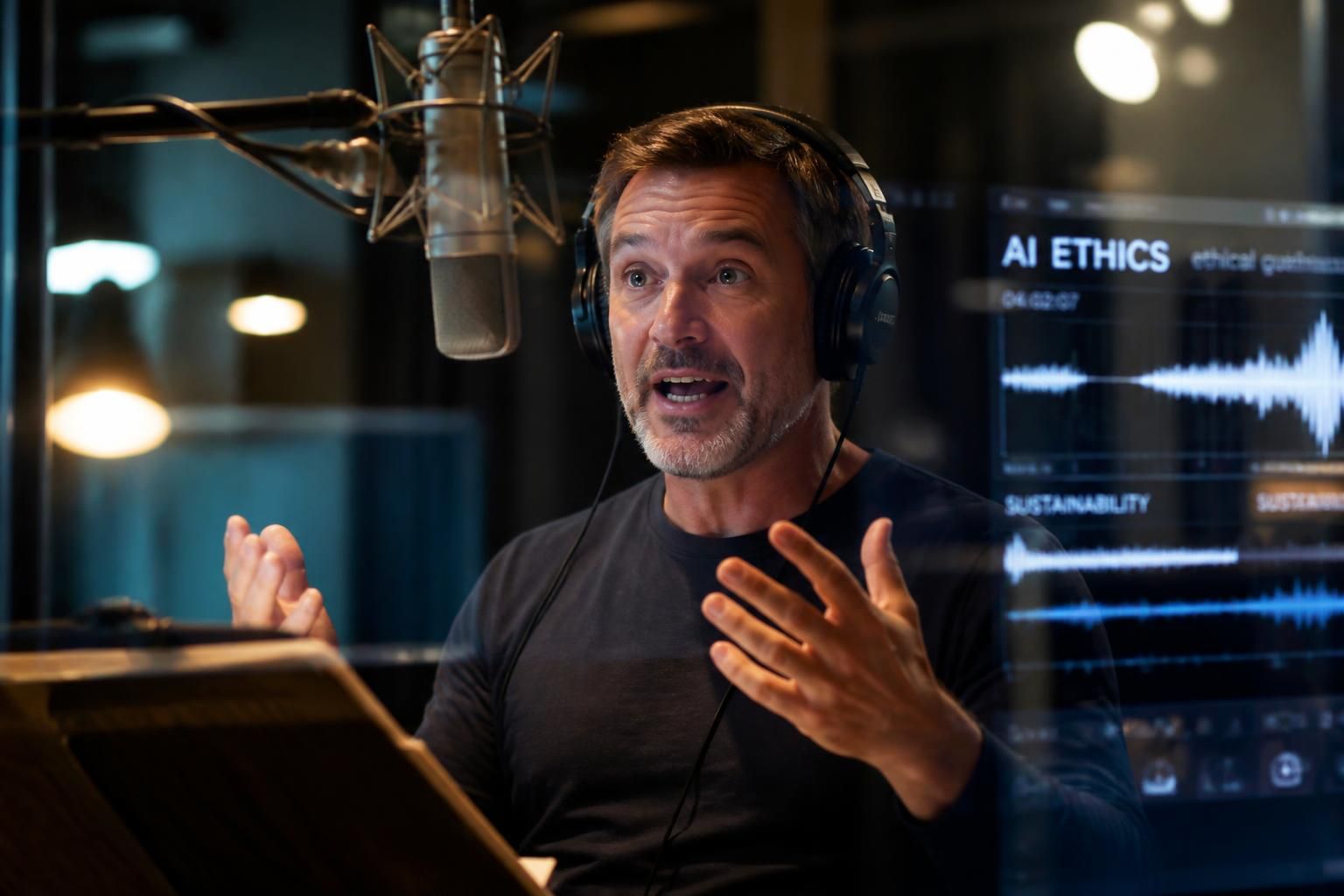
How AI Voice Cloning Is Reshaping Hollywood Jobs and Creative Work
AI Voice Cloning Technology is not replacing every type of performance at the same speed. It is changing the market first where clients previously needed quick, affordable, functional narration. Short advertising reads, online tutorials, basic corporate training, social media clips, automated explainers, and entry-level audiobook work are especially exposed because buyers often prioritise price, turnaround time, and volume. In these formats, an AI voice can produce dozens of variants without booking a studio session.
That shift affects freelancers more severely than household names. SAG-AFTRA represents roughly 160,000 performers and related professionals, yet an estimated 80% of voice work is freelance and often outside union agreements. Non-union performers may receive contracts with broad, confusing clauses that permit voice training, model development, sublicensing, or perpetual reuse. A performer trying to pay rent may see a five-figure offer as a lifeline. The same deal may effectively enable the client to generate work that would otherwise have required future bookings.
Los Angeles-based actor Stacy Rivera has described this tension directly. Her career includes commercial work and international audio projects for Netflix, including versions of Love Is Blind. Although her home includes a treated booth designed for professional recording, union opportunities have become less predictable. She reportedly had one union job in one year and three in the following year, while turning down a significant technology-company offer to train a vocal model. Her decision illustrates the human question behind the market data: how can performers protect a future income stream when current work is shrinking?
Jessica Hepburn’s experience reflects the pressure in a different segment of the industry. After building a home studio in Fort Wayne for around $250 and developing work in commercials, corporate e-learning, and YouTube narration, she saw income decline sharply after 2023. Her story matters because smaller companies have traditionally formed the foundation of many voice careers. They need quality, but their budgets are limited, making them early adopters of synthetic alternatives.
Where human performers retain a practical advantage
Generated speech has improved rapidly, but it still struggles in situations requiring unpredictable interaction, sustained character development, subtle emotional direction, and accountable interpretation. A director may ask for vulnerability without sadness, authority without aggression, or a shift that reacts to another performer’s timing. These instructions are not merely technical parameters; they are collaborative creative work.
- 🎭 Character-led drama: nuanced scenes depend on timing, intention, and reactions that are shaped during direction.
- 🗣️ Live guided experiences: guides adjust explanations to the group, ambient noise, questions, and cultural context.
- 🌍 Sensitive localisation: translation requires more than pronunciation; it needs appropriate phrasing, pacing, and cultural judgement.
- 🎧 High-trust communication: public safety, healthcare, heritage, and public-service audio require traceable responsibility.
The point is not that AI has no role. A well-designed audio workflow can use synthetic speech for draft scripts, internal prototypes, accessibility support, or limited multilingual updates. The ethical line is crossed when efficiency is built on undisclosed imitation or when clients present a cloned voice as though the individual recorded the message personally.
For a visitor experience team, the equivalent risk is using a “famous-style” narration to make an exhibition seem more prestigious. A celebrity-like voice may initially attract attention, yet it can quickly become a reputational problem if visitors discover it was unauthorised or misleading. Better practice is to commission real narrators, license a clearly labelled voice, or use an original synthetic voice that has no confusing resemblance to an identifiable person.
💡 Human voices remain valuable when authenticity, responsibility, and adaptive communication are part of the product. That value, however, needs contracts strong enough to survive rapidly changing distribution channels.
Consent, Compensation, and Ethics in Celebrity AI Voice Cloning Deals
The Ethics of AI Voice Cloning cannot be reduced to a yes-or-no question. A performer may consent to one use and firmly reject another. Licensing a voice for a Spanish edition of a newsletter is different from authorising it for political advertising, a gambling promotion, an intimate chatbot, or a fictional documentary. A contract that treats all uses as identical is not designed for the real world.
David Lawrence XVII, a veteran actor involved in audiobook negotiations, has emphasised the need for guardrails. His position reflects a practical concern: performers can be asked to authorise a digital replica without receiving clear information about training, storage, future model updates, or commercial distribution. If a voice is reusable at scale, the licence must specify what is being licensed with comparable precision.
Some platforms argue that marketplace controls provide this precision. ElevenLabs, for example, has stated that creators can adjust terms, restrict categories, or remove listed voices. The platform says more than 10,000 creators have earned income from its voice library and that total payouts have reached $22 million, having doubled since the previous November. This model can be positive when the contributor understands the agreement and can exercise meaningful control.
Yet an actor’s experience can reveal the limits of marketplace visibility. Alicia McCalla uploaded several hours of voice material to create a “warm and pleasant” clone and earned passive income from digital narration. She also encountered her voice in uses she had not anticipated, including commercials and a documentary related to Michael Jackson. Her account shows why “passive revenue” should not be confused with effortless governance. A voice can travel across contexts that a contributor may never have chosen personally.
| Contract question | Why it matters | Practical safeguard |
|---|---|---|
| 🧾 What is the permitted use? | A general licence can cover advertisements, entertainment, training, and other contexts. | List approved media, territories, languages, and content categories. |
| ⏳ How long does access last? | A perpetual licence can outlive the original commercial value of the fee. | Set a fixed term and require renewal for continued use. |
| 💰 How is payment calculated? | A single fee may be inadequate when output is distributed at scale. | Combine an upfront fee with usage-based payments or residuals. |
| 🚫 Can the voice be used in sensitive content? | Association with harmful subjects can damage a performer’s identity. | Exclude politics, adult content, health claims, scams, and deceptive endorsements. |
| 🔐 Can the licence be withdrawn? | Technology, reputation, and personal circumstances can change. | Include a removal process, audit rights, and clear deletion obligations. |
These measures are equally relevant outside entertainment. A museum commissioning a narrator for an audio trail should establish whether recordings may be repurposed to train tools, translated synthetically, reused in marketing, or retained after an exhibition closes. A guide service should also clarify whether recordings belong to the organisation, the guide, or both. Simple terms at the start prevent a costly dispute later.
Audiences deserve transparency too. If a historical figure’s voice is reconstructed for an exhibit, visitors should be told that it is an interpretive simulation rather than an archival recording. That disclosure does not diminish the experience. On the contrary, it strengthens trust and helps audiences understand the distinction between history, storytelling, and technical reconstruction.
⚖️ Ethical Innovation requires granular permission: one voice, one purpose, clear limits, and traceable payment. These principles explain why collective bargaining and new legislation have become central to the Hollywood response.
Hollywood AI Voice Cloning Rules: Union Protections and Legal Gaps
Hollywood’s prolonged writers’ and actors’ strikes in 2023 made AI protections a core labour issue. The dispute was not based on opposition to technology itself. Performers sought a workable system in which studios could use digital tools without quietly capturing and reusing a person’s identity. Subsequent SAG-AFTRA provisions introduced tighter requirements for digital replicas, including notice before a studio creates or uses a vocal replica.
Under the latest agreement signed in June, a studio must seek approval and pay an amount equivalent to an in-person performance when it wants to use a replica after the original project is completed. Digital versions used in reruns can also trigger residual payments, and replicas cannot be deployed during a strike. These rules are meaningful because they recognise that reuse is work. A studio does not receive unlimited future performances simply because an actor recorded one original session.
However, union contracts do not solve the entire problem. Freelancers may work directly with start-ups, content agencies, overseas clients, or platforms that are not bound by SAG-AFTRA conditions. The National Association of Voice Actors, founded in 2022 and representing around 30,000 professionals globally, has warned that inexperienced talent can sign away rights before understanding their value. Its free AI rider gives performers a practical addendum to attach to agreements, especially where no sector-wide contract applies.
That rider is useful because legal language often hides the highest-risk terms in phrases such as “derivative works,” “machine learning,” “in perpetuity,” or “irrevocable worldwide rights.” A performer does not need to be a lawyer to identify the warning signs, but they do need time to read them. Organisations should not pressure contributors to accept instant approvals for a technology licence that may affect their identity for years.
The push for a national right over voice and likeness
SAG-AFTRA has supported the proposed No Fakes Act, a federal policy intended to give people enforceable rights over their voice and likeness and to make unauthorised digital replicas unlawful. The appeal of a national standard is obvious. In a digital market, audio can be produced in one jurisdiction, hosted in another, and heard globally within minutes. A patchwork of local remedies leaves individuals to pursue misuse only after the damage has spread.
Recent legal action illustrates the scale of the conflict. A class-action case filed in Chicago against major technology companies, including Meta, ElevenLabs, Apple, Amazon, and Microsoft, alleges that voice and audio files were collected without consent for AI development. The claims have not eliminated the need for careful contracts today, but they show that training data is becoming as important as the generated output. The question is not only “Who made this audio?” It is also “Whose voices made the model possible?”
For operators in tourism and culture, a sensible compliance routine should include a source register for every recording, a signed release that distinguishes normal use from AI training, a content approval route, and a documented deletion process. Platforms such as Grupem demonstrate how smartphone-based audio can modernise guided visits without requiring organisations to lose control of their editorial content. A team planning synthetic narration can also review practical AI voice cloning tools and responsible use cases before choosing a provider.
Legal protection is strongest when it is paired with operational discipline. A contract is valuable, but a searchable record of consent, files, versions, and authorised channels is what enables an organisation to prove it acted responsibly.
📌 Regulation sets the floor; transparent production practices determine whether audiences and performers can genuinely trust the result. The final issue is how organisations can apply that trust in everyday audio projects.
Using AI Audio Technology Responsibly Beyond the Hollywood Celebrity Debate
The Hollywood conflict offers a clear lesson for every organisation that publishes spoken content: do not adopt voice technology simply because it is available. Start with the user need. A city tourism office may need multilingual updates when opening times change. A museum may need a clearer audio format for visitors with visual impairments. A guided-tour operator may need to help participants hear a speaker in a crowded street. These are concrete problems, and each can be solved without impersonating a Celebrity or creating a deceptive Deepfake.
Consider a fictional heritage site, Harbour Museum, preparing an audio route about migration and port life. The team wants English, French, Spanish, and Italian versions before a summer exhibition. Instead of cloning the lead curator without a detailed agreement, it can choose among three responsible options: record professional multilingual narrators; license a synthetic voice designed for commercial use; or obtain the curator’s written approval for limited, clearly labelled voice replication. The best choice depends on budget, release frequency, audience expectations, and the degree of personal identity attached to the voice.
Whatever option is selected, the visitor journey should remain the priority. Audio must be easy to access, audible in urban conditions, paced for walking, and adapted for users who may not be fluent speakers. Technology should remove friction, not add a novelty layer that distracts from the site’s stories. A transparent label such as “AI-assisted narration, created with the curator’s approval” may be brief, but it gives visitors relevant context.
A practical approval workflow for audio teams
- 🎯 Define the use case: state whether the audio supports translation, accessibility, internal prototyping, marketing, or public storytelling.
- 👤 Identify rights holders: record who owns the script, original recording, performer rights, music rights, and voice permissions.
- 📝 Obtain specific consent: distinguish recording permission from approval to clone, train, translate, or redistribute a voice.
- 🔎 Test for clarity: check pronunciation, cultural context, emotional appropriateness, and whether listeners may mistake generated content for a real endorsement.
- 🛡️ Monitor publication: keep an accessible register of links, files, versions, and an escalation contact for corrections or removal requests.
Security must also be part of the workflow. Criminals increasingly use cloned voices to imitate family members, executives, public figures, and service providers. Teams should establish a verification procedure for unusual payment requests or urgent voice messages. A second channel, such as a confirmed callback or written validation, prevents an emotional audio message from becoming a successful scam. Guidance on protecting teams and audiences from AI-enabled scams is particularly relevant for organisations managing public contacts and supplier relationships.
The most credible organisations will not claim that every synthetic voice is harmful or that every digital replica is acceptable. They will explain their choices, protect contributors, and make content useful for audiences. In practice, this approach improves both legal resilience and visitor confidence. A polished voice means little if its origin is unclear; a clearly authorised voice can support accessibility and engagement without compromising human dignity.
🌍 Responsible audio design treats consent as part of the user experience, not as a hidden legal formality.
Is AI voice cloning legal in Hollywood?
It can be legal when the performer or rights holder has given clear permission under a defined licence. Unauthorised imitation, deceptive use, or training with improperly obtained recordings can create legal exposure under contracts, publicity rights, consumer protection rules, and emerging digital-replica laws.
Why are some Hollywood Stars licensing cloned voices?
Established performers may use authorised voice replicas for translation, audiobooks, branded assistants, archival projects, or scalable narration. The crucial distinction is whether the agreement includes informed consent, payment, approved uses, duration limits, and a way to withdraw permission.
Can a museum or tour operator use an AI-generated voice?
Yes, provided it has appropriate rights to the script and voice, informs visitors when needed, protects personal data, and avoids imitating an identifiable person without permission. A clearly licensed original synthetic voice is safer than a celebrity-like imitation.
What should a voice actor check before signing an AI contract?
They should verify training rights, permitted media, territories, languages, term length, payment structure, reuse conditions, prohibited categories, audit rights, deletion procedures, and whether the company can sublicense the voice. Independent legal advice is appropriate for broad or perpetual licences.
