
North Adams Historical Museum Faces a Third Relocation Challenge
🏛️ The North Adams Historical Museum is again searching for a New Home for its Treasured Collection. The situation is urgent because the thousands of objects held by the North Adams Historical Society must leave the basement of All Saints Episcopal Church by September 1. For a collection that has already been moved repeatedly, the immediate task is not simply finding empty floor space. It is finding conditions that support responsible Cultural Heritage Preservation.
The museum’s holdings include approximately 11,000 items connected to the industrial, civic, social, and artistic life of North Adams. Disassembled mannequins from former displays, metal signs, local maps bearing the marks of age, documents, photographs, tools, and folk-art objects are currently stored away from public view. These Artifacts have not been displayed since 2022, when the museum lost the space it had occupied in the former Holiday Inn downtown, now associated with Hotel Downstreet.
The present storage arrangement began as a practical act of local solidarity. All Saints Episcopal Church offered basement space after the museum’s 2022 closure, protecting items that otherwise had no immediate destination. Yet temporary storage is rarely permanent infrastructure. The church now needs its own lower-level space for operational storage, creating a deadline that places the Historical Museum’s collection at risk of another disruptive Relocation.
This is not a marginal concern for a city whose visitor economy is closely linked to culture. Many visitors arrive in North Adams for Mass MoCA, nearby trails, historic architecture, and the wider Berkshires. They also want context: how did a former manufacturing center become the creative and cultural destination it is today? A local history museum provides the connective tissue between a restored mill landscape, immigrant histories, industrial labor, neighborhood life, and present-day arts activity.
Earlier reporting documented the museum’s previous move after nearly two decades in Western Gateway Heritage State Park, where it had presented its collections before relocating to downtown hotel space. That history is outlined in this account of the museum’s earlier relocation. The current difficulty demonstrates why a museum needs more than a short-term host: it needs a durable operational base with controlled storage, cataloguing capacity, public access, and a realistic long-term agreement.
Why repeated moves create real collection risks
Each move creates handling risks. Fragile paper can tear, paint can flake, frames can weaken, and objects without clear packing records can become separated from their historical information. A painted saw donated by a local folk artist is not merely an unusual object; its value depends on knowing who made it, where it came from, when it entered the collection, and how it relates to North Adams traditions. If those connections are lost, the object becomes harder to interpret and preserve.
The impact is also practical. The society’s volunteers continue to assist residents researching family histories, properties, and local events. However, archives become slower to use when boxes are dispersed, former displays are dismantled, and staff or volunteers cannot immediately locate requested material. A researcher looking for a family photograph, for example, may know that the museum has relevant records but still face delays if the collection is in limbo.
City Councilor Andrew Fitch responded to concerns raised at council meetings by organizing a community discussion with society members. The objective is sensible: identify unused commercial, municipal, nonprofit, or privately owned spaces before the deadline makes controlled decision-making impossible. The city budget reportedly has no spare funding allocated for this need, so the Community must consider partnerships rather than wait for a single public solution.
- 📦 Secure storage: controlled access, stable shelving, and clear responsibility for keys or access codes.
- 🌡️ Environmental stability: dry conditions, limited temperature swings, and humidity management for paper, textiles, and wood.
- 🗂️ Collection access: enough working room for inventory, research appointments, and careful packing.
- 🚚 Moving logistics: loading access, safe routes, and time to separate fragile objects from bulky exhibit pieces.
- 🤝 Long-term planning: an agreement that allows the Historical Society to build a sustainable Exhibition strategy.
A building can be modest and still be effective. What matters is whether it is dry, secure, affordable, and capable of supporting the work behind the scenes. The strongest next step for North Adams is therefore not a rushed display room, but a stable base from which the collection can be protected, documented, and eventually shared again. Preservation begins with a reliable place to care for what the city has chosen to remember.
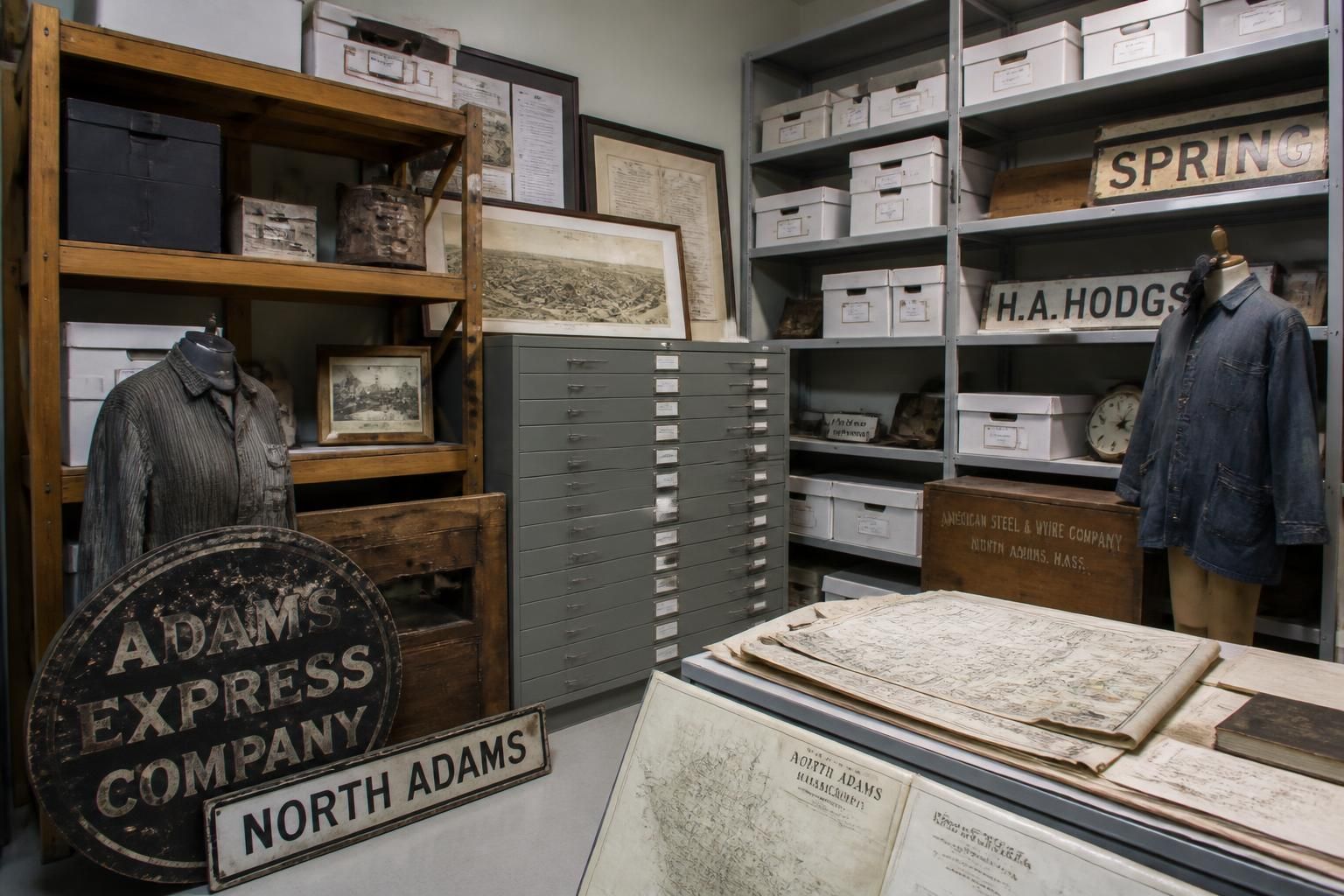
Protecting North Adams Cultural Heritage Before the September Deadline
The September 1 requirement should be treated as a collections-management project, not as a simple clearing operation. When a museum must relocate quickly, the greatest danger is that urgency encourages shortcuts: unlabeled containers, mixed object types, improvised stacking, and decisions to discard materials before their significance has been assessed. For North Adams, the immediate priority is to preserve the information surrounding each object as carefully as the object itself.
Condition is central to this work. A dry basement may be acceptable for short-term storage, but a room that is dry today is not automatically suitable during seasonal weather changes. North Adams experiences cold winters, wet springs, and warm summer periods that can bring shifts in indoor humidity. Paper archives, historic photographs, maps, textiles, and wooden artifacts all respond differently to these fluctuations. Even objects that look robust, such as metal signs, can suffer from corrosion if moisture remains uncontrolled.
Collections manager expertise is particularly useful at this point. Jason Vivori, who has experience through the Berkshire Museum and is involved with the Historical Society, can help frame the issue in professional terms: determine priorities, document condition, identify vulnerable materials, and distinguish essential holdings from exhibit components that may not be viable for reuse. This does not mean that only rare objects deserve care. It means that choices should be transparent, documented, and made with the collection’s long-term public value in mind.
A practical triage workflow for museum relocation
Before a truck is booked, volunteers should divide the holdings into clear work groups. The first group contains unique archival records and fragile items that need protective sleeves, boxes, or specialized handling. The second contains objects that are stable but require a precise location record. The third includes former exhibition furniture, graphics, mounts, and mannequins. Some display structures were designed for a specific building and may be expensive to store, but they should be photographed and assessed before disposal.
| Priority | Recommended action | Why it matters |
|---|---|---|
| 🔴 High: archives, photographs, fragile maps | Inventory first, use archival containers, move into climate-stable space | These materials can suffer irreversible damage from moisture, bending, and handling. |
| 🟠 Medium: tools, signs, framed objects | Photograph, label, record dimensions, use padded transport | Documentation preserves provenance and helps plan future Exhibition layouts. |
| 🟡 Planning: mannequins and exhibit structures | Assess reuse, photograph components, retain only where feasible | Bulky materials can consume limited storage but may support later interpretation. |
| 🟢 Public access materials | Digitize selected records and create a research request process | Access can continue even while a permanent museum venue is being developed. |
A move log should identify each box, its contents, the date it was packed, its condition, and its new shelf location. This can begin with a shared spreadsheet if a full collections-management system is not yet available. The essential requirement is consistency. For example, “Box 42” is not sufficient; “Box 42: North Adams manufacturing photographs, 1890–1940, fragile prints, shelf B-04” enables retrieval and informed care.
Digital documentation is also a realistic safeguard. A smartphone can capture a reference image of every packed carton, former display, or large artifact before moving day. Those images should be backed up in a shared folder with consistent filenames. This approach will not replace professional digitization, but it creates a practical visual record when volunteers need to verify that an item was packed and where it was placed.
The museum can draw useful lessons from other institutions that have managed disruption while preserving public relevance. A museum relocation case study illustrates how a move can become an opportunity to rethink access, interpretation, and visitor communication rather than merely a logistical burden. North Adams does not need to imitate a larger institution’s budget or model. It can adopt the same principle: protect the collection first, then design a public experience that fits local resources.
What happens if the collection has no adequate destination by September? The risk is not only physical deterioration. It is the gradual loss of visibility, institutional memory, and public confidence. Every labeled box and documented artifact turns an emergency move into a defensible Preservation plan.
Finding a New Home That Supports Historical Museum Access and Care
A suitable New Home for the North Adams Historical Museum should be evaluated with a dual purpose in mind. It must protect collections behind the scenes, and it must help residents and visitors encounter local stories without unnecessary barriers. These functions do not always need to occupy the same room on day one. A secure collection store combined with a smaller public research or display area may be more realistic than immediately recreating a full museum.
Potential partners could include vacant retail units, former office space, underused institutional buildings, commercial properties with secure back rooms, and nonprofit facilities capable of offering a long-term lease. The deciding factor should not be visual charm alone. Historic spaces often appeal to museums because they feel authentic, but a leaking roof, stairs without lift access, poor loading access, or uncontrolled damp can quickly undermine the purpose of moving there.
Evaluate buildings through visitor experience as well as storage needs
From a smart-tourism perspective, the site should be considered as part of a wider cultural route. A location near Main Street, Mass MoCA, downtown transit, or community gathering places can make the museum easier to discover. Visitors who begin with contemporary art can be guided toward the city’s industrial and social history. This is where a compact exhibition, digital map, and audio storytelling can make a smaller venue feel coherent rather than limited.
Accessibility should be built into the evaluation process. Clear entry routes, seating, readable labels, adequate lighting, and accessible digital content all improve the experience for a broader audience. A museum does not need expensive interactive hardware to provide useful interpretation. QR codes, a mobile web page, or smartphone audio can connect a metal sign, a neighborhood map, or a factory photograph to deeper stories in several languages or formats.
Audio content is particularly appropriate when physical display space is restricted. A visitor can stand before a map of North Adams and listen to a short, carefully scripted account of rail connections, mill employment, or the city’s evolving downtown. For researchers and residents, the same content can be available remotely. This approach protects fragile originals by reducing the need to place every document on permanent display.
- 🏢 Confirm the building’s physical suitability: inspect roofing, plumbing, ventilation, locks, fire safety, loading access, and environmental conditions.
- 📜 Secure a clear occupancy agreement: define duration, access hours, utility responsibilities, insurance expectations, and notice periods.
- 🗃️ Separate public and collection zones: keep archives and vulnerable objects away from uncontrolled visitor traffic.
- 🎧 Design a phased Exhibition: begin with a focused selection of objects supported by digital stories, then expand when capacity allows.
- 📣 Explain the plan publicly: residents are more likely to assist when they understand what the space will protect and how it will be used.
Such a phased plan can help prevent a familiar museum problem: reopening with too much on view, too little interpretation, and no protected storage. Instead, the Historical Society could begin with a rotating “North Adams at Work” display, using industrial maps, photographs, selected tools, and oral-history audio. A second rotation could focus on neighborhood institutions, local artists, or family archives. Rotation reduces light exposure and gives visitors a reason to return.
The city’s heritage landscape is already evolving. Reporting on efforts to revive the former state-park setting shows the importance of keeping historic places active rather than allowing them to become disconnected assets. Readers can follow local steps to bring Heritage Park back to life for wider context. A revived heritage area and a stable history collection could complement one another, provided responsibilities and resources are clearly defined.
For visitors, the best museum experience is not determined by building size. It is determined by whether the place is easy to find, easy to understand, and grounded in authentic local evidence. A well-planned modest venue can deliver more value than a large but unstable space.
Reconnecting the Treasured Collection With the North Adams Community
The collection’s value becomes most visible when it is connected to people’s questions. Residents may arrive looking for a family name, an old school, a factory job, a neighborhood store, or a photograph of a street that no longer looks the same. Visitors may ask why North Adams developed around industry, how rail infrastructure shaped its growth, or how the city’s present cultural identity relates to its manufacturing past. The Historical Museum can answer those questions with evidence rather than nostalgia.
Even before a permanent public location is secured, the North Adams Historical Society can maintain this relationship through scheduled research appointments, pop-up displays, and carefully selected digital content. The society has continued helping researchers despite the disruption, although access has become more complicated because the holdings are no longer arranged in a dedicated museum environment. Establishing a simple request process can make this service clearer: name the topic, identify dates or family names, and offer an expected response timeline.
Turn stored objects into accessible stories without putting them at risk
Public access does not require every Artifact to leave storage. A well-curated micro-exhibition can use a handful of objects to tell a substantial story. Consider a cracked city map, an industrial sign, and a historic photograph of workers. Together, these materials can explain how employment, transport, and neighborhoods developed. A short audio stop could feature a narrator describing the map’s changing street patterns, while an on-screen or printed transcript supports visitors who prefer reading.
A consistent digital interpretation system would also improve the experience of temporary programming. When an object travels to a library, school, business event, or community forum, a QR code can lead to its extended story. The public receives useful context, while the original remains protected in a supervised setting. This is especially useful for objects that cannot be handled frequently or displayed under strong light.
For smaller institutions, smartphone-led audio is a practical option because it reduces dependence on rented receiver systems and creates a more flexible visitor journey. A guide or museum educator can speak into a phone with an appropriate microphone, while participants listen on their own devices. The same content can later be repurposed for self-guided visits, short thematic walks, or online access. Technology should support the historical material, not distract from it.
A relevant model is the use of focused exhibitions to make complex local history approachable. The discussion around a museum exhibition addressing difficult historical narratives shows why context, interpretation, and accessibility matter as much as the objects selected. North Adams has its own specific history, but the operational lesson applies: give visitors enough guidance to understand why an item matters, whose experience it represents, and what questions remain.
| Community format | Example use | Visitor benefit |
|---|---|---|
| 🎙️ Audio stop | Three-minute story linked to a historic North Adams map | Supports independent exploration and accessible interpretation. |
| 📚 Library research day | Pre-booked support for genealogy and local-history questions | Maintains trust while storage access is limited. |
| 🏫 School outreach kit | Reproductions, photographs, and recorded oral histories | Connects younger residents to local Cultural Heritage safely. |
| 🗺️ Downtown history walk | Audio-guided route connecting current streets with historic sites | Extends the museum beyond its future walls. |
There is also a strong case for inviting the Community to contribute knowledge. A digitized photograph may prompt a resident to identify people, buildings, uniforms, or events that were not fully recorded when the image entered the archive. Such contributions must be verified and documented, but they can enrich collections that have grown over decades through donations.
This participatory work is not a substitute for safe storage. It is a way to ensure that the collection remains socially active while its physical future is being resolved. When people can recognize their own families, streets, and shared experiences in museum records, Preservation becomes a community responsibility rather than a specialist concern.
Building a Sustainable Future for the North Adams Historical Museum
The current crisis should lead to a practical long-term model rather than another short-lived arrangement. The North Adams Historical Museum has already experienced more than one displacement within eight years. That pattern makes it essential to create a plan that covers governance, storage standards, fundraising, visitor access, and public communication together. A new location without operational planning may only postpone the next emergency.
The North Adams Historical Society is volunteer-managed, which reflects considerable local commitment. Volunteers can bring deep knowledge, personal connections, and dedication to local research. They should not, however, be expected to carry every technical, financial, and logistical responsibility alone. A sustainable model could include volunteer-led interpretation and research, paired with professional advice for conservation, property assessment, digitization, and collection management.
Create a realistic roadmap instead of chasing a perfect building
The first stage should secure stable storage for the 11,000-item collection. The second should complete a location inventory and condition survey. The third should establish a small, visible public program, even if it begins outside a traditional museum building. Only after these foundations are in place should the organization commit to a larger permanent Exhibition environment. This sequence controls risk and gives funders concrete milestones to support.
Funding conversations can also become more precise. Rather than presenting an abstract appeal to “save the museum,” the society can identify clear needs: archival boxes, shelving, environmental monitoring, moving services, digitization equipment, accessibility upgrades, or interpretive audio production. Donors and partners are more likely to understand what their support achieves when the outcome is specific. A local business might fund a storage rack; a foundation might support a pilot exhibition; a tourism partner might help develop a self-guided historical route.
Environmental monitoring is an affordable early investment. Simple sensors can record temperature and relative humidity, helping the museum understand whether a space is appropriate before sensitive materials are moved in. A basic response plan should state what happens if a leak, heating failure, pest issue, or power outage occurs. These procedures may sound administrative, but they are what protect irreplaceable records during ordinary building problems.
- ✅ Within weeks: identify a compliant interim store, inventory high-risk materials, and assign move coordinators.
- 🧭 Within months: map collection locations, establish research-access procedures, and launch a public update page.
- 🎧 Within a year: pilot a mobile audio tour or rotating pop-up Exhibition connected to downtown history.
- 🏛️ Over the longer term: secure a lease or partnership that aligns storage, research, education, and visitor access.
Public communication will remain important throughout. Residents should know what is happening before objects disappear into another unseen storeroom. Regular updates can explain where the museum is in its search, which preservation steps are underway, and how people can donate expertise, property leads, archival information, or funds. Transparency transforms concern into useful participation.
North Adams has a strong cultural profile, but its historic identity cannot rely only on large institutions or redevelopment narratives. The everyday records held by the Historical Museum—factory material, civic memorabilia, maps, family archives, folk art, and former displays—offer the detailed evidence that makes a city’s story specific. These are the materials that help a visitor understand what came before the galleries, restaurants, and creative spaces they see today.
The most effective action is therefore clear: secure a dry and protected location, document every move, and keep the public connected to the collection through accessible research and storytelling. The future of the North Adams Historical Museum depends on treating its Treasured Collection as essential civic infrastructure, not as temporary storage to be solved later.
Why does the North Adams Historical Museum need a new location?
All Saints Episcopal Church, which has stored the collection since 2022, needs its basement space for its own operations. The Historical Society has been asked to remove the collection by September 1.
How large is the museum collection?
The North Adams Historical Society manages approximately 11,000 objects, including maps, photographs, industrial items, archival materials, folk art, and former exhibition components.
What conditions should a new storage site provide?
The priority conditions are dry, secure, accessible space with stable temperature and humidity, suitable shelving, safe loading access, and enough room for inventory and research work.
Can the public still use the museum’s historical resources?
The society has continued assisting genealogy and local-history researchers, although access is more difficult while the collection is stored and not fully organized in a dedicated museum setting.
How can community members help the Historical Museum?
Residents and local organizations can share leads on suitable space, support fundraising, offer professional expertise, contribute historical information, attend public discussions, and advocate for a stable long-term home.
