
Unlock High-Converting Ads with AI Voice Technology Through Clearer, Faster Creative Production
💡 Key takeaway: AI Voice Technology can help marketing teams produce more ad variations, localise messages, and test different delivery styles without booking a studio for every concept. The value comes from disciplined testing, not from treating synthetic narration as an automatic conversion engine.
Digital Advertising has become increasingly crowded. A viewer scrolling through social media, listening to a podcast, or watching a short video often decides within seconds whether an ad feels relevant. Voice is part of that decision. Pace, clarity, pronunciation, emotional tone, and the first spoken line can determine whether a message is understood or skipped.
For a tourism business, a restaurant group, or a cultural venue, the practical challenge is rarely a lack of ideas. It is the delay between an idea and a usable campaign asset. Recording several voice-over options traditionally requires a script, talent selection, studio time, editing, approvals, and revisions. Voice AI shortens that operational chain by making draft audio available at the script stage.
Consider a fictional city museum called Northline Gallery. Its team wants to promote a late-evening exhibition through paid social ads. One version opens with “Discover art after dark.” Another begins with “Your Thursday evening plans are ready.” A third speaks directly to visitors arriving by train. With AI voice tools, the team can listen to all three openings quickly, assess whether the wording sounds natural, then reserve professional voice talent for the final selected concept if required.
This workflow does not remove editorial responsibility. A weak offer remains weak when narrated by a polished voice. However, it makes creative review more concrete. Stakeholders can react to an actual sound file rather than trying to imagine cadence from a written script. That is especially useful when ads need to work without visuals, such as streaming audio placements, digital radio, telephone messages, or accessibility-focused campaigns.
Design the spoken message before selecting a voice
A high-performing audio ad is built around one understandable action. The listener should know what is offered, why it matters, and what to do next. Trying to include every product feature, every price point, and every condition in a 15-second spot usually creates rushed delivery and low recall.
Start with a simple voice script structure: hook, benefit, proof or context, and action. For example: “Planning a weekend in Lyon? Book a guided walk that works through your own headphones. Choose your time online today.” The script is brief, specific, and easy to say. It also avoids claims that the advertiser cannot substantiate.
- 🎯 Lead with relevance: speak to a real situation, such as a family planning a visit or a traveller looking for a flexible activity.
- 🔊 Use short sentences: spoken language needs more breathing room than display copy.
- 📍 Name the next action: “Book,” “compare dates,” or “start your Free Trial” is clearer than a vague invitation.
- ✅ Check every claim: prices, availability, and promotion terms must match the landing page.
A Limited Time Offer can be effective because it gives the listener a reason to act now. Yet urgency must be genuine. If a promotion says “Save $21” or “Free for a Limited Time,” the ad should clearly indicate eligibility, duration, and any billing conditions where relevant. Transparent messaging protects brand credibility and reduces costly support requests after a campaign launches.
Teams looking for practical reporting frameworks can use Think with Google marketing research to explore audience behaviour and measurement principles. The goal is not to copy another brand’s creative style. It is to identify the context in which people are most likely to hear, understand, and respond to a message.
🔑 The most useful AI-generated voice-over is not the most theatrical one; it is the one that makes a real offer immediately understandable.
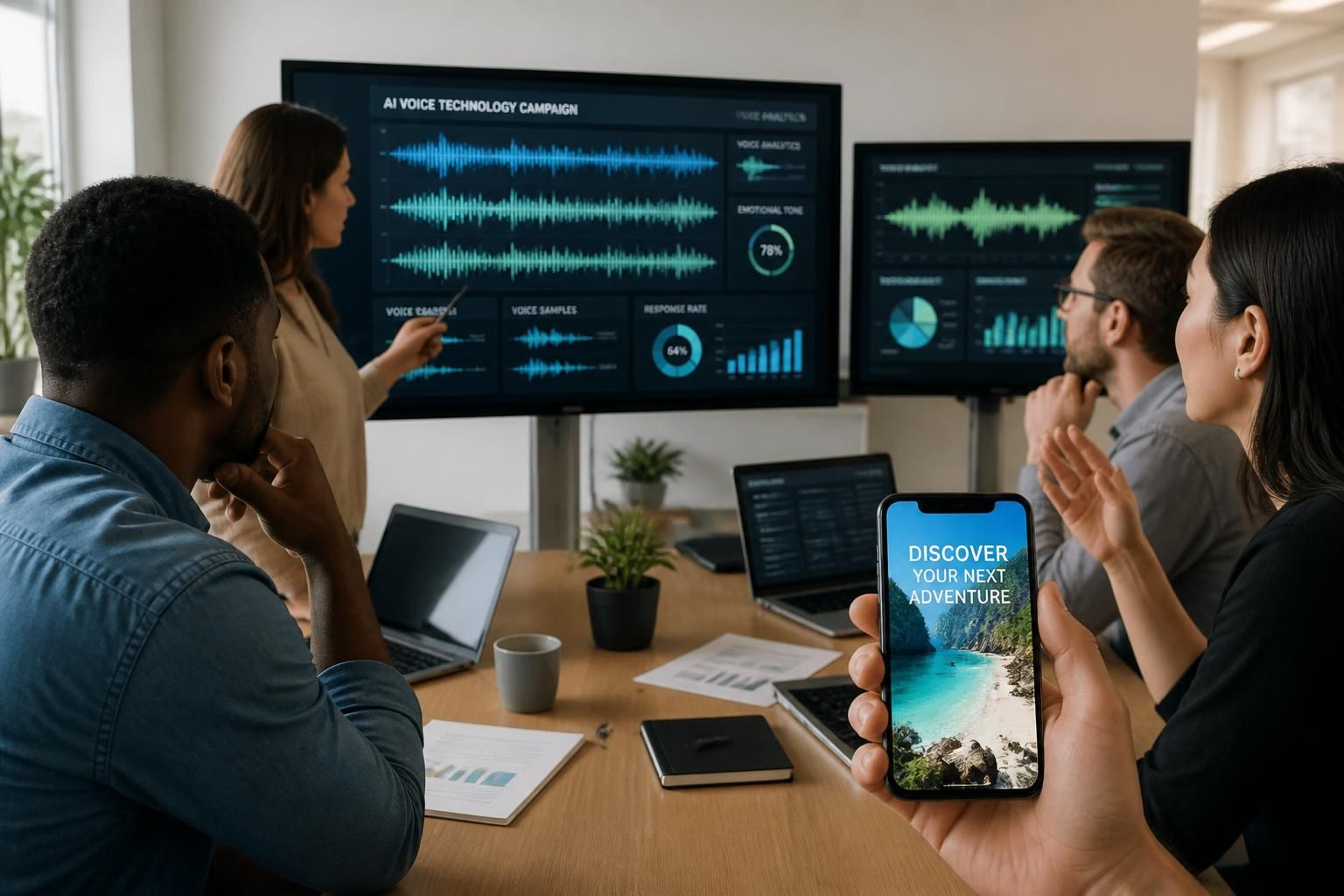
Build High-Converting Ads by Matching Voice AI to Audience Context and Accessibility Needs
Voice selection should follow audience context rather than personal preference. A dramatic voice may suit a theatre trailer, while a calm and measured delivery may better support a museum visit, a hotel booking reminder, or an accessibility announcement. The same written script can produce very different reactions depending on speed, accent, emphasis, and perceived trustworthiness.
For organisations serving visitors from multiple countries, AI Voice Technology offers a practical way to prepare local versions before committing to a full production budget. A regional tourism office can create English, French, Spanish, and Italian draft ads for the same walking-tour campaign. Those drafts allow native reviewers to identify awkward phrasing early, rather than discovering it after media spend has begun.
Localisation is not simply translation. Dates, currency, cultural references, call-to-action language, and sentence rhythm must be adapted. A phrase that creates urgency in one market can sound overly aggressive in another. Likewise, a synthetic voice that handles one language convincingly may mispronounce local streets, artist names, or heritage sites in another. A pronunciation review is therefore essential.
Use voice as an accessibility and comprehension layer
Audio can improve access when it is designed carefully. Captions should accompany video ads, while readable transcripts can support audio placements on landing pages. The spoken message should avoid relying solely on visual cues such as “click the blue button” or “look at the map on screen.” A person listening while commuting should still understand the offer and the next step.
Grupem’s work with mobile audio experiences highlights an important lesson for advertisers: clear sound is a service feature, not decorative polish. A visitor using headphones during a guided experience expects intelligible instructions, stable volume, and language that respects their attention. The same principle applies to promotional material. A compressed, hurried, or badly pronounced ad introduces friction before the customer reaches the website.
Businesses exploring conversational use cases can also review how Voice AI can support restaurant reservations. The key distinction is useful: an advertising voice-over persuades, while a conversational assistant responds. Both require clear intent, accurate information, and a tone aligned with the brand.
| Campaign context | 🎙️ Recommended delivery | 🔎 Essential quality check | 📈 Primary signal |
|---|---|---|---|
| Short social video | Energetic, concise, natural pauses | Hook understood within three seconds | ▶️ Video completion rate |
| Tourism audio ad | Warm, confident, location-aware | Place-name pronunciation | 🗓️ Booking starts |
| Free Trial promotion | Direct, transparent, measured | Terms match the landing page | ✅ Qualified sign-ups |
| Retargeting message | Helpful, familiar, not intrusive | Frequency and audience exclusions | 🛒 Return conversions |
A fictional operator, Coastway Experiences, used this approach for an off-season promotion. Rather than one generic voice-over, it tested a practical version for families, a calm version for older travellers, and a concise version for local residents. The team learned that the family message produced more clicks, but the resident-focused version generated better completed bookings. This distinction prevented the team from optimising only for cheap traffic.
🎧 When voice reflects the listener’s situation, it becomes easier to understand, more useful to hear, and more accountable as a marketing asset.
Improve Ad Optimization with Structured Testing Instead of Endless Voice Variations
One of the main advantages of Voice AI is speed. That advantage can become a problem if teams create dozens of versions without a test plan. More options do not automatically produce better decisions. Effective Ad Optimization begins by defining what is being tested and which business result matters.
A useful test isolates one meaningful element at a time. For example, test two opening lines while keeping the offer, visual, audience, and call to action unchanged. Then test voice pace or voice type in a separate round. If every element changes at once, the team cannot tell whether performance came from the script, the sound, the image, or the audience selection.
Create a practical test matrix for voice-led campaigns
Start by choosing a campaign objective. A new attraction may prioritise reach and completed video views. A ticketing platform may prioritise confirmed sales. A subscription product promoting a Free Trial should focus on qualified registrations and subsequent activation, not merely form completions.
Northline Gallery can illustrate the method. Its campaign manager creates two 20-second ads with identical footage of the exhibition. Version A opens with a visitor benefit: “See the new collection after work.” Version B opens with a local event cue: “Thursday nights at Northline are changing.” Once the stronger opening is identified, the team compares a warm female narration with a measured male narration. It then tests two calls to action: “Reserve your evening ticket” and “See Thursday availability.”
- 🧭 Set one conversion goal: ticket sale, lead, booking request, or activated trial.
- 📝 Write a controlled hypothesis: for example, “A location-specific hook will increase completed bookings.”
- 🎛️ Change one major variable: opening, pace, offer framing, or narrator style.
- 📊 Allow enough delivery: avoid deciding from a handful of clicks or impressions.
- 🛠️ Document the learning: save winning scripts, audience notes, and rejected assumptions.
Marketing Automation can make this process easier by connecting campaign data, creative libraries, approval steps, and lead-quality feedback. It should not be used to remove review altogether. Automated workflows are most valuable when they ensure that approved scripts, correct legal wording, and current pricing are consistently used across channels.
For teams generating both copy and narration, platforms such as Copy.ai for marketing workflows can support early script ideation. The script still requires a human editor who understands the audience, brand language, and legal constraints. In travel and culture, that review is particularly important because inaccurate local information can damage trust quickly.
Watch for false winners. An aggressive voice may increase click-through rate by creating curiosity, but it can lower conversion quality if the landing page does not fulfil the promise. Similarly, a highly expressive voice can attract attention while distracting from the actual offer. A campaign is successful only when the ad, landing page, and customer experience tell the same story.
📌 The strongest test programme produces reusable knowledge: which message, delivery, and audience context lead to valuable action—not simply which ad generated the loudest early signal.
Calculate Cost Savings Without Sacrificing Brand Safety, Rights, or Audio Quality
Cost Savings are often the first reason businesses investigate AI-generated voices. Traditional production can involve talent fees, studio hire, sound engineering, scheduling, revisions, and localisation costs. For a small campaign or fast-moving promotion, that process may be disproportionate to the media budget.
AI narration can reduce the cost and time of early-stage production, especially when a team needs multiple script drafts, internal prototypes, or regional variants. It may also help a local attraction update an expired offer quickly rather than continuing to run an inaccurate ad. These are meaningful operational benefits, but they should be calculated honestly.
The true cost includes more than a monthly software fee. Teams should account for editorial time, quality assurance, translation review, licensing terms, landing-page updates, media spend, and performance analysis. A low-cost voice asset becomes expensive if it drives unqualified traffic or requires repeated corrections after publication.
Protect people, brands, and audiences in every voice workflow
Voice cloning creates particular responsibilities. A business should never imitate a recognisable person, employee, celebrity, guide, or creator without explicit documented permission. It should also avoid voice choices designed to mislead listeners about who is speaking. Trust is difficult to earn and easy to lose when audiences feel manipulated.
Recent concerns around AI voice cloning threats show why governance cannot be treated as a technical afterthought. Establish a simple approval policy: who can create audio, where approved voice profiles are stored, who verifies claims, and how outdated assets are removed. For organisations managing public-facing visitor information, this policy supports both reputation and operational safety.
Audio quality deserves equal attention. Check for unnatural breathing, inconsistent emphasis, clipped consonants, incorrect names, and abrupt endings. Listen on laptop speakers, a phone, and headphones. A voice-over that seems acceptable in an editing interface may sound harsh in a real social feed or too quiet beside platform music.
The $21 saving mentioned in a promotional message should be assessed in the same disciplined way. A Limited Time Offer can lower the barrier to testing a tool, but it does not replace a commercial evaluation. Before starting a Free Trial, confirm what features are included, whether commercial usage is permitted, how exports are handled, and what happens when the promotional period ends.
Tools such as Descript’s audio and video editor can be useful when teams need to edit narration alongside captions and short-form footage. The operational gain comes from a streamlined review process: one place to revise wording, check timing, and approve the final export.
💼 Responsible voice production is a form of efficiency: it prevents inaccurate claims, costly rework, rights disputes, and audience distrust.
Deploy AI Voice Technology Across Digital Advertising Channels with a Measurable Workflow
AI Voice Technology performs best when it is connected to a complete customer journey. The audio asset should not be treated as an isolated file added at the end of production. It needs to match the platform, the visual format, the landing-page promise, and the way the organisation will measure outcomes.
For instance, a local food tour operator may use a 10-second voice-led vertical video to reach nearby visitors on social platforms. The same core message can become a 30-second streaming audio placement for people planning weekend activities, then a short confirmation message after booking. Each placement has a different purpose, even though the brand voice remains consistent.
Adapt the production workflow to each media environment
On short video platforms, the first line must work before the viewer has read the caption. On audio streaming, the narration must carry the entire offer without visual support. In paid search video extensions or display ads, voice may reinforce a visual message but should not introduce a different claim. The landing page must then provide the detail promised in the ad.
For multilingual tourism campaigns, a useful workflow includes a source script, locally adapted variants, pronunciation notes, internal audio drafts, native-language review, final rendering, and channel-specific exports. This process is more reliable than translating a final English recording word for word. It also creates an archive that can be updated when opening hours, availability, or pricing change.
- 📱 Social video: prioritise a fast hook, captions, and a single action.
- 🎧 Streaming audio: make the benefit and destination clear without relying on images.
- 🗺️ Tourism retargeting: use practical reassurance, such as flexible dates or simple access information.
- ✉️ Email and newsletter promotion: reuse the approved script in a concise written form, not as an audio-only message.
Content teams can combine campaign learnings with editorial distribution. For example, beehiiv’s newsletter platform may help organisations segment subscribers by interests, while paid campaigns test which benefits deserve more prominence. A family audience that responds strongly to “easy booking” may need a different email sequence from an audience attracted by rare cultural access.
Measurement should include both platform data and post-click behaviour. Track impressions, completed listens or views, click-through rate, landing-page engagement, conversion rate, cost per qualified action, and cancellation or refund patterns where relevant. A campaign that earns attention but produces disappointed customers is not delivering sustainable value.
Finally, maintain a human listening step before every launch. Assign someone to hear the ad from start to finish with fresh ears. Ask straightforward questions: Is the offer understandable? Are names pronounced correctly? Is the action clear? Do the terms match the destination page? These checks take minutes and prevent avoidable errors.
🚀 The practical opportunity is not to automate every creative decision. It is to use voice tools to launch relevant, accessible, and measurable campaigns with greater speed and control.
Can AI Voice Technology be used in commercial ads?
Yes, provided that the selected platform’s commercial licensing terms allow the intended use. Check usage rights, voice restrictions, export conditions, and any rules related to cloning or imitation before publishing an ad.
How can a business verify whether a voice-over improves conversions?
Test one controlled variable at a time, such as the opening line or narration pace. Measure qualified outcomes such as completed bookings, activated trials, or validated leads rather than relying only on clicks.
Should a Limited Time Offer mention all terms in the voice-over?
The narration should communicate the core condition clearly, while the landing page provides complete terms. Do not hide material eligibility rules, recurring charges, or expiry information that could change a customer’s decision.
What is the main risk of using cloned voices in Digital Advertising?
Using a recognisable person’s voice without explicit permission can create legal, ethical, and reputational risks. Use licensed synthetic voices or documented consent, and never design audio to mislead audiences about a speaker’s identity.
