
How the New Bedford Whaling Museum Turned a One-Star Review into an Internet Sensation
The New Bedford Whaling Museum has transformed an old complaint into a highly visible cultural talking point. In 2020, a Google reviewer awarded the museum one star and called it the “Worst Aquarium Ever.” The criticism was factually misplaced: the institution is dedicated to whaling history, maritime culture, regional communities, and ocean science rather than operating as a conventional aquarium. Yet the wording was memorable enough to become internal folklore.
Rather than ignoring the review or responding defensively, the museum’s team identified a useful truth behind the joke. A strange, specific comment can be more memorable than standard promotional language. The phrase had personality, local flavor, and a built-in contradiction: visitors expecting live marine animals had entered a museum filled with artifacts, stories, and enormous whale skeletons. That disconnect became the basis for a sharp piece of museum marketing. 🐋
The resulting Worst Aquarium Ever merchandise presents the review on the back of apparel and accessories, while a drawing of the museum’s sperm whale skeleton appears on the front. The design is intentionally simple. It does not require visitors to understand a complicated campaign, scan a QR code, or know an extensive institutional history before reacting. In a few words, it creates curiosity: what kind of museum would proudly sell a shirt based on a bad review?
That question is central to the campaign’s success. Humorous criticism works when it is clearly embraced by the people who received it. The museum did not pretend that it was an aquarium. Instead, it acknowledged the mismatch with a wink and used it to invite a wider public into its actual story. For cultural organizations, this is an important distinction. Self-deprecating communication cannot replace substance, but it can make a serious institution feel more approachable.
New Bedford’s identity makes the joke more effective. The Massachusetts city is widely associated with American whaling history, commercial fishing, immigration, shipbuilding, and the working waterfront. Its museum holds major collections that address the economic, cultural, and environmental dimensions of whaling. The institution is therefore not selling a random internet gag; it is connecting a modern review to a setting where visitors can stand beneath monumental skeletal specimens and confront the scale of ocean life.
Why aquarium humor matched the museum’s real collections
The original complaint became even more ironic because the museum has substantial whale remains on display. Its collection includes a 66-foot blue whale skeleton, a 37-foot humpback whale, a 49-foot North Atlantic right whale, and a 48-foot sperm whale. These are not the moving exhibits a disappointed aquarium visitor might expect, but they are powerful objects for interpreting marine ecosystems, historic hunting practices, and species conservation.
For a visitor such as Maya, a fictional day-trip traveler from Providence, the shirt can function as both a joke and a prompt. She may buy it because the phrase is funny, then learn that the museum has extensive scholarship behind its galleries. A well-designed object has done more than create a transaction: it has carried a story beyond the building. That is why the campaign has broader relevance for museums that are trying to reach people who may not respond to formal institutional language.
Coverage from WBUR’s report on the unexpected museum hit showed how quickly that local joke gained national attention. The phrase travels easily because it fits in a headline, a social post, a short video, or a conversation between friends. It is recognizable even when separated from the museum’s full name, yet it reliably directs people back to New Bedford.
The lesson is not that every museum should deliberately seek negative reviews. The useful lesson is that institutions can listen for the authentic language people already use. When a comment is harmless, specific, and culturally revealing, it may contain an opportunity for engagement. The best response is not always a formal statement; sometimes it is a product that demonstrates confidence, humor, and a clear understanding of audience expectations.
A memorable cultural brand is often built where institutional expertise and public language meet. The next question is how a local design moved from staff amusement to a surge of national orders.
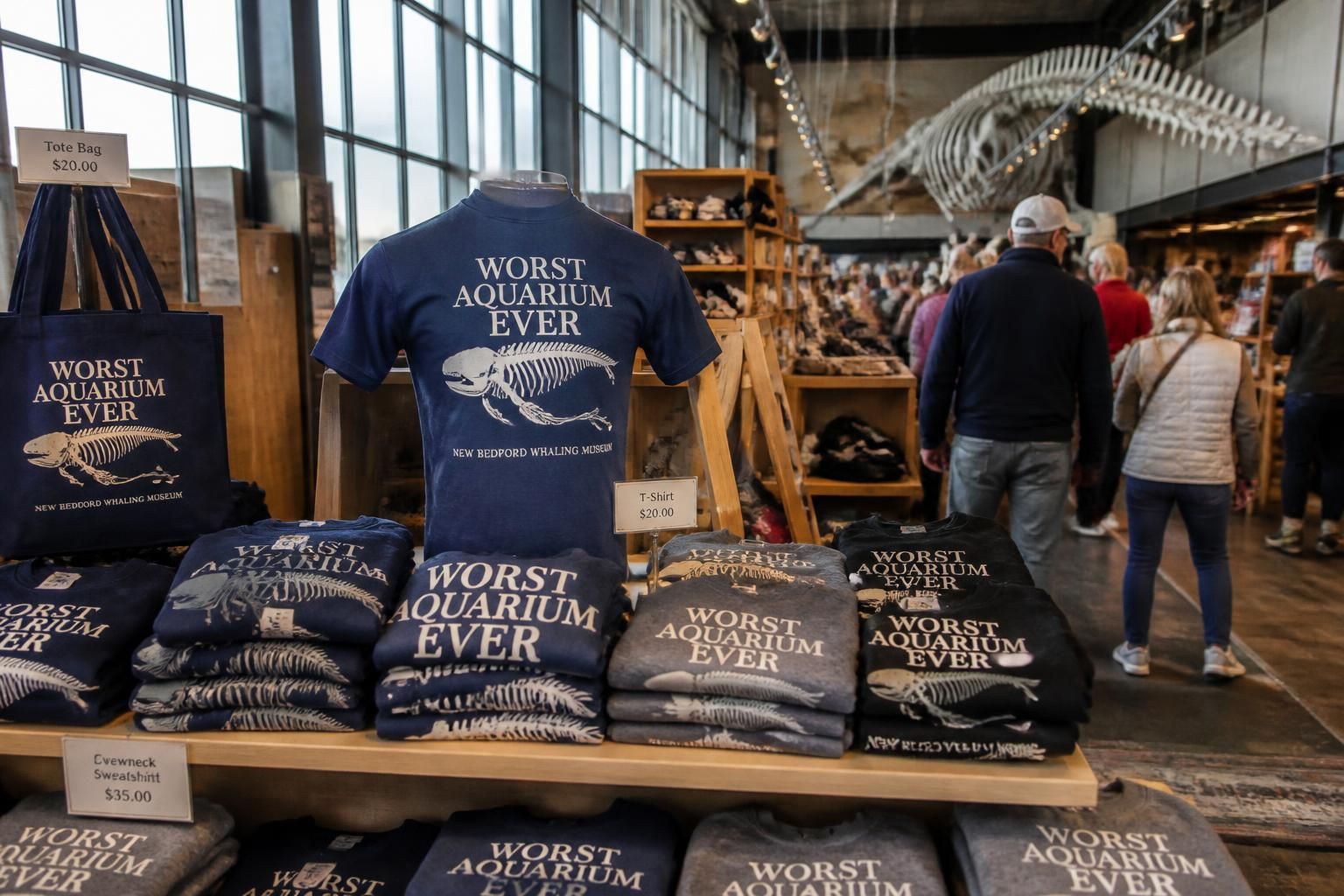
Worst Aquarium Ever Merchandise Sales Show the Power of Social Media Buzz
The campaign had signs of momentum before national television coverage. A TikTok video featuring the products in November generated more than 96,000 views, while an Instagram post announcing a restock gave the collection a renewed push. These results demonstrate an important point for museum teams: viral products rarely emerge from one isolated post. They often build gradually through a sequence of small signals, staff enthusiasm, audience reactions, and useful timing.
By the time major media attention arrived, the design was already a strong performer in the gift shop. It regularly ranked among the store’s five best-selling lines. That baseline mattered because it gave the museum confidence that the concept was not merely popular with employees. A larger restock of 160 adult T-shirts had been planned before the sudden wave of attention, already exceeding a typical order for a niche museum design.
Following regional coverage and a CBS Evening News segment, demand accelerated dramatically. Between the Wednesday-night broadcast and 2:30 p.m. the following Thursday, customers placed 738 online orders, most relating to the Worst Aquarium Ever collection. Weekly orders were reported to be 250% higher than the previous week. For a museum shop, this is not only a sales event; it is a logistics test involving stock forecasting, fulfillment capacity, website clarity, customer communication, and brand consistency.
The response required a quick but practical inventory expansion. The museum increased its planned order with hundreds of additional adult and youth T-shirts, crewnecks, hoodies, and tote bags. At the time of the surge, adult shirts were sold online for $32.50, crewnecks for $50, hoodies for $60, and tote bags for $39.95. These prices positioned the objects as accessible cultural purchases rather than luxury collectibles.
Turning attention into a reliable visitor journey
Social media buzz is valuable only when interested people can take a clear next step. In this case, customers could buy online even when an item was on back order. That detail matters. A viral moment can become frustrating if the online shop says only “sold out” and offers no indication of future availability. Back-order messaging, estimated dispatch dates, and visible product variants help capture demand without misleading buyers.
- 📱 Use short-form video to show the object being worn, held, and displayed in the actual museum.
- 🛒 Keep the online purchase path simple with clear size information, shipping details, and stock status.
- 📦 Prepare a replenishment plan before paid promotion or broadcast coverage expands demand.
- 💬 Answer recurring questions consistently, especially when products are temporarily unavailable.
- 🏛️ Connect the product to the collection so humor leads people toward the institution’s mission.
For example, Maya sees a short clip shared by a friend, recognizes the whale skeleton, and visits the museum’s shop page. If she finds an unclear checkout, no sizing guide, and no availability notice, the campaign loses momentum. If she sees a transparent back-order option and a concise explanation of the design’s origin, the experience remains coherent. Digital convenience is not separate from cultural mediation; it is part of it.
Organizations can explore the current collection through the official Worst Aquarium Ever shop selection. The store page is also a useful example of how a focused collection can support discovery without forcing visitors to navigate an entire catalog. A single clear product story works especially well for audiences arriving from a news article or a short social video.
The strongest social campaigns are operationally ready before attention becomes overwhelming. Sales matter, but the long-term opportunity is to convert a humorous purchase into a meaningful relationship with the museum.
New Bedford Whaling Museum Uses Viral Products Without Diluting Its Scholarly Mission
Humor can create an entry point, but the New Bedford Whaling Museum’s credibility depends on what visitors find after the laugh. Its core role remains the interpretation of maritime heritage and the many communities connected to New Bedford’s past and present. Whaling is not a simple nostalgic subject. It involves global commerce, labor, Indigenous knowledge, environmental change, industry, exploitation, and the long consequences of extracting resources from the sea.
The Worst Aquarium Ever line succeeds because it does not attempt to replace that complexity. It simply lowers the emotional barrier to engagement. A visitor may arrive for a funny crewneck and then encounter the 66-foot blue whale skeleton. That visual encounter can open questions about anatomy, ocean habitats, the history of collecting, and why whales now carry such strong conservation symbolism. The gift shop becomes a doorway rather than an exit point.
This approach aligns with a broader shift in museum experience design. Cultural organizations are moving away from the idea that every interaction must be quiet, formal, or limited to gallery labels. Visitors may first connect through a tote bag, a playful caption, an audio story, or a staff recommendation. What matters is whether the next layer of information is accurate, accessible, and respectful of the subject.
The museum’s leadership has framed the line as part of an interactive and welcoming public identity, backed by serious scholarship. That balance is important. A museum should not make difficult history frivolous, but it can show human warmth around the edges of the visitor experience. The distinction is visible in the design itself: the joke targets an incorrect expectation about an aquarium, not the communities, animals, or historical realities represented in the collection.
From a funny purchase to a deeper cultural encounter
A thoughtful visitor journey can connect the product to relevant content at several points. In the store, signage can identify the skeleton shown on the garment. At the gallery entrance, a short panel can explain why whale bones are displayed and what they reveal. On a mobile device, an audio stop can offer a two-minute account of the sperm whale specimen, narrated in plain language and available in multiple languages.
| Visitor touchpoint | Practical purpose | Example for this campaign |
|---|---|---|
| 🛍️ Gift shop display | Create an immediate connection | Explain that the artwork depicts the sperm whale skeleton. |
| 📲 Mobile audio stop | Provide context without crowding labels | Share a short story about whaling history and marine ecology. |
| 🧭 Gallery route | Turn curiosity into exploration | Guide buyers from the shop to the whale skeleton displays. |
| 🌊 Public programme | Extend learning beyond a visit | Host a discussion on South Coast waters and whale conservation. |
Smart tourism tools can support this pathway without adding expensive hardware. A visitor’s own smartphone can deliver an audio route, captions, transcripts, translations, and optional deeper content. This makes interpretation more flexible for families, international visitors, people who prefer to read, and guests who need to move at their own pace. The aim is not to make technology visible for its own sake; it is to make the museum easier to understand.
A comparable approach is outlined in this practical look at the New Bedford museum merchandise story, where the commercial success is considered alongside visitor engagement. A witty object may attract attention, but accessible interpretation gives that attention lasting value.
Humor earns a first glance; well-designed interpretation gives visitors a reason to stay, learn, and return. That principle becomes especially relevant now that the museum includes a real, if modest, aquatic element.
A Modest Aquarium Adds New Meaning to the Worst Aquarium Ever Joke
The timing of the campaign contains an additional layer of irony. When the one-star review was posted in 2020, the museum had no aquarium. The complaint was therefore wrong in expectation but not entirely wrong in literal terms: there were no live fish tanks for visitors to see. The museum’s response was to celebrate the misunderstanding through aquarium humor rather than treat it as a reputational problem.
In 2026, however, visitors can find a 250-gallon saltwater tank on the first floor. The display was developed in partnership with UMass Dartmouth’s School for Marine Science and Technology. It houses local South Coast species such as blue crabs, Forbes’ sea stars, and northern puffer fish. The museum is still not an aquarium in the conventional sense, and there are no live whales, but the tank gives the joke a new factual twist.
This installation has a clear educational purpose. It creates a direct link between historical whaling narratives and the health of today’s coastal waters. Visitors can move from displays of whale skeletons and historic maritime objects to living organisms associated with the nearby marine environment. That transition helps explain that ocean history is not sealed in the past. It is connected to biodiversity, pollution, climate pressures, fisheries, and local stewardship.
For museums, live elements must be carefully interpreted. A small tank can easily be seen as decorative if it lacks context. Clear information about the species, their habitats, water quality, and the role of scientific partners helps visitors understand why the exhibit belongs in a whaling museum. Short audio explanations can make this context available without adding dense text panels around the tank.
Designing accessible interpretation around living exhibits
A practical audio route might begin with a 45-second welcome near the tank. It could explain that the species are from the South Coast and identify what visitors should look for: the movement of a northern puffer fish, the shape of a sea star, or the behavior of a blue crab. A second stop could connect these living species to wider questions about coastal habitat health. The content should use everyday language, while offering an optional deeper layer for visitors interested in marine science.
Accessibility should be designed from the beginning. Audio content needs written transcripts, and essential visual details should be described for people who are blind or have low vision. A QR code can provide access, but the museum should also offer a simple printed instruction for guests who are not confident using mobile tools. Technology should support independence, not create another obstacle at the edge of the exhibit.
Consider Maya again. She has purchased a shirt as a gift and notices the tank on her way out. A short audio message explains that the tank’s species live in the same coastal region that shaped New Bedford’s maritime economy. Suddenly, the purchase is attached to a present-day ecological story. The visitor leaves with a joke, but also with an informed observation about the ocean environment.
The campaign gains strength from this evolution because it remains honest. The museum did not add a tank simply to validate a slogan. It established a scientific partnership and an exhibit with a public purpose. The phrase Worst Aquarium Ever stays deliberately exaggerated, while the tank creates a useful opportunity to discuss what an aquarium can contribute when it is connected to local ecology and learning.
A small live exhibit becomes meaningful when it connects historical collections to the environmental choices facing a community today. The final operational question is how other cultural venues can use this kind of authenticity without copying the slogan.
Museum Marketing Lessons from the Worst Aquarium Ever Gift Shop Phenomenon
Not every museum has a one-star review worth printing on a hoodie, and it should not try to manufacture one. The transferable lesson from the New Bedford Whaling Museum is more disciplined: identify the moments where the public already describes your institution in revealing, distinctive language. That might be a recurring visitor question, a local nickname, an unexpected object in the collection, or a staff anecdote that communicates a real sense of place.
The campaign also shows the value of staff-led creativity. The merchandise was designed by Emily Roznoy, the museum’s visitor experience manager, after staff had joked for years about putting the review on a shirt. Inspiration came from seeing another business turn a negative comment into apparel. This is a useful reminder that people who work closest to visitors often recognize the clearest opportunities for relevant communication.
For a museum director, tourism office, or guided-tour operator, the process can begin with a short review audit. Look for patterns rather than isolated insults. Do guests repeatedly say the venue is confusing, unexpectedly emotional, too quiet, unusually large, or more fun than expected? Some feedback requires service improvements, not a punchline. But a harmless misconception can sometimes become a creative angle if it reflects the institution’s personality.
Build a campaign that supports visitors rather than chasing clicks
Any cultural organization considering playful merchandise should establish several boundaries. The joke should not target a vulnerable group, trivialize traumatic history, or mislead potential visitors about what is actually available. It should be understandable outside the local community and should connect back to a credible collection, place, or programme. These checks prevent museum marketing from becoming empty trend-chasing.
- 🔎 Review public feedback and separate real service failures from harmless misunderstandings.
- 🎨 Test one clear design with staff and a small visitor group before ordering large quantities.
- 📷 Create authentic visual content inside the venue rather than relying on generic product images.
- 🗣️ Prepare staff talking points so each sale can lead to accurate cultural information.
- 🎧 Link products to interpretation through audio stops, gallery prompts, or a simple mobile route.
- 📈 Measure more than revenue by tracking web traffic, shop visits, tour bookings, and visitor feedback.
Measurement is particularly important after an internet sensation. A sudden increase in orders can be temporary, while the broader benefit may be a stronger email list, greater awareness among regional travelers, or more first-time museum visits. The New Bedford case is notable because the collection was already selling before the national surge. That suggests the concept had local relevance before it became a media story.
For organizations using guided tours, a smartphone-based audio solution can carry the same direct, visitor-centered approach. A guide can speak clearly to a group, distribute accessible content, and maintain flexibility without handing out complex equipment. The product, the tour, and the digital layer should feel like parts of one experience rather than separate promotional tactics.
It is also useful to study how other cultural venues develop distinctive visitor-facing retail ideas. This overview of museum gift shops in the Twin Cities illustrates how retail can reinforce a location’s identity when objects are selected with context and care. The goal is not to fill shelves with branded items; it is to offer objects people genuinely want to use, wear, or give.
The New Bedford Whaling Museum proves that a gift shop can support cultural access when its products carry a truthful, local, and well-explained story.
What does “Worst Aquarium Ever” refer to?
It refers to a one-star Google review posted in 2020 by a visitor who appeared to expect an aquarium at the New Bedford Whaling Museum. The museum turned the memorable phrase into a humorous merchandise collection.
Does the New Bedford Whaling Museum have a real aquarium?
The museum now includes a 250-gallon saltwater tank featuring local South Coast species, including blue crabs, Forbes’ sea stars, and northern puffer fish. It remains a maritime and whaling history museum, not a conventional aquarium.
What items are available in the Worst Aquarium Ever collection?
The range includes adult and youth T-shirts, crewneck sweaters, hoodies, and tote bags. The design pairs the humorous review text with an illustration inspired by the museum’s sperm whale skeleton.
Why did the merchandise become so popular?
The phrase was easy to understand, genuinely local, and visually linked to the museum’s collection. TikTok, Instagram, regional reporting, and national television coverage amplified demand, while the museum provided a clear online buying option.
