
AI Voice Cloning Can Turn a Brief Recording Into a Familiar-Sounding Call
📞 A voice message no longer proves who is speaking. In 2026, some AI voice cloning tools can produce a recognizable imitation from only a few seconds of source audio. The quality varies, but a short sample may be enough to recreate features such as pitch, rhythm, and pronunciation—especially when the listener hears the result through a phone connection.
That distinction matters because telephone audio is already compressed. A caller does not need to deliver a flawless performance in a quiet room; the imitation only needs to sound plausible during a hurried conversation. Background noise, a weak connection, or an emotional story can make small irregularities easier to overlook.
Why voice authentication risks extend beyond celebrity deepfakes
Consider a fictional family preparing for a weekend city visit. Maya, a museum guide, has posted a short public video explaining where her tour starts. Her father later receives a call from someone who sounds like Maya and says she has been detained while traveling. The recording did not reveal her bank details or address. It supplied something different: a voice that her father might instinctively trust.
Public-facing professionals have particular exposure. Guides, museum educators, visitor-service teams, and event organizers routinely appear in promotional clips, audio tours, interviews, and short social posts. Those recordings are useful for making cultural experiences more accessible, but they should not be treated as harmless identity material. Anyone building an audio-led visitor experience should understand both the benefits of clear recorded speech and the security concerns surrounding cloned voices.
Attackers can also draw from less obvious material: an old voicemail greeting, a public presentation, a livestream excerpt, or a video in which someone speaks for only a moment. Removing one clip may reduce exposure, but it cannot guarantee that copies or other samples do not exist. The practical response is therefore not to stop communicating by audio. It is to stop using a familiar voice as the sole proof of identity.
This change affects households as well as organizations. A museum director might recognize a colleague’s voice on a call requesting an urgent supplier payment. A parent might recognize a child’s voice asking for help. In both situations, the listener has learned to associate the sound with a real person, while the sound itself has become reproducible. That gap between recognition and verification is the opening that synthetic speech fraud exploits.
The clearest immediate safeguard is a separate check that the recording cannot provide. If the call concerns money, account access, or an unexpected emergency, end it and contact the person through a number already saved or independently confirmed. Calling back the number shown on the incoming call is not the same step: caller identification can be manipulated, and the displayed number may not be a reliable route to the person you know.
Key fact: A short audio sample may be enough to make a caller sound familiar; familiarity alone cannot establish that the caller is genuine.
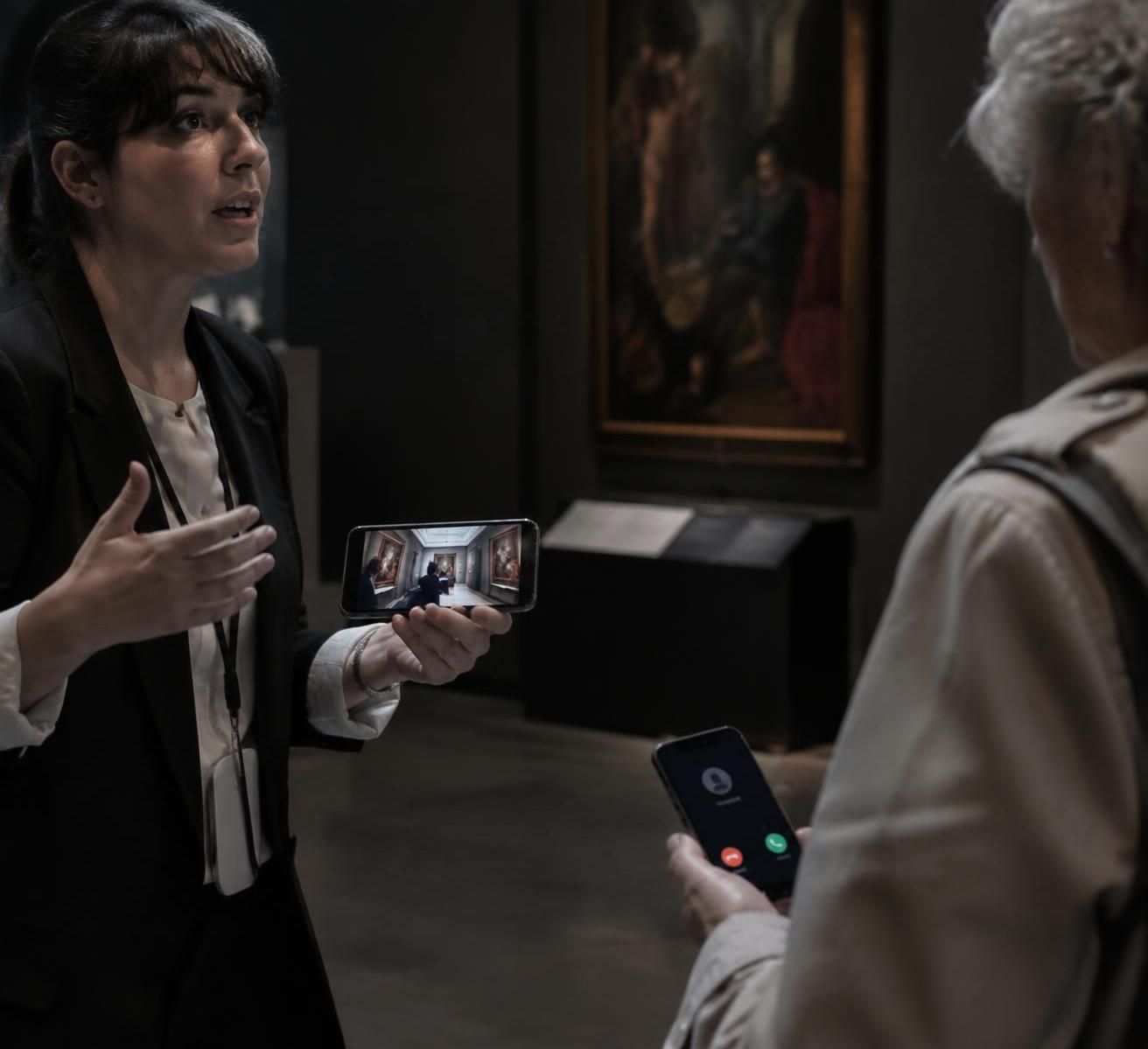
Public Videos Can Feed Voice-Cloning Scams Without a Data Breach
🔓 Many people associate identity theft with a hacked account. Voice-cloning scams can begin much more simply: someone collects audio that its owner intentionally posted for public viewing. A video on Facebook, Instagram, TikTok, or YouTube may be convenient for legitimate audiences and just as accessible to a fraudster searching for a clean speech sample.
Public content is not automatically unsafe, and a private account is not an absolute barrier. A friend might reshare a clip, or a recording from a public event might appear elsewhere. Still, reviewing privacy settings can meaningfully reduce casual harvesting. It is a practical first step for relatives who post frequent videos, particularly when those clips include clear, uninterrupted speech.
How to reduce audio exposure without abandoning useful recordings
Maya’s museum cannot reasonably remove every tour preview or recorded accessibility feature. Those assets help visitors understand a site before arrival and follow a visit at their own pace. The better approach is to separate public communication from sensitive approval processes. Her voice can welcome visitors; it should not, by itself, authorize a bank transfer or a change to staff credentials.
Organizations can audit what they publish and what each recording reveals. A promotional video may include a guide’s full name, work schedule, and references to upcoming travel alongside a clear voice sample. Each detail may seem minor on its own, but together they make an impersonation more believable. Limiting unnecessary personal details and keeping staff contact procedures separate from public posts reduces the attacker’s room to improvise.
Individuals can make similar choices. Check whether older videos are public by default, review tagged posts, and consider who can download or redistribute recordings. These measures cannot erase already copied audio, so they belong alongside verification habits rather than replacing them. For households, guidance focused on older adults and voice scams can help start a calm discussion before an alarming call arrives.
For a cultural organization using smartphone-based audio experiences, accessibility and security should reinforce each other. Clear audio, straightforward visitor instructions, and familiar voices improve the experience; defined staff approval channels protect what those voices cannot verify. A platform such as Grupem can help teams deliver professional audio tours through visitors’ phones, while payment approvals and internal account changes remain subject to independent organizational controls.
One useful exercise is to list all the places where an employee’s voice appears and then list all the decisions that employee can request remotely. If the second list includes refunds, urgent purchases, password resets, or supplier updates, managers should document how each request is confirmed. A callback to a known number or approval inside an existing work system is stronger than asking a colleague whether the voice “sounds right.”
This is not a reason to treat every public recording as a crisis. It is a reason to update assumptions that were formed before inexpensive imitation tools became widely accessible. Publishing useful audio and guarding sensitive actions are compatible goals, provided the organization does not confuse one with the other.
Key fact: Reducing public audio exposure helps, but the more durable defense is to keep identity checks separate from the voice heard on a call.
Family Emergency Scams Use Familiar Voices to Compress Decision Time
🚨 The script behind many family emergency scams is deliberately narrow. A caller who sounds like a child or grandchild claims to be injured, arrested, stranded, or in serious debt. They ask for immediate help and may insist that the recipient tell nobody. The aim is not to sustain a long conversation. It is to secure action before the recipient checks the story.
Return to Maya’s father. The caller says, “There has been an accident; please do not call anyone else yet.” That instruction is revealing. A genuine emergency can be urgent, but urgency does not remove the need to confirm where a loved one is and how to help. In a scam, isolating the recipient prevents the very callback that would expose the deception.
How social engineering turns concern into payment
The familiar voice supplies credibility. The frightening event supplies emotional pressure. The request for secrecy or immediate payment closes the time available for reflection. These are separate elements of social engineering, assembled to make a recipient act before evaluating evidence. Recognizing the sequence is more useful than trying to identify an artificial accent or an odd syllable.
The caller may add details taken from public posts: a recent trip, a workplace, or the name of a relative. None of those details establishes identity. If Maya mentioned a museum event online, an impersonator can mention it too. Even a convincing backstory should be treated as unverified until someone reaches Maya through an independent channel.
Professionals can encounter the same pressure in a different costume. A guide hears what sounds like an organizer asking for emergency equipment funds before a tour starts. A front-desk employee receives a supposed director’s call demanding that a supplier’s account details be changed before closing time. The story changes, but the structure remains: recognized voice, urgent problem, unusual request.
A short response plan helps because it removes the need to invent one under stress:
- 📵 End the call if the caller demands immediate money, secrecy, or account access.
- 📞 Call the person directly using a number already in your contacts, not one supplied during the call.
- 👥 Check another trusted contact if the person cannot be reached; lack of an immediate answer does not confirm the caller’s story.
- 🛑 Pause payment until the situation has been independently verified.
Hanging up can feel impolite when the caller sounds distressed. It is still the safest way to interrupt the pressure. You can help a real relative after verification; you cannot easily reverse every payment made to an impostor. That difference makes a brief pause an act of care rather than a failure to respond.
Some fraudsters also use ordinary recorded speech instead of a live synthetic conversation, allowing them to repeat a short plea while another person handles the payment instructions. Whether the audio is generated, edited, or replayed, the same rule applies. Focus on the requested action and the means of verification, not on judging the sound alone. More background on AI voice scam tactics can help families recognize how these calls are staged.
Key fact: The emergency story is designed to shorten your decision time; an independent callback restores it.
Gift Cards and Rushed Transfers Are Stronger Scam Detection Signals Than Audio Glitches
💳 People often ask how to hear deepfake audio. There may be clues: unnatural pauses, inconsistent emotion, or a voice that struggles with an unexpected question. But these signs are unreliable. A real caller may sound strange because of stress or a poor connection, while an imitation may sound smooth enough to pass a quick listening test. Payment demands are usually more actionable evidence than sound quality.
Gift card codes are a major warning sign. A supposed court official, lawyer, or hospital representative who asks for retail gift cards is not following a credible institutional payment process. Cryptocurrency, unfamiliar payment links, and urgent transfers to a new account deserve similar scrutiny. Wire transfers can be legitimate in other circumstances, so the issue is not that every transfer is fraudulent. The danger is an unexpected, time-pressured transfer requested on an unverified call.
Match the request to a verification step
If Maya’s father is asked to buy gift cards for “bail,” he should stop and contact Maya directly. If a museum administrator receives a familiar-sounding request to change a supplier’s bank details, the administrator should use the supplier’s existing contact information and the organization’s established approval process. Neither recipient needs to prove that AI was used before declining an unsafe payment route.
| ⚠️ Call signal | What it may indicate | Safer response |
|---|---|---|
| 🎁 Gift card codes requested | Payment designed to be difficult to recover | End the call and verify through an independent contact |
| ⏱️ “Pay now; tell nobody” | Pressure intended to prevent checking | Pause and speak with another trusted person |
| 🏦 New transfer details from a “colleague” | Possible AI impersonation or account-change fraud | Follow the existing supplier verification process |
| 📲 Caller ID appears familiar | A displayed number that may be spoofed | Dial a previously saved or independently verified number |
These checks work because they address the attacker’s objective. A fraudster wants money, credentials, or a change in account control; a synthetic voice is merely the delivery method. For practical digital scam detection guidance, teams should examine the transaction being requested as closely as the message carrying it.
Clear procedures are especially useful in busy visitor operations. During a festival or exhibition opening, staff may be handling queues, transport changes, accessibility requests, and last-minute supplier calls. A plausible voice message can fit into that chaos. A rule requiring a second approver for new payment details creates a pause even when the first employee is distracted.
The same principle applies at home. Before any urgent payment, ask where the money is going, whether the recipient can be verified independently, and why the request cannot wait for a brief callback. A caller who becomes angry at verification is supplying another reason to stop. A genuine person may be upset about their situation, but they can still be reached through a trusted route or corroborated by someone else.
It is also important not to turn this into a test of whether a victim was “careful enough.” A familiar voice combined with a frightening claim is persuasive by design. Shared procedures reduce the burden on any one listener and make it easier to resist pressure without having to debate the caller.
Key fact: When an unverified caller requests unusual payment, the safest decision depends on the request—not on whether you can detect an audio flaw.
A Family Code Word and Independent Callback Create a Practical Verification Routine
🔐 A prearranged family code word adds a useful layer to voice-cloning prevention. Relatives agree in advance on a word or phrase that is not published online, easily guessed, or reused as an account password. If an unexpected caller claims to be a family member, the recipient can ask for it. An impostor relying only on a voice sample will not automatically know the answer.
The code word is not a magic password. It can be overheard, shared accidentally, or disclosed through another scam. It also may not be available to a real family member in every circumstance. Treat it as a quick warning test, not as permission to send money immediately. The stronger routine is code word, hang up, independent callback, and then decide what help is needed.
Build a voice-cloning prevention plan that works under stress
Maya’s family could agree on a memorable but unrelated phrase during a normal conversation, then make sure everyone understands when to use it. They could also confirm that Maya’s father has current numbers saved for Maya and another trusted relative. Preparation matters because searching for a number while frightened leaves more time for a caller to regain control of the conversation.
For a museum or tourism team, an equivalent plan should define who may approve purchases, where staff find trusted contact details, and what happens when a supposed manager calls from an unfamiliar number. A verbal code alone is insufficient for organizational payments; documented approvals and a callback to a number already held by the organization are more reliable. An audio-guide team can keep visitor-facing recordings engaging while protecting operational decisions with separate checks.
Practice makes the routine easier to use. A family can run through a simple hypothetical: someone calls claiming that a relative has been injured and needs an immediate transfer. Who hangs up? Which number is called next? Who else can confirm the situation? The exercise need not be dramatic. Its value is in making the first action automatic when emotions are high.
If money or account details have already been shared, speed still matters. Contact the bank or payment provider through its official channel, explain the suspected fraud, and ask what can be stopped or secured. Change affected credentials where appropriate, preserve call details and messages, and report the incident to the relevant local authority. In the United States, reports can also be submitted to the FTC at ReportFraud.ftc.gov and to the FBI’s Internet Crime Complaint Center at ic3.gov.
Do not wait to identify which cloning product, if any, produced the audio. A response plan should address the loss or exposure in front of you. Someone who can no longer reach a relative should contact another trusted person rather than treating silence as proof that the emergency story was true. Someone facing an immediate safety concern should use the appropriate emergency service, not the number supplied by the caller.
The broader approach to protecting yourself from AI-enabled scams is straightforward: prepare trusted routes of contact before they are needed, and keep high-risk decisions out of a single phone conversation. That approach serves families, guides, cultural venues, and visitor-service teams alike.
Key fact: A code word helps challenge an impostor, but an independent callback is the step that confirms who needs your help.
Can AI voice cloning really work from a few seconds of audio?
Some tools can create a recognizable imitation from a very short sample, although quality varies. A familiar-sounding voice on a phone call should never be the only proof of identity.
What should you do if a loved one calls asking for urgent money?
End the call and dial the person using a number already saved or independently verified. If they do not answer, check with another trusted contact before making any payment.
Is a family code word enough to stop voice-cloning scams?
A private code word is a helpful warning test, but it may be disclosed or forgotten. Use it alongside an independent callback, especially before sending money or sharing account details.
What is the strongest warning sign in an apparent deepfake audio call?
An urgent demand for gift card codes, an unfamiliar transfer, secrecy, or account access is more useful to act on than subtle audio glitches. Stop and verify the request through a trusted channel.
