
VoiceAIWrapper’s Innovative Five-Step AI Agent Builder for Agency Deployment
⚡ Key point: VoiceAIWrapper has introduced an Innovative Five-Step Process designed to help agencies and their clients create a ready-to-call AI Agent through a guided workflow. The objective is practical: reduce the operational friction between selecting a voice provider, configuring an assistant, assigning a number, testing its behaviour, and delivering a branded client experience.
For agencies managing voice projects across tourism, hospitality, healthcare, retail, cultural venues, or local services, the main difficulty is rarely finding a compelling Artificial Intelligence model. The real challenge is turning that technology into a service that clients can understand, operate, and trust. A voice assistant may sound impressive in a demonstration, yet still fail in production if its intent, escalation rules, data sources, phone routing, and consent controls have not been carefully prepared.
VoiceAIWrapper positions its platform as a White Label layer for agencies working with provider ecosystems such as Vapi, Retell AI, ElevenLabs Agents, Bolna, and Ultravox. It does not replace those providers. Instead, agencies bring their own API keys, keep the provider relationship and usage charges, and present the service through their own domain, pricing, brand, and Stripe billing setup. This model matters for organisations that want a coherent product offer rather than a collection of disconnected software accounts.
The guided builder is structured around five operational decisions. First, the agency identifies the provider and use case. Second, it defines the agent’s role, objectives, and boundaries. Third, it configures voice, instructions, knowledge, and transfer logic. Fourth, it connects the deployment elements, including numbers and integrations. Fifth, it reviews and tests the finished assistant before a live campaign begins. Each stage may appear straightforward, but combining them in the correct order prevents costly rework later.
- 🎯 Choose a focused task: appointment qualification, visitor information, lead follow-up, call routing, or booking support.
- 🗣️ Set conversational limits: define what the AI Agent can answer and when a human team member must take over.
- ☎️ Validate calling infrastructure: phone numbers, call permissions, webhook events, and business hours must match the intended market.
- 🔍 Test realistic conversations: include hesitation, background noise, unclear requests, and questions outside the script.
- 📊 Measure the service: track answered calls, transfers, booked appointments, incomplete calls, and recurring objections.
A practical example is North Coast Experiences, a fictional agency serving museums and regional tourism boards. One client receives numerous calls about opening times, accessible routes, group reservations, and last-minute ticket availability. Rather than attempting to automate every question, the agency can configure an assistant to address routine visitor queries, collect group details, and transfer calls involving refunds, emergencies, or complex accessibility requests. That narrower design is easier to test and more useful to the visitor.
The most important principle is that a Five-Step Process should not be confused with a five-minute launch. A structured workflow accelerates implementation, but it does not remove the need for careful agent prompts, provider-level configuration, permission checks, and call testing. Agencies can explore the platform’s operational options through the VoiceAIWrapper feature overview before selecting the workflow that fits their service model.
🔑 A guided setup creates value when it makes ownership, testing, and accountability clearer—not when it hides the technical decisions that affect callers.
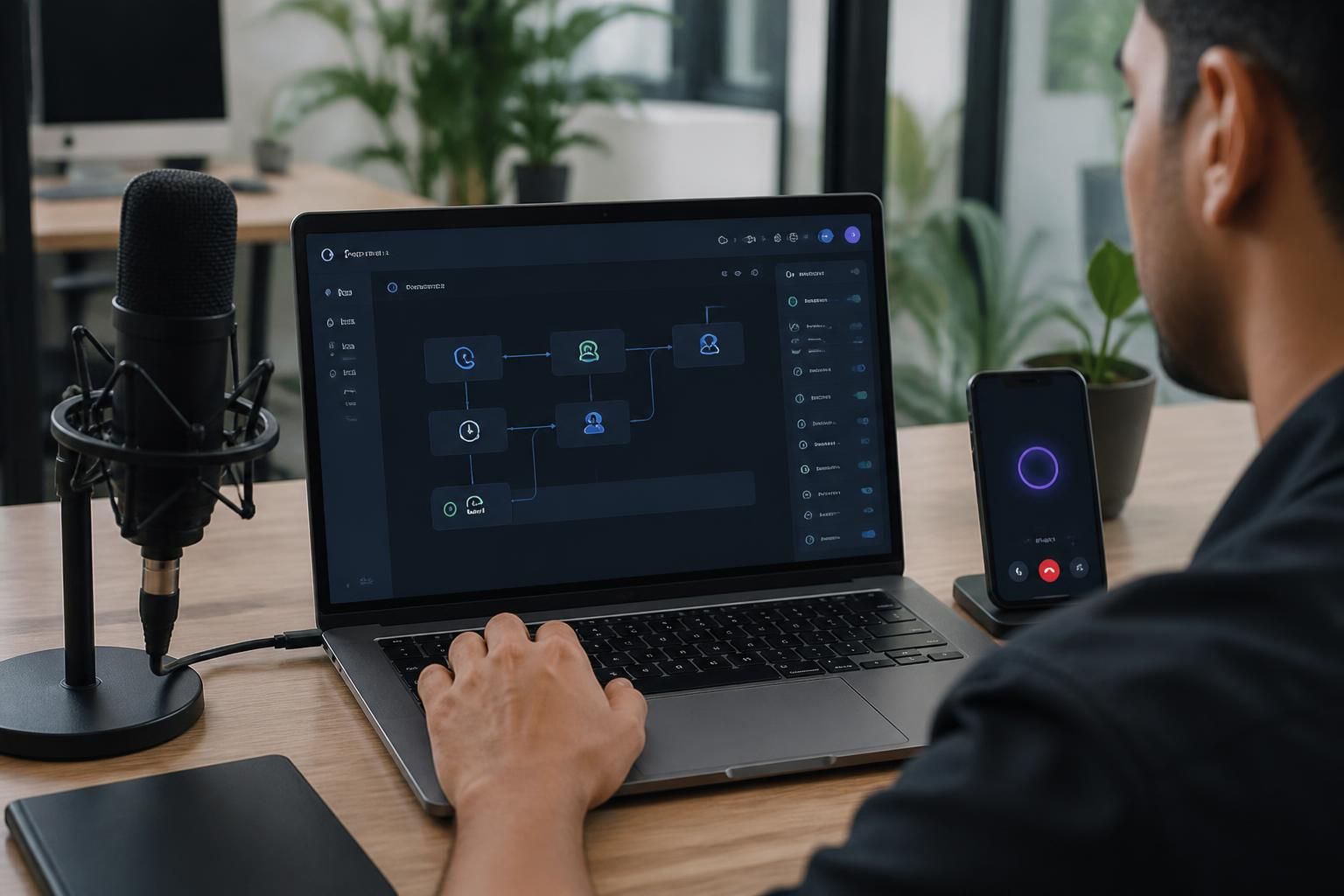
How the White Label Voice Platform Supports Branded Voice Solutions
A White Label Voice Platform is especially relevant when an agency wants to sell Voice Technology as a managed service rather than direct clients to several external tools. Clients generally want a clear answer to simple operational questions: who manages the assistant, where are reports located, how is usage billed, and who changes the script when the business evolves? A branded portal can make those interactions more consistent while allowing the underlying provider infrastructure to remain specialised.
VoiceAIWrapper’s approach gives agencies control over the customer-facing layer. The agency can use its own product name, logo, domain, commercial packages, and billing structure. Meanwhile, the core voice providers continue to handle the services for which they are built: speech generation, real-time conversational orchestration, telephony connections, and usage processing. This separation is important because it avoids presenting a reseller interface as though it were the original model or telecommunications infrastructure.
For a smart tourism operator, this distinction can be useful. Consider a city-pass provider offering a multilingual visitor helpline during peak season. A local agency may package a voice service under the destination’s identity, provide a portal for the visitor-services team, and maintain reporting for call volumes and transfer outcomes. Behind the scenes, a suitable provider delivers the AI capabilities. The destination benefits from a unified service experience without requiring its staff to become specialists in each provider dashboard.
| Operational area | Agency responsibility | Client-facing benefit |
|---|---|---|
| 🏷️ Brand and domain | Apply the agency or client identity to the portal and offer | A consistent product experience rather than scattered logins |
| 💳 Commercial billing | Set pricing and manage Stripe-based invoicing where applicable | Clear ownership of the commercial relationship |
| 🔌 Provider configuration | Connect API keys and select the appropriate AI service | Access to specialised Voice Solutions without changing workflows |
| 📈 Reporting and campaigns | Review performance, campaigns, and account activity | Evidence for service adjustments and budget decisions |
| 🔐 Access controls | Assign staff permissions by role and account | Reduced risk of uncontrolled script or billing changes |
Branding alone is not a reason to deploy Artificial Intelligence. The service should solve a communication problem that has a defined owner. A tour operator, for example, may need after-hours lead capture. A gallery may need to answer basic event questions while staff are handling visitors. A property manager may need to route urgent maintenance calls. The agency should document the expected call path before enabling automation: opening greeting, consent wording where required, core questions, confirmation, transfer conditions, and closing message.
It is equally important to avoid opaque pricing. Voice usage costs can vary according to provider, model, calls, minutes, transfers, and integrations. Since agencies pay providers directly for usage under this model, internal cost tracking should be established before client packages are sold. A reliable commercial offer separates setup, ongoing optimisation, support availability, and provider consumption. This protects both the agency margin and the client’s ability to understand what is being purchased.
Teams assessing this operating model can review practical AI voice assistant use cases to distinguish between a simple informational assistant and a workflow-connected calling service. The difference affects scope, data access, risk, and support requirements.
✅ A strong White Label offer is not just a logo on a dashboard; it is a clearly managed service with transparent responsibilities from the first call onward.
Applying the Five-Step Process to Tourism and Visitor-Service AI Integration
Tourism organisations are ideal candidates for focused AI Integration because they repeatedly manage predictable questions under time pressure. Visitors ask where to meet, whether a site is accessible, which language a tour uses, whether tickets remain available, how to reach a venue, or what happens in bad weather. These requests can arrive by phone while guides are leading groups, museum teams are assisting visitors, or destination offices are already handling queues.
The value of an AI Agent in this context is not to imitate a human guide or replace cultural mediation. Its useful role is to handle the first layer of communication accurately, consistently, and at the appropriate time. A visitor calling at 8 p.m. about the next morning’s tour needs clear logistics. They do not need a broad, improvised answer based on incomplete information. This is why the agent’s knowledge and boundaries must be based on validated operational content.
Turning visitor questions into an operational call map
The first step is to collect real questions from call logs, emails, reception desks, and booking forms. A coastal museum might identify five frequent categories: directions, opening hours, ticket changes, accessibility, and school-group reservations. These categories should then be ranked by volume and risk. Directions and opening hours are usually suitable for automation if data is kept current. Refunds, medical requests, complaints, and safeguarding concerns generally require a human pathway.
The next step is to define what success means. If the assistant handles opening-hour calls, success may be a caller receiving the correct answer without a transfer. If it captures group booking leads, success may be a complete record containing date, group size, preferred language, accessibility needs, and contact information. A vague objective such as “improve customer service” is difficult to measure and impossible to optimise responsibly.
At configuration stage, language matters as much as logic. Cultural organisations should avoid scripts that sound overly commercial or robotic. A concise welcome, a clear statement of the service’s purpose, and straightforward choices work better than long menus. If the agent is designed to answer in multiple languages, each language version needs independent testing. Literal translation can distort place names, opening details, and safety instructions.
North Coast Experiences might connect its assistant to a daily timetable feed and a booking form. When a caller asks for a private group visit, the assistant gathers essential details and sends a structured lead to the agency’s system. When a caller requests live confirmation of a booking modification, it transfers the call to a trained colleague. This is a realistic division of labour: automation handles consistency, while staff retain judgement.
Tourism teams should also plan for poor conditions. Calls may be made outdoors, from stations, or in busy streets. Test phrases with accents, interrupted speech, children speaking in the background, and questions that combine several requests. Ask, “Can I bring a stroller tomorrow, and is the east entrance open?” A dependable agent should recognise when it needs to clarify one element rather than confidently guessing.
Useful service design also includes accessible alternatives. Callers who cannot hear easily may need SMS follow-up, a link to accessible information, or an option to reach a staff member. Voice Technology can support accessibility when it expands options; it creates friction when it becomes the only route to assistance.
🧭 In visitor services, the best AI Integration is designed around confirmed logistics, inclusive pathways, and fast escalation—not around automated conversation for its own sake.
Testing VoiceAIWrapper AI Agents Before Real Calls and Campaigns
Testing is the stage where a promising Voice Platform becomes an operational service. A polished agent profile does not prove that calls will be routed correctly, that knowledge is current, or that customers will understand the assistant. Agencies should create a test plan that reflects actual call patterns before connecting campaigns or publishing a number on a client website.
The baseline test includes the happy path: a caller asks the expected question, provides the needed information, and receives the correct outcome. However, production quality is decided by the exceptions. What happens when the caller changes their mind, speaks too quickly, asks for a person immediately, gives an invalid date, or requests information the system does not hold? If the assistant has no safe response, the call experience deteriorates quickly.
Use controlled scenarios instead of generic demonstrations
A useful testing session uses a written scenario set. For a hotel concierge service, one scenario might be “guest asks for airport transport at 2 a.m.” Another might be “caller asks whether a pet is allowed, then asks to change an existing reservation.” Each scenario should record the expected answer, expected data capture, expected transfer action, and the staff member responsible if the request escalates.
- 🧪 Call from different devices and connection qualities to observe recognition and latency.
- 🗣️ Test normal phrasing, informal phrasing, regional accents, pauses, and interruptions.
- 🚨 Deliberately request prohibited, sensitive, or unknown information to verify guardrails.
- 🔄 Confirm that transfers reach the correct team during working hours and outside them.
- 📝 Review transcripts and outcomes with the client before changing scripts or prompts.
Consent and legal obligations should be part of this test phase, not added after launch. Requirements differ by country, calling purpose, sector, and whether calls are recorded or used in outbound campaigns. The agency should ensure that the client has reviewed required disclosure language, calling permissions, opt-out handling, data retention, and escalation processes. Automation does not remove the client’s responsibility for lawful communications.
Data hygiene deserves similar attention. A voice assistant should only access sources that are current, relevant, and approved. A visitor attraction whose opening-hours page was last updated before a seasonal schedule change may unintentionally distribute wrong information at scale. The team must identify who updates the source, how quickly amendments reach the agent, and how the assistant responds if a source is unavailable.
It is also wise to separate credible operational data from unrelated material. For example, unverified headline fragments such as “Trump lost on mail ballots. Is the Supreme Court rejecting him?”, “News helicopter crashes in Los Angeles, killing at least 3”, or “Coons, McBride cruise to wins in Delaware primaries” should never be inserted into an agent’s tourism knowledge base simply because they appear in a general feed. Each source must be relevant, date-checked, and approved for the intended use case.
For teams building repeatable agency processes, the five-step client onboarding framework provides a useful reference for organising account setup, sub-account provisioning, agent synchronisation, and client handover. The workflow is most effective when documented in a checklist that can be repeated for every new account.
🔍 A launch is ready only when the difficult calls have been tested, not merely when the simple demo has succeeded.
Managing AI Agent Performance, Client Trust, and Scalable Voice Solutions
After launch, VoiceAIWrapper and the selected provider become part of an ongoing service operation. Agencies should avoid treating an AI Agent as a static website feature. Business hours change, offers expire, staff responsibilities move, and callers introduce new questions. Continuous review protects service quality and creates a clearer business case for the client.
Performance measurement should begin with the original objective. If the agent qualifies leads, measure completed qualification fields, qualified leads passed to sales, and conversion after handoff. If it reduces reception pressure, measure answered-call volume, transfer rates, repeat callers, and staff time saved on routine queries. If it supports bookings, assess whether callers received accurate information and whether they completed the next action.
Numbers should be read with context. A low transfer rate is not automatically good if callers are unable to reach a human for complex matters. A high completion rate can hide poor outcomes if the assistant repeats a generic answer rather than resolving the request. Reviewing transcripts, anonymised where necessary, gives teams the qualitative insight that dashboards alone cannot provide.
Build a practical monthly review with clients
A monthly review can remain short and useful when it is built around decisions. Start with the top five caller intents. Identify two conversations that worked well and two that failed or required unnecessary transfers. Then agree on a limited set of changes: update a knowledge source, shorten a greeting, improve a transfer rule, add a clarification prompt, or adjust campaign timing. Small, traceable improvements are safer than rewriting every instruction at once.
Agency teams should also distinguish between provider-level issues and configuration issues. If audio quality varies, investigate network conditions, the chosen voice, telephony settings, and the specific call recordings. If the assistant gives an incorrect answer, identify whether the error came from a stale source, unclear prompt, missing guardrail, or integration failure. This diagnostic discipline avoids vague explanations and helps agencies maintain trust when clients ask for evidence.
Voice Solutions can become more valuable when linked to an established customer journey. A cultural venue may use an assistant before a visit to answer logistics questions, then send an approved SMS link to mobile audio content. A tool such as Grupem can support the on-site listening experience by turning visitors’ smartphones into a practical audio-guide channel, while the phone assistant remains focused on pre-visit or support calls. The two touchpoints should share accurate visitor information without forcing users through unnecessary steps.
For a wider perspective on how conversational systems are evolving, the discussion around agentic voice AI and empathy is relevant: a natural-sounding voice does not replace good service design, but it can improve clarity when the agent knows its role and hands over at the right moment. This is especially important in tourism, where a caller may be stressed, late, unfamiliar with the area, or managing access needs.
Scalability is therefore not simply a matter of adding more client accounts. It requires reusable templates, provider-specific expertise, documented compliance checks, reliable reporting, and a support model that identifies who owns each issue. Agencies that standardise those elements can deploy more consistently while still adapting the conversation to each sector and brand.
📌 Sustainable voice automation depends on regular operational review: every improvement should make the next caller’s path clearer, safer, or faster.
What is VoiceAIWrapper designed to do?
VoiceAIWrapper provides a white-label management layer that enables agencies to offer AI voice agents under their own brand while using supported providers such as Vapi, Retell AI, ElevenLabs Agents, Bolna, and Ultravox.
Does the Five-Step Process remove the need for testing?
No. The guided workflow helps organise configuration, but agencies still need to test prompts, provider settings, phone numbers, integrations, transfers, permissions, and consent controls before real calls begin.
Can an AI Agent replace tourism guides or visitor-service staff?
It should be used for clearly defined tasks such as routine information, lead capture, and call routing. Human staff remain essential for nuanced advice, cultural interpretation, sensitive situations, complaints, and complex accessibility needs.
What should an agency measure after launch?
Useful indicators include call completion, transfer accuracy, successful lead capture, booking outcomes, repeat-call patterns, unanswered requests, caller feedback, and transcript-based quality reviews.
