
UK Novelists and AI Job Replacement: What the Survey Actually Shows
The headline says “nearly half,” but the reported figure is 51%: just over half of the participating novelists. That distinction matters because the Cambridge research measures what respondents believe is likely to happen, not a verified rate of job replacement across British fiction.
The study gathered 332 responses between February and May 2025, including 258 published novelists, 42 fiction-publishing professionals, and 32 literary agents. Among the writers, 233 were traditionally published and 25 were self-published, making this primarily a study of people already working within established publishing channels.
Led by Clementine Collett at Cambridge’s Minderoo Centre for Technology and Democracy, the university’s research on generative AI and novelists combined a survey with interviews, focus groups, and stakeholder discussions. Published in association with the Institute for the Future of Work, it examines professional experiences alongside expectations about technological change.
Reading author concerns without turning predictions into facts
Three findings describe different levels of exposure: 51% anticipated complete replacement of their fiction-writing work, 39% reported an existing negative effect on income, and 85% expected future earnings to suffer. These figures should not be collapsed into a single claim that half of British authors have already lost their livelihoods.
The income findings are self-reported, rather than independently audited financial measurements. Similarly, the replacement figure reflects participants’ expectations; it does not establish that artificial intelligence can reliably reproduce the full range of work involved in developing, revising, publishing, and sustaining a successful novel.
| Survey finding | What it supports | What it does not establish |
|---|---|---|
| ⚠️ 51% anticipated complete replacement | Substantial concern among participating novelists | A measured probability of future displacement |
| 💷 39% reported reduced income | Respondents attributed existing financial pressure to generative systems | An independently verified amount of lost earnings |
| 📉 85% expected lower future earnings | Widespread pessimism about future income | A forecast of the size or timing of losses |
| 🔎 258 novelists participated | A detailed snapshot of this respondent group | Automatic representation of every UK fiction writer |
The report also describes a respondent sample that was predominantly white and female, at 87% and 78% respectively. This does not invalidate the experiences recorded, but it limits how confidently readers can generalise them across different communities, career stages, and publishing routes.
Why cultural organisations should care about the distinction
Consider Maya, a hypothetical British novelist who also writes scripts for a local museum. Her concern about losing future commissions is relevant to the museum’s procurement decisions, even if it does not prove that a machine could replace her entire creative contribution.
If the museum mistakes perceived exposure for demonstrated capability, it may replace a knowledgeable contributor before testing historical accuracy, narrative quality, or audience response. If it dismisses the survey as mere anxiety, it may overlook real financial pressures already affecting the people who supply its cultural content.
A useful assessment therefore separates three questions: which tasks software can assist, which commissions buyers are already withdrawing, and which professional responsibilities still require human accountability. A generated draft might be quick to obtain, while checking its interpretation, securing permissions, and making it suitable for visitors still demand substantial work.
For decisions made in 2026, the survey remains evidence collected in 2025; it should not be presented as a fresh annual measurement. The practical lesson is to take reported disruption seriously without treating expectations as proof of inevitable replacement.
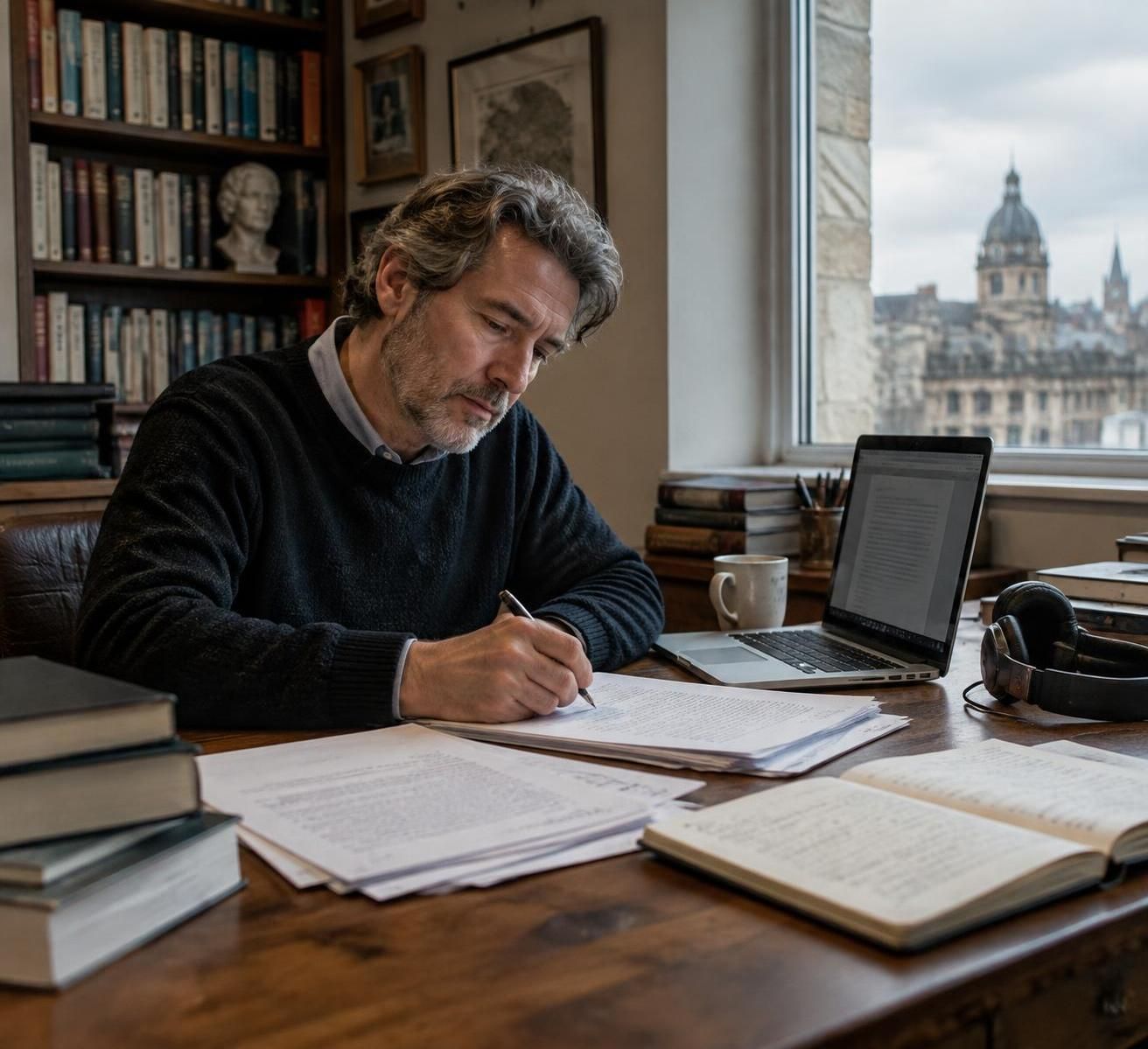
How Generative AI Threatens Writing Careers Beyond Book Sales
The most immediate pressure on writing careers may arrive through supplementary work rather than through a bestselling machine-written novel. A writer can retain a publishing contract while losing the copywriting, translation, editing, or educational commissions that previously made that contract financially sustainable.
In Collett’s explanation of the research findings, the wider employment picture is central. Many authors depend on several income streams, so changes in the market for short commercial assignments can affect their capacity to continue producing long-form fiction.
This is why a narrow comparison between a human novel and an automatically generated book misses an important mechanism. A manuscript may take months or years to develop, and losing regular paid assignments can reduce the time available for research, revision, and experimentation.
Following the financial pressure through a realistic example
Suppose Maya receives occasional royalties, a modest advance, and recurring commissions to write exhibition narratives. This is an illustrative scenario, not a case documented in the Cambridge report, but it shows how several small procurement changes can accumulate.
One client starts generating its promotional copy internally; another reduces its translation budget; a third asks Maya to repair automatically produced scripts for a lower fee. None of those clients has replaced her novel, yet together they have weakened the financial foundation supporting its completion.
The resulting effect is not only lower income. She must spend more hours finding replacement work, has less uninterrupted time for her manuscript, and may decline ambitious projects that require extensive unpaid preparation.
For museums and tourism organisations, the relevant purchasing question is therefore broader than “Can a tool produce this paragraph?” It is “What expertise does this commission support, and which parts of that expertise would disappear if the organisation stopped paying for it?”
AI-generated fiction creates discovery and identity problems
Respondents also described competition from automatically produced books and reported titles appearing under their names that they had not written. Such accounts raise separate issues: market congestion affects discoverability, while false attribution threatens professional identity and reader trust.
The study additionally records concerns about apparently generated reviews containing confused character names and damaging ratings. These are participant reports, not a platform-wide measurement, but they illustrate why unreliable automated material can impose costs on people who never chose to use it.
A literary festival listing, library catalogue, or museum shop can inadvertently repeat those errors if staff rely on an unverified marketplace description. Checking the author’s official bibliography and the publisher’s catalogue is a small operational step with clear value.
- 💷 Separate creation from repair: specify whether a commission covers original writing, fact-checking, editing, or correcting supplied machine-generated material.
- 🔎 Verify authorship: confirm titles and contributors through reliable publishing records before promoting books or events.
- 📝 Keep evidence of commissioned work: retain contracts, approved drafts, invoices, and publication dates to support attribution disputes.
- 🤝 Discuss workflow changes openly: do not quietly reduce fees while expecting the same research, judgement, and accountability.
Some participants imagined a future in which human-written fiction becomes an expensive niche while generated content is cheap or free. That scenario is not an established market outcome, and affordability alone does not determine whether readers value a book.
Cultural buyers nevertheless influence which work remains viable through their everyday budgets. Protecting a writer’s livelihood starts with understanding the whole portfolio of paid work, not merely counting book sales.
Creative Writing and AI-Generated Fiction: Separate Assistance from Substitution
The survey does not describe uniform rejection of technology. Around 80% of all respondents recognised that AI offers benefits to parts of society, while approximately one-third of participating novelists reported using generative tools within processes surrounding their work.
Task boundaries explain much of this apparent tension. A person can welcome help organising information while objecting to a system producing the sentences, characters, and narrative decisions that readers understand as that person’s creative contribution.
About 20% of novelists reported using these tools to source general facts or information, and roughly 8% used them to edit text they had written themselves. Neither practice removes the need for verification: a fluent answer can contain fabricated references, misleading context, or an interpretation that is unsuitable for publication.
Why literary creativity cannot be judged by output speed
Resistance increased sharply when generated prose became the proposed product. Some 97% of participating novelists felt extremely negative about using the technology to write entire novels, and 87% expressed that response toward generating short sections.
Editing was also contested, with 43% feeling extremely negative about its use for that purpose. An editing system may appear merely corrective while changing rhythm, flattening regional language, or removing an ambiguity that the writer deliberately introduced.
Imagine Maya preparing a story about a coastal community for a heritage exhibition. A suggestion to shorten a sentence may improve listening comprehension; a suggestion to replace local speech with generic phrasing may remove cultural specificity that gives the passage its meaning.
That distinction matters particularly in audio interpretation. Visitors need intelligible narration, but intelligibility does not require every speaker to sound interchangeable or every historical account to follow the same emotional pattern.
Useful assistance should improve access without silently taking control of meaning. A practical workflow lets the author review individual changes, reject unsuitable recommendations, and preserve a record of the final approved version.
Genre vulnerability is a perception, not a quality ranking
Across the surveyed literary professionals, romance received the highest “extremely threatened” rating, at 66%, followed by thrillers at 61% and crime fiction at 60%. Literary fiction received that assessment from 32%.
These results reflect perceived vulnerability, not experimental evidence that one genre is easier to replace or less artistically valuable. The report did not compare actual displacement rates across genres or test generated novels against human-written books.
Recognisable conventions may influence those perceptions: a romance has reader expectations, just as a crime novel usually promises a meaningful investigation. Yet meeting a structural expectation is not the same as earning emotional credibility, developing memorable characters, or handling social experience responsibly.
The report records fears that greater reliance on generated material could reduce originality and reproduce stereotypes from existing texts. A related 2024 study in Science Advances examined how generated ideas could improve individual short-story assessments while making outputs more similar across participants; its findings should not be treated as a direct test of full-length novels.
For professional teams, the workable boundary is task-specific. Allow a tool to suggest a checklist, flag possible inconsistencies, or help organise approved material, then assign a named person responsibility for evidence, interpretation, and final wording.
The same principle informs modern audio delivery: a smartphone-based platform such as Grupem can support the listening experience without being treated as a substitute for the expertise behind the script. Technological convenience and literary authorship are different functions, and purchasing decisions should keep them distinct.
Intellectual Property and AI Training: Make Permission and Payment Explicit
Questions about intellectual property sit at the centre of the survey because authors are concerned not only about competing output, but also about how their existing work enters training datasets. Ownership of a manuscript and control over its reuse are separate from the ability to access its text online.
Some 59% of participating novelists reported knowing that their work had been used to train generative systems. Within that group, 99% said they had not given permission, and every respondent said they had received no payment.
Those denominators matter: the permission and payment findings apply to the writers who reported knowing about training use, not automatically to every novelist in the sample. They remain strong evidence of dissatisfaction among that group without requiring a broader unsupported claim.
Distinguishing an opt-in licence from an opt-out mechanism
The research found substantial resistance to a proposed copyright exception permitting text mining unless rights-holders opted out. Around 83% of all respondents considered that approach negative for publishing, while 93% of novelists said they would probably or definitely opt out.
By contrast, 86% of all respondents preferred an opt-in approach based on permission and remuneration. Among novelists, 48% favoured collective licensing negotiated through a writers’ union or society, suggesting interest in arrangements that reduce the burden of individual negotiation.
These preferences do not themselves determine the legal position. They show what respondents regarded as fairer governance and should be distinguished from enacted rules, contractual obligations, and the technical ability to identify training material.
The policy context also changed after the survey. In its March 2026 copyright and AI report, the UK government stated that a broad exception with an opt-out was no longer its preferred approach and proposed further evidence gathering and consideration of other options.
That change should not be described as a complete ban on training or as proof that every rights dispute has been resolved. Cultural organisations still need to assess the permissions attached to specific material and obtain qualified advice where a contract or proposed reuse is unclear.
Turn abstract rights concerns into commissioning questions
Suppose a museum commissions Maya to create a literary walking-tour script. Permission to publish the text in a visitor guide should not simply be assumed to include permission to upload it into an external model, generate unlimited adaptations, or reproduce her voice synthetically.
A practical commissioning brief should distinguish the original text, translations, recordings, distribution channels, and any proposed automated processing. It should also specify who can authorise additional uses and whether those uses require further payment.
Data handling deserves its own discussion. A service’s retention settings, subcontractors, and terms governing uploaded content may matter as much as its visible editing features, especially when the draft contains unpublished writing or sensitive interview material.
The connection to audio becomes particularly clear in discussions of AI voice cloning and creative performers. Permission to use written words and consent to reproduce someone’s vocal identity should be checked separately rather than bundled into a vague approval for “digital use.”
For a small organisation, the first operational step is a rights register recording the contributor, permitted uses, duration, approval requirements, and relevant agreement. This is an administrative safeguard, not a replacement for legal review, but it makes missing permissions easier to identify before publication.
Fair licensing begins with a precise account of what is being reused, by whom, and for which purpose. Without that clarity, payment negotiations and promises of transparency remain difficult to enforce.
Publishing Industry Trust: Build Accountable AI Workflows for Cultural Content
The publishing industry faces a trust problem alongside the financial and legal pressures. Readers may object to undisclosed generated prose, while writers may suffer reputational harm when people incorrectly accuse them of using automated tools.
The survey found greater reported adoption among fiction-publishing professionals than among novelists: 45% of publishing respondents used generative systems to some extent in their work. That figure does not mean almost half of published books contain generated prose, because the questionnaire covered workplace processes rather than the composition of every title.
Marketing support, internal organisation, research assistance, editing, and narrative generation have different consequences. A useful disclosure policy explains consequential uses rather than placing every digital process under one uninformative label.
Make transparency specific enough to help readers
If Maya’s museum script is human-written but delivered through synthetic narration, visitors should be able to understand that distinction. If a generated passage is included, the organisation should identify the relevant contribution and the person responsible for checking it.
A statement such as “technology helped produce this experience” communicates very little. A more useful description explains whether software supported translation, produced the spoken voice, suggested wording, or contributed material that appears in the final narrative.
Responsibility should remain identifiable even where several tools are involved. Visitors need a straightforward way to report an incorrect date, a mispronounced name, an inaccessible passage, or a disputed interpretation without being passed between suppliers.
Grupem’s discussion of AI safeguards beyond a simple shutdown mechanism offers a related topic for teams considering operational oversight. For cultural content, practical safeguards include version control, documented approvals, restricted access to unpublished material, and a clear correction procedure.
The Cambridge report also records concern about both undisclosed use and false accusations. Organisations should therefore avoid treating a text-detection score as decisive evidence of authorship and use a documented review process before making damaging claims.
Test usefulness through visitor experience, not production volume
A cultural organisation can assess a proposed workflow with a limited pilot rather than replacing its content process outright. Select one short script, retain the approved original, and document every intervention so that reviewers can see what changed and why.
Ask a historian to check interpretation, a writer to review narrative coherence, and intended users to assess comprehension. For an audio tour, include pronunciation, pacing, listening conditions, and the availability of a readable alternative.
Efficiency should be measured across the complete process. A draft generated in seconds may require substantial correction; a carefully commissioned passage may be quicker to approve and less costly to maintain.
Accessibility also needs a balanced approach. Speech recognition, assistive drafting, and other tools can support contributors with disabilities, so a blanket prohibition may exclude people without improving the quality or integrity of the final work.
The report’s recommendations recognise accessibility needs while supporting opportunities for creative writing without generative assistance, particularly in education. That balance preserves the value of developing judgement through writing while avoiding the assumption that every person works under identical conditions.
Support for independent publishers and underrepresented voices is another practical concern raised by participants. For a festival, museum, or tourism office, it can translate into paid commissions, realistic deadlines, and procurement criteria that reward relevant knowledge rather than simply the lowest price.
Before approving Maya’s next script, the museum can record its source material, contributor permissions, tool use, review responsibilities, and correction route on a single project sheet. An accountable workflow protects the audience’s experience and the contributor’s authorship at the same time.
Did nearly half of UK novelists say AI could replace their writing entirely?
The reported figure was 51% of the 258 participating published novelists, which is just over half. It describes respondents’ expectations about future replacement, not a measured displacement rate for all UK writers.
Has generative AI already reduced authors’ income?
Some 39% of surveyed novelists attributed an existing negative effect on their income to generative AI. These were self-reported experiences, and the research did not independently audit the amount of money lost.
Are novelists opposed to every use of artificial intelligence?
No. Around one-third reported using generative tools in processes surrounding their work, often for tasks they considered non-creative. Opposition was substantially stronger when tools produced prose intended to replace the writer’s own contribution.
What should museums check before processing a commissioned script with AI?
Check the commissioning agreement, permission for the proposed processing, the service’s data-retention terms, and whether additional reuse requires approval or payment. Obtain separate consent where synthetic narration involves reproducing a contributor’s vocal identity.
Did the UK resolve the AI copyright debate in 2026?
The government’s March 2026 report said a broad copyright exception with an opt-out was no longer its preferred approach. It proposed gathering further evidence and considering other options, rather than announcing that all training, licensing, and remuneration disputes had been settled.
