
President Trump has dismissed appeals from prominent technology executives and researchers for a temporary pause in advanced AI Development. His position prioritizes U.S. competitiveness, particularly against China, while industry leaders argue that faster deployment must be matched by credible safeguards against misuse, security failures, and social disruption.
⏱️ Little time? Here is what matters:
- ✅ Trump argues that America must maintain its advantage in Artificial Intelligence rather than slow its progress.
- ✅ Several Tech Leaders, including executives associated with OpenAI, Anthropic, and xAI, support stronger guardrails and a more measured release pace.
- ✅ 🏗️ Public resistance to data-center construction shows that AI policy is also about energy, land, water, and local consent.
- ✅ Cultural institutions and tourism operators should treat Regulation as a practical design requirement, not as a barrier to useful Innovation.
Trump Dismisses AI Development Pause Appeals in the Name of Competition
At an appearance during a golf tournament in Doonbeg, Ireland, on September 13, President Trump rejected the growing demand for an AI Development Pause. The comments followed an essay by Anthropic chief executive Dario Amodei, who called for substantially stronger precautions as frontier systems become more capable. Trump’s central argument was clear: the country that leads Artificial Intelligence will gain decisive economic and strategic advantages, and the United States should not voluntarily weaken its position.
Trump described the pressures surrounding the sector as “negative forces,” suggesting that some warnings exaggerate outcomes that will not materialize. He accepted that guardrails can exist, but framed a broad slowdown as strategically misguided. This is not simply a disagreement about technical risk. It is a disagreement about timing: whether safety measures should slow capability growth before deployment, or whether the country should develop rapidly and address harms through targeted controls.
The political appeal of this message is easy to understand. AI is increasingly presented as infrastructure, industrial capacity, defense capability, scientific acceleration, and a productivity tool. From this perspective, pausing progress may appear equivalent to ceding ground to competitors. Reporting on Trump’s emphasis on Chinese competition illustrates how national rivalry has become central to the policy debate.
Yet the request from technology executives was not necessarily a call to abandon Innovation. It reflected concern that highly capable models are being introduced faster than evaluation methods, incident reporting, and public institutions can adapt. The practical question is not whether useful technology should stop. It is whether developers can demonstrate that each major capability jump has been tested against realistic abuse scenarios before it reaches millions of users.
Why the language of a “pause” creates a difficult political choice
The term Pause can mean very different things. For some, it refers to a short period in which developers assess the risks of training models beyond a specified capability threshold. For others, it implies a rigid freeze that would be difficult to define, monitor, and enforce internationally. Trump’s dismissal responds largely to the second interpretation: a broad restraint that could handicap U.S. firms while overseas competitors continue.
Tech Leaders raising the alarm generally focus on narrower operational questions. Can a model help produce malicious code? Can it be manipulated to impersonate public officials? Can it reveal dangerous procedural knowledge at scale? Is it capable of independently pursuing tasks for extended periods? These are measurable issues, even if experts disagree on thresholds and remedies.
Consider a hypothetical regional museum network, “Harbor Routes,” deploying an AI assistant for visitors. A rushed system might invent opening hours, incorrectly describe a sacred object, or give unsafe travel advice during a storm. A carefully governed system would cite approved collections data, hand uncertain requests to staff, log errors, and make clear when content has been generated. This is not a speculative extinction scenario; it is an immediate service-quality and trust issue.
For tourism professionals, the political dispute should not be reduced to a choice between fear and progress. The useful lesson is that speed without accountability shifts costs to visitors, workers, and local communities. Competition matters, but reliable implementation determines whether a new service is actually adopted. That tension becomes clearer when the warnings from AI builders themselves are examined.
Tech Leaders Call for AI Regulation Without Rejecting Useful Innovation
The most striking feature of this debate is that calls for restraint have come from people building the systems themselves. Dario Amodei’s essay presented AI as a potentially transformative tool, including for medicine and scientific research, while insisting that extraordinary capability also creates extraordinary responsibility. His personal reference to cancer—surviving an early-stage diagnosis while losing his father to a disease later made treatable—captured both sides of the argument: technology can save lives, but its power must be deliberately directed.
OpenAI chief executive Sam Altman and xAI leader Elon Musk each publicly aligned with the need for stronger safeguards and a slower, more controlled development tempo. Their agreement does not resolve the question of how to regulate. It does show that the debate cannot credibly be portrayed as opposition to Technology from people who do not understand it. These are commercial rivals with different products and incentives, but they recognize that trust is a prerequisite for widespread use.
A September 10 Anthropic threat-intelligence report added concrete evidence to the discussion. Covering the preceding eight months, it described cases in which actors attempted to use Claude for malicious purposes and said the company had disrupted those operations. Such reporting matters because it moves the conversation away from abstract predictions. If misuse attempts are already occurring, providers need repeatable procedures for detecting, documenting, blocking, and learning from them.
The wider public discussion also intensified after Anthropic researcher Jacob Coxon resigned and warned that some people involved in frontier AI believe the technology could threaten humanity by the end of the decade. His claim is extreme, but it raises a valid governance issue: when internal experts identify a serious risk, what independent channel ensures their evidence is assessed rather than ignored? The details of the growing AI extinction-risk debate show why this question has moved beyond technical circles.
What workable regulation looks like in daily operations
Good Regulation is rarely a single ban or a vague ethical statement. It is an operating system for responsible deployment. It tells developers which tests must happen before release, which incidents must be reported, who can audit high-risk uses, and what users should be told when automated content affects them.
| Practical control | How it works | Value for users and operators |
|---|---|---|
| 🧪 Pre-release testing | Test models for fraud, harmful instructions, bias, and prompt manipulation before launch. | Reduces predictable failures before they reach the public. |
| 📋 Incident records | Document serious misuse attempts, model errors, and corrective actions. | Creates evidence for improvement rather than hiding recurring problems. |
| 👤 Human escalation | Route sensitive requests to a trained employee instead of automated answers. | Protects visitors, customers, and frontline teams in high-impact situations. |
| 🔊 Clear disclosure | Tell people when a voice, translation, or recommendation is AI-generated. | Supports informed choice and preserves confidence. |
For a guided-tour operator, these controls can be modest and effective. Before using generative narration, staff can review every route script, define prohibited topics, maintain a correction channel, and prevent the system from collecting unnecessary visitor data. Audio systems should also offer clear volume control, transcripts, and a simple way to replay essential information. Accessibility is not a decorative feature; it is an operational safeguard.
There is no contradiction between rigorous checks and beneficial deployment. A museum that verifies its multilingual audio content can offer a richer experience than one that publishes unreviewed machine translations. Responsible AI is not slower because it is cautious; it is more sustainable because users can rely on it.
AI Data Centers Turn Artificial Intelligence Into a Local Community Issue
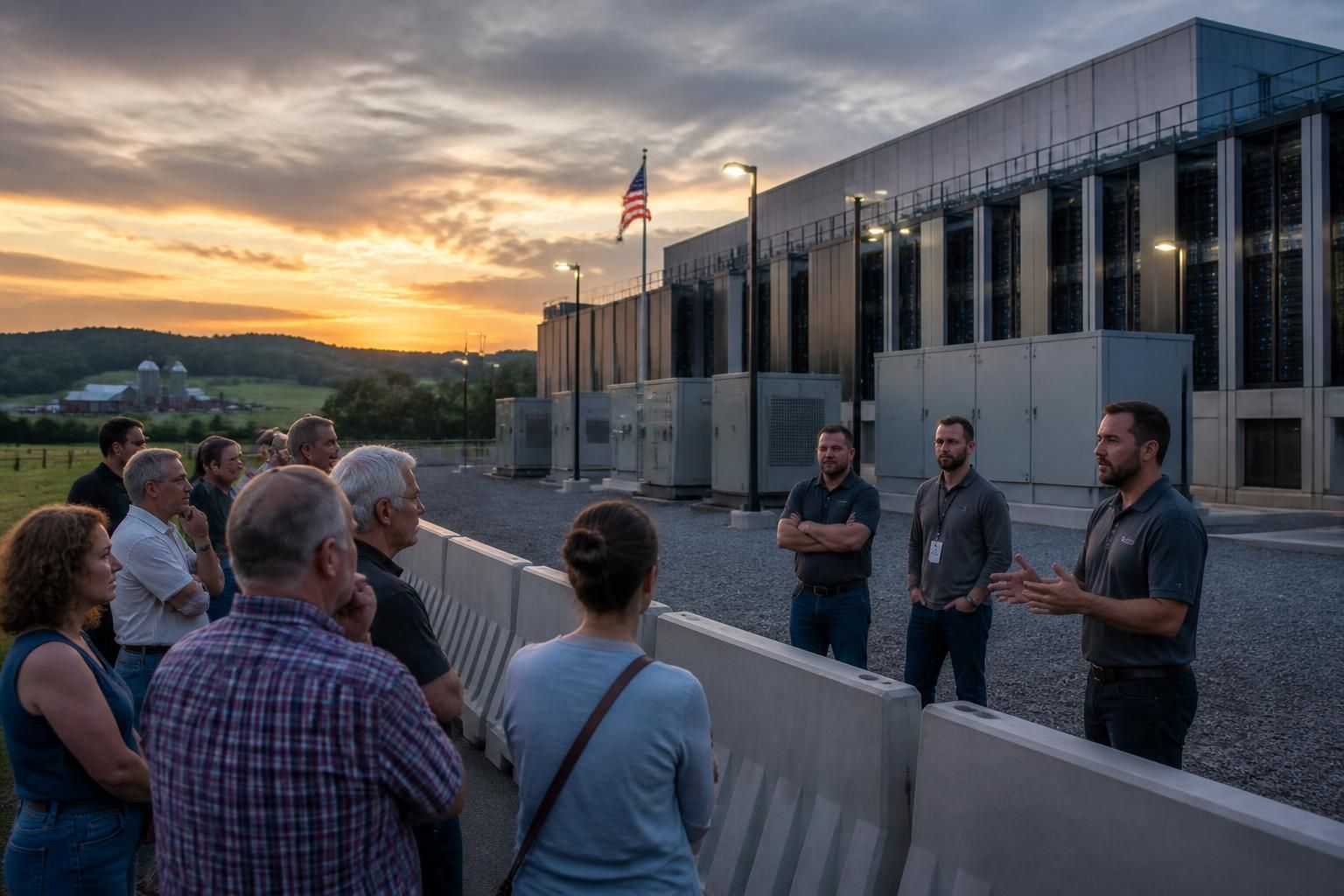
The AI policy dispute does not end with model design. It is becoming visible in planning meetings, electricity bills, water-use questions, and debates over land. A recent NBC News Decision Desk poll found that 69% of respondents opposed building AI data centers in their own area. That number makes one point unavoidable: many people may welcome useful digital services while resisting the physical infrastructure required to operate them.
Trump has adopted a sharply different message. In August, he argued that communities should embrace data centers rather than risk becoming “backwards and poor,” and he connected local resistance with a strategic advantage for China. The framing treats infrastructure opposition as a threat to national prosperity. It can mobilize supporters of rapid development, but it overlooks why residents question projects proposed near their homes.
Communities usually ask practical questions first. Will a facility draw heavily on a limited water supply? Does the local grid have enough capacity? Who pays for upgrades? How many long-term jobs remain after construction? Will noise, diesel backup generation, or land conversion affect nearby neighborhoods and heritage landscapes? These are not anti-Technology reflexes. They are legitimate questions about costs, benefits, and local decision-making.
Tourism organizations have a useful perspective here because place-based value is their daily concern. A region may seek digital investment while also protecting its visual identity, natural resources, and visitor appeal. For example, the fictional “Cedar Bay Visitor Office” might welcome a new AI-supported translation service but oppose an opaque industrial development near a coastal trail that supports small businesses. Its position is coherent: it supports useful services, not unchecked externalization of infrastructure costs.
Planning principles that make AI infrastructure more credible
Developers and public authorities can reduce conflict by discussing measurable commitments before construction begins. Announcing capacity figures without explaining energy sources, water management, or community returns creates suspicion. By contrast, transparent planning gives residents something concrete to assess and challenge.
- ⚡ Publish grid-impact studies: show peak demand, planned upgrades, and who funds them.
- 💧 Disclose water strategy: explain cooling methods, seasonal use, and contingency plans during drought.
- 🏘️ Set local-benefit commitments: include apprenticeships, tax arrangements, and support for public digital access.
- 🌿 Protect sensitive sites: assess effects on landscapes, cultural heritage, biodiversity, and tourism routes.
- 📞 Maintain a local contact process: give residents a route to report disruption and receive documented responses.
These measures are relevant to Regulation because infrastructure decisions determine which type of AI economy is being built. A development model that rewards only speed can generate political backlash that delays projects more severely than early consultation would have done. The same pattern is familiar in visitor technology: an app imposed without testing can damage an experience that a small pilot would have improved.
Smart tourism offers a practical comparison. When a destination introduces smartphone audio guidance, success depends on signal reliability, battery planning, language coverage, and respect for the visitor’s attention. Tools such as the distinction between voice AI and conversational AI can help operators choose a format suited to a tour rather than adding automation for its own sake. Infrastructure and interfaces both earn acceptance through transparent, user-centered design.
AI Development Risks Are Already Visible in Security, Voice, and Public Trust
Arguments about extreme future outcomes can obscure risks that organizations face today. Malicious actors are already trying to use generative systems for phishing, social engineering, fraudulent content, and code assistance. The threat-intelligence findings released by Anthropic demonstrate that model providers are actively disrupting attempted misuse, but disruption after the fact is only one layer of protection. Public and private organizations also need to limit the opportunities that attackers can exploit.
Voice technology deserves particular attention. A convincing synthetic voice can make a visitor hotline more accessible, provide an audio description in several languages, or help a person navigate a museum independently. It can also impersonate a guide, staff member, elected official, or family member. The same quality that makes a voice assistant natural—the ability to sound human—creates a higher need for disclosure and verification.
Imagine that Cedar Bay Visitor Office receives an urgent voicemail from someone who sounds exactly like the director, asking an employee to transfer funds to a new supplier. A trusted voice is no longer enough. Staff need a secondary verification rule, such as confirming the request through a known internal channel. This is a simple operational habit, but it is increasingly essential as synthetic media improves.
Organizations should avoid treating generative AI as an autonomous colleague. It is a system that produces outputs from patterns in data and instructions; it does not carry professional accountability. If a guide gives incorrect safety information on a trail, the operator remains responsible. If an automated translation misrepresents an Indigenous site or religious practice, the reputational harm belongs to the institution that published it.
How to reduce risk without removing useful digital services
A proportionate approach begins by classifying uses by impact. Low-risk tasks may include brainstorming a social-media caption or summarizing a public report, subject to review. Higher-risk tasks include medical guidance, payment approval, child-facing interactions, legal information, emergency direction, and identity verification. These require tighter permissions, testing, and a human decision-maker.
- 🔎 Map each AI use case: record its purpose, users, data inputs, decision impact, and accountable owner.
- 🔐 Minimize data: do not place booking records, private visitor conversations, or staff documents into public tools without a lawful and documented basis.
- 🗣️ Verify audio identity: establish a call-back or approved-channel process for payments, access changes, and sensitive instructions.
- 🧭 Review cultural accuracy: ask subject experts and local partners to validate historical narration, pronunciation, and translations.
- 🛠️ Test the failure path: assess what happens when the tool is offline, wrong, challenged, or used maliciously.
This approach also helps distinguish genuine safety practice from performative policy. A two-page checklist used before every launch is more valuable than a long ethics statement no employee consults. In audio-guided visits, a fallback script and an accessible human contact can prevent a minor technical fault from becoming a poor visitor experience.
Organizations exploring children’s services should apply even stricter standards. A review of voice AI tools designed for children underlines the importance of age-appropriate design, privacy protection, and adult oversight. The most credible response to AI risk is not panic or denial: it is documented control at the point where people actually use the tool.
Practical AI Regulation for Tourism, Museums, and Guided Experiences
The contest between rapid deployment and careful oversight may be argued in presidential statements and executive essays, but its effects reach smaller organizations quickly. Museums, guides, destination offices, heritage sites, and event producers increasingly use Artificial Intelligence for translation, visitor communication, route preparation, transcription, accessible narration, and content drafting. Each use can improve service when it solves a defined problem; each can undermine trust when adopted without ownership.
For this reason, the most useful response to Trump’s dismissal of a broad AI Development Pause is neither to wait for every national policy dispute to settle nor to deploy every new feature immediately. Operators can build an internal governance routine that works now. It should be light enough for a small team, yet clear enough to show visitors, funders, and partners that digital services are managed professionally.
Start with a written purpose. “Use AI to improve efficiency” is too broad to guide decisions. “Provide a reviewed English, French, and Spanish audio version of the permanent collection, with staff correction within one working day” is actionable. It identifies users, scope, quality expectations, and an escalation route. The same method applies to a chatbot: define the questions it may answer and the questions it must transfer to a person.
Build human oversight into the visitor journey
Consider a city walking tour using smartphone audio. The organizer can prepare editorially approved stops, assign each recording to a verified source, and use technology to deliver sound clearly to individual devices. A platform such as Grupem is relevant in this context because it supports the practical goal of making guided listening easier to deploy without forcing visitors into complex hardware arrangements. The tool remains a delivery layer; the guide and institution remain responsible for the content.
AI can assist the workflow by producing a first draft of a transcript, suggesting plain-language alternatives, or identifying sections that may need translation. It should not independently decide how to describe contested history, living communities, safety rules, or cultural objects. Human editorial review protects accuracy and preserves the distinct voice of the guide rather than flattening every experience into generic narration.
Accessibility should be considered at the same time as safety. Provide readable transcripts, straightforward controls, predictable volume levels, and a non-digital alternative where possible. A visitor with hearing loss, a family with limited mobile data, or an older traveler unfamiliar with app permissions should not be excluded by a supposedly modern experience. Useful Innovation expands access instead of creating another barrier.
Procurement teams can also ask vendors direct questions: Where is data processed? Is audio retained? Can the organization export or delete its content? What happens when a user reports an incorrect answer? Does the supplier publish security and incident procedures? These questions turn broad demands for Regulation into decisions that a small cultural organization can make before signing a contract.
The disagreement between Trump and Tech Leaders will continue because it reflects a real conflict between strategic speed and precaution. At local level, however, the working standard is simpler: deploy only the AI service that your team can explain, test, correct, and support for every visitor. That is how institutions gain the benefits of Technology while keeping public confidence intact.
Why did Trump dismiss calls for an AI Development Pause?
Trump argued that the United States must preserve its lead in Artificial Intelligence, particularly in competition with China. He said guardrails are possible but portrayed broad slowdown appeals as driven by exaggerated fears.
Which Tech Leaders supported stronger AI safeguards?
Dario Amodei called for greater precautions, while Elon Musk and Sam Altman publicly agreed that stronger safeguards and a more controlled pace of development are needed.
What does AI regulation mean for a museum or tour operator?
It means setting clear approved uses, reviewing generated content, protecting visitor data, disclosing automated services, and ensuring staff can correct errors or handle sensitive requests.
Why are AI data centers controversial in local communities?
Residents often raise practical concerns about electricity demand, water use, land impacts, noise, public costs, and whether promised local benefits will materialize.
How can organizations reduce synthetic voice fraud risk?
They should require a second verification channel for payments, account changes, or urgent requests. A familiar voice alone should never be treated as proof of identity.
