
Short on time? Here is what matters:
- 🌟 The Bell Museum Statewide Star Party connects Minnesota communities through practical, family-friendly astronomy education.
- 🔭 Cohasset and Grand Rapids offer useful local models: accessible outdoor locations, shared telescope viewing, and programming that makes the night sky easier to understand.
- 🎧 Clear information, timed activities, and mobile-friendly audio guidance can make a large community event more inclusive without adding operational complexity.
Bell Museum Statewide Star Party Brings Minnesota’s Night Sky Into Focus
The Bell Museum’s Statewide Star Party is designed as more than an evening of looking through telescopes. It is a statewide network of astronomy events that brings museums, libraries, parks, universities, nature centers, and local organizations together around one practical objective: helping people observe, identify, and better understand the sky above their own communities.
For the 2026 program, the focus on Ursa Minor gives visitors an approachable entry point into celestial navigation. Known as the Little Dipper, this official Minnesota constellation contains Polaris, commonly called the North Star. Polaris is not the brightest object visible after dusk, yet it remains one of the most useful. Its apparent fixed position near the north celestial pole has guided travelers for generations and directly connects with Minnesota’s “Star of the North” identity.
That connection is valuable for tourism and cultural mediation. A visitor does not need prior astronomy knowledge to take part. A facilitator can begin with a simple question: how can one star help someone find north? From there, an event can move naturally from observation to stories of place, seasonal change, science, and the history of navigation. This is why the Bell Museum format works particularly well for a broad public. It makes scientific content visible, local, and immediately relevant.
The official Statewide Star Party 2026 program details provide a useful reference for visitors planning their experience. Rather than treating every gathering as identical, participating sites can adapt the shared theme to their own landscape and audience. An urban museum might pair constellation activities with indoor demonstrations. A lakeside park may prioritize horizon visibility and guided sky orientation. A community center can build a program around family crafts, short talks, and a viewing session led by local volunteers.
For organizers, the most effective format combines a short welcome, a clear explanation of the evening’s observing conditions, and multiple activity stations. People arrive at different times and with different levels of confidence. A rigid lecture can leave late arrivals disconnected, while open stations allow guests to join the experience at their own pace. This structure also reduces pressure on telescope operators, who can concentrate on safe and meaningful viewing rather than repeatedly explaining basic logistics.
| Event component | Visitor value | Practical purpose |
|---|---|---|
| 🌌 Sky orientation talk | Helps guests locate north and identify Ursa Minor | Creates shared context before darkness deepens |
| 🔭 Telescope viewing | Offers direct observation of bright objects | Turns abstract astronomy into a memorable experience |
| 📱 Mobile audio prompts | Supports independent exploration and accessibility | Limits crowding around one presenter |
| 🧭 Family activity station | Gives younger visitors a hands-on role | Keeps engagement active during waiting periods |
Consider a fictional family arriving at a local gathering shortly before sunset: Maya, her grandfather, and two children see a volunteer point to the northern horizon. A short audio prompt explains that Polaris is the end star of the Little Dipper’s handle. Later, they use a telescope to observe the Moon or a bright planet while waiting for darker conditions. The experience is not dependent on seeing every faint star perfectly. It is built around a sequence of understandable moments.
This flexibility matters because weather remains a real operational factor in outdoor stargazing. Cloud cover, haze, wind, and late sunsets can all change the program. Strong astronomy education does not fail when a telescope cannot be used. It shifts toward sky maps, constellation storytelling, meteorite samples, red-light demonstrations, or a discussion of why light pollution changes what people can see. A successful Star Party is measured by informed participation, not only by a perfectly clear sky.
That statewide model becomes especially compelling in northern Minnesota, where Cohasset and Grand Rapids can connect local outdoor culture with a deeper awareness of the night sky.
Cohasset Stargazing Creates a Practical Outdoor Astronomy Experience
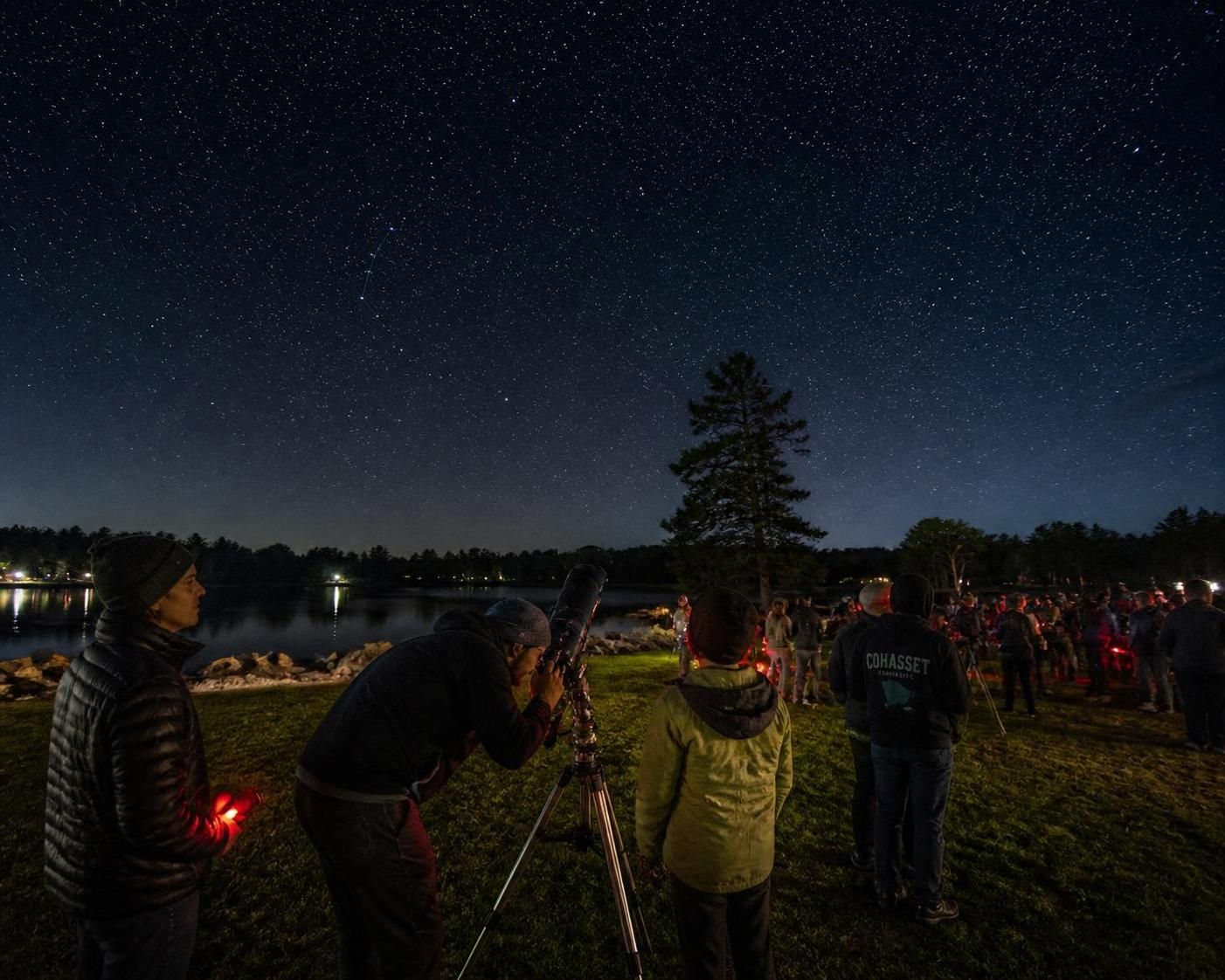
Cohasset offers a useful setting for a community event centered on the sky because its outdoor spaces can make observation feel connected to the surrounding landscape rather than separated from it. The listed Cohasset gathering at Clay Boswell Boat Landing, located on Blackwater Road, demonstrates how a public waterfront site can become an accessible astronomy venue. Visitors are not required to enter a specialist facility before they can begin learning; they can arrive, orient themselves, and look upward together.
The location matters. A successful viewing site needs a reasonably open horizon, room for participants to move safely, predictable vehicle access, and an area where telescope operators can work without constant interruption. A boat landing or lakeside public space can meet many of these requirements, but it also creates responsibilities. Organizers should assess ground conditions before the event, identify low-light walking hazards, and make the transition from parking to observation zones easy to understand.
Clear communication is often more important than advanced equipment. A concise event page should state the arrival time, exact meeting point, weather policy, recommended clothing, and whether attendees should bring blankets or folding chairs. It should also explain that telescopes are shared instruments. Many first-time guests expect continuous access, but a calm queue system and a visible “what to expect” sign prevent frustration.
How Cohasset Can Make Telescope Viewing More Comfortable
Telescope viewing is often the signature moment at a Star Party, yet it can become the least accessible part if it is not planned carefully. Eyepieces may sit at heights that are difficult for children, wheelchair users, or visitors with limited mobility. A simple step stool, an adjustable observing chair, and a volunteer assigned to the queue can significantly improve the experience. Where possible, one telescope can be paired with a live screen feed so people who cannot comfortably use the eyepiece still see the target.
Red light is another small detail with a major effect. White phone flashlights reduce dark adaptation and can make it harder for visitors to see faint stars. Event teams should encourage guests to dim their screens, use red-light settings, or cover ordinary lights with a red filter. This is not merely etiquette; it is a practical lesson in human vision. After roughly 20 minutes in darkness, the eye becomes far more sensitive to low light, but a bright flash can interrupt that adaptation.
The Cohasset event calendar listing illustrates the value of giving residents a direct local route to participation. Local communication builds attendance more reliably than generic regional messaging because it answers the first questions people have: where is it, when does it begin, and who is hosting it?
- 🧥 Ask guests to dress for temperatures that can fall quickly after sunset.
- 🔦 Request red-light use and discourage bright white flashlights near equipment.
- 🪑 Provide seating or a waiting area for families during busy telescope sessions.
- 🗺️ Display a simple sky map showing Polaris, Ursa Minor, and the northern horizon.
- ☁️ Publish a cloud-cover alternative with indoor or guided learning activities.
A practical Cohasset program can also use sound as a navigation tool. Short recorded prompts, delivered through a phone and headphones, can identify activity areas or explain what is visible without requiring a guide to repeat the same instructions dozens of times. This is where smart tourism tools can support, rather than replace, educators. A mobile audio route can offer a two-minute orientation, a child-friendly Polaris explanation, and an optional deeper segment for visitors interested in celestial coordinates.
For example, Maya’s family could scan a posted code near the waterfront entrance and hear: “Face the open horizon. Find the brightest steady point toward the north. This is your starting direction.” The message is short, usable, and does not compete with the atmosphere of the evening. It also supports visitors who arrive after the main presentation has ended.
Cohasset’s strength is its ability to turn a public outdoor site into a shared observing room, where practical planning protects both comfort and curiosity. The next challenge is connecting that local intimacy with the broader visitor and community ecosystem in Grand Rapids.
Grand Rapids Astronomy Events Connect Visitors, Families, and Local Partners
Grand Rapids adds a different but complementary dimension to the Bell Museum Statewide Star Party. As a regional destination with established visitor services, cultural venues, and access to northern landscapes, the city can welcome both residents and travelers looking for meaningful evening programming. A well-designed astronomy event can extend a visitor’s stay beyond daytime activities while offering families a reason to engage with local science and nature after dinner.
The important point is not to market the event as a technical test. Most people attending a community event are not amateur astronomers with their own equipment. They are curious visitors, parents, students, and residents who may have never learned how to recognize a constellation. Their first experience should feel structured but not intimidating. A host who says, “You only need your eyes for the first activity,” immediately lowers the barrier to entry.
The regional Grand Rapids and Cohasset Star Party guide helps demonstrate the value of cross-community programming. When neighboring sites share a common theme, visitors can choose the location that suits their schedule while still feeling part of a statewide celebration. This distributed approach is especially useful for tourism offices and cultural partners: it spreads attendance, creates local ownership, and avoids concentrating all demand at a single venue.
Designing a Community Event That Does Not Depend on One Expert
Many astronomy events rely heavily on one knowledgeable volunteer. That person may be excellent, but the whole experience becomes fragile if they are delayed, overwhelmed, or occupied at a telescope. Grand Rapids organizers can avoid this bottleneck by assigning distinct roles: a welcome host, a sky-map facilitator, telescope operators, a family-activity coordinator, and a person responsible for weather updates and accessibility questions.
Each role should have a short, accurate script. The welcome host might explain the schedule and safety rules. The sky-map facilitator can show how the Big Dipper points toward Polaris. A telescope operator can focus solely on aligning guests and describing the target. This division makes the program calmer and improves consistency. It also allows partner organizations to contribute without requiring every volunteer to be an astronomy specialist.
A regional event can also strengthen local business and cultural partnerships without turning the evening into a commercial exercise. A library can provide constellation books, a school science club can help with demonstrations, and a park department can assist with site management. Restaurants or accommodation providers can share the schedule with guests who may otherwise miss the event. The benefit is mutual: visitors receive a more complete local experience, while participating organizations become visible in a useful context.
Audio technology can support this coordination. A lightweight group-guiding solution such as mobile audio and visitor communication tools can help organizers distribute short, multilingual or accessible content without purchasing dedicated headsets. For an outdoor setting, the goal is not to place every guest in a digital bubble. It is to offer optional, clear audio layers for people who need them: captions paired with transcripts, short recordings for late arrivals, and content that can be replayed at a visitor’s own pace.
There is also an important visitor-flow benefit. When a popular telescope has a line, an audio-guided activity can keep waiting guests engaged. One station might ask children to locate the seven stars of the Little Dipper on a printed sky chart. Another could explain why Polaris appears nearly stationary while other stars seem to circle around it. A third might invite visitors to compare what the sky looks like from downtown with what they can see from a darker shoreline.
Grand Rapids can therefore treat the event as both science programming and destination design. The experience begins before the first telescope view, with practical travel information and a welcoming arrival. It continues through interpretation that is understandable to newcomers. It ends with visitors leaving able to recognize at least one feature overhead. The strongest community event gives people a reason to return outside and look up again after the official program ends.
Night Sky Accessibility Makes Astronomy Education More Inclusive
Accessibility should be treated as a core component of astronomy education, not as a late adjustment. The night sky is shared by everyone, but participation at an outdoor event can vary widely depending on mobility, hearing, vision, language, sensory needs, age, and familiarity with science. A thoughtful Bell Museum Statewide Star Party site can address many barriers with low-cost decisions made well before event day.
Start with physical access. Paths from parking areas to viewing zones should be checked in daylight. Uneven ground, loose gravel, narrow routes, and unmarked changes in elevation can become significant hazards once darkness falls. If the primary observing location is difficult to reach, organizers should provide a nearby alternative activity area where visitors can still participate in astronomy education. No attendee should feel that the only meaningful part of the night is inaccessible.
Information access is equally important. Astronomy vocabulary can be unfamiliar even to enthusiastic visitors. Rather than beginning with terms such as “celestial pole” or “right ascension,” a facilitator can use plain language first: “Polaris is a star that helps us find north.” Technical detail can follow for guests who want it. This layered approach respects different knowledge levels and avoids treating beginners as passive observers.
Using Audio, Text, and Tactile Activities Together
Audio guidance is especially useful outdoors because visual attention is often directed upward. A brief recording can describe where to face, when to lower a phone screen, or why a telescope line is moving slowly. For visitors with low vision, descriptive audio can explain the shape of Ursa Minor and the relationship between the Big Dipper and Polaris. For visitors who are deaf or hard of hearing, the same content should be available as readable text, ideally in concise language that works on a phone screen.
Tactile activities make abstract ideas easier to grasp. A raised-line constellation card, a model showing how Earth’s rotation produces apparent star movement, or textured labels for the Little Dipper can add a meaningful sensory route into the subject. These tools are not only for one audience. Children, adults, and multilingual groups often benefit when complex concepts are communicated through more than one format.
Event teams should also consider sensory comfort. A crowded field with bright lights, sudden amplified announcements, and long lines can be difficult for some attendees. Creating a clearly marked quiet viewing zone, limiting unnecessary amplified sound, and publishing a simple schedule helps visitors plan their participation. A family may choose to arrive for the early sky map activity, leave before peak attendance, and still have a complete experience.
Weather communication deserves the same care. If clouds cover the sky, a cancellation notice that says only “event postponed” is not enough. It should explain whether indoor activities continue, whether a speaker session is still available, and how participants can find the revised date. The referenced regional reporting may be unavailable to some European Economic Area readers because of GDPR access controls, which makes it even more important for organizers to publish essential logistical information on accessible first-party pages and local public channels.
For tourism professionals, this is a useful reminder: information that cannot be easily reached cannot support the visitor journey. Event pages should be lightweight, mobile-readable, and clear about any changing conditions. A downloadable audio briefing or a simple web page can provide a dependable alternative to relying on a third-party article that some audiences may not be able to open.
Imagine a visitor named Daniel arriving with his mother, who has reduced mobility. They find an accessible parking space, receive a printed large-text sky map, and listen to a short orientation through one smartphone. Daniel later looks through the telescope while his mother watches the target on a nearby screen and reads the explanation. Both take part in the same story, even though their access routes differ.
Inclusive astronomy does not require a complex technical installation; it requires multiple clear ways to participate in the same moment of discovery. With these foundations in place, organizers can plan a resilient event that remains useful under changing skies.
Planning Statewide Star Party Operations for Weather, Safety, and Lasting Engagement
A strong Statewide Star Party depends on preparation that guests may never notice. This is a positive sign. When arrival is straightforward, volunteers know their roles, equipment is protected, and alternative activities are ready, visitors can focus on the sky rather than operational problems. For Cohasset, Grand Rapids, and other participating locations, the goal is to create a dependable community event that feels welcoming under both ideal and imperfect conditions.
Weather planning should begin with a simple principle: clouds do not cancel learning. A clear-sky plan may include telescope viewing, constellation identification, and a laser-pointer orientation session where permitted and safely managed. A cloudy-sky plan can include planetarium-style projections, meteorite handling, interactive sky-map demonstrations, talks with amateur astronomers, and guided use of astronomy apps. The transition between plans should be communicated early enough that families can decide what to expect before leaving home.
Safety planning also benefits from specificity. Telescope legs should be visible with low-level red markers. Cables, if any, should be secured or avoided. Equipment should never be left unattended around young children. Volunteers need a clear escalation process for medical issues, lost children, sudden weather changes, and parking congestion. A short briefing before doors open is often enough to make responsibilities clear.
Measuring What Visitors Actually Valued
Attendance alone is an incomplete measure of success. A site might welcome hundreds of guests, yet still leave them uncertain about what they observed. Better evaluation asks whether visitors found the event easy to access, whether they learned something concrete, and whether they would recommend it. A one-question mobile survey can be effective: “What was the most useful thing you learned tonight?” Open answers frequently reveal what content should be retained or improved.
Organizers can also record operational observations. How long was the average telescope queue? Which activity retained families when clouds arrived? Did guests find the parking instructions easily? Were there points where volunteers repeatedly answered the same question? These details are valuable for the next event and can guide the creation of better signage, audio prompts, or online information.
A practical follow-up message can extend engagement beyond one evening. Within a day or two, attendees might receive a link to a simple sky guide, a recording explaining how to find Polaris, and future dates for local astronomy events. This is a responsible use of digital communication because it gives visitors a direct next step rather than assuming one observation session will build lasting confidence.
For example, a visitor who first spotted the Little Dipper in Grand Rapids may later use a phone-based audio guide during a camping trip. A child who made a tactile constellation card in Cohasset may bring it to school and explain why Polaris points north. These are modest outcomes, but they show that the event created an ongoing relationship with the night sky rather than a single entertainment moment.
The Bell Museum’s collaborative model is well suited to this continuity. Community partners retain local knowledge, while the statewide theme gives them a shared educational foundation. Museums and tourism organizations can use that combination to create experiences that are scientifically sound, operationally realistic, and genuinely welcoming.
For the next planning meeting, assign one person to visitor access, one to weather alternatives, and one to clear on-site interpretation; those three decisions will improve the experience before the first star appears.
What is the Bell Museum Statewide Star Party?
It is a Minnesota-wide series of community astronomy events coordinated with local partners such as museums, parks, libraries, nature centers, and universities. Activities commonly include sky orientation, constellation learning, hands-on demonstrations, and telescope viewing.
What can visitors see during stargazing in Cohasset or Grand Rapids?
What is visible depends on weather, darkness, and equipment. Programs may feature Polaris and Ursa Minor, the Moon, bright planets, seasonal constellations, and other accessible targets selected by telescope operators.
Do attendees need to bring a telescope?
No. Community star parties are designed for beginners as well as experienced observers. Bringing binoculars can be useful, but guided activities and shared telescopes allow visitors to participate without personal equipment.
What should families bring to a night sky event?
Wear warm layers, sturdy footwear, and bring a chair or blanket if the site permits it. Use a dim red light rather than a bright flashlight, and check the local event page for weather updates and site-specific instructions.
