
Paris Museum Closures: Why Access to the Louvre and Mona Lisa Can Stop
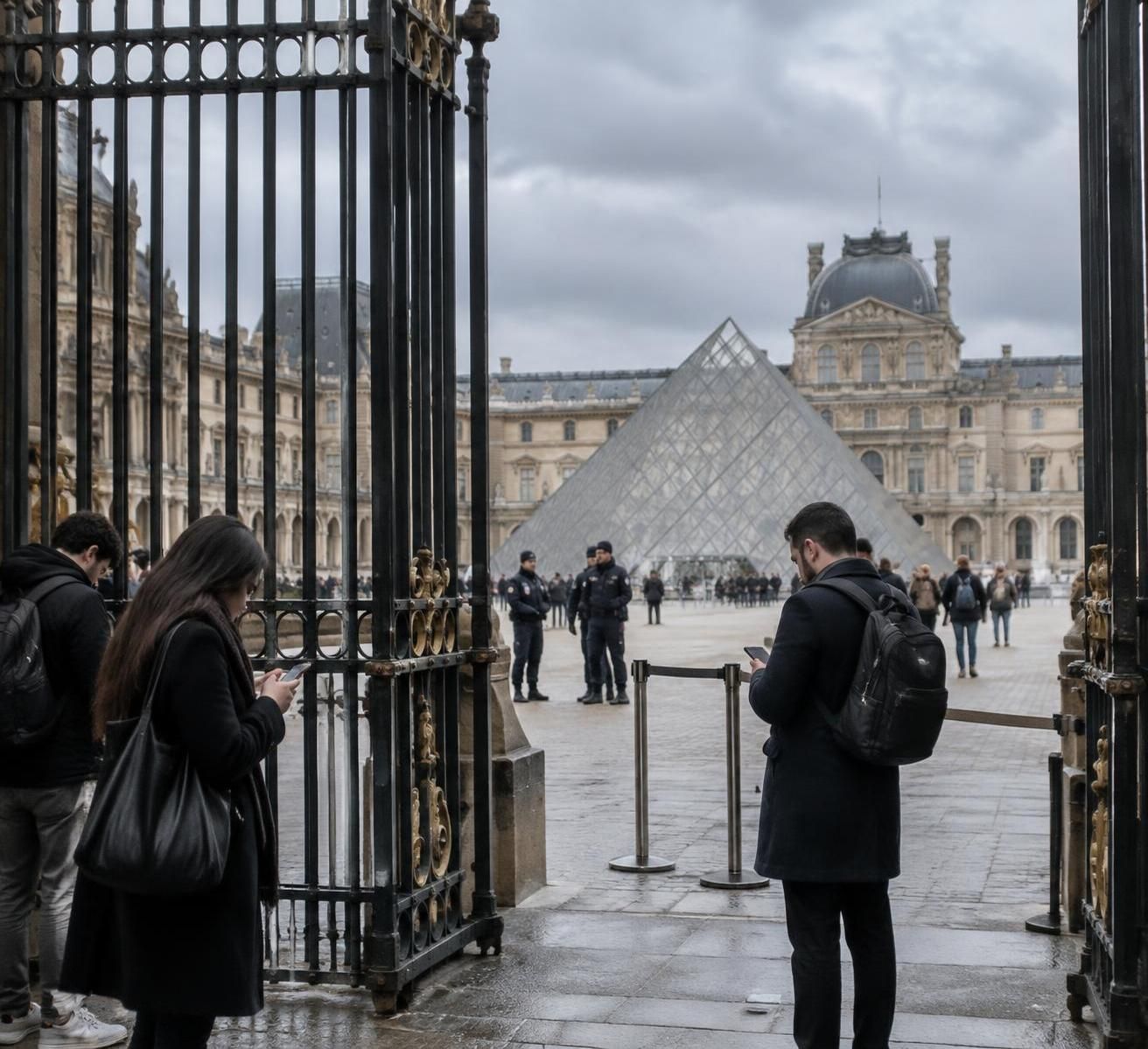
The supplied reporting describes tourists arriving at locked entrances as major Paris museums suspended admission ahead of anticipated protests. The Louvre’s closure placed the Mona Lisa beyond visitors’ reach, while restrictions elsewhere disrupted itineraries built around Impressionist collections, temporary exhibitions, and evening performances.
The Reuters report dated October 24, 2026 describes a precautionary response following earlier unrest associated with living costs and public services. That dated account provides context for the disruption; it should not be treated as a live notice of which institutions are open when you travel.
According to the supplied account, the affected venues included the Musée d’Orsay, Orangerie, Jeu de Paume, and Picasso museum. Access restrictions also extended to the Tuileries area, showing why a closed exhibition can affect considerably more than the rooms containing paintings.
Why Louvre security involves more than protecting the galleries
A cultural institution must consider entrances, evacuation routes, staff journeys, surrounding streets, and the movement of large groups. Even when artworks remain secure inside, conditions outside can make normal admission difficult to manage safely.
Visible police deployments do not automatically resolve those operational problems. An entrance may be guarded while nearby transport is disrupted, employees cannot reach their posts, or visitors would have to cross a restricted perimeter to leave.
A precautionary shutdown does not, by itself, mean the collection has been damaged. Clear communication should distinguish between threats to public safety, restrictions on access, and confirmed incidents involving cultural heritage.
The supplied account also describes cancellations affecting both Paris Opera venues and an Art Basel Paris weekend programme. These details should remain attached to the particular reported episode rather than becoming a general claim that every performance or exhibition closes whenever demonstrations occur.
What the disruption means for a short cultural visit
Consider Camille, a hypothetical professional guide responsible for twelve visitors on a two-day stay. Their morning booking centres on Leonardo da Vinci’s portrait, and their afternoon plan involves another major collection nearby.
If both institutions suspend admission, simply reversing the itinerary solves nothing. Camille needs to establish whether the problem concerns one building, a shared neighbourhood, or several independently managed venues before proposing a replacement.
The visitor accounts supplied with the report illustrate the consequences of missing that distinction. One traveller had purchased two tickets for an Impressionist collection; others reached several closed destinations in succession, losing time as well as the opportunity to see particular works.
Another visitor hoped at least to view the Louvre pyramid. Yet exterior access is a separate operational question: a museum forecourt, garden, or approach can fall within a restricted area even when the intended activity involves no indoor visit.
For tourism professionals, the practical lesson is to separate three questions: what happened, what is accessible now, and what your group can safely do next. News coverage helps explain the first; official venue and public-authority notices must inform the other two.
The first task is not to defend or challenge a closure decision, but to translate its actual boundaries into a workable visitor plan.
Check Paris Museum Opening Notices Before Visitors Leave Their Hotel
The most avoidable failure during museum closures is not a cancelled booking; it is allowing visitors to discover the cancellation at the gate. A notice published the previous evening offers little practical protection if nobody connects it to the following morning’s reservations.
The supplied reporting says institutions posted warnings on Friday, yet some travellers still arrived unaware. That gap reveals a communication problem: publishing information and successfully delivering it are different tasks, particularly when guests are abroad and checking unfamiliar channels.
Camille’s fictional group provides a useful operational example. Instead of asking twelve people to monitor multiple websites independently, the guide assigns one coordinator to check official notices and distributes a single, timestamped update through the group’s agreed contact channel.
Build a reliable verification sequence for Louvre closures
Start with the institution’s own website, booking correspondence, and official visitor notices. Then check relevant transport operators and public-authority announcements, because an open attraction may still be difficult to reach from a particular starting point.
Use news reporting to understand the wider situation, not to guarantee entry. For example, coverage of the disruption across Paris cultural venues can explain why several bookings need review without replacing each organiser’s current instructions.
Record when the information was checked and which visit it concerns. “Closed on Saturday” becomes ambiguous when a screenshot circulates days later; a complete calendar date and the institution’s name make an operational message much harder to misinterpret.
- 🔎 Check before departure: review the venue’s current notice before the group leaves its accommodation.
- 🎟️ Read booking-specific messages: inspect the purchaser’s inbox, spam folder, and reseller account where applicable.
- 🚇 Verify the journey: confirm transport changes and access restrictions around the intended entrance.
- 📍 State one meeting point: prevent different travellers from following conflicting updates.
- 🔄 Set the next update: explain when you will communicate again, even if the situation remains unchanged.
Write closure messages that answer practical questions
A useful update tells visitors what has changed, what they should do, and what remains unresolved. It should separate a confirmed cancellation from a booking still awaiting instructions, rather than presenting every disrupted service as having identical conditions.
For Camille’s group, an effective message might read: “Your scheduled gallery visit cannot proceed under the venue’s announced closure. Please remain at the hotel meeting point while the coordinator checks an accessible replacement and the ticket provider’s instructions.”
This wording avoids promising a refund, guaranteeing another attraction, or implying that an alternative route has already been cleared. It also prevents people from travelling independently to an entrance that offers no practical assistance.
Accessibility information belongs in the same message. A replacement involving additional walking, stairs, outdoor waiting, or an unfamiliar transport interchange may not suit everyone, even if the destination itself is available.
Maintain a telephone fallback for travellers who cannot receive mobile updates. International roaming, depleted batteries, hearing needs, and language differences can all weaken an otherwise sensible digital communication plan.
A successful closure alert changes the visitor’s next action before an unnecessary journey begins.
Replace a Cancelled Louvre Visit Without Sending Groups Toward Protests
A closed landmark creates immediate pressure to find another recognisable attraction. However, proximity and popularity are poor selection criteria when demonstrations, transport interruptions, or restricted streets affect a wider area.
The best replacement is the one that is confirmed, reachable, suitable, and honestly described. An available activity should not be sold as equivalent to seeing the Mona Lisa when it offers a different experience.
For Camille’s hypothetical group, the replacement decision begins with the original purpose of the visit. Some participants wanted Renaissance painting, others wanted an iconic Paris experience, and several primarily wanted an engaging shared activity with reliable interpretation.
Choose alternatives by visitor needs and verified access
Those interests create different options. A confirmed appointment at another collection might satisfy an art-focused visitor, while a hosted discussion in an authorised indoor venue could preserve the group experience without requiring access to a busy cultural district.
An outdoor architecture walk is appropriate only after checking local instructions, the route, weather conditions, and participants’ mobility requirements. It should never become a reason to approach demonstrations, cross barriers, or ask staff for informal exceptions.
| Possible replacement | What to verify | Visitor expectation to manage |
|---|---|---|
| 🏛️ Another collection | Opening status, capacity, tickets, and accessible entrance | Different artworks and potentially separate admission costs |
| 🎧 Hosted cultural session | Permission to use the room, seating, audio, and image rights | Interpretation rather than access to original objects |
| 🚶 Architecture route | Official restrictions, crossings, transport, weather, and mobility needs | More outdoor exposure and walking than the original plan |
| 📅 Rescheduled admission | Availability, booking conditions, and departure times | No guarantee of the original slot or exhibition access |
The table works as a decision aid, not a list of destinations presumed open. A smaller institution may have limited group capacity, while a hotel meeting room may require permission and an additional charge.
Camille therefore contacts a potential host before moving anyone. If the space is confirmed, the guide can explain the revised duration, seating arrangements, content, and any financial changes before participants choose whether to join.
Keep cultural interpretation meaningful when the original artwork is unavailable
A session about Leonardo can explore portrait conventions, the sitter’s identity, workshop practice, and the painting’s later public reputation. Clearly identified reproductions can support close observation, provided their use respects the relevant rights and source conditions.
The important distinction is between discussing a masterpiece and claiming to reproduce the experience of standing before it. Visitors deserve to know what they are receiving, especially when the original booking carried considerable personal significance.
For broader itinerary design, Grupem’s guide to art museums and their cultural role offers a useful starting point for thinking beyond a single headline attraction. Any candidate venue still requires its own opening and reservation checks.
Video can support a seated discussion when language, captions, viewing conditions, and permissions suit the setting. It should complement a guide’s explanation rather than become an improvised substitute presented without context.
A credible replacement preserves the purpose of the visit while being transparent about what has changed.
Use Smartphone Audio to Support Visitors During Paris Museum Closures
When an itinerary changes suddenly, interpretation often becomes harder to deliver. A group may be dispersed across a temporary meeting space, distracted by travel messages, or struggling to hear instructions in an unfamiliar environment.
Smartphone-based audio can help organise communication, but it does not remove the need for a suitable location. Audibility supports coordination; it does not make a restricted area safe or authorise access.
For tourism teams evaluating tools such as Grupem, the practical question is whether the application fits their actual guiding workflow. Before depending on any platform, test its current functions, device compatibility, connection requirements, and suitability for the participants involved.
Test the audio workflow before changing the route
Camille’s fictional operation uses a simple rehearsal before the day begins. One colleague speaks from the intended guide position while another listens on an ordinary visitor handset, checking clarity, volume, delay, and the steps needed to reconnect after an interruption.
The test should reflect real conditions rather than a quiet office alone. Wind, hard surfaces, passing traffic, and crowded interiors can expose problems that were not obvious during initial setup.
Check battery reserves and charging arrangements as well. A visitor who has spent the morning using maps, messages, and translation tools may have little power left for an extended audio activity.
Connectivity requires similar attention. Do not assume that a mobile signal, venue Wi-Fi, or a particular offline function will be available; establish the selected service’s requirements and prepare a workable fallback.
Make the revised cultural experience accessible
Good sound is only one part of access. Some participants may need a written version of essential instructions, captions for recorded material, a quieter listening position, or additional time to understand a changed meeting arrangement.
Ask about needs discreetly and offer options without making assumptions about age or appearance. Hearing-aid compatibility, headphone comfort, language preference, and the ability to operate a touchscreen vary between individuals.
For a temporary indoor session, the guide can divide material into short, clearly labelled segments: the artwork, its historical setting, and a discussion prompt. This makes it easier for visitors to follow the content after a stressful interruption.
Outside, attention to the surroundings takes priority over uninterrupted listening. Pause commentary at crossings, avoid configurations that isolate participants from environmental sounds, and use an agreed regrouping procedure rather than relying on audio alone.
Training material on inclusive interpretation can help staff identify improvements, but a video cannot certify a particular service as accessible. Test the complete experience with the people who will use it and document any unresolved barriers.
Keep emergency instructions separate from cultural commentary
A discussion about a portrait should not obscure a change of meeting point or an instruction from authorised personnel. Establish a recognisable verbal cue for operational messages, then repeat essential details in a concise written format where practical.
Handle personal information proportionately. A temporary group needs a reliable contact method, not an unnecessarily detailed record of every participant’s movements or personal circumstances.
The strongest audio setup is one that improves understanding without adding friction, excluding participants, or competing with safety instructions.
Manage Tickets, Refund Requests, and Reopening Plans After Louvre Disruption
Once visitors have a workable alternative, attention shifts to the booking they could not use. Financial uncertainty can damage trust long after the immediate inconvenience, particularly when admission was purchased through a reseller or packaged with guiding and transport.
A venue closure does not establish one universal refund rule. The applicable process depends on the seller, the product, the cancellation notice, and the terms attached to each component.
The supplied reporting includes a visitor who had paid €50 for two tickets. That amount belongs to the reported individual purchase; it should not be presented as a current standard tariff, a universal admission price, or proof of the amount recoverable under another booking.
Separate admission costs from other tourism services
Camille’s hypothetical operator keeps a record of admission, guiding, transport, and any separately purchased exhibition supplement. This allows staff to explain what was cancelled, what was delivered, and which supplier controls each potential reimbursement.
A museum ticket and a guide’s professional service are not interchangeable products. If interpretation takes place in another approved setting, the operator must explain whether that arrangement is included, optional, or subject to a revised agreement.
Visitors should retain their booking reference, payment confirmation, cancellation correspondence, and the relevant notice. A screenshot with its date can help document the circumstances, although it does not replace the seller’s formal claims process.
For background on how prices and access models differ, Grupem’s discussion of admission fees at heavily visited museums provides useful context. For an individual claim, however, the actual purchase terms and provider instructions remain decisive.
Prepare reopening decisions without promising immediate entry
A reopening announcement does not necessarily restore every service at once. Timed admission, group capacity, exhibition access, entrances, or visitor facilities may have separate arrangements, so check the details relevant to the original booking.
Rescheduling also requires the traveller’s agreement. A replacement slot after a train departure is not a practical remedy, and splitting a group across several times may undermine the guided experience that participants purchased.
For a short stay, establish decision deadlines. Camille might agree to review available options at a specified time, then offer the confirmed choices without suggesting that a preferred slot will inevitably appear.
Communicate unresolved items plainly: “The admission seller has received the request” is different from “The refund has been approved.” This distinction prevents a reassuring conversation from becoming an accidental financial promise.
Turn the disruption into a repeatable operating procedure
After the immediate incident, record where the information chain worked and where it failed. Useful measures include how many travellers received the alert before departure, how long confirmation took, and whether the alternative met stated accessibility needs.
Review the backup plan with guides, booking staff, and partner venues rather than leaving it in one person’s inbox. A documented process should identify who checks notices, who authorises additional spending, and who communicates with visitors.
Do not measure success only by whether the original attraction was eventually reached. Avoided journeys, accurate explanations, fair handling of payments, and a meaningful cultural activity are also concrete service outcomes.
For the next booking, assign a named status checker and an update deadline before tickets are issued.
Does a Louvre closure always mean the Mona Lisa has been damaged?
No. A precautionary closure can concern visitor access, staffing, surrounding streets, or public safety without indicating damage to the collection. Claims about an artwork’s condition require a specific, reliable statement.
Can visitors still see the Louvre pyramid when the museum is closed?
Not necessarily. The forecourt, gardens, and approaches may be subject to separate restrictions. Check current official access instructions rather than assuming the exterior remains available.
Are museum tickets automatically refunded after protest-related closures?
There is no universal procedure. Follow the instructions from the museum or ticket seller, retain your booking documents, and distinguish admission charges from guiding, transport, or other services.
What should a guide check before offering an alternative Paris visit?
Confirm that the replacement is open, accepts the group, can be reached without crossing restricted areas, and meets participants’ accessibility needs. Explain changes in content, walking distance, duration, and cost before proceeding.
Can a smartphone audio guide replace a cancelled museum admission?
It can support an alternative interpretive activity, but it cannot provide access to the original artworks or override a closure. Test the selected tool, provide suitable listening conditions, and describe the revised experience accurately.
