
⏱️ Key points at a glance: Pakistan’s planned request for the return of a Gandharan Buddhist Statue from the British Museum is tied to heritage protection, tourism development, and international cultural dialogue. The 1,800-year-old Hariti and Panchika sculpture is central to a broader Historical Claim intended to reconnect north-west Pakistan with its Buddhist past. A long-term loan may offer a practical path where full legal transfer remains difficult. 🏛️
Pakistan’s Repatriation Claim for a Buddhist Statue from the British Museum
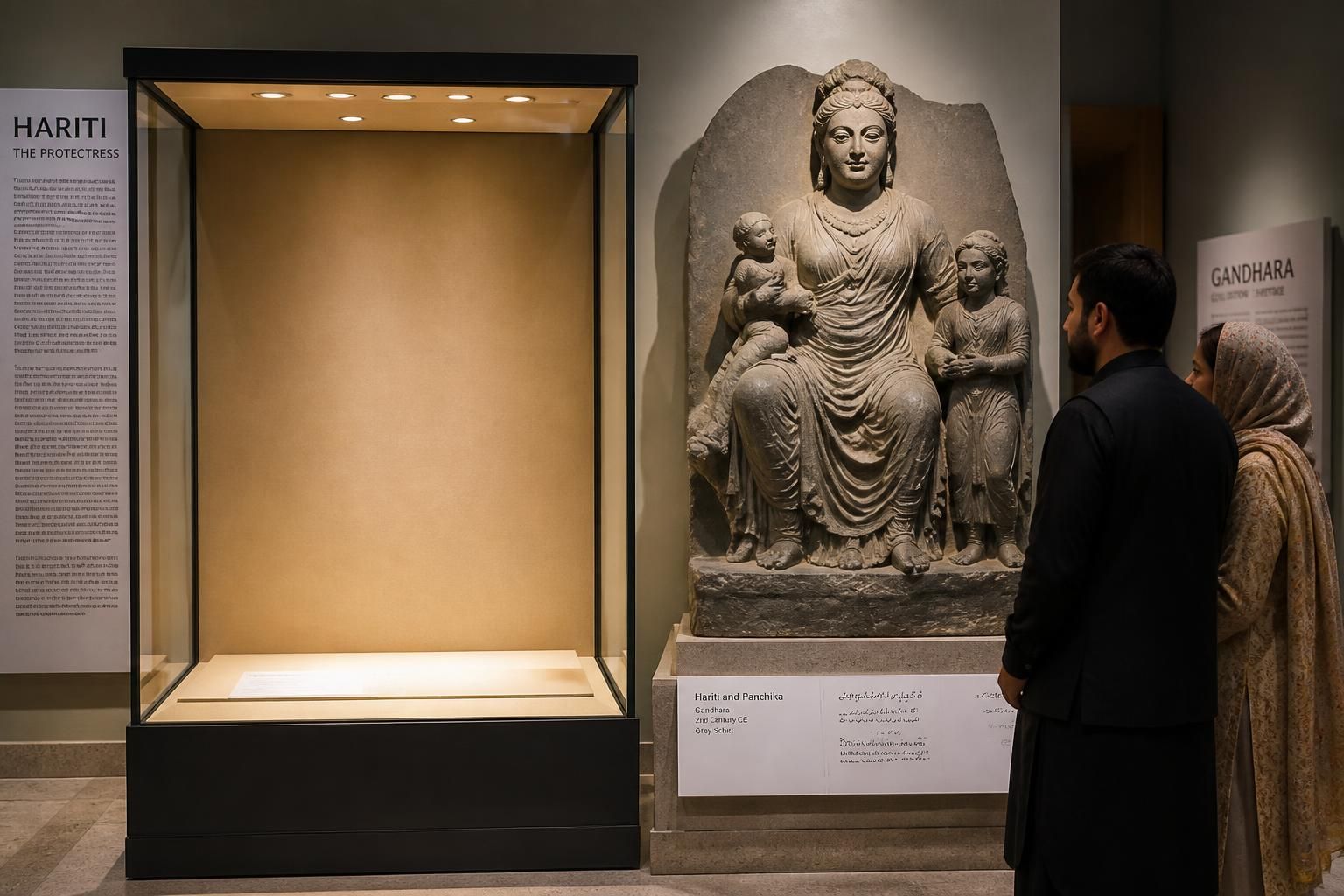
Pakistan is preparing a formal Cultural Heritage initiative focused on Gandharan works held abroad, including a significant Buddhist Statue in the British Museum. The object most frequently associated with this effort is a sculpture of Hariti and Panchika, protective Buddhist deities connected with domestic life, prosperity, and the safeguarding of children. Estimated to be around 1,800 years old, the Artifact belongs to a period when the Gandharan region was a major centre of Buddhist learning, religious practice, and sculpture.
The request is not simply about placing another ancient object in a museum display. It concerns how Cultural Property can be interpreted when it has been separated from its original archaeological, geographical, and religious context. For the Museum of Peshawar, the possible return or long-term placement of the sculpture would allow visitors to see it alongside a related statue of the same divine couple. This curatorial connection could make the meaning of both works more accessible than either object can be in isolation.
Officials in Pakistan have reportedly kept an empty display case in anticipation of a future agreement. This gesture echoes other prominent heritage debates, including campaigns involving the Parthenon sculptures and West African royal objects. It is an expressive but practical museum tool: it visualises absence for visitors and shows precisely how a returned Artifact could improve historical interpretation. 🧭 The central argument is contextual value, not only ownership.
Gandhara once covered areas of present-day Pakistan and Afghanistan, with major sites and artistic workshops concentrated in what is now Khyber Pakhtunkhwa. From roughly the first to third centuries CE, the region developed a distinctive visual language. Buddhist subjects were represented through local craftsmanship while incorporating Mediterranean and Hellenistic motifs that travelled east after Alexander the Great’s campaigns and later political exchanges. Drapery, facial modelling, architectural ornament, and narrative reliefs reveal this complex cultural encounter.
The sculpture of Hariti and Panchika represents that convergence particularly well. Hariti is associated with protection and motherhood, while Panchika is traditionally linked with abundance. Their representation in Gandharan art offers a valuable route into the social history of Buddhism: religious images were not limited to abstract doctrine but addressed everyday concerns such as family wellbeing, safety, and material security. A museum display in Peshawar could therefore help local and international audiences understand the lived dimensions of the ancient region.
Pakistan’s claim also forms part of a wider effort to change how international audiences perceive the country. The focus is on presenting an identity connected with deep historical layers, religious diversity, archaeological knowledge, and artistic production. This does not erase modern challenges, including security concerns in some regions, but it expands the public narrative beyond them. A carefully managed Cultural Property programme can support a more accurate view of Pakistan as a place that contributed substantially to world civilisation.
For tourism professionals, this case illustrates why heritage interpretation must be considered alongside transport, site conservation, visitor safety, and digital access. A repatriated object can create attention, but it does not independently establish a sustainable visitor destination. A meaningful experience requires clear storytelling, trained mediators, accessible routes, multilingual interpretation, and audio content that connects the Museum object to archaeological sites such as Taxila, Takht-i-Bahi, and the Peshawar Valley.
The issue has received international attention through reporting on Pakistan’s request for the Gandharan sculpture. This attention can be useful, yet institutions should avoid reducing the debate to a simple contest between two countries. The more productive question is how Museum Diplomacy can create public access, scholarly collaboration, and appropriate recognition of the object’s place of origin.
Pakistan’s Historical Claim is strongest when it combines provenance research, contextual interpretation, and a clear plan for public access. That same approach makes the case relevant not only to diplomats, but also to museum managers, guides, and cultural-tourism organisations.
Why Gandharan Cultural Heritage Matters to Pakistan’s Tourism Strategy
Pakistan’s interest in recovering or borrowing Gandharan objects is closely linked to a long-term tourism strategy. The country has major Buddhist archaeological resources, but many are insufficiently known by overseas visitors. Taxila, a UNESCO World Heritage Site near Islamabad, is one of the best-known locations. Its wider landscape includes urban remains, monasteries, stupas, and educational centres that demonstrate the importance of the region across several historical periods.
In Khyber Pakhtunkhwa, Buddhist sites and museum collections represent a distinct opportunity for cultural tourism. These assets can appeal to several audiences: Buddhist pilgrims, academic groups, art-history travellers, diaspora visitors, school groups, and travellers seeking archaeological experiences beyond more familiar destinations in South Asia. The challenge is to provide a coherent visitor journey rather than presenting isolated ruins or objects without narrative continuity.
A returning Buddhist Statue would not automatically generate high visitor numbers. Its value lies in how it can anchor a larger interpretation programme. Consider a hypothetical visitor called Maya, travelling from Singapore with an interest in Buddhist history. She may first encounter the Hariti and Panchika sculpture at the Peshawar Museum, then receive an audio-guided route linking the figures to monasteries, trade networks, and Gandharan artistic traditions. Her museum visit becomes the first stage of a well-structured regional experience rather than a short stop in front of a single case.
Building visitor confidence around Gandharan sites
Visitor confidence depends on practical measures. Current information about opening times, access conditions, local guides, emergency procedures, language availability, and transport options should be available before arrival. These basics are especially important for faith-based visitors who may be planning around dates of religious significance or travelling as part of an organised group.
Digital interpretation can support this effort without replacing knowledgeable guides. Smartphone audio systems can deliver location-based narratives in English, Urdu, Mandarin, Japanese, Korean, Thai, or other relevant languages. A guide leading a group at Taxila, for example, can use an audio platform to ensure every participant hears the explanation clearly, even in open-air locations where traffic, wind, or crowd noise can affect communication.
- 🗺️ Create connected itineraries: link museums, archaeological sites, local craftspeople, and regional food stops into a realistic route.
- 🎧 Prioritise clear audio: provide multilingual narration and individual listening options for groups.
- ♿ Design for accessibility: include transcripts, visual descriptions, easy-read content, and mobility information.
- 🛡️ Communicate safety precisely: publish verified practical advice instead of vague promotional language.
- 📍 Use place-based storytelling: explain where an Artifact was made, used, found, collected, and displayed.
Pakistan established a Task Force on Gandhara in July as part of efforts to develop the country into a recognised destination for Buddhist travellers. The initiative signals political interest, although implementation must proceed carefully. Some local stakeholders have raised concerns about how explicitly faith-oriented facilities, including meditation centres, should be developed in a predominantly Muslim society. A step-by-step model can reduce tension by starting with heritage education, community employment, conservation, and well-managed visitor services.
This approach matters because tourism succeeds when host communities see direct benefits. Rural populations near archaeological areas may support conservation more strongly when visitors contribute to local income through guiding, accommodation, transport, food services, and craft markets. The aim should not be to package sacred history as a superficial attraction. It should be to develop respectful access that supports both the local economy and the physical protection of sites.
Pakistan has already benefited from other restitution processes. Reports on the return of more than 450 cultural artefacts from the United States demonstrate that international cooperation can bring significant objects back into public collections. Such cases also strengthen professional capacity in documentation, conservation, customs coordination, and public communication.
🌏 A Gandharan tourism strategy becomes credible when it connects the museum object, the physical landscape, and a reliable visitor experience. The next question is how a UK institution can respond within the legal structures that govern its collection.
British Museum Repatriation and the Limits of International Law
Repatriation debates are often presented as moral disputes with a simple answer: return the object or retain it. In practice, the legal and institutional situation is more complex. The British Museum is subject to legislation that restricts the permanent disposal of objects in its collection, except in narrow circumstances. This means that even where an institution accepts the importance of a Historical Claim, it may have limited authority to transfer ownership outright.
International Law provides several frameworks for dealing with Cultural Property, but these do not function as an automatic solution for every historic collection. The 1970 UNESCO Convention focuses primarily on preventing illicit import, export, and transfer of ownership of cultural goods. Many disputed objects entered European collections long before that framework was adopted. Questions about legality at the time of acquisition, ethical standards, colonial power imbalances, documentation gaps, and modern public interest must therefore be considered together.
The Hariti and Panchika sculpture has been discussed in the context of potential negotiations rather than a confirmed legal outcome. Pakistan may seek a permanent return, a renewable loan, a shared custodial arrangement, or a wider research and exhibition partnership. Each route has different implications for ownership, insurance, transport, conservation standards, display rights, and public interpretation.
| Option | What it could mean for Pakistan | What it could mean for the British Museum | Visitor benefit |
|---|---|---|---|
| 🏛️ Permanent repatriation | Full physical return and local stewardship of the Artifact | Requires a legal route or policy exception | Reunites the object with its regional context |
| 🔄 Long-term loan | Display in Peshawar without immediate transfer of title | Retains ownership while enabling access abroad | Supports interpretation at the place of origin |
| 🤝 Shared partnership | Joint research, staff exchange, and co-curated displays | Develops Museum Diplomacy beyond a single object | Offers richer, multi-perspective interpretation |
| 💻 Digital reunification | High-quality scans and multilingual online material | Improves remote access to collection knowledge | Helps audiences compare objects across collections |
Long-term loans have become an increasingly visible tool in heritage diplomacy. They can allow communities and institutions to display important works while avoiding the immediate legal obstacles associated with deaccession. In 2024, Asante royal regalia was returned to Ghana on long-term loan arrangements. In the following year, the British Museum also developed lending relationships with Indian institutions amid wider discussions about colonial collecting and the interpretation of Asian art.
These models are not without criticism. Some claimants argue that a loan wrongly requires the source community to accept the lender’s ownership. Others see loans as a pragmatic interim measure that produces public access, research opportunities, and cultural recognition now rather than after decades of legal dispute. There is no universal answer. The best arrangement depends on the provenance of the specific object, the claimant’s priorities, the museum’s statutory duties, and the quality of the partnership being proposed.
A productive negotiation would require transparent documentation. Pakistan would need to identify its requested objects precisely, explain their archaeological and cultural importance, and demonstrate capacity for conservation and display. The British Museum would need to clarify provenance evidence, legal restrictions, object condition, and potential lending terms. Both parties should define how the story of acquisition will be communicated to visitors, rather than concealing difficult aspects of the collection history.
Scholarly discussions of volunteer perspectives and the tensions surrounding “universal museum” narratives show why transparency matters. Research into public-facing views on British Museum repatriation debates illustrates that museum workers themselves encounter complex visitor questions about return, retention, empire, and responsibility. Clear interpretation benefits staff as much as audiences.
⚖️ International Law sets boundaries, but Museum Diplomacy determines whether those boundaries become barriers or workable pathways. A future agreement should be judged by its ability to improve access, understanding, and accountability for the public in both countries.
How Museum Diplomacy Can Reconnect a Buddhist Artifact with Its Original Context
Museum Diplomacy is most effective when it moves beyond ceremonial announcements. A single handover photograph may generate headlines, but a sustained partnership can generate knowledge, professional skills, and durable visitor value. In the Pakistan–British Museum case, the Hariti and Panchika Buddhist Statue could become the basis for joint work in conservation, collections management, archaeology, interpretation design, and digital publishing.
Context is essential. When a Gandharan sculpture is displayed in London, it can be understood within global histories of Buddhism, ancient trade, and classical influence. When it is displayed in Peshawar, it can also be related to local sites, excavation histories, languages, communities, and regional memory. These perspectives are not mutually exclusive. A high-quality partnership should make room for both while being honest about how the object moved from its original setting into a British national collection.
From object transfer to shared cultural infrastructure
One practical model would include a multi-year loan coupled with professional exchange. Conservators from Pakistan and the United Kingdom could assess the sculpture’s condition together before transport. Curators could develop two connected displays: one in Peshawar focused on Gandharan landscapes and local archaeological context, and another in London explaining the partnership and Pakistan’s current heritage programme. Both exhibitions should use matching collection records and clearly identify the source of every historical claim.
Digital tools can make this relationship more useful for audiences who cannot travel. Photogrammetry or structured-light scanning can create a detailed 3D record of the Artifact. This record can be used for conservation monitoring, online exhibitions, tactile replicas for visually impaired visitors, and educational models for schools. It does not substitute for physical repatriation where that is the agreed goal, but it expands the number of people who can engage with the sculpture responsibly.
Audio interpretation also deserves careful planning. A generic recording that calls the work “an ancient Buddhist figure” would waste the opportunity. A useful guide should explain who Hariti and Panchika are, why their imagery mattered, how Gandharan artists worked, and what questions remain open. It should also invite visitors to consider why the sculpture is now being discussed through Repatriation rather than treating the debate as a side note.
- 📚 Establish a shared object dossier: combine provenance records, condition reports, scholarly references, and accessible summaries.
- 🎙️ Co-produce multilingual audio content: include Pakistani researchers, Buddhist scholars, local guides, and UK curators.
- 🧩 Present acquisition history clearly: explain the object’s collection pathway without evasive labels.
- 👥 Train front-of-house teams: prepare staff to answer questions about ownership, loans, and colonial history.
- 📱 Measure visitor use: analyse which stories, languages, and digital formats help audiences understand the work.
For a guide operator, museum, or tourism office, this case offers a useful lesson: heritage technology should help visitors make connections, not overwhelm them with features. A smartphone-based audio guide can deliver synchronised narration to a group, enable visitors to choose their language, and provide transcripts for accessibility. It can also help institutions update information quickly if an object moves between exhibitions or if new provenance research is published.
Successful digital mediation requires editorial discipline. Each stop should answer a visitor question. Why is this statue important? What does its style reveal about Gandhara? Why is Pakistan requesting its return? What could a loan agreement change? By structuring the experience around these questions, museums can turn an emotionally charged debate into an informed, human discussion.
Related debates about the responsibilities of large cultural institutions are explored in this discussion of decolonising loans at the British Museum. The key operational lesson is that loans should not be treated as a public-relations substitute for dialogue. They should include mutual decision-making, clear timelines, collections care, and access for audiences in the country of origin.
🎧 The strongest cultural partnership does not merely move an object; it reconnects people with the knowledge, voices, and places surrounding it. That requires attention to community expectations as well as institutional agreements.
Protecting Cultural Property While Supporting Communities in Khyber Pakhtunkhwa
The debate over the British Museum sculpture must also be connected to the realities of heritage protection in Pakistan. Khyber Pakhtunkhwa contains valuable archaeological sites, museums, and landscapes, yet it has often been framed internationally through security concerns rather than cultural achievement. Reframing the region requires more than publicity. It requires investment in conservation, responsible visitor management, local training, and community trust.
Gandharan heritage includes monumental remains, portable sculptures, inscriptions, monastic architecture, and museum archives. Each category needs a different protection strategy. A stone sculpture in a climate-controlled museum faces different risks from a remote archaeological site exposed to weather, unauthorised digging, insufficient drainage, or inconsistent visitor supervision. Repatriation discussions should therefore include a realistic stewardship plan rather than assuming that physical return is the final stage of responsibility.
Pakistan’s cultural institutions can strengthen the case for requested objects by making collection care visible. This includes public conservation policies, trained staff, secure storage, environmental monitoring, object inventories, and emergency procedures. These are not merely technical details for specialists. They show communities and international partners that Cultural Property is being managed for future generations.
Community participation is equally important. A local resident living near a Buddhist site may not automatically feel a connection to a tradition that is no longer widely practised in the area. Interpretation should therefore explain that Gandharan history belongs to the region’s shared past, not exclusively to one present-day religious group. It can be understood through archaeology, art, local identity, education, and economic opportunity while still respecting the sacred significance it holds for Buddhist visitors.
There is a sensible reason for a gradual approach to faith-oriented visitor infrastructure. Proposals such as meditation centres can be valuable for pilgrims, but they should follow consultation with local communities, religious leaders, heritage professionals, and site managers. Premature development may create avoidable tension or place pressure on fragile locations. In contrast, accessible museums, interpretation centres, conservation workshops, and community-led guiding programmes can build understanding before more specialised services are introduced.
Practical measures for responsible heritage tourism
Tourism planners should begin with operational basics. A site needs trained personnel, clear paths, toilets, shade where possible, emergency contacts, reliable opening times, waste management, and easy-to-understand visitor rules. These details may seem ordinary, but they determine whether visitors stay longer, recommend the destination, and treat the site respectfully.
Digital tools can complement on-site measures. QR codes should not replace interpretation boards where mobile coverage is limited. Instead, sites can offer downloadable audio tours before arrival, lightweight web pages, and offline content. Museum teams can also provide a short pre-visit audio briefing that explains etiquette, photography rules, landscape sensitivity, and why visitors should remain on designated paths.
There is a wider international benefit in making Pakistan’s Gandharan heritage more visible. Pilgrimage routes can encourage cultural exchange between Pakistan and Buddhist-majority countries across Asia. Academic partnerships can support excavations and conservation research. Schools can use digital materials to teach the interconnected histories of South Asia, Central Asia, and the Mediterranean world. The country’s Historical Claim to a Buddhist Artifact therefore has relevance far beyond one gallery or one diplomatic negotiation.
At the same time, public communication must remain precise. Cultural tourism should not promise unrestricted access, instant growth, or easy solutions to complex regional issues. Visitors and partners need reliable, updated information. If a site is closed for conservation or security reasons, that should be communicated clearly. Trust grows when institutions are transparent about both their strengths and their operational limits.
🏺 The return, loan, or shared display of the Hariti and Panchika sculpture would matter most when it strengthens the wider care of Pakistan’s living archaeological landscape. Cultural Heritage is not a single object in a case; it is the relationship between collections, communities, knowledge, and responsible access.
Which Buddhist Statue is Pakistan seeking from the British Museum?
Pakistan’s discussions have focused on an approximately 1,800-year-old Gandharan sculpture depicting Hariti and Panchika, protective Buddhist deities associated with family wellbeing and prosperity.
Why is the Gandharan Artifact important to Pakistan?
Gandhara was a major Buddhist civilisation centred largely in present-day north-west Pakistan. The sculpture would help museums in Pakistan explain the region’s artistic, religious, and archaeological history in its original geographical context.
Can the British Museum permanently return the object?
Permanent transfer may be restricted by UK legislation governing the British Museum collection. A long-term loan or shared curatorial partnership may therefore be a more immediately workable Museum Diplomacy option.
How could Repatriation support tourism in Pakistan?
A returned or loaned object could anchor improved museum displays, guided itineraries, multilingual audio interpretation, research partnerships, and visits to Gandharan sites such as Taxila and locations in Khyber Pakhtunkhwa.
