
Key points at a glance: 🦷 The Jacksonville Museum’s new Exhibit connects a local innovator to the foundations of Modern Dentistry. 🔬 Original instruments and a documented filling make Dental History tangible rather than abstract. 🎧 For museums, the display also offers a strong model for accessible, story-led interpretation that can be extended through audio and digital tools.
Jacksonville Museum Exhibit Brings G.V. Black’s Revolutionary Impact Into Focus
The Jacksonville Area Museum has opened a Historical Exhibit devoted to Dr. Greene Vardiman Black, the Jacksonville resident widely recognized as the Father of Modern Dentistry. Titled “This Won’t Hurt a Bit,” the display presents a local story with international significance: how a scientist, inventor, and teacher helped dentistry move toward more consistent methods, better materials, and formal professional education.
The timing is meaningful. The presentation was launched to mark what would have been Black’s 190th birthday, placing his career within a public conversation about the long development of Oral Health care. Rather than treating his legacy as a remote scientific milestone, the Jacksonville Museum connects it directly to the tools, choices, and standards that continue to shape a dental appointment today.
Visitors encounter more than a biography. The Exhibit frames Black as a practical problem-solver who worked across disciplines. His research addressed questions that affected real patients: how to prepare a tooth, how to place and shape a filling, how to improve instruments, and how to teach future dentists a repeatable approach. These concerns may sound familiar in 2026, but they were not always organized into a clear professional system.
According to museum manager Tori Ohl, Black combined curiosity with a commitment to teaching, producing discoveries and inventions that reshaped patient care. This perspective matters because it avoids reducing his contribution to a single tool or technique. His Revolutionary Impact came from linking observation, experimentation, material science, and education.
Why this local story has global relevance for Dental History
Black’s connection to Jacksonville gives the museum a valuable interpretive advantage. Many medical and scientific breakthroughs are presented in major national institutions, where a visitor may admire an artifact without understanding its community roots. Here, the narrative begins with a recognizable place and expands outward. A resident of Jacksonville helped influence Dental Techniques used well beyond Illinois.
This local-to-global structure is especially effective for visitors who do not arrive with technical knowledge. A family may enter out of curiosity about old equipment, while a dental student may be drawn by Black’s professional legacy. Both audiences can follow the same storyline: an everyday health need inspired experimentation, and experimentation gradually produced standards that improved care.
- 🦷 Local connection: G.V. Black lived and worked in Jacksonville, making the collection relevant to regional heritage.
- 🔬 Scientific contribution: His work helped establish more systematic approaches to restorative treatment.
- 🎓 Educational legacy: He supported dentistry’s evolution into a more structured and teachable profession.
- 🏛️ Visitor value: Historic objects provide a concrete entry point into medical progress and Oral Health awareness.
The museum’s approach also makes room for a useful question: what makes an innovation endure? A new device can attract attention, but a lasting innovation changes routines. Black’s influence is often associated with the systematization of cavity preparation and restorative practice, showing how methods can be as consequential as machinery. By helping create a common framework for dentists, he supported consistency at a time when standards varied widely.
For cultural venues, this is an instructive model. A specialized collection becomes more accessible when it is built around human stakes rather than technical vocabulary alone. Visitors do not need to understand every term in dental science to recognize the importance of pain reduction, reliable treatment, and the preservation of natural teeth.
The museum has shared details of the opening through its announcement about the dentistry display, offering a useful starting point for visitors planning to see the installation. The display is housed in the West Gallery during regular museum hours, with scheduled opening periods including Wednesday and Saturday daytime access and Sunday afternoon access.
The central lesson is clear: G.V. Black’s legacy is not merely a chapter in professional history; it is evidence that rigorous, patient-focused thinking can transform an entire field.
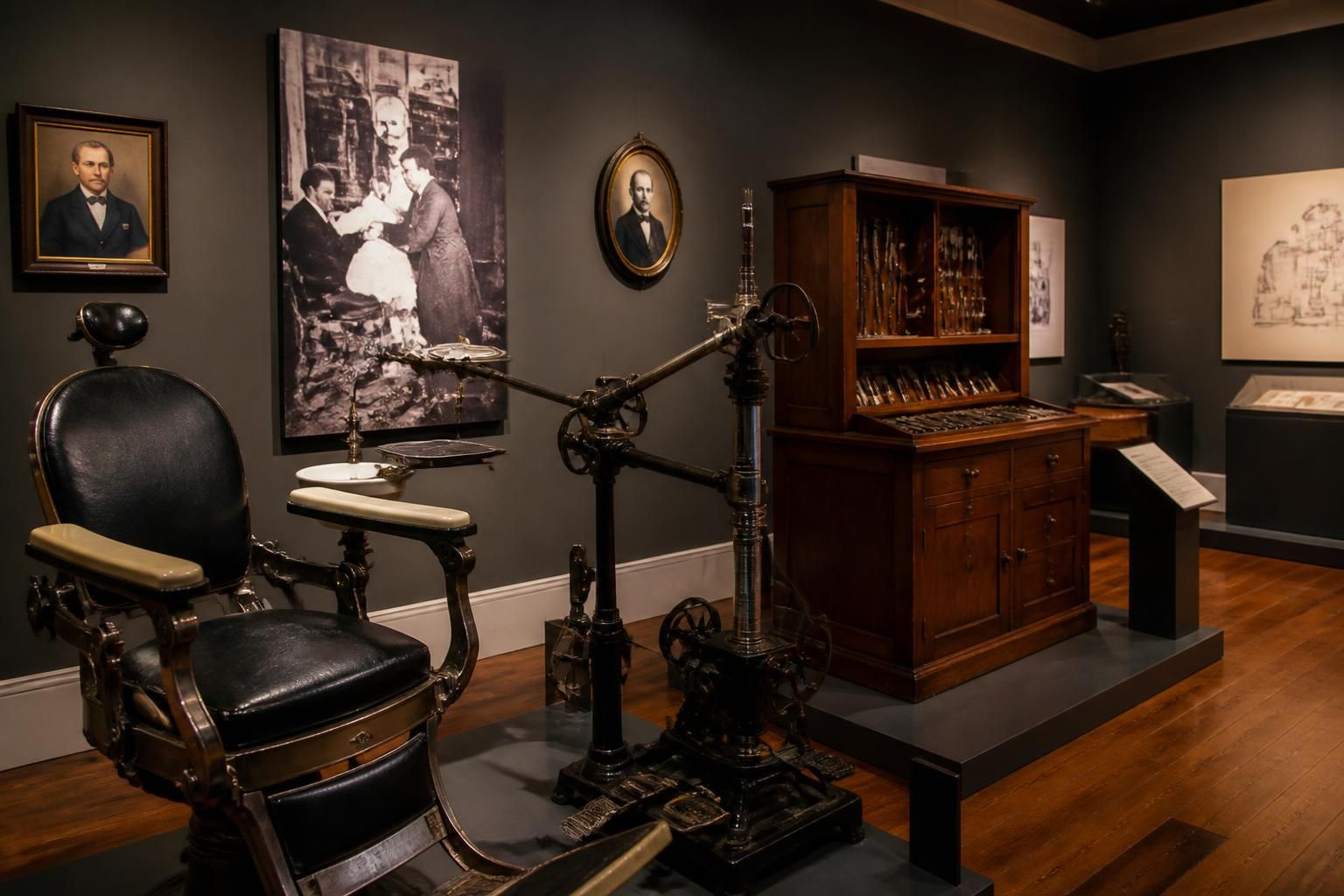
Historic Dental Instruments Reveal How Modern Dentistry Developed
The objects selected for the Jacksonville Museum Exhibit provide a direct visual record of changing Dental Techniques. Instead of describing past practice through labels alone, the installation places visitors near the physical tools that shaped treatment. A gold rolling machine, a treadle-powered drill, a period dental chair, and a cabinet for dental instruments each show how much skill and labor earlier care required.
The gold rolling machine is particularly revealing. Gold was long used in restorative work because it could be manipulated into durable fillings. The device flattened the metal into suitable form, demonstrating that restorative dentistry depended not only on diagnosis but also on precise material preparation. What a visitor sees as a compact mechanical object represents a time when the dental office resembled a workshop as much as a clinical space.
The treadle drill offers another powerful contrast with contemporary equipment. Powered by foot motion rather than electricity, it required sustained physical coordination from the practitioner. Its presence helps visitors understand why speed, comfort, noise, and precision have remained central concerns in dental Innovations. Modern drills are not simply newer versions of an old object; they respond to practical limits that patients and dentists experienced every day.
Reading tools as evidence of changing patient care
A historic dental chair can easily be viewed as decorative furniture. In context, however, it reveals how the relationship between practitioner, patient, posture, lighting, and access to the mouth was managed. Chair design affects the clinician’s visibility and physical reach, while also influencing a patient’s sense of security. Even now, comfort and communication remain essential elements of Oral Health visits.
The instrument cabinet donated by Black’s descendants adds a personal dimension to the display. It is not only a storage object. It suggests the accumulated routine behind professional care: instruments needed to be protected, organized, cleaned, and ready for use. This practical environment is an important part of Dental History because reliable treatment depends on systems, not just individual expertise.
| Exhibit object | What it demonstrates | Modern connection |
|---|---|---|
| 🟨 Gold rolling machine | Preparation of restorative material for fillings | Material selection remains central to long-term restoration quality |
| ⚙️ Treadle-powered drill | Manual power and the physical limits of early procedures | Today’s equipment prioritizes precision, ergonomics, and patient comfort |
| 🪑 Period dental chair | How treatment positioning shaped access and reassurance | Clinical design still affects the patient experience |
| 🗄️ Descendant-donated tool cabinet | Daily organization of professional instruments | Safe, systematic workflows support consistent care |
One of the most notable artifacts is a tooth reportedly filled by Black using a method that later gained broad use among dentists internationally. This object has unusual interpretive force. It does not simply represent an era; it links an individual procedure to a method that became part of wider professional practice. Visitors can see a physical result of clinical experimentation rather than only reading about an abstract theory.
For an audience accustomed to sleek, compact medical technology, the contrast is compelling. Yet the display should not be read as a simplistic story in which the past was primitive and the present is complete. Every generation of dentistry works with the best available knowledge, materials, and equipment. The historical value lies in seeing how practitioners identified limitations and designed better responses.
This is why artifact-centered storytelling works so well in a museum setting. It gives a visitor a clear sequence: object, use, problem, and improvement. A guide can point to the treadle mechanism, explain the physical effort involved, then invite the group to consider how today’s clinical technology still seeks the same outcomes—accurate treatment and a more manageable experience.
These instruments show that progress in dentistry is built through practical refinement, one procedure and one tool at a time.
G.V. Black’s Dental Techniques Set Standards Beyond His Own Era
G.V. Black’s standing in Modern Dentistry rests on more than his reputation as an inventor. His lasting importance comes from his effort to create a disciplined, evidence-based language for clinical work. In an era when dental procedures could differ sharply from one practitioner to another, he promoted methods that could be studied, taught, repeated, and improved.
This transition from individual craft to organized practice is one of the most important themes visitors can take from the Jacksonville Museum Exhibit. Dentistry requires fine manual skill, but skill alone cannot create reliable standards. A profession advances when practitioners can describe what they do, compare outcomes, assess materials, and train others with a shared framework.
Black is associated with systematic approaches to cavity preparation and with classifications that helped dentists identify and discuss patterns of tooth decay. The value of classification may seem administrative at first glance. In reality, it supports clinical clarity. When professionals share a consistent way to describe a condition, they can improve teaching, communication, documentation, and treatment planning.
From isolated procedures to a profession built on shared knowledge
Consider a hypothetical visitor named Maya, a dental hygiene student touring the Historical Exhibit with classmates. She may recognize that contemporary oral care is shaped by protocols: clinical records, infection-control processes, diagnostic categories, and standardized patient communication. The display allows her to trace the roots of that system back to figures such as Black, whose work treated dentistry as a field that could be observed scientifically and transmitted responsibly.
This perspective is also useful for visitors outside the profession. A filling can appear routine, yet it represents decisions about preserving tooth structure, controlling decay, selecting materials, and restoring function. Black’s work helped advance the idea that restorative procedures should follow carefully considered principles instead of relying only on personal habit.
- 🔍 Observe the condition: identify what is happening in the tooth and why it matters.
- 📐 Apply a consistent method: use a defined approach to preparation and restoration.
- 🧪 Evaluate materials: consider durability, handling, and suitability for the procedure.
- 🎓 Teach and document: make knowledge transferable so that care can improve across practitioners.
The Exhibit’s title, “This Won’t Hurt a Bit,” adds an important layer. The phrase is familiar enough to make visitors smile, but it also points to historical anxiety around treatment. Dental pain has been one of the most persistent barriers to care. Improvements in technique, equipment, and education all matter because they support safer, more predictable, and more respectful patient experiences.
It is worth avoiding a common misunderstanding: historical figures are not important because they solved every problem forever. Black’s Revolutionary Impact lies in creating foundations that later professionals could test, adapt, and extend. Modern care has evolved through advances in imaging, anesthesia, preventive education, adhesive materials, and digital workflows. Yet the underlying commitment to methodical practice remains recognizable.
For museums and visitor organizations, this theme creates opportunities for engaging mediation. Rather than presenting classifications or scientific principles as dense text, an audio stop can frame a short scenario: “A dentist in the late nineteenth century needs to decide how to treat decay. What information would make that decision more reliable?” The answer naturally opens the door to Black’s research and teaching.
Smartphone-based audio can support this without crowding the gallery. Visitors may choose a two-minute overview, while students or professional groups can access a longer explanation. This layered format respects different levels of interest, reduces dependence on lengthy wall text, and supports accessibility for visitors who prefer listening to reading.
Black’s most durable innovation was a culture of clinical reasoning: make care understandable, teachable, and open to improvement.
Accessible Interpretation Can Turn Dental History Into a Memorable Visit
The Jacksonville Museum’s display demonstrates how a focused collection can connect a specialist subject with a broad audience. Dental History is not automatically familiar to every visitor, but it touches nearly everyone. Most people have experienced a dental checkup, a filling, or a conversation about prevention. The interpretive challenge is therefore not finding relevance; it is presenting the relevance clearly.
The bust of G.V. Black by sculptor Richard Bock provides an effective anchor. Bock’s connection with architect Frank Lloyd Wright, including work associated with Springfield’s Dana-Thomas House, adds a cultural layer that may attract visitors interested in art and architecture as well as health history. This cross-disciplinary link broadens the Exhibit without diluting its central theme.
Visitors are invited to take photographs with the bust and participate in the tradition of rubbing its nose for good dental health. This is a small gesture, but it has substantial engagement value. It gives people a reason to pause, share an image, and remember a historical figure through a physical interaction. When handled respectfully, such a feature can make a museum visit more social and more memorable.
Audio and digital layers should clarify, not distract
A photograph point or tactile ritual works best when visitors understand its meaning. A concise audio segment can explain who Bock was, why the bust is present, and how the nose-rubbing custom links humor with Oral Health awareness. The best digital interpretation does not compete with the object. It gives the object a voice, then lets visitors look closely.
For example, a self-guided route could be organized around five short stops: Black’s portrait, the gold rolling machine, the treadle drill, the filled tooth, and the bust. Each stop could offer a one-minute essential version and a deeper optional segment. This approach helps families, casual travelers, school groups, and medical-history enthusiasts choose their own pace.
- 🎧 Keep audio concise: one idea per stop is easier to retain than a long lecture.
- 📱 Use personal smartphones: visitors can listen at a comfortable volume with their own headphones.
- ♿ Offer text alternatives: transcripts improve access for people who prefer or need to read.
- 🧭 Use clear wayfinding: numbered stops should match physical labels and the visitor route.
- 👥 Design for groups: guides need a simple way to keep everyone synchronized without raising their voice.
A tool such as Grupem can be relevant in this context because it turns participants’ smartphones into an organized audio-guiding system. For a museum educator or local guide, the practical benefit is not technology for its own sake. It is the ability to speak clearly to a group, limit surrounding noise, and offer accessible content without installing complicated permanent equipment.
Imagine a Saturday tour with 20 visitors in the West Gallery. The guide begins at the chair, then moves to the drill. Instead of gathering everyone tightly around a label or repeating explanations over ambient conversation, the group receives clear commentary through their phones. Visitors who stand farther back still hear the same information, while the artifacts remain protected and visible.
Digital mediation can also extend the visit beyond the room. A short post-visit audio recap might encourage participants to schedule preventive dental care, explore Jacksonville heritage sites, or share what they learned with younger family members. This creates continuity without making unsupported claims about health outcomes.
The museum’s own exhibits information page can help visitors check current programming before travel. As the display is expected to relocate to the institution’s new central gallery in 2027, clear online updates will be especially important for tour planners and returning audiences.
The most effective visitor experience combines authentic objects, straightforward interpretation, and optional digital support that gives every guest a clear way into the story.
Planning a Visit to the G.V. Black Historical Exhibit in Jacksonville
The G.V. Black display is located in the Jacksonville Area Museum’s West Gallery, where it can be viewed during the institution’s scheduled public hours. Reported regular access includes Wednesday and Saturday hours from 10 a.m. to 4 p.m., plus Sunday hours from 1 p.m. to 4 p.m. Visitors should verify opening times before traveling, particularly when planning a group visit, school program, or heritage itinerary.
Practical planning improves the value of a specialist exhibit. A casual visitor may need 20 to 30 minutes to view the core objects and read key panels. A family that uses the photo opportunity and discusses the machinery may spend longer. Educators, history enthusiasts, and dental professionals could reasonably plan additional time for close observation and conversation around Black’s influence on Modern Dentistry.
The museum’s 2026 programming has made the display a useful reason to include Jacksonville in a regional cultural itinerary. It pairs well with themes such as Illinois medical history, nineteenth-century craftsmanship, local innovation, and the connection between design and public health. Because the artifacts include both technical equipment and personal legacy items, the experience can support multiple interests within one group.
How guides and educators can build a purposeful group visit
A successful group visit begins before arrival. Tour organizers should define one clear learning goal rather than trying to cover every aspect of dentistry. For a school group, the goal might be understanding how inventions improve everyday life. For a professional dental group, it may be the development of clinical standards. For tourists, it could be discovering why Jacksonville has a place in global Dental History.
A simple route can create a logical sequence. Begin with the portrait panels to establish Black’s identity, move to the gold rolling machine and drill to explain changing practice, pause at the filled tooth to connect research with clinical application, then end at the bust for a memorable cultural and photographic moment. This order makes the story easy to follow without rushing visitors.
| Visitor type | Recommended focus | Useful planning action |
|---|---|---|
| 👨👩👧 Families | How old tools compare with today’s dental visits | Allow time for the bust photograph and discussion |
| 🏫 School groups | Inventions, science, and community history | Prepare three observation questions before arrival |
| 🦷 Dental professionals | Black’s influence on standards and education | Arrange a guided discussion when possible |
| 🧳 Cultural travelers | Jacksonville’s connection to wider Innovations | Check museum schedules and nearby heritage stops |
There is also value in treating the visit as a prompt for contemporary prevention. Historic equipment can spark conversation about why regular Oral Health care matters, how patient comfort has evolved, and why professional education remains essential. The museum does not replace clinical advice, but it creates a meaningful cultural setting in which visitors can reflect on changes in care.
For accurate event details and possible updates surrounding the display, visitors can consult the Jacksonville event listing for the G.V. Black display. Those interested in deeper local involvement can also explore museum membership and volunteer opportunities through the institution’s official channels.
The expected move to the new central gallery in 2027 offers an opportunity to rethink orientation, audio access, and visitor flow. A larger or more central placement could make the collection easier to discover while preserving the intimate quality that historic instruments require. Clear digital updates, short audio narratives, and well-paced tours can help ensure that the move expands access rather than adding complexity.
A visit is most rewarding when visitors arrive with one guiding question: how did a Jacksonville scientist help make dental care more systematic, safer, and more understandable?
Where is the G.V. Black dentistry display located?
The G.V. Black Historical Exhibit is presented in the West Gallery of the Jacksonville Area Museum in Jacksonville, Illinois. The museum expects to move the display to its new central gallery in 2027.
Why is G.V. Black called the Father of Modern Dentistry?
Greene Vardiman Black is recognized for research, inventions, clinical methods, and teaching that helped make dentistry more systematic, standardized, and professionally organized.
What objects can visitors see in the Jacksonville Museum Exhibit?
The display includes a gold rolling machine for filling material, a treadle-powered dental drill, a period dental chair, a dental instrument cabinet donated by Black’s descendants, photographs, interpretive panels, a Richard Bock bust, and a tooth filled by Black.
Can the exhibit work for school or guided groups?
Yes. The objects provide clear prompts for discussions about invention, public health, material science, local history, and the evolution of patient care. Short audio-guided stops can make the experience easier to follow for larger groups.
