
EAA Aviation Museum adds six new aircraft across a century of flight
The EAA Aviation Museum in Oshkosh, Wisconsin, is expanding its exhibits with six new aircraft, bringing together early flying machines, an influential ultralight, and three military types. The additions described in its October 2026 announcement broaden the stories visitors can explore without reducing aviation to a succession of faster engines and larger airframes.
The group includes replicas of the Douglas World Cruiser and Epps Monoplane, John Moody’s Icarus II, a Curtiss P-40 Warhawk, an FM-2 Wildcat, and a PBY-5A Catalina. Their value lies in their differences: each offers a distinct answer to a practical question about how people build, operate, or use an aircraft.
For visitors, “new aircraft” means newly added to the displays, not newly manufactured machines. The distinction matters because the selection combines replicas, a personally built aircraft, and historic types on loan, each requiring a different approach to interpretation.
| Aircraft added | Historical perspective | Useful viewing question |
|---|---|---|
| 🛩️ Douglas World Cruiser replica | Long-distance flying and international operations | What did global flight require beyond a capable engine? |
| 🛠️ Epps Monoplane replica | Early individual experimentation | How did builders solve unfamiliar design problems? |
| 🪶 John Moody’s Icarus II | Lightweight recreational flight | What changes when weight becomes the central constraint? |
| 🦈 Curtiss P-40 Warhawk | Flying Tigers interpretation and wartime service | How do markings communicate identity? |
| ⚓ FM-2 Wildcat | Naval fighter operations | How does an operating environment influence design? |
| 🌊 PBY-5A Catalina | Amphibious flying and maritime missions | Why combine a boat-like hull with an aircraft? |
The Visit Oshkosh account of the six additions provides a useful starting point for understanding the expanded selection. Museum teams and tour organizers should pair such destination coverage with current information from the institution before preparing visitor materials.
This is a museum expansion of exhibition content; the supplied announcement does not establish that a new building or additional floor area has opened. Describing it accurately helps visitors understand what has changed and prevents promotional language from creating the wrong expectation.
Reading the expanded aircraft collection through practical questions
Consider a hypothetical school group whose teacher, Maya, has one main learning objective: show how engineering responds to different needs. Rather than asking pupils to memorize six names, she assigns each small team a problem—distance, weight, water operations, or identification—and asks it to find visible evidence.
That approach makes the aviation exhibits relevant to visitors without specialist knowledge. A wing, hull, cockpit, or painted emblem becomes something to investigate, rather than simply a feature to photograph.
The loans also reveal how an aircraft collection develops through relationships. The P-40 and FM-2 come from the Frasca Collection, while the Catalina is on loan from the American Heritage Museum; these arrangements allow objects held by different organizations to support a shared public learning experience.
For interpretation teams, the practical opportunity is to connect the machines without treating them as interchangeable. The strongest route through these additions follows the problems their designers and operators were trying to solve.
Douglas World Cruiser and Epps replicas make early aviation history tangible
The Douglas World Cruiser and Epps Monoplane replicas give visitors two very different entry points into early aviation history. One directs attention toward coordinated long-distance operations; the other brings the discussion back to an individual builder confronting the fundamentals of powered flight.
A replica should be interpreted as a reconstruction, not presented as an original surviving airframe. That distinction does not diminish its educational value. It clarifies which questions the object can answer directly and which depend on photographs, documents, or evidence about the aircraft it represents.
The Douglas World Cruiser type is associated with the first successful aerial circumnavigation in 1924. Its historical importance extends beyond the aircraft itself: a journey of that scale required maintenance, navigation, supplies, suitable stopping places, and coordination across widely separated locations.
A useful guided explanation therefore begins with a logistical question: how would a crew obtain fuel or replacement parts far from its starting point? Visitors can then connect the machine in front of them with the largely invisible network that made its operation possible.
Using the Douglas World Cruiser replica to explain operational complexity
For Maya’s hypothetical school visit, a simple exercise would be to plan a short sequence of remote landing stops. Pupils would need to consider weather, available supplies, communication, and the consequences of a mechanical fault, rather than merely drawing the shortest line on a map.
This exercise explains why range alone does not determine whether a journey is feasible. An aircraft may be physically capable of reaching a destination while still lacking the support needed to depart again safely.
The same idea resonates with tourism professionals. Reliable visitor operations also depend on connections between transport, staffing, information, and contingency planning; an impressive centerpiece cannot compensate for a broken service chain.
The Epps Monoplane offers a complementary perspective. Associated with early Georgia aviation pioneer Ben Epps, the design represents the initiative of a builder working when established solutions and standardized components were far less available than they are today.
Using the Epps Monoplane replica to explain experimental aviation
Here, the central question is not how to organize an international expedition, but how to create a workable flying machine at all. Visitors can consider the relationship between structural strength, engine output, control, and weight without needing equations or technical vocabulary.
Guides should distinguish clearly between what can be observed and what requires historical documentation. A visible structural arrangement can support a discussion about design choices; a claim about a particular construction material or modification should come from verified exhibit information.
A concise audio stop could ask listeners to identify the parts responsible for lift, propulsion, and control, then explain how those functions interact. Providing the same explanation in text would support visitors who cannot hear the recording or prefer to read at their own pace.
Together, these replicas show that aviation heritage includes both ambitious coordinated projects and individual experimentation. Their educational strength is the ability to make early engineering decisions visible while keeping the distinction between reconstruction and original evidence clear.
John Moody’s Icarus II connects experimental aviation with accessible flight
John Moody’s Icarus II shifts attention from institutional projects toward the possibilities of lightweight personal flying. Its inclusion gives experimental aviation a clear place alongside machines more readily associated with military service or major historical milestones.
Moody is closely associated with the development and popularization of ultralight flying. The aircraft invites a practical discussion about what happens when a designer reduces mass, simplifies construction, and reconsiders how much equipment is necessary for a particular kind of flight.
Lightweight does not mean technically unimportant. Removing weight can demand careful judgment because a seemingly small change may affect strength, balance, handling, or available performance. A modest-looking machine can therefore support a substantial engineering conversation.
For visitors accustomed to enclosed cabins and complex instrument panels, the Icarus II offers an immediate visual contrast. A guide can begin by asking what appears absent, then explore why different aircraft require different combinations of protection, instrumentation, power, and structure.
Explaining ultralight design without suggesting that flying is effortless
The important interpretive balance is to make the design understandable without implying that operation requires no preparation. Training, weather awareness, maintenance, and applicable operating rules remain significant considerations; historical enthusiasm should not become casual advice about taking to the air.
An effective explanation separates three questions: what the machine was designed to do, how its configuration supports that purpose, and what an operator needs to understand. These questions help visitors appreciate ingenuity while retaining respect for operational discipline.
Maya’s group could compare the Icarus II with the World Cruiser replica using a simple hypothetical task. If the assignment changes from a supported long-distance journey to local recreational flying, which requirements become less important, and which remain essential?
The answer demonstrates why there is no universally best aircraft. A feature that is valuable for one mission may add unnecessary weight or complexity to another, while a minimalist arrangement may be unsuitable for a very different operating environment.
This is also a useful way to explain EAA’s broader identity. Homebuilding and experimentation are not side stories to aviation heritage; they are part of the process through which people test ideas, exchange practical knowledge, and develop new approaches to flight.
Making the Icarus II aircraft display engaging for mixed audiences
Different visitors will notice different things. An experienced pilot may focus on control arrangements, a student may examine structural supports, and a first-time visitor may simply wonder how the person flying it would experience the air around them.
A layered interpretation can accommodate all three. The first level explains the purpose in plain language, a second explores one visible engineering choice, and an optional deeper layer introduces verified biographical or technical detail.
For audio delivery, a short listening prompt works better than a continuous catalogue of specifications. Asking visitors to look at one structural feature before explaining it gives the narration a physical reference and reduces the effort needed to follow unfamiliar information.
The display can also support a grounded conversation about innovation: not every useful advance makes a machine bigger, faster, or more complicated. The Icarus II demonstrates that reconsidering the essentials can be as consequential as adding new capability.
P-40 Warhawk, FM-2 Wildcat, and Catalina broaden wartime aviation exhibits
The three military additions expand the range of missions represented in the museum. The Curtiss P-40 Warhawk, FM-2 Wildcat, and PBY-5A Catalina should not be interpreted as a single category of interchangeable “warbirds”: their operating environments and design priorities differ substantially.
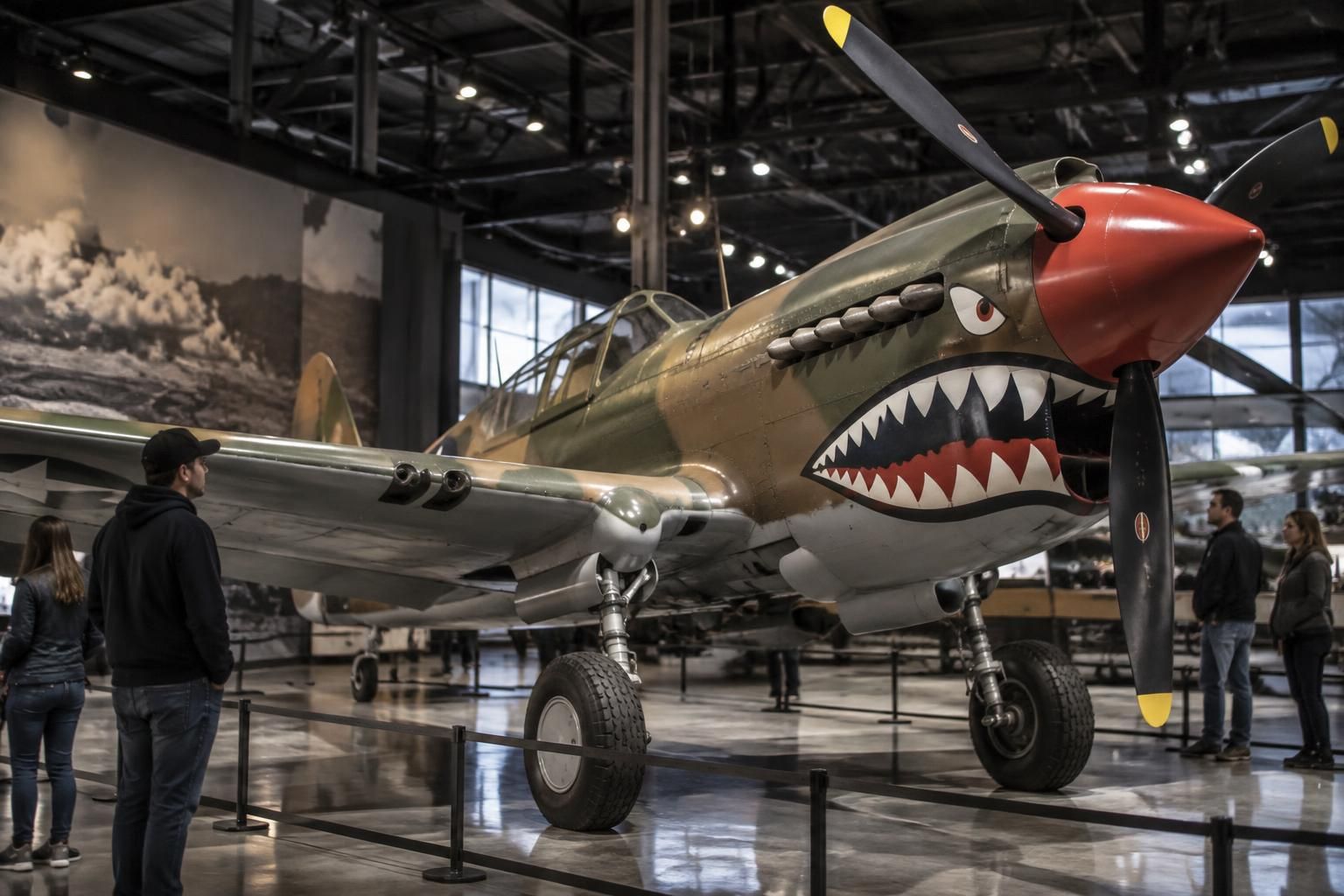
The P-40 provides a particularly strong visual starting point through its shark-mouth artwork. In the reporting supplied for the announcement, museum director Chris Henry identifies the decoration and Flying Tigers emblem as important elements in explaining the aircraft to visitors.
The shark-mouth motif and the Flying Tigers emblem are separate visual elements. The group’s emblem was developed by Disney artists, while the recognizable teeth painted around the nose served a different graphic purpose. Distinguishing them makes the interpretation more precise.
Connecting the P-40 Warhawk with Flying Tigers history
The Flying Tigers, formally the American Volunteer Group, supported China against Japan during the Second World War. Their organization took shape before the United States entered the conflict, while their combat operations began afterward—a chronology worth preserving in a short museum explanation.
It is equally important to distinguish representation from provenance. Flying Tigers markings do not, by themselves, establish that this particular airframe served with the group. Claims about an individual machine’s operational history should follow its documented record, not assumptions drawn from its paint scheme.
The Wisconsin connection gives the display a more personal dimension. Fritz Wolf, from Shawano, was a Flying Tigers pilot, allowing guides to connect an international wartime story with a person whose background is geographically familiar to many visitors.
According to the supplied local reporting, a Second World War Jeep is positioned in front of the P-40 within the Hometown Heroes presentation. That pairing helps suggest an airfield environment and opens discussion about the people and ground equipment required to support flying operations.
The Frasca connection adds another layer. Henry describes the loan as meaningful because of the family’s relationship with the museum, showing how preservation depends not only on technical restoration but also on owners willing to make significant objects publicly accessible.
Comparing the FM-2 Wildcat and PBY-5A Catalina by mission
The FM-2 belongs to the Wildcat family, although this variant was manufactured by General Motors’ Eastern Aircraft division rather than Grumman. Explaining that distinction briefly helps visitors understand why historical aircraft names sometimes combine a familiar design lineage with a different manufacturer.
Its naval context offers a clear comparison with the Catalina. A carrier fighter and an amphibious patrol aircraft faced different requirements involving endurance, operating surfaces, equipment, and crew duties; their forms become easier to understand when those requirements are explained first.
The PBY-5A’s amphibious configuration is especially useful for non-specialist audiences because it connects visible form with function. Its boat-like hull and landing gear provide a direct starting point for explaining how an aircraft can operate from both water and land.
The Catalina is on loan from the American Heritage Museum, while the two fighters come from the Frasca Collection. Further context is available in this account of the expanded displays and participating collections.
Mission-led interpretation turns three impressive machines into a clearer understanding of wartime aviation’s different demands.
Planning an EAA Aviation Museum visit around the expanded displays
The six additions create a useful opportunity to refresh a visit, but successful planning begins with current practical information. Confirm opening hours, admission arrangements, accessibility provisions, and aircraft availability directly with the museum before publishing an itinerary or organizing a group.
Loaned objects can be subject to changing arrangements, and exhibition coverage is not a guarantee that every item will remain available indefinitely. For professional organizers, the EAA’s official news releases provide a stronger reference point than an undated third-party itinerary.
Visits associated with EAA AirVenture deserve a separate operational check. Do not assume that museum access, event admission, transportation, or scheduled activities follow identical arrangements; establish the relevant conditions for the dates and group involved.
Building a manageable route through the new aircraft
For Maya’s hypothetical school group, a thematic route would work better than six equally long technical talks. She could begin with experimentation, move to long-distance logistics, and then compare military missions, adjusting the order to the actual gallery layout.
A family group may need a different approach: one observation question at each stop, with optional detail for visitors who want it. Organizers comparing destinations can use Grupem’s guide to aviation museums as a starting point, then verify individual venues’ current services.
- ✅ Choose a learning objective: focus on design, people, or operating environments rather than collecting disconnected facts.
- 🎧 Test listening conditions: check speech clarity in the actual gallery before relying on audio delivery.
- ♿ Offer equivalent information: pair spoken interpretation with readable text and a route that considers different access needs.
- 📍 Use visible reference points: direct attention to a hull, wing, emblem, or structural feature before explaining it.
- 📅 Recheck visit details: confirm arrangements close to departure, especially when coordinating with a major event.
Using smartphone audio without distracting from the aircraft display
Aviation galleries can present difficult listening conditions because large rooms, reflective surfaces, and simultaneous conversations may reduce speech intelligibility. Increasing volume is not always the best answer; shorter explanations, appropriate positioning, and a suitable listening system may be more effective.
A smartphone-based guiding tool such as Grupem can be considered within that operational assessment. Its relevance should be judged against the actual visit: participant devices, connectivity requirements, accessibility needs, staff confidence, and the time available for setup.
Before deployment, run a small test with the same route and an ordinary visitor device. Check whether instructions are understandable, whether visitors can begin listening without repeated assistance, and whether attention remains on the exhibits rather than the screen.
Content design matters just as much as delivery. A P-40 stop might explain the difference between nose art and documented service history, while a Catalina stop could connect the visible hull to amphibious operation; each recording should answer one clear question.
Provide a non-audio alternative and avoid assuming that every visitor owns compatible equipment. A successful digital layer makes the aircraft easier to understand without becoming another obstacle between the visitor and the object.
Which six aircraft are joining the EAA Aviation Museum displays?
The additions are Douglas World Cruiser and Epps Monoplane replicas, John Moody’s Icarus II, a Curtiss P-40 Warhawk, an FM-2 Wildcat, and a PBY-5A Catalina.
Are all six aircraft original historic airframes?
No. The Douglas World Cruiser and Epps Monoplane are identified as replicas. Interpretation should distinguish these reconstructions from the other aircraft and explain each exhibit’s documented background.
Who is lending the military aircraft?
The P-40 Warhawk and FM-2 Wildcat are on loan from the Frasca Collection. The PBY-5A Catalina is on loan from the American Heritage Museum.
Does the P-40’s Flying Tigers paint scheme prove wartime service with the unit?
No. Markings can represent a historical unit without establishing an individual airframe’s service history. Consult the museum’s documented provenance for claims about this particular aircraft.
What should visitors confirm before traveling to Oshkosh?
Check current opening hours, admission, accessibility arrangements, and exhibit availability directly with the museum. If visiting during EAA AirVenture, verify museum access and event arrangements separately.
