
Community Voices Rise Against Meta AI Data Center Plans in Northeast El Paso
⚠️ The dispute around Meta’s AI Data Center in El Paso is not limited to a construction project. It has become a local discussion about water security, neighborhood comfort, public oversight, and what residents should receive in return when major digital infrastructure arrives near their homes.
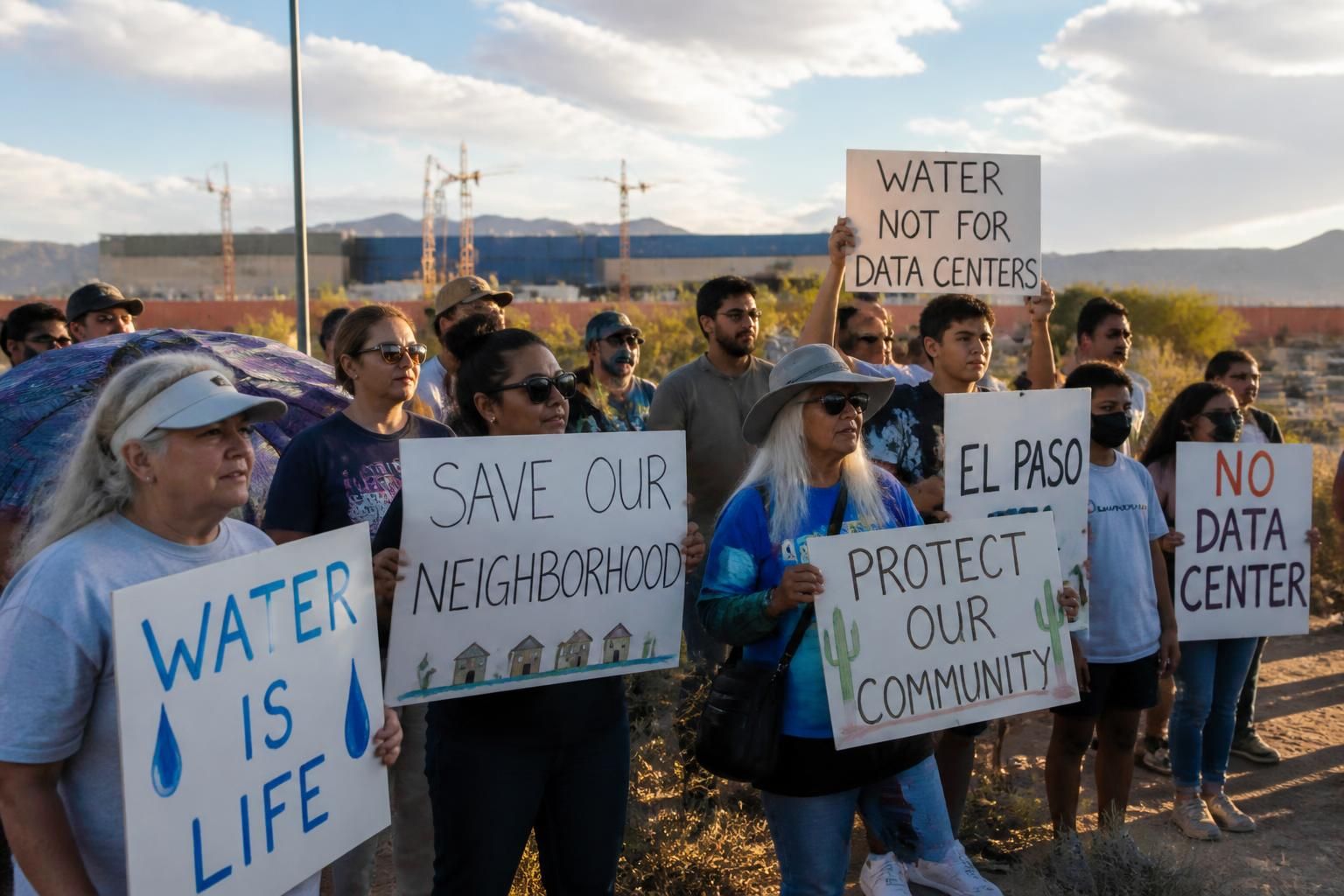
On a Saturday gathering in Northeast El Paso, residents assembled close to the site of Meta’s hyperscale campus to express concerns about its long-term footprint. The demonstration was organized by Desert Guardians and Sembrando Esperanza 915, two groups seeking clearer answers from decision-makers and stronger safeguards for nearby households.
For many participants, the project represents a difficult imbalance. Meta has described the campus as an investment exceeding $10 billion, with more than 300 permanent roles and thousands of construction jobs expected during development. Those figures matter to a growing city. Yet Neighbors living closest to the site are asking whether employment promises can offset changes they say are already affecting daily life.
Residents have cited heavy vehicle circulation, dust on local streets, intense nighttime lighting, construction noise, and fears about future air and heat effects. One local homeowner described water trucks using residential routes, while another stated that relocation had become a serious consideration. These are not abstract planning concerns: they relate directly to sleep, outdoor use, property confidence, and the feeling of safety inside a familiar neighborhood.
The visibility of this Opposition is significant because data centers were once treated as largely invisible infrastructure. Unlike a factory with a recognizable product, an AI facility can appear as a sealed complex with few public-facing functions. It processes information remotely, but its physical demands are highly local: land, electrical capacity, backup systems, water, roads, and construction labor all affect the host Community.
Public scrutiny is growing well beyond Texas. An overview of communities challenging AI data center projects shows that local resistance has emerged across the United States, frequently bringing together residents with different political views. Their concerns vary by location, but the recurring themes are familiar: water availability, utility costs, land use, tax incentives, and limited community input before approvals are granted.
El Paso adds a particularly sensitive context. The city sits in an arid region where water is not simply an operational resource; it is a central condition for household stability, agriculture, public health, and future development. When residents hear that a large industrial-scale campus will require substantial volumes of water, the question becomes practical: how will that demand interact with drought planning and existing public needs?
Why local experience matters before the facility opens
Infrastructure reviews often focus on final operating targets, projected economic value, and regulatory permits. That approach can overlook what happens during construction. Trucks create traffic patterns. Temporary lighting changes the night environment. Dust can accumulate near homes and schools. Large sites may run equipment around the clock to maintain project timelines.
A useful way to understand the concern is to consider a fictional nearby resident, Maria, who works early shifts and walks her dog after sunset. A brighter construction zone, unfamiliar heavy traffic, and persistent dust do not need to trigger a formal environmental violation to change her routine. For Maria, the Impact is immediate because it changes how she uses the neighborhood every day.
That is why community meetings should not be reduced to a procedural checkbox. They can surface details that technical reports miss: which streets children use, where night lighting enters bedroom windows, when construction traffic overlaps with school drop-off times, and how residents currently experience heat and water restrictions. Listening early is not a delay tactic; it is a practical method for preventing avoidable harm.
The central point is clear: digital infrastructure may serve global AI services, but its consequences are felt first by the people living beside it. The next issue, therefore, is whether the project’s water commitments are measurable enough for a desert city.
Meta AI Data Center Water Use Raises High-Stakes Concerns for El Paso
💧 Water is the issue that gives the El Paso debate its urgency. According to figures cited by El Paso Water, the Meta facility is expected to use roughly 480,000 gallons per day on average, with a potential ceiling of 2.5 million gallons on the hottest days. Those two figures should be read together, not selectively.
An average helps planners estimate routine demand. A maximum matters because extreme heat is precisely when regional water systems and households may face their greatest pressure. In a desert climate, peak consumption is not a theoretical footnote. It is the operational moment that can test the resilience of a utility network.
Meta has said it will restore twice the quantity of water used by the site to local watersheds and that it is working with El Paso Water to reduce impacts. Such commitments are important, but residents are right to ask how restoration is calculated, where it occurs, when benefits materialize, and whether restored water is comparable to the water withdrawn from the local system.
Water restoration can include leak reduction, conservation programs, watershed projects, infrastructure upgrades, or support for agricultural efficiency. These measures may offer real environmental value. However, they are not automatically identical to providing potable water at the same time and in the same place where demand occurs. The distinction needs to be transparent, particularly when public confidence is already strained.
| Topic | Reported or proposed position | Why Community Voices seek detail |
|---|---|---|
| 💧 Typical water demand | Approximately 480,000 gallons per day | Residents want to understand the baseline effect on a constrained regional supply. |
| 🌡️ Peak-day cap | Up to 2.5 million gallons on the hottest days | Maximum demand may coincide with high household and municipal demand. |
| ♻️ Restoration commitment | Meta says it will restore twice its water use | Methods, timing, geography, and independent verification all affect credibility. |
| ⚡ Energy matching | Meta says electricity use will be matched with clean energy | Neighbors need clarity on local grid capacity and possible rate effects. |
Cooling design also deserves careful explanation. Data centers generate heat continuously because servers, networking hardware, and electrical equipment operate at high density. Depending on the architecture, cooling may use air systems, evaporative methods, chilled water loops, or hybrid approaches. Each choice has different effects on water use, electricity use, noise, and resilience during heat waves.
There is no single “green” cooling formula that works everywhere. A water-saving system may require additional electricity. An air-cooled design may reduce direct water demand but increase energy consumption during hot periods. The responsible approach is to publish site-specific information, including anticipated seasonal use, the cooling configuration, efficiency targets, and contingency plans for unusually hot or dry conditions.
Questions that should be answered in public, not buried in technical filings
Residents do not need to be engineering specialists to seek usable information. They need a clear reporting process that converts technical data into understandable indicators. Monthly totals, peak-use explanations, conservation milestones, and third-party audit results should be available in plain language.
- 💧 What cooling system will operate during normal summer conditions and during heat emergencies?
- 📊 Will water consumption figures be published monthly, including peak-day withdrawals?
- 🏜️ Which local watersheds will benefit from restoration projects, and on what timetable?
- 🔎 Who will independently verify that the restoration target has been achieved?
- 🚰 What protections apply if regional drought restrictions become more severe?
These questions are not anti-technology. They are a request for accountable technology. A data-driven company should be able to share data that helps the public evaluate its local footprint. This is particularly relevant in 2026, as large AI facilities are increasing in scale and public agencies are being asked to balance industrial growth with resource resilience.
For museums, visitor centers, and cultural venues adopting smart tools, the lesson is equally useful. Technology choices should be adapted to local capacity, not deployed on the assumption that infrastructure is limitless. This examination of another AI center proposal illustrates why site-specific questions matter more than broad sustainability messaging.
Water accountability becomes credible only when the public can see the numbers, the method, and the local outcome. Yet water is only one part of the lived experience around a hyperscale campus.
Neighbors Express Concerns About Light, Dust, Noise, and Everyday Livability
🏘️ A data center’s footprint is measured not only by gallons and megawatts, but also by the quality of life around its perimeter. During the Northeast El Paso protest, residents raised concerns about visible construction lighting, dust from water-truck traffic, noise, heat pollution, and possible air-quality effects. These issues require separate mitigation plans rather than a single general promise of environmental responsibility.
Light pollution is often underestimated because it appears less severe than water scarcity. For a household near an active building site, however, bright nighttime lighting can affect sleep, privacy, and the ability to enjoy outdoor space. It can also change the visual character of a neighborhood that previously experienced darker desert skies.
Practical measures are available. Construction lighting can be shielded and angled downward. Timers and motion controls can reduce unnecessary illumination. Site plans can identify sensitive residential edges and establish brightness limits measured at property boundaries. These details should be confirmed before complaints accumulate, not only after residents have spent months adapting their lives to glare.
Noise has a similar pattern. During construction, common sources include engines, reversing alarms, earth-moving equipment, concrete work, and truck traffic. Once operational, generators, cooling systems, transformers, and maintenance activity can create persistent low-frequency sound. Low-frequency noise is especially important because it can travel farther and be harder to ignore indoors.
From complaints to measurable neighborhood protections
There is a major difference between saying that a company will “minimize disruption” and establishing measurable standards. A workable agreement could define construction hours, delivery routes, dust-control procedures, lighting restrictions, noise monitoring locations, complaint-response times, and escalation procedures. It should also identify the public office responsible for enforcing each requirement.
Consider another practical scenario. A parent named Daniel notices that trucks begin arriving before a nearby school’s morning traffic clears. Rather than filing a complaint with an unclear destination, Daniel should have access to a single contact point, a published response timetable, and a record showing whether route adjustments were made. This is basic service design: make the reporting path simple, visible, and trackable.
The same principle applies to air quality. Construction dust can be controlled through street cleaning, vehicle wheel-wash systems, covered loads, reduced idling, and regular site inspections. Future operational emissions depend partly on backup generator use, fuel storage, testing schedules, and local air regulations. Residents deserve details on when generators may be tested and how emissions will be monitored.
Heat is another legitimate concern in a city already familiar with high summer temperatures. Large paved surfaces, electrical equipment, and industrial buildings can contribute to localized heat effects. Design responses may include reflective roofing, shaded buffers, drought-appropriate landscaping, reduced heat-retaining surfaces, and facility layouts that limit warm air discharge toward homes.
Community participation can sharpen these measures. Residents know which sidewalks are used after school, where dust collects after wind events, and when noise is most disruptive. Their knowledge does not replace expert assessment, but it improves it. The most effective planning combines engineering evidence with direct local observation.
Reporting on local challenges to Big Tech data centers has highlighted how noise and electricity costs can become flashpoints when residents believe that infrastructure decisions have been made without meaningful dialogue. El Paso’s case demonstrates why early, open engagement is less expensive than repairing trust later.
A neighborhood is not an empty buffer around a technical asset; it is a living environment with routines that deserve protection. Those protections must also include a credible account of economic and energy consequences.
Economic Benefits and Electricity Demand Need Transparent Community Oversight
⚡ Meta’s projected economic contribution is substantial, but large numbers do not remove the need for public scrutiny. The company says the El Paso campus will support thousands of construction jobs and more than 300 permanent positions. Construction employment can create immediate opportunities for contractors, tradespeople, food providers, transportation firms, and local suppliers.
Permanent roles may include facilities operations, security, electrical maintenance, network support, logistics, and engineering. These are valuable jobs, especially if recruitment, training, and contracting pathways genuinely include local residents. Yet the economic picture should be assessed with precision. A multi-billion-dollar facility can be capital-intensive while employing fewer long-term workers than a similarly priced manufacturing or mixed-use development.
That does not make the project inherently unhelpful. It means officials and residents should distinguish between temporary construction activity, direct full-time employment, indirect business opportunities, tax arrangements, and public infrastructure costs. An honest assessment is stronger than a promotional headline because it allows the Community to judge the actual trade-offs.
Electricity is central to this assessment. AI Data Center facilities can demand large and steady volumes of power, and their needs may grow as computing capacity expands. Meta has stated that its electricity use will be matched with clean energy. This can support renewable development, but residents still need answers about the local grid: which upgrades are necessary, who funds them, how reliability is maintained, and whether ratepayers face added pressure.
El Paso Electric and public agencies must communicate clearly about planning decisions connected to the campus. If new generation, transmission, substations, or gas capacity are considered, the public deserves a full explanation of alternatives, costs, emissions, timelines, and ownership. Grid planning should not be so technical that only specialists can follow it.
What a balanced public-benefit framework can include
A useful framework does not assume that every major project should be rejected. Instead, it defines what the developer, utility, and public authorities must provide in return for the land, energy, water, and social license they receive. The goal is not to obstruct innovation; it is to ensure that innovation creates durable local value.
- 🧰 Local workforce pathways: Publish apprenticeship targets, local hiring data, and partnerships with schools or workforce organizations.
- ⚡ Grid-cost clarity: Explain whether system upgrades are funded by the company, utilities, public programs, or customers.
- 🌱 Verified clean-energy planning: Show the source, timing, and additionality of renewable energy arrangements.
- 🏥 Community investment: Support water conservation, emergency preparedness, neighborhood facilities, or heat-resilience projects chosen through public consultation.
- 📢 Public reporting: Release regular performance updates in a format that residents can understand without specialist software.
Economic credibility also depends on the quality of public meetings. Notices should be accessible, held at convenient times, and available in languages used by the surrounding population. Technical documents need short summaries, maps, and clear definitions. This approach resembles good visitor experience design in cultural institutions: information becomes meaningful when people can find it, understand it, and use it.
For organizations introducing digital tools in public-facing spaces, this is a relevant principle. Whether deploying an audio-guide system or a major computing campus, success depends on user trust. People engage with technology when they understand its purpose, its constraints, and the choices available to them.
Jobs and clean-energy commitments matter most when they are paired with enforceable local benefits and transparent utility planning. The final practical question is how residents can remain involved as the project moves from construction toward operation.
How Community Voices Can Shape Meta AI Data Center Accountability
📣 Community participation is most effective when it is organized, specific, and sustained. The El Paso gathering led by Desert Guardians and Sembrando Esperanza 915 gave residents a visible forum for concerns they believe have not been fully addressed. Public demonstrations can draw attention, but their long-term value increases when they connect to documented requests, hearings, monitoring, and regular communication with agencies.
Residents can begin by separating immediate construction issues from long-term operational questions. A dust complaint, for example, may require a fast response from a contractor or municipal inspector. Water accounting, electricity planning, and restoration commitments require a longer oversight process involving utilities, regulators, and independent technical review.
Documentation strengthens both forms of engagement. Residents can record dates, times, locations, photos, and descriptions of traffic, lighting, dust, or noise. A shared log is more useful than isolated complaints because it can reveal a pattern. It also gives local leaders a clearer basis for determining whether mitigation requirements are being met.
Public-facing reporting should work in the other direction too. Meta, El Paso Water, El Paso Electric, and city agencies can reduce conflict by publishing a shared project dashboard. It could provide construction milestones, approved truck routes, contact details, complaint statistics, water data, environmental commitments, and meeting schedules. A dashboard is not a substitute for accountability, but it can make accountability easier to observe.
Building a practical process that residents can use
Local Voices are most likely to influence outcomes when requests are precise. “Protect our neighborhood” is a valid demand, but it becomes more actionable when paired with defined measures: install light shielding by a specific date, publish water figures monthly, monitor noise at agreed locations, or hold quarterly public meetings with named representatives.
The wider national context suggests that this approach is becoming increasingly important. Research into why communities are pushing back against data centers points to the way local concerns can converge around environmental resources, energy affordability, and a sense that decisions are moving faster than public understanding. That pattern explains why early consultation must be treated as core infrastructure, not public relations.
For community institutions such as museums, tourism offices, and cultural organizers, there is a useful parallel. Digital projects work better when audiences are included in the design process. Accessible information, clear audio, multilingual support, and simple feedback channels reduce friction. The same user-centered thinking can improve public engagement around industrial infrastructure.
A resident advisory group could include homeowners, renters, school representatives, small-business owners, water specialists, youth representatives, and neighborhood associations. Its role should be practical rather than ceremonial. Members could review performance reports, identify recurring impacts, recommend mitigation priorities, and publish meeting notes for the wider public.
It is equally important to avoid turning the debate into a false choice between technology and community welfare. El Paso can support digital investment while insisting on resource protections. The relevant question is not whether AI infrastructure exists, but whether it is planned and managed in a way that respects a water-limited city and the people who live next door.
Residents should also watch for the difference between voluntary commitments and binding obligations. A company pledge can signal intent. A permit condition, community benefits agreement, public reporting schedule, or independently audited target creates a clearer standard for follow-through. Promises build attention; enforceable measures build trust.
The most durable outcome is a process in which Neighbors can see what was promised, verify what has happened, and obtain a timely response when reality falls short. That is how Community Voices can continue to shape the Impact of a major Meta AI Data Center long after construction banners disappear.
How much water could Meta’s El Paso AI Data Center use?
Figures cited by El Paso Water indicate average use of about 480,000 gallons per day, with a possible maximum of 2.5 million gallons on the hottest days. Residents are seeking public reporting on both routine and peak consumption.
What benefits has Meta announced for the El Paso project?
Meta has described the campus as an investment of more than $10 billion. The company says it will create more than 300 permanent jobs and support thousands of construction jobs while matching its electricity use with clean energy.
Why are nearby residents concerned about the data center?
Concerns raised include water demand, rising utility costs, construction traffic, dust, nighttime lighting, noise, air quality, heat effects, and the possibility that local commitments may not be fully enforceable.
What does water restoration mean in this context?
Meta says it will restore twice the water used by the facility to local watersheds. Residents and public agencies should assess the specific projects, timing, location, verification method, and whether the restoration meaningfully supports local water resilience.
How can residents monitor the project’s local impact?
Residents can document recurring issues, participate in public meetings, request accessible water and energy reporting, ask for third-party monitoring, and support a resident advisory process with published follow-up actions.
