
Battelle’s $1 Million Donation Expands the Columbus Museum of Art’s Learning Fund
Battelle’s $1 million donation to the Columbus Museum of Art will support student programs, educator partnerships, and new approaches to learning. According to the museum’s October 6, 2026 announcement, the investment strengthens its Fund for Learning, extending a relationship that began in 1977.
The contribution follows Battelle’s $1.2 million investment in 2023, which established the fund. These are separate commitments: the latest gift builds on the earlier initiative rather than replacing it or revising its original value.
That distinction matters for school leaders and cultural organizations assessing the announcement. Together, the two reported commitments represent $2.2 million for the Fund for Learning, but they do not establish an annual funding level, a permanent endowment, or a published allocation for individual activities.
How the Battelle gift supports student programs and teachers
The museum identifies three practical priorities: expanding K–12 opportunities, developing relationships with schools and youth organizations, and testing educational offerings. Its announcement of the new Fund for Learning investment connects these priorities with creative thinking and civic participation.
For a teacher, those ambitions become useful when they translate into manageable experiences. Consider Ms. Carter, a fictional middle-school educator planning a visit: she needs an appropriate learning objective, clear booking information, preparation materials, and an activity that continues after students return to class.
Funding can help an institution build that complete learning pathway rather than offer an isolated gallery encounter. The announcement, however, should not be read as confirmation that every participating school will receive transportation, equipment, or a specific package of services.
| Milestone | Reported commitment | Relevance for education |
|---|---|---|
| 🏛️ 1977 partnership begins | Battelle’s first museum contribution | Established a long-running relationship supporting institutional development. |
| 📚 2023 Fund for Learning launch | $1.2 million | Created the initiative’s initial funding foundation. |
| 🎨 2026 additional investment | $1 million | Supports expanded K–12 work, partnerships, and educational experimentation. |
Why sustained philanthropy matters for museum education
Educational partnerships require time that a single visit cannot provide. Staff must coordinate schedules, understand classroom priorities, develop resources, and adjust activities after observing how different groups respond.
Repeat support can make that iterative work more feasible. A pilot discussion activity, for example, may reveal that students need simpler prompts or more time to examine an artwork before speaking; revising it requires paid preparation, not simply enthusiasm.
The museum’s 2023 explanation of the original investment provides the historical context for the current expansion. Reading both announcements helps distinguish the initiative’s founding purpose from its next stage.
The latest gift was announced October 2 at the museum’s annual Art Celebration, where Battelle received recognition for its educational support. That public recognition is part of the relationship, but the operational question remains what staff and partners can deliver consistently.
For other institutions, the useful lesson is not simply to seek a large donor. It is to define an educational purpose that supporters can understand, then demonstrate how ongoing investment improves delivery.
Effective philanthropy funds the work between visits as well as the experience inside the galleries. The next question is how that investment shapes what students actually practice.
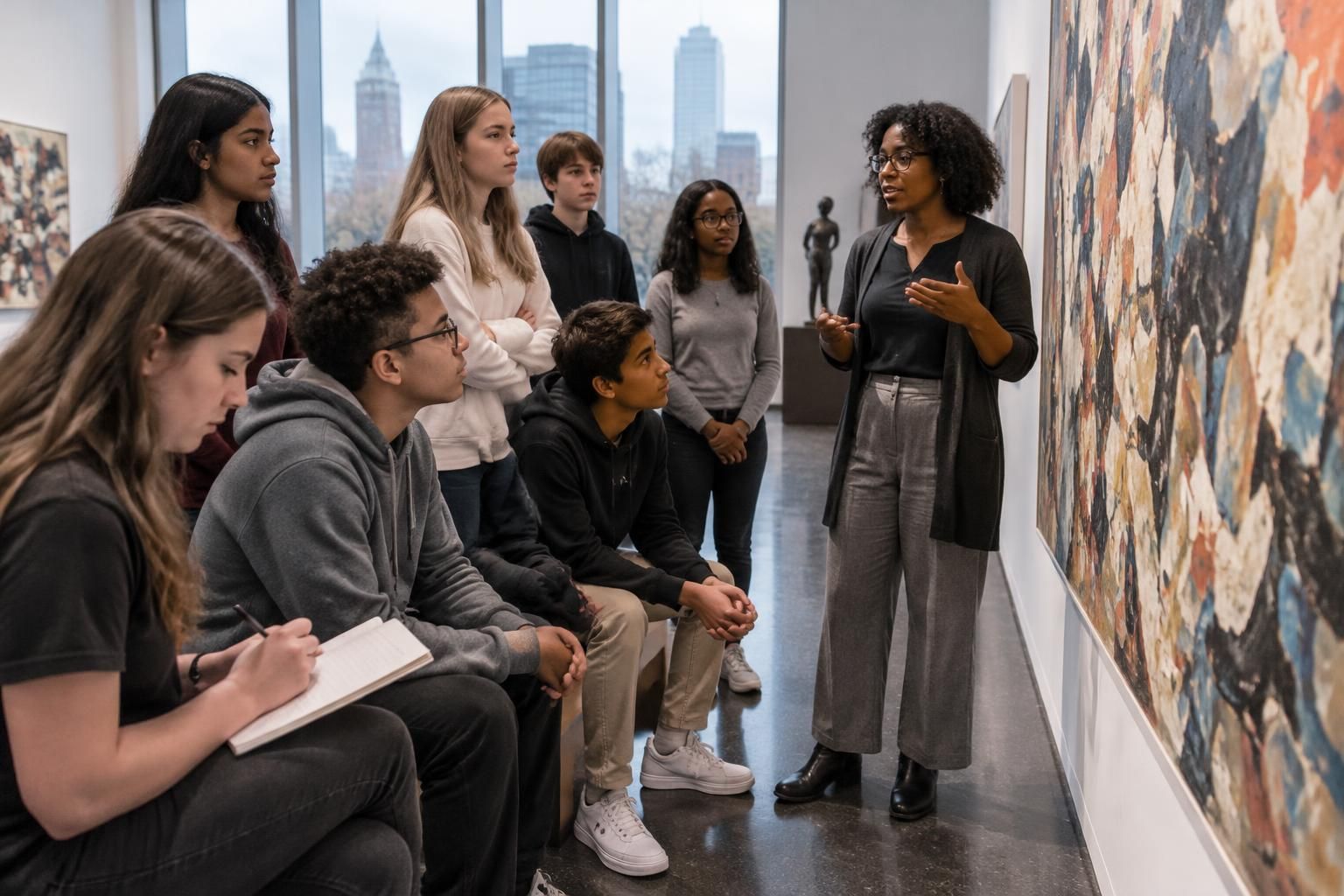
Strengthening Arts Education Through Creative and Civic Learning
A central element of the supported work is Cultivating Creative & Civic Capacities, known as C4. The Columbus Museum of Art developed the framework with researchers from Project Zero at the Harvard Graduate School of Education, with support from Battelle and the Martha Holden Jennings Foundation.
Its purpose connects creative thinking with participation in civic life. That relationship gives arts education a practical dimension: looking carefully, considering alternative interpretations, and explaining a judgment are useful in both a gallery discussion and a classroom debate.
These abilities should not be confused with memorizing an approved interpretation. An artwork can support several defensible readings, provided students explain what they notice and how that evidence informs their response.
Turning the C4 framework into purposeful student engagement
Imagine Ms. Carter’s class encountering a painting of a public gathering. Rather than starting with a lecture about its meaning, an educator could ask students to observe silently, identify a detail, and describe what that detail suggests.
One learner might notice who occupies the center; another might focus on figures at the edge. Comparing those observations opens a discussion about perspective without requiring either participant to possess specialist vocabulary.
This is an illustrative teaching sequence, not a published C4 lesson plan. Its value lies in showing how a museum can make reasoning visible while keeping the artwork—not a worksheet or device—at the center of attention.
- 🔎 Begin with observation: ask learners to identify something visible before proposing a meaning.
- 💬 Request supporting evidence: invite them to explain which feature influenced their interpretation.
- 🔄 Make room for revision: allow an answer to change after another person contributes a useful detail.
- 🤝 Connect discussion to participation: explore how listening and disagreement affect a shared decision.
Each step serves a different purpose. Observation slows premature judgment, evidence makes thinking discussable, revision normalizes learning, and shared reflection connects individual interpretation with group responsibility.
Supporting teachers beyond a single gallery visit
Professional learning becomes stronger when educators experience an activity before adapting it. A workshop might ask teachers to compare two interpretations themselves, then examine which prompts encouraged participation and which unintentionally narrowed the conversation.
Back in school, Ms. Carter could use a similar sequence with a historical photograph or a piece of student writing. Transfer matters because the benefit of a visit should not depend entirely on remembering the names of the works displayed.
The museum reports that, since the fund’s initial investment, it has reached more than 120,000 young people, trained more than 1,300 teachers, and shared resources with more than 30,000 educators nationally. Those figures describe different forms of reach and should remain separate.
Resource distribution, for instance, does not establish that every recipient used a lesson. Likewise, participation in training does not by itself demonstrate a measurable change in classroom practice.
A useful follow-up would ask teachers which activity they reused, what they modified, and whether students could explain their reasoning more clearly. That produces actionable feedback without turning every encounter into a formal examination.
The educational value of creative learning becomes clearer when students can show how their thinking develops. Ensuring that a wider range of learners can participate is the next operational challenge.
Expanding Arts Access Beyond Free Admission
The museum connects the new support with its expansion of free admission for visitors aged 25 and younger. Removing an admission charge addresses an important barrier, particularly for families and young adults who might otherwise postpone a cultural visit.
Yet arts access involves more than the price at the door. A school may still face transportation costs, substitute-teacher arrangements, permission requirements, accessibility planning, and limited time within an already crowded timetable.
For that reason, community support is most effective when it addresses the complete visitor journey. Clear information before arrival can matter as much as an engaging activity once a class reaches the gallery.
Helping school groups turn eligibility into participation
For Ms. Carter, a free-admission policy does not automatically answer whether a facilitated session requires advance booking or whether other charges apply. Schools should confirm the current terms directly, including group procedures, chaperone arrangements, and any separately priced activities.
A practical booking page should distinguish general entry from educational services. It should also explain arrival points, expected visit length, available facilities, and whom to contact when a learner requires an accommodation.
These details reduce administrative friction. When information is scattered across several pages or email exchanges, the schools with the least staff capacity can be the first to abandon a visit.
Partnerships with youth organizations can create additional routes into the museum. An after-school provider, for example, may reach participants who cannot attend a conventional field trip, although transport and supervision still require explicit planning.
Designing museum education for different participation needs
Accessibility should include physical, sensory, linguistic, and social considerations. A participant may need a quieter route, a place to sit, readable instructions, or an alternative to answering aloud in front of classmates.
Offering more than one response format can improve participation without lowering expectations. A student might sketch an observation, discuss it with a partner, or dictate a response before contributing to the wider group.
Predictability also helps. Sharing a simple schedule and explaining when discussion, movement, and independent looking will occur allows teachers to prepare students who find unfamiliar environments demanding.
Professionals examining these questions across institutions can explore Grupem’s coverage of the reopening of a Holocaust museum as a separate cultural-sector reading topic. The operational lesson here is to assess access in relation to the audience and setting, rather than assume one format suits every institution.
Columbus has a longer educational history to draw on. Battelle supported an interactive exhibition for children and families in the 1990s, helping shape the institution’s approach to learning in its galleries.
Other initiatives include Wonder School, created with Columbus State Community College and The Childhood League Center, and the JPMorgan Chase Center for Creativity. These examples show that educational participation can extend beyond a standard school-tour model.
For managers, a useful access review follows one hypothetical learner from the first invitation to the return journey. Every unanswered question—about cost, transport, language, sensory conditions, or supervision—identifies a possible point of exclusion.
Free entry opens an opportunity; practical access determines who can use it. Digital tools can support that journey, provided they remove friction rather than introduce another requirement.
Using Audio Technology to Support Student Programs Without Distracting From Art
Audio technology can support museum education when it solves a defined listening or communication problem. It should not be presented as an announced use of Battelle’s gift: the supplied funding information does not identify a particular audio platform or equipment purchase.
For institutions considering their own implementation, the starting point is simple. Can everyone hear the educator comfortably, understand the instructions, and remain attentive to the artwork?
A device is useful only if it improves those conditions. An elaborate digital experience that consumes the first fifteen minutes of a school visit with installation and troubleshooting can undermine the learning it was intended to support.
Choosing audio delivery around the school group’s needs
Live voice transmission and prerecorded interpretation serve different purposes. The first helps a group follow an educator; the second offers reusable explanations that visitors can access at an appropriate moment.
For a discussion-led school visit, an educator’s voice must not displace student contributions. Any listening arrangement should allow participants to hear classmates and understand when to pause the audio and join the conversation.
Grupem, a mobile application designed to turn smartphones into professional audio guides for guided visits, is one option institutions can assess within that wider category. Its suitability should be tested against actual requirements, including setup time, device availability, accessibility, and on-site conditions.
No platform should be described as part of the Columbus Museum of Art’s funded initiative without a separate announcement. Keeping that distinction clear protects both editorial accuracy and procurement decisions.
Testing digital interpretation before a full school rollout
Suppose Ms. Carter’s group includes students without personal phones and others whose devices have low batteries. A smartphone-based plan needs a workable alternative, such as shared equipment or an equivalent device-free activity.
Staff should also test signal coverage and sound levels along the intended route. Conditions in a quiet entrance area may differ from those near a busy public gallery or a school-group gathering point.
Content requires similar discipline. A short spoken prompt asking learners to inspect one visual detail can support close looking; several uninterrupted minutes of narration may compete with it.
Text alternatives are important for anyone who cannot or prefers not to use audio. Instructions should remain readable, and visual-description content should be developed thoughtfully rather than treated as a generic recording of wall labels.
Privacy deserves attention whenever minors use a digital service. Institutions should review account requirements, permissions, and data practices, avoiding unnecessary collection of student information and following applicable school and organizational policies.
A small pilot can reveal whether the system genuinely helps. Ask a teacher how long setup took, an educator whether discussion remained natural, and students whether they knew what to do without repeated assistance.
Technical success is not the same as educational success. Clear sound matters, but so do participation, comfort, and the amount of time learners spend engaging with the collection.
For wider cultural-programming perspectives, Grupem’s coverage of a Bell Museum star-party event offers another topic to explore when considering how interpretation changes with the setting. A gallery discussion and a public evening event should not automatically use identical delivery methods.
The best audio setup makes listening easier while preserving attention for art and conversation. Evaluating that balance requires evidence that goes beyond equipment counts.
A technology pilot should be reviewed alongside the same learning and access objectives used for the wider visit. That keeps digital decisions connected to the purpose of the program.
Measuring the Community Value of Battelle’s Arts Education Support
The long relationship between Battelle and the Columbus Museum of Art gives the latest announcement a context larger than one fundraising event. The partnership began in 1977, making 2026 its forty-ninth year rather than an exact fiftieth anniversary.
According to the museum, that first contribution was its largest grant from a single source at the time. Subsequent support helped sustain an educational approach that values experimentation, including interactive experiences for children and families.
The institution also reports that more than 100 museums have visited its Center for Creativity over the past 20 years to learn about its approach. That indicates professional interest, although a study visit does not establish that another organization adopted the same practices or achieved equivalent results.
Separating program reach from educational outcomes
Public reporting should distinguish attendance, participation, professional development, and learning. Each answers a different question, and none can replace all the others.
Attendance shows who came through the door. Participation records can show which activities people joined, while teacher feedback can reveal whether resources were practical enough to use again.
Learning requires closer attention to what changed. A short example of student reasoning before and after a discussion may be more informative than a satisfaction score alone, particularly when the objective involves interpretation or perspective-taking.
For Ms. Carter’s class, an educator might compare two brief responses to the same artwork. The useful evidence would be whether students add relevant observations, acknowledge another perspective, or explain a revised interpretation—not whether everyone reaches the same answer.
This approach should remain proportionate. Collecting extensive data during every encounter can burden staff and interrupt the experience, so a carefully selected sample may provide better insight than a lengthy compulsory survey.
Making community support accountable and useful
A practical evaluation plan can organize evidence around four questions: who participated, what they experienced, what they learned, and what prevented others from attending. The answers should guide the next round of planning.
If teachers value an activity but struggle to schedule it, the response may involve booking changes rather than new content. If students attend but rarely contribute, educators may need different prompts, smaller discussion groups, or more varied response options.
Financial reporting adds another layer. Partners should be able to understand the supported categories of work without assuming that the public donation figure represents the entire operating budget for education.
Organizations should also distinguish direct delivery costs from the preparation that makes delivery reliable. Curriculum development, staff training, coordination, accessibility work, and evaluation are substantive educational functions, not incidental extras.
Supporter recognition can communicate why those functions matter. A clear example of a teacher reusing an activity explains the value of sustained funding more effectively than a broad claim that every visit transforms a life.
Long-term partnership also creates room to report adjustments honestly. An experimental format that requires revision can still produce useful knowledge if the institution explains what it learned and how the next version will improve.
The most actionable reporting cycle links evidence to a specific decision: revise a prompt, simplify booking, strengthen an accommodation, or expand a successful partnership. That makes accountability a management tool rather than a retrospective publicity exercise.
The clearest measure of community support is whether evidence leads to better learning opportunities. For the Fund for Learning, that means keeping student experience, educator usefulness, and practical access visible alongside participation totals.
What will Battelle’s $1 million donation support?
The gift supports the Columbus Museum of Art’s Fund for Learning, including expanded K–12 programming, partnerships with schools and youth organizations, and testing new educational offerings. The announcement does not provide a detailed public allocation for every activity.
How does the new gift relate to Battelle’s 2023 contribution?
Battelle contributed $1.2 million in 2023 to establish the Fund for Learning. The additional $1 million announced in October 2026 represents a separate commitment, bringing those two reported investments to $2.2 million.
What is the museum’s C4 learning framework?
Cultivating Creative & Civic Capacities, or C4, is a framework developed with researchers from Project Zero at the Harvard Graduate School of Education. It connects creative thinking with capacities relevant to civic participation and received support from Battelle and the Martha Holden Jennings Foundation.
Does free admission mean every school activity is free?
Free admission for visitors aged 25 and younger concerns entry. Schools should confirm current group-booking requirements, facilitated-program charges, chaperone arrangements, and any separately priced activities directly with the museum.
Is audio technology included in the announced funding?
The supplied announcement does not identify an audio platform, smartphone application, or equipment purchase. Audio tools are an operational option for institutions to evaluate, not a confirmed component of this gift.
