
⏱️ Little time? Here is what matters:
- ✅ Artificial Intelligence can widen participation when communities influence design, data, language, and governance from the start.
- 🎧 Voice interfaces, translation, and accessible audio can improve Digital Accessibility for visitors, learners, and local residents.
- ⚠️ Scale alone is not inclusion: shallow generated content, biased datasets, and extractive use of culture can reproduce older exclusions.
- 🌍 The most credible AI Innovation begins with real feedback from people affected by the service, not assumptions made inside a product team.
AI Amplification Is Moving Beyond the Closed Circles of Earlier Tech Surges
Previous Tech Surges often emerged from relatively narrow professional networks. The early internet, personal computing, and many platform-era products were shaped primarily by engineers, investors, and colleagues who shared similar workplaces, social backgrounds, and technical assumptions. That concentration did not make the resulting technologies useless, but it limited the questions that were asked during design. Who has reliable access? Which languages are missing? What happens when a family, a teacher, a visitor with hearing loss, or a rural community uses the tool in a real-world setting?
Artificial Intelligence is developing in a more connected environment. Smartphones, remote work, messaging platforms, and accessible creation tools mean that technology is now present in homes, schools, libraries, museums, community centers, and guided tours. This proximity changes the feedback loop. A founder may observe how children reject a repetitive AI game after a few days. A museum educator may explain why a generic chatbot answer harms Cultural Representation. A tour guide may identify that an automated translation is technically correct but misses the historical nuance of a place.
That shift matters because lived experience is becoming product evidence. It does not mean every AI company is inclusive by default. Many still operate under intense work cultures that exclude caregivers, community contributors, and people with limited time or access. Yet the distance between product teams and everyday users is smaller than it was during earlier waves of innovation. More people can test, criticize, adapt, and publicly compare AI services before those services become deeply embedded in daily life.
Consider a fictional cultural organization called Harbour City Heritage. It manages guided walks, a small maritime museum, and seasonal events. In a previous technology cycle, it might have bought an expensive digital system designed by a remote supplier, then asked visitors to adapt to it. With today’s tools, staff can pilot an audio guide on visitors’ own phones, collect comments from families and multilingual groups, and adjust routes within days. The technology becomes more responsive because the people using it shape the service continuously.
This is where the idea of Amplification becomes practical. Amplification is not simply giving a larger audience to material already produced by institutions. It means reducing the effort required for people to contribute knowledge, correct inaccuracies, preserve local language, or request a different format. A resident can record a short oral-history clip. A guide can add a contextual stop to explain a neighborhood’s migration history. A student can ask for simpler wording without being treated as an exception.
For tourism and cultural mediation, the implications are direct. A visitor rarely experiences a destination through a single official narrative. They notice the soundscape, the language spoken on the street, the accessibility of public spaces, and whose memories are absent from plaques and brochures. AI-supported audio, translation, and content tools can help institutions reflect that complexity, provided they do not flatten it into generic output.
Researchers and practitioners examining AI as a tool for inclusion emphasize that access alone is not enough. A service may be technically available yet still fail users if it assumes high literacy, a dominant accent, unlimited data, or confidence with digital interfaces. The useful question is not “Can AI reach more people?” It is “Who can meaningfully influence what AI says, hears, recommends, and remembers?”
The strongest signal of progress is therefore not the number of automated features. It is the quality of the feedback relationship between a service and the communities around it. When real users can change the system’s direction, AI moves from mass production toward meaningful participation.
Diverse Voices Improve AI Products When Feedback Becomes a Design Requirement
Diverse Voices should not enter an AI project only at the communication stage, when a company needs testimonials or imagery for a launch campaign. Their value is greatest much earlier: when teams identify the problem, decide what data is appropriate, define acceptable outputs, and establish how errors will be corrected. This is particularly important in services that deal with education, travel, health, public information, voice, and culture.
Families offer one useful example. Product teams often assume younger users will be impressed by any interactive interface. In reality, children can be highly selective. They quickly detect when an AI toy repeats the same patterns, offers no meaningful story, or treats their input as a prompt rather than a contribution. Their engagement may be intense for a few days and then disappear. For investors and creators, that pattern is more revealing than a demonstration that performs well in a controlled setting.
Feedback from parents also changes the definition of quality. A family may value an AI activity that supports shared play, allows different ages to participate, and avoids turning every moment into isolated screen time. This is why products built around collaborative storytelling or game creation can be more durable than products designed only to maximize individual attention. The decision is not anti-technology; it is about making technology fit social life rather than displace it.
Education provides another strong example. Teachers have often encountered AI tools after major decisions were already made by districts, vendors, or central administration. Some educators have reported using personal connections or mobile hotspots to explore conversational tools because formal access was restricted. Their concern is rarely a blanket rejection of Innovation. More commonly, they want safeguards, clear learning objectives, student privacy, and a practical way to supervise use in a classroom.
A three-year-old education startup, Flint, built momentum after listening closely to former high-school teachers who felt excluded from the direction of AI in schools. Its founders did not treat school visits as a symbolic consultation. They used teachers’ feedback to refine workflows, attend education conferences, and understand the gap between a polished AI demonstration and the daily reality of lesson planning. That distinction is essential: an educator needs a tool that works with diverse learning levels, time constraints, assessment requirements, and safeguarding duties.
From Consultation to Shared Decision-Making in Artificial Intelligence
Harbour City Heritage can apply the same lesson. Before launching an AI guide, it can invite local historians, disability advocates, youth groups, and guides to test a small route. The goal is not to ask, “Do you like it?” That question generates vague approval. More productive prompts include: “Which story feels incomplete?” “Where did the audio become difficult to follow?” “What wording could alienate a resident?” “What would help a non-native speaker understand this stop?”
| Design moment | Who should contribute | Practical question | Expected benefit |
|---|---|---|---|
| 🧭 Route planning | Guides, residents, mobility advocates | Which paths create physical or sensory barriers? | ♿ More accessible visitor journeys |
| 🎙️ Voice content | Local speakers, historians, multilingual users | Which pronunciation and context must be preserved? | 🌍 Stronger Cultural Representation |
| 📚 Learning tools | Teachers, students, caregivers | What supports learning rather than distraction? | 🎓 More credible educational use |
| 🔎 Evaluation | All pilot participants | Where did the tool fail or confuse people? | ✅ Faster, evidence-based improvement |
This approach also creates employment and reinvention opportunities. As organizations redesign services around responsible AI, they need facilitators, content editors, accessibility reviewers, local researchers, language specialists, audio producers, and trainers. People affected by technology cutbacks may bring exactly the human expertise that automated systems lack. The future of work is not improved by pretending AI eliminates the need for judgment; it is improved when organizations recognize new forms of contribution.
Useful listening needs structure. Record feedback, separate recurring issues from isolated preferences, explain which changes were made, and tell contributors when a request cannot be implemented. Otherwise, participation becomes performative. Inclusion is credible when people can trace a visible line between their input and a better product decision.
Digital Accessibility Makes AI Amplification Useful in Tourism, Culture, and Public Services
Digital Accessibility is often discussed as a compliance requirement, but it is also a practical route to better experiences for everyone. In tourism, visitors may be navigating an unfamiliar city, dealing with noise, limited battery life, different language skills, visual impairments, or temporary mobility constraints. A service that assumes perfect hearing, fast reading, stable connectivity, and local cultural knowledge excludes people long before they reach a museum entrance or tour meeting point.
AI can reduce some of these barriers when used carefully. Speech-to-text can provide live captions for a guide’s explanation. Text simplification can offer a clearer version of complex historical content. Translation can support multilingual groups. Personalized route suggestions can help visitors avoid steep streets or identify quiet spaces. Smart audio systems can improve listening without forcing every participant to stand close to a speaker in a crowded location.
However, accessibility cannot be left to Machine Learning alone. Automatic captions can confuse names, dates, dialects, and local place references. Translation can turn a cultural concept into a literal phrase that loses its meaning. Voice recognition may struggle with accents or speech patterns that were poorly represented in training data. A system that produces an answer quickly is not necessarily a system that communicates fairly.
For this reason, organizations should combine automation with editorial controls. Harbour City Heritage could create a core script approved by historians and community contributors, then use AI to generate shorter summaries, multilingual versions, and question-and-answer support. Every high-risk element—sacred sites, contested history, memorial spaces, safety instructions, or minority language material—should have a human review process. This approach is slower than publishing raw output, but it is far more reliable.
How Smart Audio Supports Inclusive Visitor Experiences
Audio deserves special attention because voice is personal. It communicates mood, identity, authority, and belonging. A synthetic voice may be useful for rapid translation or low-cost prototyping, yet it should not automatically replace local narrators. Visitors often respond to the authenticity of a guide, artist, resident, or curator explaining why a place matters. Blending professionally recorded human voices with AI-assisted delivery can protect that emotional connection while improving operational flexibility.
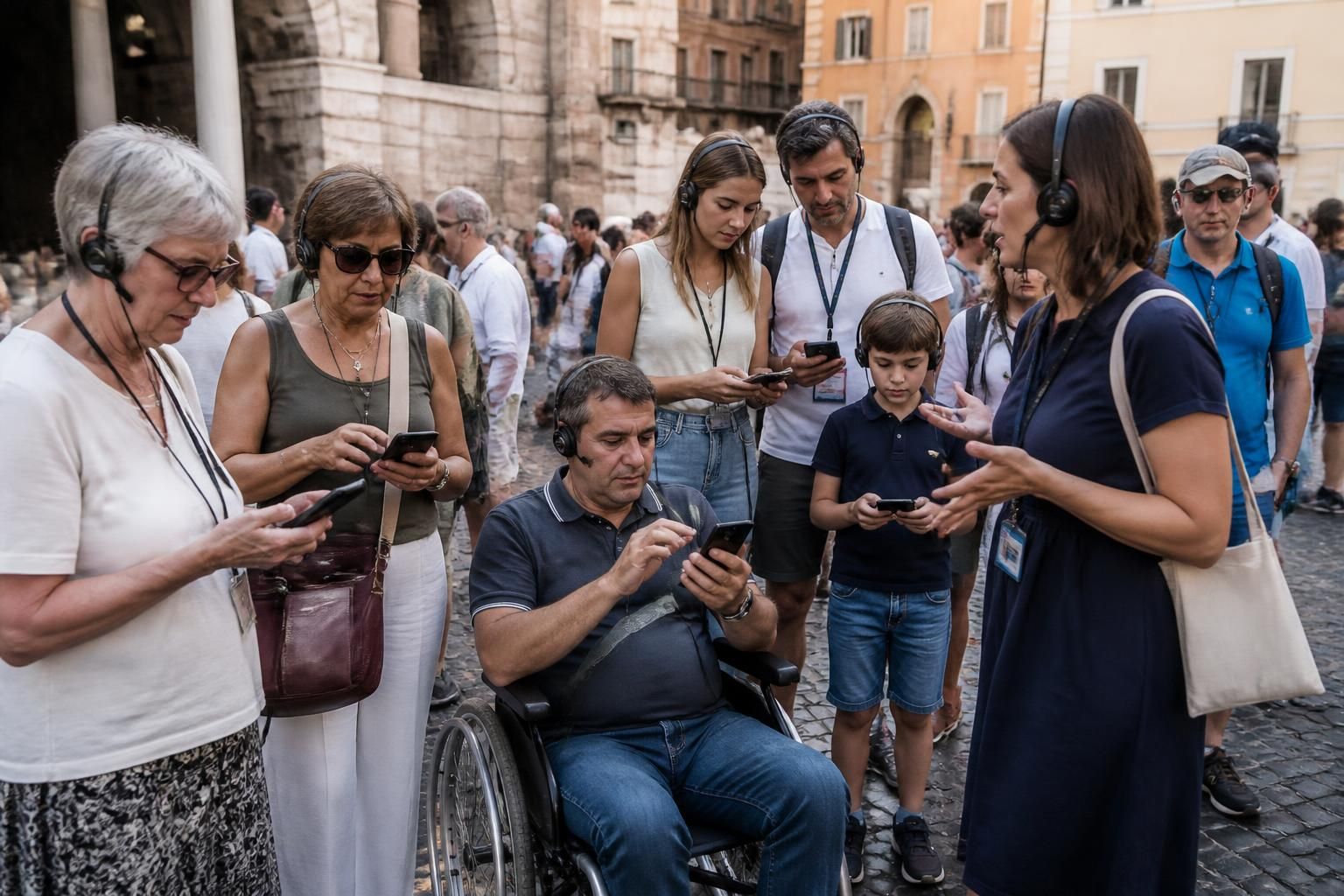
A smartphone-based platform is particularly effective when it avoids unnecessary equipment. Participants already know how to adjust their own device volume, connect headphones, or read a transcript. Guides can speak naturally while attendees listen clearly from a distance. That makes tours easier to manage in busy streets, galleries with sound limits, or sites where a large group would otherwise block the route.
Accessibility also requires simple operational choices:
- 🎧 Provide transcripts and readable text alongside every important audio segment.
- 🌐 Offer human-reviewed translations for core visitor information, not only automated summaries.
- 📱 Test the experience on older smartphones and limited mobile connections.
- 🧑🦽 Include route information about steps, surfaces, seating, toilets, and quiet areas before the visit begins.
- 🔊 Let visitors control speed, volume, replay, and language without needing staff assistance.
These measures support disabled visitors, but they also help families with sleeping children, travelers in loud environments, people with temporary injuries, and learners who need more time. This is the broader value of inclusive design: it avoids treating accessibility as a niche feature for a small audience.
Organizations planning voice-led services can learn from developments in compact voice AI technology, while remaining clear about where a human voice is essential. The decision should depend on context. A real person may be vital for testimony and local memory, while a synthetic voice may be appropriate for neutral interface instructions or instant navigation prompts.
Accessible AI is not defined by how many features it offers; it is defined by whether people can understand, control, and trust the experience under real conditions.
Cultural Representation Requires More Than AI-Generated Content at Scale
Cultural Representation is one of the clearest areas where AI can either expand access or deepen existing distortions. Generative systems can help small museums, guides, archives, and associations create summaries, draft translations, organize metadata, and make collections easier to search. These are valuable capabilities, especially for organizations with limited time and staffing. Yet cultural content is not simply information waiting to be reformatted. It contains memory, conflict, ownership, language, and sometimes pain.
When an AI tool produces generic narratives, it can give the illusion of completeness while omitting the people who made a place what it is. A historic district may be described through architecture and famous leaders but ignore labor, migration, women’s history, disability history, or communities displaced by redevelopment. The output may sound polished because it relies on familiar language patterns. That is precisely why it needs scrutiny.
The humanities provide a useful warning: an archive is never neutral. What was collected, catalogued, digitized, and translated reflects prior decisions about whose voice counted. AI systems trained on uneven material can repeat those choices at speed. Work examining marginalized voices in AI and the humanities highlights the importance of treating technology as a critical mediation layer rather than an objective narrator.
Harbour City Heritage faces this issue when creating an AI-assisted waterfront tour. Its archive contains shipowners’ records, newspapers, photographs, and official plans. It has much less material from dock workers, migrant families, and women who ran businesses around the port. If the organization asks a model to create a history from the available records, the resulting story may reinforce the archive’s imbalance. The solution is not to ban AI. It is to identify the gaps before automation turns them into a public narrative.
Building a Responsible Content Workflow for Diverse Voices
A workable process starts by separating factual verification from narrative generation. First, identify approved sources and record what is unknown. Second, invite community members or researchers with direct knowledge to contribute context. Third, use AI for controlled tasks such as tagging images, drafting alternate reading levels, or creating a first outline. Fourth, have an editor validate every claim and ensure that wording matches the voice and consent of contributors.
Consent is especially important for audio. A recorded voice is not just data. It can reveal identity, location, age, emotion, and community affiliation. Organizations should agree in advance how recordings may be edited, translated, reused, or used to train a system. A contributor who permits an interview for a local tour has not necessarily approved synthetic imitation or commercial reuse. Clear terms protect both people and institutions.
Voice diversity also affects how audiences feel represented. A visitor listening to a guide in their first language may experience a site with greater confidence and depth. A local speaker using a regional accent can preserve the character of a place. At the same time, organizations should avoid tokenism: adding one clip from a community does not compensate for a route that ignores its role in the city’s history.
For practical inspiration, the discussion on voice diversity and technology is useful because it frames voice as part of social identity, not merely an interface setting. This matters for every audio product. The selection of narrator, pronunciation standard, language option, and transcription format all communicate whose presence is expected.
Content teams should also label AI assistance transparently where it affects the visitor experience. A short note explaining that translations or summaries were AI-assisted and human-reviewed is more helpful than pretending all material was created in the same way. Transparency creates a route for correction. It also encourages audiences to notice the difference between verified testimony, interpretation, and automated formatting.
The responsible use of AI in culture begins with a simple discipline: do not allow a fluent output to substitute for a community’s own account of itself.
Social Impact Depends on Governance, Measurement, and Community Control
Social Impact is often claimed when an AI service reaches a large audience, lowers a production cost, or generates impressive engagement figures. Those measures can be useful, but they do not prove that the service has improved inclusion. A multilingual chatbot that misunderstands users, a voice assistant that fails with regional accents, or a recommendation system that repeatedly favors dominant cultural venues may have high usage while reinforcing unequal access.
Responsible governance begins by defining what success looks like for the people served. For Harbour City Heritage, success may include whether visitors with hearing impairments can complete a tour independently, whether local contributors feel accurately represented, whether guides retain control over their expertise, and whether participants from different language groups stay engaged through the final stop. These indicators are more meaningful than download numbers alone.
Data governance is equally important. AI systems need information to improve, but organizations must not collect everything simply because they can. A tourism app may be tempted to store precise location trails, voice recordings, device details, language settings, and behavioral patterns. Most of this is unnecessary for delivering a basic guided experience. Data minimization reduces risk and demonstrates respect for visitors.
Practical Controls for Inclusive AI Innovation
Before deployment, a team should document the purpose of each automated function. If the tool recommends a route, explain which factors it considers. If it translates an answer, clarify whether the text was reviewed. If it records feedback, state how long the file is kept and who can access it. These are operational details, not legal decoration. They influence whether people feel safe enough to participate.
- 🧪 Run a limited pilot: test with a small group that includes people with different languages, ages, access needs, and familiarity with smartphones.
- 📝 Measure completion and comprehension: ask whether participants understood the information, not only whether they enjoyed the interface.
- 🔍 Audit harmful patterns: review incorrect translations, missing voices, biased recommendations, and failures in speech recognition.
- 🤝 Create an escalation route: give staff and users a clear way to report issues and receive a response.
- 🔄 Review regularly: models, datasets, and local contexts change, so a one-time assessment is not enough.
Governance also needs representation at leadership level. Community consultation is helpful, but major choices about procurement, datasets, partnerships, and acceptable risk should not be made solely by people with similar backgrounds. The argument that diverse leaders must participate in AI growth and regulation applies directly to local institutions as well as global companies. A museum board, destination office, or event organizer can make more informed decisions when it includes people who understand the communities affected.
There is also a workforce dimension. AI may automate narrow tasks, but it increases the need for people who can validate information, build trust, guide adoption, train staff, and manage exceptions. Organizations should invest in these skills instead of treating technology as a shortcut around human capacity. A well-run pilot includes time for staff preparation, content review, accessibility testing, and user support.
For teams evaluating speech and scheduling solutions, examples such as voice AI scheduling workflows show why implementation details matter. The interface must be understandable, the handoff to a person must remain possible, and the automated function must solve a specific problem. Broad claims about transformation do not replace service design.
AI can bring Diverse Voices into wider circulation, but only if organizations protect the right to be heard, corrected, and respected. The lasting value of AI Innovation is not automation for its own sake; it is a more accountable relationship between technology, communities, and the stories they choose to share.
How can AI amplify diverse voices without speaking for communities?
Use AI for support tasks such as transcription, translation, search, accessibility formats, and content organization, while allowing community members to approve narratives, correct errors, and control how their voices are reused.
What is the first accessibility feature a guided-tour provider should add?
Start with clear smartphone audio, a written transcript, adjustable volume, and simple replay controls. These features are practical for many visitors and create a solid foundation for wider digital accessibility.
Why is human review still necessary for AI cultural content?
Machine Learning can produce fluent text while missing context, repeating archive bias, mistranslating local terms, or presenting disputed history as fact. Human reviewers provide factual validation and cultural accountability.
How should organizations measure inclusive AI social impact?
Track whether different user groups can complete tasks, understand content, report fewer barriers, and see their experiences represented accurately. Combine these findings with qualitative feedback rather than relying only on usage or download figures.
