
The Forgotten Fossil Fish That Changed a Coelacanth Family Tree
A fossil stored at London’s Natural History Museum has been identified as Macropoma gombessae, a newly recognized species of coelacanth. The discovery concerns an ancient skull from the Lower Cretaceous Gault Formation, not a recently collected animal or a fish preserved alive in storage.
The distinction matters because the story combines two very different timelines: the geological age of the remains and the period they spent in a collection. An object can be more than 100 million years old while its scientific significance remains unrecognized for only a few generations.
What “150 years in a museum drawer” actually means
Accounts of the discovery describe the specimen as having remained in the collection for approximately 150 years. Reports that date its acquisition to 1885 imply about 141 years by 2026, so the headline should be understood as a rounded description rather than a precise storage duration.
Likewise, “forgotten” is an engaging shorthand, not proof that nobody ever catalogued, handled, or examined the object. A museum specimen may have an accession record and an established identification while still containing anatomical evidence that earlier researchers could not recognize or investigate.
The Natural History Museum’s account of the rediscovered coelacanth provides an institutional starting point for understanding the finding. It connects the historical collection to work involving Jack L. Norton, a former University of Portsmouth palaeontology student, and the identification of the new species.
Why an old identification can change
Taxonomy is not simply the act of attaching a permanent name to an object. It is a testable interpretation based on the features available for comparison, the quality of preservation, and the scientific understanding of related organisms.
For a fossil fish, important evidence can include the shape and arrangement of skull bones, the paths of sensory canals, and relationships between internal structures. Some characteristics are difficult to distinguish when bones overlap, remain partly embedded in rock, or have been flattened during burial.
A revised identification therefore does not automatically mean that an earlier curator made a careless mistake. It can reflect the arrival of better imaging, a larger comparative dataset, or a research question that nobody had previously asked of that particular object.
The reported significance of Macropoma gombessae is that it represents the oldest known member of its genus and helps clarify a poorly documented part of coelacanth evolutionary history. Its value comes from the combination of age, anatomy, and position in the family tree—not simply from its long stay in a cabinet.
Turning the discovery into a clear visitor experience
Consider a hypothetical museum educator, Maya, preparing a short gallery stop about the find. Rather than beginning with “scientists found a missing link,” she places three dates on separate cards: when the animal lived, when the object entered the collection, and when its identity was reassessed.
Visitors can then understand the central surprise without confusing the timelines. The discovery happened through a new interpretation of existing material, demonstrating that collecting and discovering are related activities but are not always the same event.
A useful display would pair the historic catalogue description with the revised species identification and explain what evidence changed. The drawer did not preserve a finished answer; it preserved material that a later generation could ask better questions of.
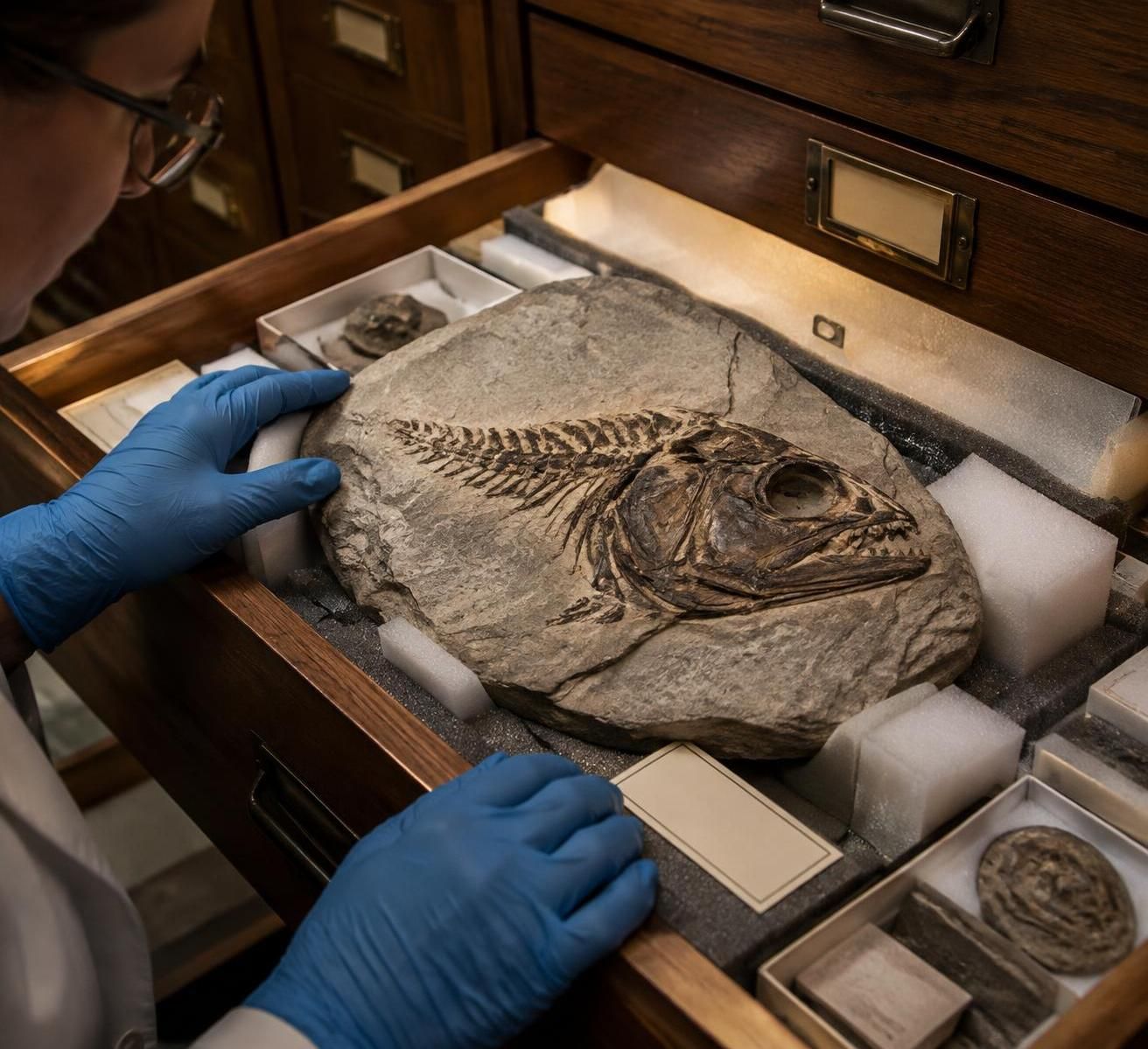
How X-Ray Imaging Revealed the Ancient Fish Without Cutting It Apart
The technological turning point in this fossil discovery was the ability to inspect structures hidden beneath the surface. X-ray computed tomography, commonly called CT scanning, allows researchers to investigate internal anatomy without physically cutting through the object.
That capability is especially important for rare historical material. Removing surrounding rock may expose useful details, but preparation can also damage delicate bones or destroy relationships that another researcher would later want to examine.
From X-ray measurements to a digital reconstruction
A CT scanner records X-ray measurements from multiple angles. Software uses those measurements to calculate a sequence of cross-sectional images, which can then be assembled into a three-dimensional representation of the scanned object.
The process is not equivalent to taking a photograph through stone. Different materials interact with X-rays differently, and the usefulness of the resulting images depends on contrast between the fossilized tissue, surrounding sediment, and any minerals introduced during preservation.
Researchers interpret these images through a process called segmentation, separating structures of interest from surrounding material. A reconstructed bone can then be rotated, inspected from an otherwise inaccessible angle, and compared with corresponding anatomy in another species.
For an ancient fish skull, this can reveal relationships that a surface photograph cannot show. A feature partly covered by another bone may become visible digitally, while internal spaces can be examined without opening the original object.
What scanning can establish—and what it cannot
Digital access improves observation, but it does not turn every irregularity into a meaningful biological characteristic. Cracks, compression, incomplete preservation, and reconstruction choices must be distinguished from anatomy before a feature can support a species identification.
Scientific research therefore combines imaging with comparative expertise. A striking three-dimensional model is useful only when its interpretation can be traced back to the underlying evidence and assessed against other specimens.
The Discover report on the newly identified coelacanth offers a public-facing account of the finding. For exhibition development, such coverage is useful for identifying the audience’s likely questions, while the study published in Papers in Palaeontology remains the appropriate source for technical claims.
- 🔍 Inspect hidden anatomy: use internal images to investigate structures that are obscured in ordinary photographs.
- 🦴 Protect the original: favor non-destructive examination when physical preparation could remove valuable evidence.
- 💻 Support comparison: rotate and examine digital models alongside documented examples from related animals.
- 📚 Keep interpretations traceable: retain links between reconstructed features, scan data, and published descriptions.
Showing the process rather than only the polished model
In Maya’s hypothetical gallery, an animation begins with a photograph of the stone, moves through several scan slices, and finishes with a simplified skull reconstruction. Each stage answers a different question: what was preserved, what the scanner recorded, and what researchers interpreted.
The distinction prevents visitors from treating a digital model as an untouched view of the original animal. Color coding can separate preserved bones from missing areas, while an accessible caption explains that bright display colors are visual aids rather than original biological coloration.
A museum should also preserve scan metadata and document any processing used to create public-facing models. Otherwise, an attractive interpretation can become detached from the measurements that made it scientifically useful.
The real innovation is not simply seeing inside a fossil; it is making that new view inspectable, explainable, and reusable. That is what allows a technological result to contribute meaningfully to evolutionary interpretation.
What the 50-Million-Year Evolutionary Mystery Really Means
The phrase “fills a 50-million-year gap” describes a problem in reconstructing relationships across deep time. It does not mean that one skull provides a continuous record of every generation that lived during that interval.
A fossil can narrow an evolutionary mystery by documenting a previously missing combination of age and anatomical features. Researchers then use that evidence to test where an animal belongs relative to other known members of its lineage.
A gap in evidence is not a gap in existence
The fossil record is uneven because preservation requires particular circumstances. An animal must leave remains that survive decay, burial, chemical change, geological disturbance, exposure, collection, and eventual recognition.
Even when a lineage persisted for millions of years, its known record may contain long intervals without identified specimens. Such absences can reflect the environments in which animals lived, the rocks available for study, or the difficulty of recognizing fragmentary remains.
The new coelacanth helps address a reported gap of roughly 50 million years in the documented history of the relevant family-tree relationships. Describing it as a “missing link” can be convenient, but that phrase should not imply that researchers have established a direct ancestor-to-descendant chain.
Evolutionary trees usually describe branching relationships. A newly identified species may share informative characteristics with later relatives without being their direct ancestor, just as two cousins can reveal something about a family without one descending from the other.
Why the Eocene epoch belongs on the timeline, not on the fossil label
The Eocene epoch lasted approximately 56 to 34 million years ago. It occurred substantially later than the Lower Cretaceous rocks associated with Macropoma gombessae, so this discovery should not be described as an Eocene fossil.
This distinction is particularly useful when visitors hear both “50-million-year mystery” and “ancient fish” in the same explanation. The first phrase concerns the scale of an evidential gap; it does not establish the specimen’s geological age.
A layered timeline can separate the age of the object, the interval discussed in evolutionary analysis, and later geological periods. That simple design choice prevents numerical language from creating an inaccurate impression.
| Timeline reference | What it describes | What it does not establish |
|---|---|---|
| 🦴 Lower Cretaceous | The geological setting of the reported fossil | An Eocene age for the specimen |
| 🧬 Roughly 50 million years | The reported scale of a gap in evolutionary evidence | A complete sequence of direct ancestors |
| 🌍 Eocene epoch | A later interval, approximately 56–34 million years ago | The age of this Cretaceous skull |
| 🗄️ Approximately 150 years | A rounded description of the specimen’s collection history | The biological age of the animal |
How one specimen can change a wider interpretation
Imagine a family tree built from several animals whose anatomical similarities suggest a relationship, but whose known ages leave a substantial interval poorly represented. Adding an older, informative member can change how researchers evaluate the timing and distribution of particular traits.
This is where the discovery contributes to understanding prehistoric biodiversity. It adds a named form and a documented set of characteristics to a record that was previously less complete, giving future comparisons a stronger evidential foundation.
Maya’s display could demonstrate this with two simplified branching diagrams: one representing the earlier evidence and another including the newly recognized animal. The revised diagram should highlight the additional data point rather than draw an unsupported straight line to living species.
The finding strengthens a historical reconstruction; it does not eliminate every unknown within it. Explaining that distinction makes the scientific achievement more credible, not less impressive.
Why Coelacanths Are More Than Unchanged “Living Fossils”
Coelacanths are widely associated with the expression “living fossil”, partly because living representatives were recognized after the group had been considered extinct. The label is memorable, but it can suggest a misleading picture of an animal untouched by evolutionary change.
A lineage can retain recognizable aspects of its body plan while its members change in anatomy, genetics, distribution, and ecology. The newly identified Cretaceous species is valuable partly because it helps investigate that variation rather than treating all coelacanths as interchangeable.
The 1938 discovery that changed public expectations
In 1938, a living coelacanth caught off South Africa came to the attention of museum curator Marjorie Courtenay-Latimer. Its subsequent scientific recognition overturned the assumption that the group had disappeared long before modern times.
That episode remains a powerful example of how observation can challenge an established interpretation. It also shows why natural history depends on networks connecting fishers, collectors, curators, and specialist researchers rather than on isolated scientific insight.
Living coelacanths are classified in the genus Latimeria, whereas the rediscovered fossil belongs to Macropoma. Their relationship is an evolutionary question, not evidence that the skull represents exactly the same animal swimming in modern seas.
Two living species are recognized: the African coelacanth, Latimeria chalumnae, and the Indonesian coelacanth, Latimeria menadoensis. This distinction helps visitors understand that the familiar name covers biological diversity even among surviving representatives.
Recognizable anatomy does not mean evolutionary inactivity
Coelacanths are lobe-finned fishes, a broader group that also includes lungfishes and the lineage leading to tetrapods. Their fleshy, internally supported fins are relevant to evolutionary comparison, but living coelacanths should not be presented as animals on the verge of becoming land vertebrates.
Their survival is not a ladder toward a supposedly more advanced form. They are organisms adapted to their own circumstances, with evolutionary histories that continued long after their lineages separated from those of other vertebrates.
Calling an animal unchanged can also conceal the limits of the available evidence. Similar-looking skeletal features do not establish that behavior, physiology, or genetic composition remained identical over tens of millions of years.
The historical significance of the fossil fish therefore lies in examining specific traits and relationships. Claims about complete biological stasis are much broader than a skull can demonstrate.
Explaining the name without dismissing local knowledge
The species name gombessae refers to “gombessa,” a regional name associated with coelacanths in the western Indian Ocean. Popular accounts translate the term as “inedible” or “worthless fish,” but those translations need cultural context.
A name reflecting limited food value does not establish that coastal communities lacked knowledge of the animal. It may instead express a practical relationship with a fish that was unsuitable or undesirable for a particular use.
For a museum audience, the responsible approach is to distinguish local recognition from formal scientific classification. The 1938 episode was a rediscovery for international zoology, not necessarily the first time any person had encountered or understood such a fish.
Maya could make that distinction through two adjacent audio passages: one explaining the taxonomic history and another discussing how regional names encode everyday experience. Any commissioned cultural contribution should be attributed and used with appropriate permission.
The most accurate coelacanth story combines survival, change, and different ways of knowing the natural world. It is richer than the claim that an unchanged prehistoric creature simply reappeared.
How Museums Can Turn the Coelacanth Discovery into Accessible Digital Interpretation
A rediscovered skull offers museums more than a compelling headline. It provides a practical opportunity to explain how collections, imaging, and paleontology work together—and why material outside the public galleries continues to support new knowledge.
Effective interpretation should let visitors distinguish the object, the evidence, and the explanation. Digital tools are useful when they make those distinctions easier to understand, not when they add effects without improving comprehension.
Build a short, layered audio experience
For the hypothetical exhibition, Maya prepares a core audio stop covering three points: the specimen was already in a collection, scanning revealed additional anatomy, and comparison supported a revised identification. A separate optional track explores geological time and the meaning of the reported evolutionary gap.
This layered approach respects different levels of interest. A visitor accompanying children can hear the essential explanation, while someone interested in research methods can choose a more detailed account without slowing everyone else down.
The script should define unfamiliar terms when they first appear. “Computed tomography” can be introduced as X-ray imaging that produces a series of internal slices, while “genus” can be explained as one level used to group closely related species.
Grupem can be considered as a smartphone-based audio option within that wider interpretation plan. Its relevance is practical: supporting an audio experience without making the device or application the central subject of the visit.
Make access requirements part of the initial design
Audio alone is not sufficient for every visitor. Provide an equivalent transcript, readable labels, and descriptions of visual information that would otherwise remain inaccessible to someone who cannot inspect a screen or display.
For a rotating skull model, the narration should explain what a visitor is meant to notice rather than merely saying “look here.” For example, it can identify the position of a highlighted bone and describe why that relationship matters to the comparison.
The discussion of AI-supported access in museums is relevant to planning complementary tools such as language support and alternative content formats. Any automated output still requires review, particularly for scientific names, geological dates, and culturally sensitive terminology.
Accessibility also includes practical conditions: screen contrast, seating near longer stops, easy volume control, and a route that does not require every visitor to own a recent smartphone. An alternative listening or reading option should remain available.
Keep scientific claims reviewable as the research develops
Before publication, a curator or subject specialist should check the script against the institutional announcement and research paper. The review should separate established observations from simplified analogies, especially where phrases such as “missing link” or “unchanged for millions of years” appear.
Content records should include the source, review date, and responsible editor. That makes it easier to revise a label or audio segment if a later study changes the interpretation without rewriting the entire visitor experience.
A useful testing session asks visitors to explain the story back in their own words. If several participants say the fossil is 150 years old or comes from the Eocene, the problem is not their attention: the interpretation needs clearer separation of its timelines.
The same approach applies when evaluating accessible digital mediation methods. Measure whether people can understand and use the content, rather than treating the presence of new technology as evidence of success.
A successful digital exhibit makes the reasoning behind the discovery easier to follow. The first practical step is to test one short audio passage, its transcript, and its accompanying visual explanation with visitors who have different access needs.
What is Macropoma gombessae?
Macropoma gombessae is a newly recognized coelacanth species identified from a historical fossil skull held at London’s Natural History Museum. The specimen comes from the Lower Cretaceous Gault Formation and has been reported as the oldest known member of its genus.
Did the fossil spend exactly 150 years in a museum drawer?
The 150-year description is approximate. Accounts that place its acquisition in 1885 imply about 141 years in the collection by 2026. Its geological age is entirely separate from the length of time it has been held by the museum.
Does the discovery completely solve a 50-million-year gap?
It adds important evidence to a poorly documented interval in coelacanth evolutionary relationships. One specimen does not provide a continuous record of that interval or prove a direct ancestor-to-descendant sequence.
Is this an Eocene fossil?
No. The reported specimen is from the Lower Cretaceous. The Eocene epoch occurred much later, approximately 56 to 34 million years ago, and should not be confused with the reported 50-million-year gap in evolutionary evidence.
How did researchers examine the skull without cutting it apart?
X-ray computed tomography produced internal cross-sectional images that could be assembled and interpreted digitally. This allowed researchers to investigate hidden anatomy while preserving the original object, although the resulting models still required careful scientific interpretation.
