
Tokyo Court Recognizes Voice Rights in Kenjiro Tsuda’s AI Voice-Cloning Dispute
The reported Tokyo court decision involving Kenjiro Tsuda establishes an important distinction: a performer’s recognizable voice can receive legal protection, even when the requested remedy is not granted. The actor associated with Kento Nanami in Jujutsu Kaisen challenged TikTok over recordings that he alleged reproduced his distinctive delivery through artificial intelligence.
According to the supplied reporting, the Tokyo District Court recognized that unauthorized commercial exploitation of a performer’s vocal identity can infringe publicity rights. However, it rejected the request requiring TikTok to remove the disputed material because the anonymous account holder had already deleted it.
That makes the headline a partial victory rather than a complete account of the outcome. Recognition of a protected interest and an order compelling platform action are separate legal questions, and understanding that separation is essential for anyone commissioning, publishing, or distributing synthetic narration.
Why the Jujutsu Kaisen voice actor’s claim matters beyond anime
Tsuda is known for roles including Nanami and Seto Kaiba in the Yu-Gi-Oh! franchise. His recognizable vocal identity has professional value because audiences associate its tone, rhythm, and delivery with particular performances and with the actor himself.
The reported reasoning compared a person’s voice with a portrait as an expression of personality. The relevant protection concerned using that identity for its commercial appeal, rather than establishing that every resemblance between two speakers automatically amounts to unlawful copying.
The Guardian’s account of the Tsuda dispute describes the contested recordings and the commercial argument advanced by his representatives. Reporting dated September 30, 2026, places the decision after the publication period alleged in the complaint, which ran from July 2024 to September 2025.
For readers outside Japan, the jurisdiction matters. A Japanese legal ruling should not be treated as a universal rule applying unchanged to every country, platform, or recording contract.
Separating the reported decision from broader assumptions
The case has been described in reporting as Japan’s first judicial recognition of this form of protection for vocal identity. That description signals its significance, but it does not mean the judgment resolves every question about consent, imitation, model training, or cross-border enforcement.
Consider a hypothetical regional museum preparing an exhibition audio guide. Its production team finds an inexpensive generated narrator that sounds remarkably like a famous actor, although the supplier describes the output simply as a dramatic male voice.
The immediate operational question is not whether the museum owns its exhibition script. It is whether the narration relies on an identifiable person’s commercial appeal and whether the supplier has permission for that use.
Owning the words does not automatically authorize the identity used to speak them. Equally, a license for an audio file does not necessarily answer whether the underlying performer consented to synthetic reproduction.
The museum should therefore ask for the voice’s provenance, the applicable license, and any restrictions on association with public figures. If those answers remain vague, commissioning an original performance or selecting a documented, licensed synthetic narrator provides a clearer production route.
⚖️ The practical significance is recognition, not unrestricted prohibition: vocal identity deserves its own rights assessment, separate from the script, recording, and distribution platform. That assessment becomes particularly important when audience recognition is part of the product’s appeal.
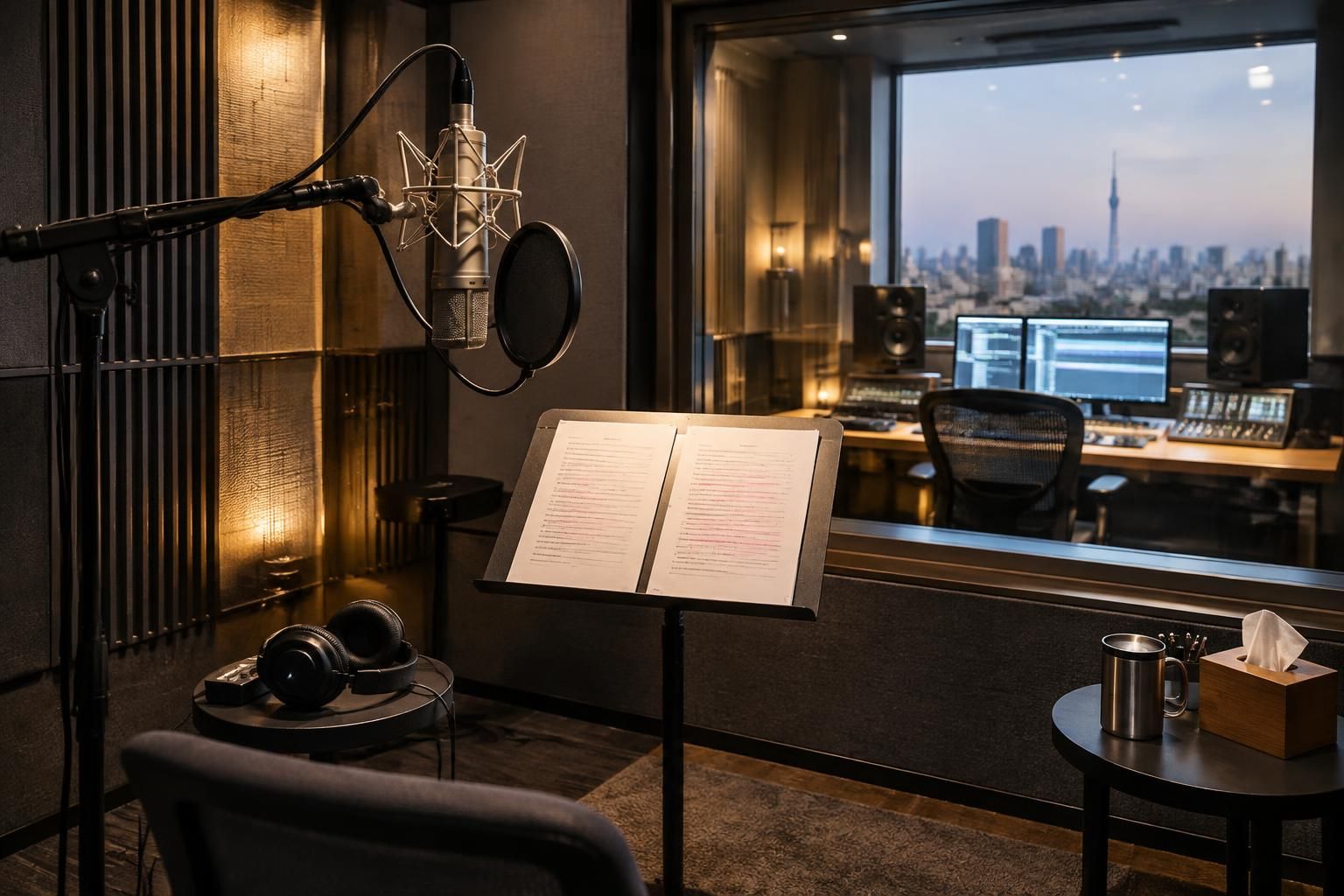
How the TikTok Videos Made Commercial Appeal Central to the Voice-Cloning Dispute
The disputed account reportedly published 188 videos between July 2024 and September 2025. Its content combined images with generated narration discussing urban legends, occult subjects, and conspiracy theories, while its profile picture resembled a character voiced by Tsuda.
Those details matter because identity can be suggested through several signals working together. A recognizable delivery, a character-like image, and a familiar audience niche may create an association that no single element would establish on its own.
The account reportedly exceeded 200,000 followers at one point. Tsuda’s complaint argued that it could have generated more than ¥500,000 per month, but that figure should be understood as the claimant’s commercial estimate, not independently established earnings.
What a “generic male voice” defense does—and does not—explain
TikTok argued that the videos used a generic male narrator and that any resemblance to Tsuda was subjective, according to the reporting. This disagreement illustrates a recurring difficulty in AI voice cloning: identifying when broad vocal characteristics become a recognizable imitation of a particular person.
A low register, measured pacing, or resonant delivery does not belong exclusively to one performer. However, the combination of vocal features and surrounding presentation can be relevant when assessing whether a publication deliberately draws on someone’s identity.
Imagine the same museum marketing its evening tour with a generated voice described internally as “close to Nanami.” If promotional artwork also evokes the character, the project raises a different set of questions from a neutral narrator chosen for clarity and intelligibility.
Neither example establishes liability by itself. The useful distinction is that production intent, audience association, and marketing context should be documented rather than ignored.
| Case element | Reported position | Practical significance |
|---|---|---|
| 🎙️ Vocal resemblance | Tsuda alleged an unauthorized synthetic imitation; TikTok disputed that characterization. | Similarity should be assessed alongside provenance and presentation. |
| 📈 Commercial scale | The account reportedly attracted more than 200,000 followers. | Audience reach can make exploitation concerns more consequential. |
| 💴 Revenue argument | The complaint estimated potential monthly income above ¥500,000. | Alleged revenue should not be presented as verified profit. |
| ⚖️ Removal request | The account holder had already deleted the contested videos. | A rights finding does not automatically produce a removal order. |
Why evidence collection should precede a platform complaint
When disputed content disappears, a claimant may lose easy access to the surrounding context. Screenshots, publication dates, account identifiers, and copies preserved through lawful procedures can help explain what appeared online and how it was promoted.
For a cultural institution, evidence management should remain proportionate. Staff should preserve relevant records without circulating the disputed audio unnecessarily, publishing accusations, or collecting unrelated personal information.
A useful incident file separates observation from interpretation. “The profile used this image on this date” is a documented observation; “the account intentionally impersonated the actor” is an allegation requiring supporting evidence.
The reporting on the court’s recognition of human voice protection provides context for the distinction between the rights issue and the dismissed removal demand. Organizations should retain that distinction when briefing management, insurers, suppliers, or legal advisers.
For the hypothetical museum, the same discipline applies before publication: keep the supplier’s license, the approved script, and the selected narrator’s documentation together. The most useful safeguard is a traceable production record, not a reassuring label such as “generic.”
What Voice Rights Mean for Intellectual Property and Audio Production Contracts
Voice rights are related to intellectual property, but they should not be collapsed into copyright alone. An audio project can involve several separate interests: authorship of the script, rights in the recording, contractual permissions from performers, and protections connected to a person’s identity.
The Tsuda case concerns the reported commercial exploitation of a recognizable vocal identity. It does not establish that the actor owns every recording with similar acoustic qualities, nor does it make permission to use one recorded performance equivalent to permission to create unlimited new speech.
This distinction is especially relevant to museums, tour operators, and visitor services. A contract written for a conventional recording session may say little about synthetic extensions, model creation, or later generation of entirely new narration.
Specify what the performer is actually authorizing
Suppose the museum commissions a narrator to record twenty exhibition stops. Six months later, its team wants to generate additional material from those recordings without arranging another session.
That second activity is not necessarily covered by permission to publish the original files. The production agreement should explicitly address whether synthetic reproduction is authorized, for which purposes, and under what review process.
Useful terms distinguish between editing recorded speech and generating speech the performer never delivered. Removing background noise, adjusting levels, and correcting a pause are operationally different from making a recognizable narrator endorse a sponsor or explain a new exhibition.
- 🎙️ Permitted purpose: identify the exhibition, tour, campaign, or service covered by the agreement.
- 🌍 Distribution scope: specify languages, channels, territories, and the duration of use.
- 🤖 Synthetic permissions: state whether voice-model creation, training, or new generated speech is allowed.
- 📝 Review and payment: define approval steps and compensation for additional uses.
- 🔐 Data handling: explain storage, supplier access, subcontracting, and deletion obligations.
- 🚫 Restricted associations: address sensitive topics, endorsements, and uses outside the original project.
Each item resolves a practical ambiguity rather than adding paperwork for its own sake. Clear boundaries make it easier to commission updates, manage budgets, and explain the project to the performer and the technical supplier.
Check the supplier’s rights, not just its product features
An audio vendor may offer excellent pronunciation controls and rapid multilingual output while providing incomplete information about its training sources. Technical quality and legal provenance are separate purchasing criteria.
Ask whether the selected narrator is a licensed performer, an original synthetic persona, or a customer-created model. Then request documentation supporting the permitted use rather than accepting a broad assurance that all outputs are commercially usable.
The supplier’s terms should also explain what happens to uploaded recordings. An institution needs to know whether those files remain private, whether they can improve shared systems, and whether deletion includes associated models or only the original uploads.
Grupem’s coverage of AI voice-cloning tools is a relevant starting point for examining available technologies alongside their operational implications. Product selection should still include a project-specific review of the current license and data-processing terms.
The museum’s procurement team can make this manageable by using one approval sheet for every narrator. It records the source, consent documentation, permitted uses, expiry dates, and the staff member responsible for checking future changes.
No template guarantees compliance across jurisdictions, and specialist advice may be necessary for recognizable performers or international distribution. A usable production contract describes future audio generation explicitly instead of expecting an old recording license to cover it silently.
Why the Entertainment Industry’s Response Matters for Museum and Tourism Audio
Japanese performers launched the “No More” campaign in 2024 to oppose unauthorized generative imitation of their voices. The initiative reflects a concern that extends beyond individual celebrity disputes: synthetic copies can compete with the professional work that made those voices recognizable.
The Japan Actors Union has emphasized that a performer’s delivery develops through sustained training and professional experience. For the entertainment industry, the issue therefore involves working conditions and bargaining power as well as identity.
Tourism professionals encounter the same underlying questions at a different scale. Their projects may not involve famous anime actors, but they still depend on narrators, interpreters, guides, and cultural mediators whose speech carries expertise and personal credibility.
Distinguish useful automation from identity substitution
Artificial intelligence can support an audio workflow without reproducing a particular person. Examples include drafting alternative script lengths, helping staff identify inconsistent terminology, and generating narration through a clearly licensed synthetic persona.
These uses should still be checked for factual accuracy and suitability. A fluent recording can mispronounce a place name, flatten a culturally significant expression, or confidently deliver an incorrect historical date.
Now consider the museum’s temporary exhibition about local oral histories. Cloning a retired guide’s voice could make a new script sound authentic, but authenticity of sound is not the same as approval of the words.
Would visitors assume the guide personally endorsed the interpretation? If that assumption is likely, the institution needs meaningful consent, an agreed review process, and clear information about how the recording was produced.
Using a neutral, authorized narrator may be the simpler choice. Where a person’s identity is genuinely central to the exhibition, the project should treat that identity as part of the curatorial responsibility rather than a convenient audio effect.
Make accessibility measurable instead of assuming more audio is better
Rapid generation makes it easier to produce many versions of a tour, but volume alone does not improve accessibility. Visitors need intelligible speech, manageable segment lengths, usable playback controls, and alternatives such as transcripts.
For a smartphone-based experience, test the recording in the actual venue. Background noise, reverberation, mobile reception, and the visitor’s headphones can affect comprehension more than the sophistication of the synthesis engine.
Grupem’s positioning as a smartphone-based audio-guide application is relevant to this practical approach: the objective is to make professional listening experiences easier to deploy. The content’s rights, accuracy, and accessibility still require their own checks, regardless of the playback application.
The museum can test three short stops with staff and representative visitors before generating the full tour. Ask participants where they lost the thread, whether names were understandable, and whether the controls supported their preferred listening pace.
Human review remains particularly valuable for emotionally sensitive material, community testimony, and disputed historical interpretation. These are situations in which a polished voice may conceal weak sourcing or an inappropriate tone.
Grupem’s discussion of Hollywood voice-cloning issues connects entertainment-sector debates with broader questions about consent and synthetic performance. Tourism teams can apply the same distinction between authorized innovation and unapproved identity substitution.
A balanced workflow might use a human narrator for testimony and a licensed synthetic speaker for frequently changing service information. Opening times and route updates have different editorial demands from a survivor’s account or an artist’s personal reflection.
The useful innovation is not simply cheaper speech: it is a reliable listening experience built around appropriate permissions, accurate content, and visitor needs. Those priorities also determine how an organization should respond when questionable audio appears outside its own channels.
How to Manage AI Voice-Cloning Risks Before Publishing Visitor Audio
The Tokyo court case shows why rights checks cannot wait until a recording becomes popular. Once a recognizable imitation circulates, organizations may face complaints, reputational damage, supplier disputes, and practical difficulties identifying every copy.
A preventive process does not require every cultural institution to become an audio-forensics laboratory. It requires clear ownership of approvals, reliable records, and a defined response when something appears wrong.
For the hypothetical museum, the starting point is a modest inventory of its current recordings. Each entry identifies the speaker or synthetic source, the production supplier, the permission record, and every channel on which the audio is available.
Build a release checklist around evidence and responsibility
Before releasing a new tour, one staff member should confirm the content and another should verify the rights documentation. In a small organization, these checks can be brief, but they should remain distinct so that good audio quality does not overshadow missing consent.
The team should also confirm that translations preserve the approved meaning. Generating another language is not merely a technical conversion when the script contains cultural terminology, safety directions, or statements attributed to a named person.
- 🔎 Identify the source: record who supplied the narration and how it was produced.
- 📄 Verify permission: retain the agreement covering the intended publication and any synthetic generation.
- 🎧 Review the output: check pronunciation, accuracy, tone, and unintended resemblance concerns.
- 📱 Test the visitor experience: assess playback, transcripts, volume, and navigation in the venue.
- 🗂️ Archive the approved version: preserve the script, audio file, license, and approval date.
- 🚨 Assign an incident contact: identify who can suspend distribution and coordinate a response.
These steps are useful because incidents frequently involve uncertainty about which version was approved or which supplier produced it. A traceable release record allows staff to investigate without reconstructing the entire project from email fragments.
Respond to suspected impersonation without amplifying it
If an employee finds a recording that appears to imitate the institution’s guide, the first response should be evidence preservation and internal escalation. Public accusations can spread the material further and may mischaracterize an ordinary resemblance as deliberate impersonation.
Record the relevant address, publication date, account details, and surrounding claims through lawful means. Compare those observations with the organization’s own contracts and recordings before deciding whether to contact the publisher, supplier, platform, or legal adviser.
Do not rely on listening alone as proof of provenance. A familiar sound is a reason to investigate, while conclusions should consider documentary evidence, technical information where available, and the relevant legal standard.
Grupem’s guidance on protection against AI-enabled scams offers a related operational perspective: suspicious communications should be verified through an independent channel. A familiar-sounding voice should not authorize payments, password resets, or changes to visitor safety instructions.
For example, if a message apparently from the museum director requests an urgent supplier payment, staff should call a previously verified number. This control works whether the suspicious audio is an advanced imitation, an edited recording, or a convincing human impersonation.
Institutions should review their procedures when suppliers, contracts, or distribution channels change. A previously approved file does not automatically authorize a new campaign, a new language model, or a new association with a commercial partner.
The operational standard is straightforward: every published narrator should have a documented source, an authorized purpose, and an accountable owner. That standard supports both respectful use of performers’ identities and dependable audio experiences for visitors.
Did Kenjiro Tsuda win his case against TikTok?
The reported outcome was a partial victory. The Tokyo District Court recognized that unauthorized commercial exploitation of a performer’s voice can infringe publicity rights, but rejected the requested removal order because the account holder had already deleted the disputed videos.
Does the Tokyo court decision make every similar-sounding AI voice unlawful?
No. The reported reasoning concerns the commercial exploitation of a recognizable vocal identity. Broad features such as a deep register do not automatically establish infringement; the relevant facts, presentation, permissions, and applicable law matter.
Can a museum generate new narration from recordings it already owns?
Ownership or licensed use of a recording does not necessarily include permission to generate new speech in the performer’s voice. The institution should review the agreement and obtain explicit authorization for synthetic reproduction where required.
What should an organization check before buying synthetic narration?
Check the narrator’s provenance, permitted uses, consent documentation, supplier data practices, and restrictions on model training or reuse. Review the output for factual accuracy, pronunciation, accessibility, and potentially misleading associations before publication.
Does the Japanese ruling automatically apply to audio guides published elsewhere?
No. Publicity, personality, copyright, contractual, and data-protection rules differ between jurisdictions. An internationally distributed project should assess the laws and agreements relevant to its performers, suppliers, and intended markets.
