
Short on time? Here is what matters:
- 🎧 Anker AeroClip 2 combines an open-ear clip-on format with six microphones and the THUS AI chip to prioritize Voice Clarity in challenging environments.
- 🌍 Its Advanced AI tools include live translation for more than 100 languages through the Soundcore app, which can be relevant for guides, visitor teams, and international events.
- 🔋 The claimed battery figure is up to eight hours per charge and up to 40 hours with the case, while real autonomy changes with volume, Bluetooth multipoint, and AI usage.
- 🚶 Open-Ear Earbuds improve awareness but do not replace careful volume management, responsible use near traffic, or a dedicated system for large guided groups.
Anker AeroClip 2 Open-Ear Earbuds Bring Voice Clarity to Everyday Mobility
Anker is positioning the AeroClip 2 as more than another pair of Wireless Audio accessories. The model uses an open-ear, clip-on construction intended to leave the ear canal unobstructed, while directing sound toward the listener. This format has gained momentum among walkers, runners, commuters, and tourism professionals because it supports listening without disconnecting users from the environment around them.
Unlike conventional in-ear models, the AeroClip 2 does not create a sealed acoustic chamber. That decision has a clear consequence: listeners will generally obtain less physical bass reinforcement than with silicone-tipped earbuds. In exchange, they can hear a bicycle bell, an approaching vehicle, a colleague speaking nearby, or an announcement in a station. For urban mobility and guided cultural experiences, this awareness is not a marginal comfort feature; it is part of safe and practical listening.
The defining promise is award-winning Voice Clarity. Anker combines six microphones with its proprietary THUS AI chip, a processor designed with computing and memory resources integrated for efficient audio processing. The stated aim is not simply to make voices louder. It is to isolate the speaker’s voice from wind, street activity, office chatter, and other competing sounds during calls.
That distinction matters in real usage. A guide named Sofia, leading a small architecture walk through a busy historic district, may need to coordinate with a museum contact while crossing an active square. Standard earbuds can transmit traffic noise so aggressively that the person on the other end hears the city rather than Sofia. The AeroClip 2 approach attempts to identify vocal characteristics and reduce background interference before transmitting the call. This is a practical application of Smart Technology rather than a vague AI label.
Anker’s call-performance claims have been linked to Guinness-recognized testing for clear calls, a point highlighted in coverage of the product launch. The recognition should be read as evidence of a specific tested performance claim, not as a guarantee that every call will sound identical. Wind direction, cellular coverage, call platform, and speaking distance still influence results. Nevertheless, voice isolation is a meaningful advantage for professionals who take frequent calls outdoors.
The open-ear design also avoids the common need to switch between active Noise Cancellation and transparency modes. With a sealed earbud, a listener often chooses between blocking external sound or electronically restoring it. Here, environmental sound remains naturally accessible because the ear is not closed. This is simpler, although it also means the AeroClip 2 is not designed for travelers who need silence on an aircraft or want to suppress a loud train carriage.
For organizations planning visits, this difference should guide procurement. A museum educator using earbuds for staff calls, pre-tour coordination, and short audio checks may value open listening. A visitor needing to focus on a recorded exhibition soundtrack in a crowded gallery may benefit more from a sealed model with Noise Cancellation. The correct choice depends on the task, not on a generic assumption that one design is superior.
Readers comparing formats can explore Anker’s broader open-ear headphone collection to see how clip-on and ear-hook solutions differ. The important criterion is whether the wearer needs awareness, isolation, long-term comfort, or a balance of these elements.
The key point is simple: AeroClip 2 treats clear communication and environmental awareness as complementary needs, which makes the format particularly relevant for mobile, public-facing work.
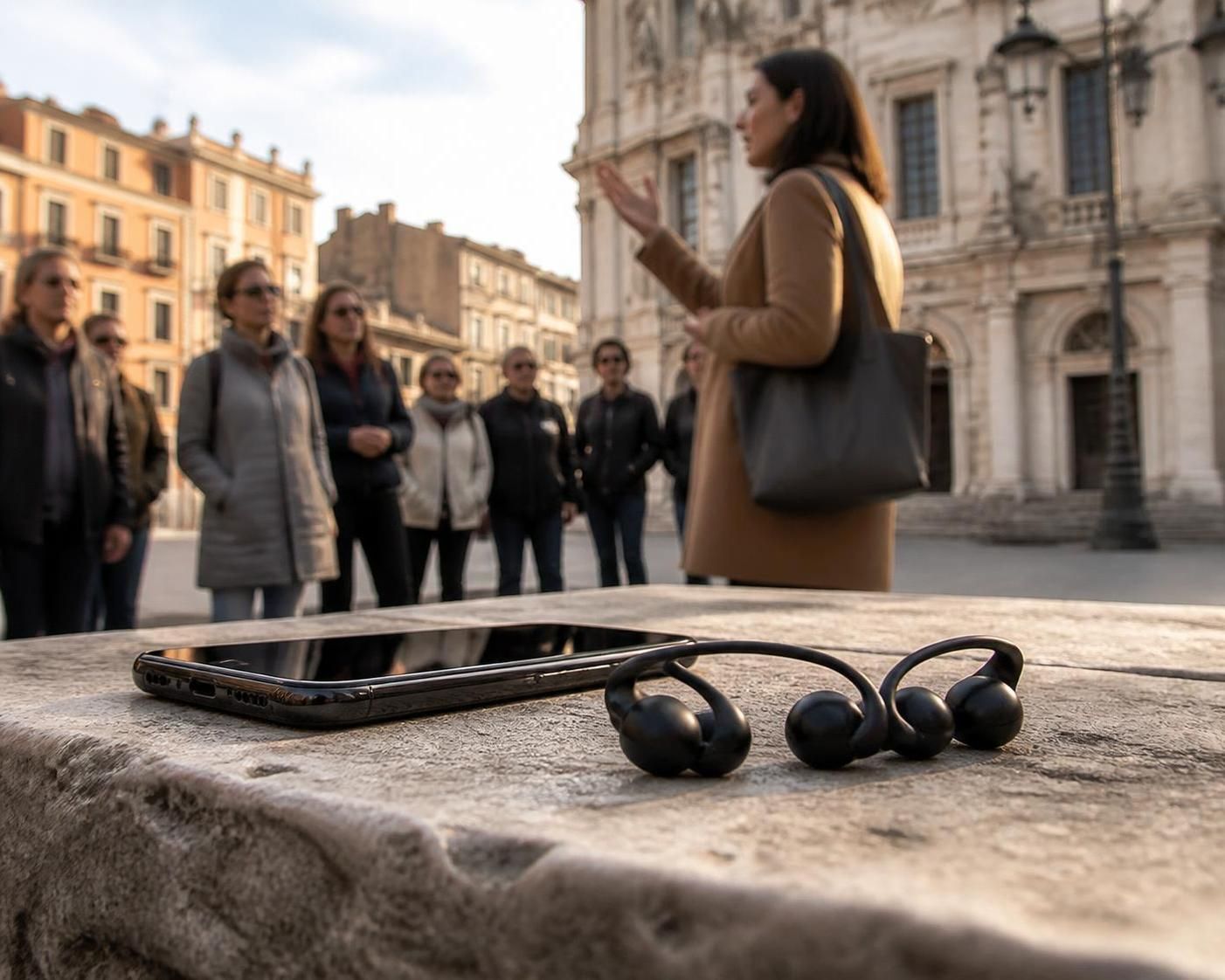
How the THUS AI Chip Supports Advanced AI Calls and Live Translation
The THUS AI chip is central to Anker’s current audio strategy. Rather than treating artificial intelligence as a Voice Assistant that answers general questions, the chip is designed around audio-specific tasks: separating speech from ambient noise, supporting real-time language functions, and enabling interaction features directly connected to listening and communication. Reporting on Anker’s wider IFA 2026 portfolio describes the chip’s expansion across several audio products, showing that AeroClip 2 belongs to a broader product direction rather than an isolated experiment.
The most concrete benefit is voice processing. During a phone call, six microphones collect sound from different positions around the earbuds. Software can compare those inputs to identify the likely direction and characteristics of the speaker’s voice. It can then lower persistent environmental interference, such as traffic rumble, office ventilation, or crowd noise. This does not create silence, and it cannot fully remove a sudden construction drill beside the wearer. Its purpose is more realistic: to make speech more intelligible to the remote caller.
For tourism teams, this capability can solve small but recurring problems. Consider a destination office coordinating a multilingual press group. A staff member may be outside a venue, speaking with a driver while also receiving updates from a colleague inside. Clear outbound speech can avoid repeated calls, missed instructions, and delays at the entrance. The benefit is operational rather than theatrical: fewer “Can you repeat that?” moments during a time-sensitive schedule.
Translation Features Need a Clear Workflow
The Soundcore app reportedly enables live translation across more than 100 languages. This can be useful when a host needs to manage simple interactions with international guests, confirm directions, or support a spontaneous conversation during a site visit. Yet live translation should be approached as assistance, not as a substitute for a qualified interpreter when accuracy, nuance, legal content, medical information, or sensitive cultural material is involved.
A practical workflow starts with preparation. Teams should install the Soundcore app, update firmware, check permissions, and test language pairs before meeting visitors. A quiet test call in the office will not perfectly replicate a street environment, but it verifies that the feature is available and that each participant understands how to start it. Translation functions also depend on a compatible phone and a reliable data connection where cloud services are required.
For example, an independent guide could use the function to welcome a visitor who speaks a language not covered by the scheduled tour. The translated exchange may help establish meeting points, explain timing, or confirm dietary needs for a partner venue. The guide should still deliver the cultural interpretation in the language promised for the tour, rather than relying on automated translations for historical context. A translated sentence may be understandable while missing the tone and precision needed for heritage mediation.
AI also changes the way teams should think about privacy. Calls and translations can involve names, locations, booking details, and personal preferences. Organizations should define who can use such features, on which devices, and under which data policies. Staff should avoid recording or translating confidential conversations without informed consent. Smart Technology delivers value when it is deployed with clear boundaries.
The device’s touch controls remain intentionally simple. A single tap can play or pause audio, while double taps can skip tracks. A triple tap activates a “nap mode” that plays white noise. This is an unusual addition to open-ear hardware, but it may suit airport waiting areas, shared accommodation, or a short rest between travel appointments. It should not be viewed as a health tool; it is merely an audio option for users who prefer neutral background sound.
Anker has also made its announcements part of a larger Advanced AI product story. The most useful way to assess that story is to focus on repeatable tasks: clearer calls, quick language support, and easier controls. A feature becomes valuable only when it reduces friction during a real day of work.
AI audio is most credible when it helps people communicate faster and more clearly without forcing them to change their established routines.
Open-Ear Design, Comfort, and Safety for Tourism and Outdoor Professionals
Open-Ear Earbuds are especially relevant for people who move through public spaces for long periods. Guides, event coordinators, city ambassadors, and museum operations staff often need an audio device that does not fully isolate them. They may receive calls, listen to navigation prompts, or check a short voice note while remaining available to colleagues and alert to nearby visitors.
The AeroClip 2 attaches around the outer ear rather than sitting inside the ear canal or hooking behind the ear. Its speaker points toward the ear, directing playback without a conventional seal. Anker says that the shape was informed by 2,000 three-dimensional ear scans, with the goal of accommodating varied ear forms and reducing pressure points. Individual fit still matters, because no scan database can predict the comfort of every user over a full workday.
For this reason, an organization should not purchase any wearable audio equipment in bulk without testing it with different staff members. A useful pilot involves at least one person who wears glasses, one person who works outdoors, and one person who regularly makes calls in a shared office. Each participant should wear the earbuds for a realistic period, including walking, speaking, carrying bags, and using a phone. Comfort assessments made after two minutes rarely predict comfort after two hours.
Clip-on hardware can also be attractive to users who dislike the plugged-in sensation of in-ear models. Some people experience fatigue or feel less aware when a silicone tip seals the canal. AeroClip 2 addresses that concern by keeping the canal open. The trade-off is audible external noise and potentially reduced low-frequency impact, particularly in busy environments. This is a physical limitation of the category, not necessarily a flaw in a particular product.
Sound Leakage and Responsible Listening
Because the speaker is close to but not inside the ear, sound leakage deserves attention. Anker states that the design aims to limit leakage at lower volumes. In a calm library, museum gallery, coach, or waiting room, however, even well-controlled open-ear playback can be audible to nearby people when volume rises. Users should set the volume at the lowest level that keeps speech or music clear.
This is important in cultural venues. A museum team may use individual earbuds for internal coordination before opening, but those same devices should not disturb visitors once galleries are occupied. Similarly, a guide should not rely on personal audio at high volume while escorting a group around quiet monuments. Technology should support the experience, not become a new source of ambient clutter.
- 🚶 Use open-ear listening outdoors when awareness of traffic, cyclists, and colleagues is important.
- 🔈 Lower volume in quiet venues to reduce leakage and preserve a respectful visitor environment.
- 🧪 Test the fit during movement before using the earbuds on a long walking tour or event shift.
- 📞 Check call quality in the actual location, especially near wind corridors, fountains, roads, and crowds.
- 🛡️ Keep a backup communication method for operationally critical events; earbuds should not be the only channel.
The IP57 rating brings another practical layer. It indicates dust resistance and protection against water exposure at the specified level, making the earbuds better suited to sweat, rain splashes, and unpredictable outdoor conditions than unprotected consumer electronics. It does not mean that charging cases, phones, or every usage situation are equally water-safe. After a wet walk, users should dry the earbuds before placing them back into the case.
For a guide named Sofia, the ideal use may be a morning route inspection: she can hear a route update, answer a call from a venue manager, and still remain aware of traffic at crossings. During the actual group commentary, a dedicated tour-audio platform remains more appropriate. Services such as Grupem can distribute the guide’s voice directly to visitors’ smartphones, creating a more inclusive experience than asking a whole group to share personal earbuds or gather tightly around a speaker.
Open listening is not about adding sound everywhere; it is about keeping communication available without sacrificing awareness, comfort, or respect for shared places.
Wireless Audio Quality: LDAC, Spatial Sound, and Personalized Listening
Voice performance may be the headline feature, but Anker has not treated music playback as secondary. AeroClip 2 uses a 12 mm dual-magnetic driver, a component designed to deliver a fuller and more controlled sound response than the smallest drivers commonly found in compact earbuds. The model also supports LDAC, a Bluetooth codec associated with high-resolution audio transmission when the source device, streaming service, operating system, and settings all support the necessary configuration.
It is worth separating capability from outcome. LDAC compatibility does not automatically mean every track will sound lossless or dramatically better. The listener needs a compatible source device and appropriate files or streaming settings. Bluetooth conditions can also vary in dense radio environments, and higher-quality transmission modes may affect stability or battery use. For most professional users, clear speech and reliable connection will remain more valuable than chasing a technical specification during a busy day.
Spatial Audio is another supported feature for suitable Dolby Atmos content. When the source material includes a spatial mix, the earbuds can create a broader sense of placement than traditional stereo playback. This may add interest to films, immersive travel documentaries, or downtime listening. It should not be confused with accurate positional monitoring for professional production. It is an entertainment enhancement, best evaluated with content specifically mixed for the format.
The Soundcore app offers preset equalizer modes and a hearing test intended to create a personalized sound profile. This can be useful because open-ear acoustics interact strongly with individual ear shape and surrounding sound. A user who finds speech slightly thin can adjust the midrange. Another who wants more perceived energy for music may raise appropriate frequencies, within sensible limits. Personalization is meaningful when it addresses a clear listening need rather than becoming an endless search for a perfect graph.
| Feature | Practical value | Best use case |
|---|---|---|
| 🎙️ Six microphones and THUS AI processing | Improves speech separation in calls | Outdoor coordination, mobile teams, shared workspaces |
| 🎵 12 mm dual-magnetic driver | Supports more substantial playback than basic compact drivers | Music, podcasts, spoken commentary during travel |
| 📡 LDAC Bluetooth support | Enables higher-quality Wireless Audio with compatible sources | Users with supported devices and high-quality streaming settings |
| 🌐 Live translation | Helps with short multilingual exchanges | Visitor reception, event logistics, basic travel assistance |
| 💧 IP57 protection | Offers resilience against dust and water exposure | Walking routes, light rain, exercise, outdoor operations |
The absence of active Noise Cancellation should be evaluated honestly. For a train journey, aircraft cabin, or noisy open-plan office, sealed earbuds with ANC are still likely to provide a more focused listening experience. AeroClip 2’s advantage is that it does not require digital transparency to restore environmental awareness. The surrounding world is already present, which is useful outdoors but less desirable when the goal is quiet concentration.
Multipoint Bluetooth connectivity can make daily switching easier. A user may keep the earbuds paired with a work laptop and a phone, moving from a video call to an incoming mobile call without repeated manual pairing. This convenience can increase battery consumption, so it is sensible to enable it only when it supports a genuine workflow. A museum coordinator working at a desk may need it daily; a visitor using a single phone may not.
Independent assessments have noted the product’s lightweight construction, compact case, LDAC support, and call-focused approach. A detailed AeroClip 2 review can be useful for readers who want another perspective on fit and sound before purchasing. Technical features should always be weighed against personal comfort and actual daily environments.
Good Wireless Audio is not defined by the longest specification sheet; it is defined by whether calls, media, controls, and connection quality remain dependable in the places where people actually work and travel.
Battery Planning, Controls, and Deployment Choices for Professional Use
Anker states that AeroClip 2 can provide up to eight hours of playback from the earbuds and up to 40 hours in total when the charging case is included. A ten-minute recharge is claimed to provide about four additional hours of playback. These are useful reference points, particularly for workers who need a device through a full day of transfers, calls, and walking routes.
As with all battery claims, actual results will vary. Higher listening volume, frequent calls, active translation, unstable Bluetooth conditions, spatial playback, and multipoint connections can all require more energy. The most reliable approach is to treat “up to” figures as planning ceilings rather than guaranteed working durations. For a full-day event, staff should begin with both earbuds and case fully charged and carry a compact charging option for the phone that powers the app features.
Fast charging can be particularly helpful in tourism operations. Imagine a conference host who finishes a morning airport transfer with low battery, then has twenty minutes before an afternoon venue walkthrough. A brief charge can provide enough listening time for essential coordination. This is more useful than a theoretical large battery that requires several hours to recover. Still, charging plans should include the case: fast charging does not help if there is no cable, power source, or charged case available.
Controls Should Reduce, Not Create, Cognitive Load
Touch controls work best when users know them before they need them. Single taps handle play and pause, while double taps can move forward or backward through tracks depending on the earbud used. Triple tapping accesses the white-noise nap mode. For staff members, a two-minute onboarding session is enough to avoid accidental commands during an event.
Organizations should also distinguish between personal audio devices and professional visitor-audio systems. AeroClip 2 can be highly useful for a guide’s personal calls, translation support, music, navigation prompts, and logistics. It should not be treated as a replacement for a dedicated group communication system. When twenty visitors need to hear commentary at once, a smartphone-based platform such as Grupem offers a clearer structure: the guide speaks through a microphone, participants listen from their own smartphones, and the group can maintain distance without losing intelligibility.
The distinction improves accessibility. Visitors may arrive with their own headphones, hearing preferences, language needs, or assistive devices. A flexible audio-guide platform allows them to use familiar equipment and control their own volume. Personal open-ear earbuds serve the professional behind the experience; a purpose-built group audio service serves the audience.
Price is another deployment consideration. AeroClip 2 has been listed at around $169.99, subject to regional availability and retailer changes. At that level, the value calculation depends on call quality, comfort, and feature use. Someone who only listens to music at a desk may find a simpler product sufficient. A person who works outside, speaks with clients, moves between devices, and regularly engages with international visitors may find the combination more compelling.
A sensible evaluation process can be completed before a wider purchase:
- ✅ Identify the primary task: calls, outdoor movement, translation support, music, or staff coordination.
- ✅ Test fit for at least 60 minutes, including walking, wearing glasses, and taking a call.
- ✅ Make sample calls in the noisiest expected location, not only in a quiet office.
- ✅ Verify that the phone supports the preferred Bluetooth features and that the Soundcore app is permitted by internal policy.
- ✅ Compare the personal-earbud workflow with the needs of visitors, who may require a separate audio-guide solution.
For teams following the broader product announcements, coverage of Anker’s IFA 2026 audio lineup provides context around the company’s wider move toward AI-enabled headphones and earbuds. This matters because product ecosystems can influence future firmware support, app development, and accessory choices.
The strongest deployment decision is not “buy the newest earbuds”; it is matching the device to the communication task, the environment, and the people who need to hear clearly.
Are Anker AeroClip 2 earbuds suitable for guided tours?
They are useful for a guide’s personal calls, navigation prompts, quick translation support, and coordination. For delivering commentary to a full group, a dedicated smartphone audio-guide platform remains more suitable because every visitor can listen through their own device.
Do open-ear earbuds provide active noise cancellation?
No. AeroClip 2 uses an open-ear format, so external sound remains naturally audible. This supports awareness outdoors but is less appropriate than sealed ANC earbuds for aircraft cabins, loud trains, or situations where silence is the priority.
What does the THUS AI chip do?
The chip supports audio-focused processing such as voice isolation for calls and AI-enabled functions through the Soundcore app. Its practical role is to help prioritize the wearer’s speech over competing environmental noise.
Can AeroClip 2 translate conversations without preparation?
Live translation can support short multilingual exchanges, but users should install the Soundcore app, verify permissions, test the needed languages, and confirm connectivity beforehand. It should not replace professional interpretation for sensitive or complex content.
How long does the AeroClip 2 battery last?
Anker quotes up to eight hours from the earbuds and up to 40 hours with the case. Real-world battery life depends on volume, calls, Bluetooth multipoint, audio settings, and use of AI features.
