
Short on time? Here is what matters:
- 🏒 NHL 27 reportedly uses generative AI-powered voiceovers to expand in-game broadcast lines.
- 🎙️ John Buccigross’s account highlights a practical requirement: every generated line still needs specialist review for hockey vocabulary and context.
- ⚠️ For gaming studios, museums, tour operators, and event teams alike, artificial intelligence can scale narration, but it cannot replace consent, editorial control, or audio quality assurance.
NHL 27 AI-Powered Voiceovers Bring a New Layer to Sports Commentary
EA Sports is reported to be using generative artificial intelligence to create selected commentator voice lines for NHL 27. The information came from veteran broadcaster John Buccigross during an appearance on the Chirping Zebras podcast, after the discussion was highlighted by games media. Buccigross confirmed that he is involved in the title and explained that EA had played back generated material using a simulation of his voice.
The important detail is not simply that a familiar broadcaster can be reproduced digitally. Sports games have always relied on recorded line libraries, where presenters spend long sessions delivering variations for goals, penalties, rivalry games, player milestones, and season modes. The limitation is obvious: a real match can produce thousands of combinations, while a fixed recording session can only cover a defined range of situations. AI-powered production could help a studio create more contextual phrasing without asking a presenter to record every possible permutation.
For players, that could make the interactive experience feel less repetitive. A hockey match is fast, chaotic, and full of small shifts in momentum. When a commentator responds accurately to a rebound, a late power-play goal, or a goaltender’s exceptional save, the broadcast layer helps turn game mechanics into a believable sporting event. The aim is not merely to add more sound. It is to make each moment sound appropriate to what happened on the ice.
Yet the reported use of generated voiceovers should be understood as an assisted workflow rather than an autonomous broadcast booth. Buccigross’s comments indicate that the technology can produce convincing results, but it still requires corrections. That distinction matters for any organization considering synthetic narration. A voice that sounds natural is only one part of a successful audio experience; the terminology, timing, intention, and credibility of the message are equally important.
Several reports have focused on the implications of this development, including this coverage of Buccigross’s comments on NHL 27 commentary. The available information does not establish that every line in the game is machine-generated, nor does it confirm whether the system is used beyond commentator audio. What it does show is that generative voice technology is moving closer to player-facing production in a major sports franchise.
That move follows a wider trend across gaming. Steam pages for several EA Sports releases, including College Football, Madden, and FC, include notices about generative AI use in development. NHL does not have a Steam release, so players do not receive the same platform-level disclosure there. This creates a useful discussion about transparency: players may care not only about whether artificial intelligence was used, but also where it was used, whose voice was involved, and what approval process protected the final result.
For a fictional arena operations team such as “Northline Media,” the lesson is familiar. If its goal is to deliver a more varied audio layer, it must first define what the technology is allowed to do. Is it generating draft phrases? Producing approved variations from licensed recordings? Or being used in real time? Each option has different operational, legal, and creative consequences.
The value of NHL 27’s approach will depend less on the novelty of the tool than on whether the final commentary remains accurate, licensed, and enjoyable during real gameplay.
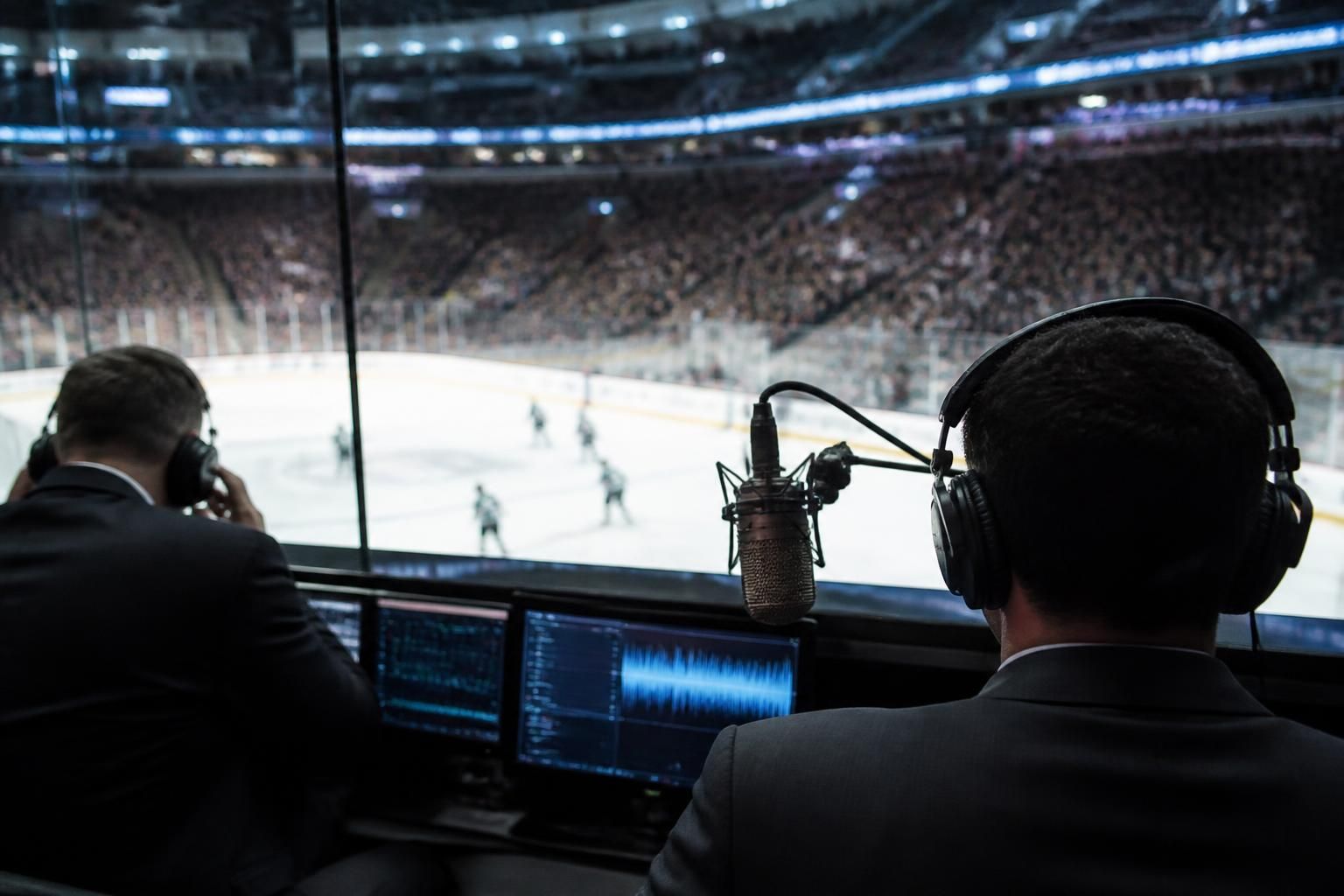
Why Hockey Vocabulary Is the Real Test for AI Sports Commentary
One anecdote from Buccigross’s account explains the central challenge better than a technical specification ever could. A generated line reportedly described the crowd getting out of its “chairs.” The correction was immediate: in the language of sports venues, spectators rise from their seats. The difference may seem small to a general-purpose language system, but it is noticeable to fans, broadcasters, and anyone familiar with the culture of hockey.
This is where AI sports commentary succeeds or fails. A language model can identify that a goal has been scored and that the crowd is reacting. However, a credible sports voice must recognize the accepted phrasing of the sport, the rhythm of play-by-play, and the emotional weight of the moment. Hockey audiences notice details: whether a shot is snapped, wired, redirected, or tucked past a goaltender; whether a team is killing a penalty or defending a power play; whether the play is in the slot, along the boards, or at the blue line.
For a studio, terminology management should be an active editorial process. It cannot be left to an automated prompt alone. Northline Media, for example, could build an approved phrasebook that distinguishes between official terminology, broadcaster preferences, prohibited wording, player-name pronunciation, and venue references. The result is not a restriction on creativity. It is a framework that helps generated material stay recognizably authentic.
NHL 27 Needs Editorial Review Behind Every Natural-Sounding Line
A reliable review process involves more than listening for robotic delivery. Editors should test whether the line corresponds to the exact game event, whether it avoids incorrect claims, and whether it matches the personality of the announcer. A calm analysis segment after an icing call should not have the same pace as live commentary after an overtime winner.
Context is equally essential. A player may score a goal, but the meaning changes if it is the first goal of the game, a hat-trick, a short-handed effort, or the equalizer in the final minute. A well-designed system needs game-state data and approved editorial rules. Without them, more lines can simply mean more opportunities for awkward or misleading narration.
| Review area | What the team should verify | Player impact |
|---|---|---|
| 🏒 Hockey terminology | Use established terms such as “seats,” “power play,” and “slot.” | More credible sports commentary for knowledgeable fans. |
| 🎙️ Voice identity | Check pace, emphasis, pronunciation, and broadcaster style. | Consistent presentation across a full season mode. |
| ⚙️ Game context | Match the wording to score, period, penalty status, and player action. | Fewer generic or poorly timed reactions. |
| ✅ Final approval | Require human validation before voiceovers enter the release build. | Greater trust in the finished interactive experience. |
The same operational principle applies beyond video games. A museum using voice technology for an exhibition should not allow a system to improvise historical claims. A city guide should not accept inaccurate place names because a voice sounds fluent. In both cases, editorial quality defines whether audio assistance feels professional or careless.
The gaming industry is already learning this through public reaction. Players have pushed back when generative systems appear to reduce craft or produce low-quality assets. Commentary is particularly sensitive because audiences hear it repeatedly. One wrong phrase can become memorable for the wrong reason, especially during highlight clips and streams.
Natural speech is not enough: authoritative sports commentary depends on a controlled vocabulary, precise event data, and human listening before release.
How AI Voice Cloning Changes Production Workflows in NHL 27 Gaming
The practical attraction of voice cloning is easy to understand. Traditional game audio production depends on scheduling talent, booking studios, recording alternate reads, editing files, tagging assets, and integrating them into gameplay systems. Those steps remain necessary, but generative tools can potentially reduce repetitive recording work when a presenter has already approved the use of their voice and when the output is closely supervised.
Buccigross’s reaction reflected that possibility. He suggested that having less recording work while maintaining compensation could be acceptable, but he also stressed the need to listen carefully because the system can make mistakes. That is a realistic position. AI-powered narration is not automatically a cost-cutting substitute for talent. In a responsible model, it can support talent by handling controlled variations while the broadcaster retains contractual protection and editorial influence.
For NHL 27, this could mean generating alternative descriptions around recognized game states, then allowing producers to test those lines against actual gameplay. A goal sequence might need different reactions based on distance, period, score margin, and whether the scorer has had an outstanding match. If each variation is derived from approved language and reviewed by an experienced audio editor, the studio can add coverage without sacrificing the recognizable identity of its broadcast team.
Voice rights are therefore central. A performer’s voice is not just an audio file; it is part of their professional identity. Consent should be explicit about the scope of use, the duration of permission, territories, compensation, edits, and the ability to revoke or renegotiate rights for future versions. These safeguards are useful for sports commentators, actors, museum narrators, and tour guides alike.
Organizations exploring the technology can learn from the broader debate around synthetic voices in entertainment. This overview of AI voice cloning tools and responsible use cases is relevant because the question is no longer whether a voice can be replicated. The question is how teams establish a clear, documented framework before that capability enters public-facing content.
From Draft Audio to Approved Voiceovers
A strong production pipeline treats generated narration as a draft asset. First, writers define the permitted content categories. Second, the broadcaster or rights holder approves the voice model and usage rules. Third, the system produces limited variations based on trusted templates. Fourth, hockey specialists and audio producers review language, delivery, and game fit. Finally, quality assurance teams test the material across real matches, not just isolated clips.
- 📝 Define approved phrases, game events, and prohibited claims.
- 🎧 Record or license source material under a transparent agreement.
- 🧠 Generate only the line variations covered by that agreement.
- 🔎 Review pronunciation, terminology, timing, and emotional tone.
- 🎮 Test the final files in full matches, season modes, and edge-case scenarios.
This sequence also protects the user experience. An unreviewed voice can sound flawless in a short demo and still fail after several hours of play. Repetition, mistimed excitement, incorrect player names, and unsuitable language become much more visible in a long sports season. The final test must therefore reflect how players actually engage with the game.
The reported September 11, 2026 release on PlayStation 5 and Xbox Series X/S gives the debate a concrete context. Players will judge the implementation not by a production claim, but by what they hear during faceoffs, breakaways, playoff games, and online matches. In that environment, reliability matters more than novelty.
Responsible AI voice production is a workflow discipline: consent first, controlled generation second, and human quality assurance throughout.
Live Commentary Expectations and the Limits of an Interactive Experience
It is important to separate generated voice lines from true live commentary. In a broadcast of a real hockey game, commentators react to unpredictable events, add tactical interpretation, correct themselves, and respond to human emotion in the arena. In gaming, the system receives structured data about the match and selects or generates a response. That can create a responsive experience, but it is not the same as a human broadcaster following a live game from the press box.
This distinction is useful because marketing language can easily overstate what artificial intelligence is doing. A game may offer a broad set of context-aware voiceovers without delivering unrestricted real-time analysis. The most effective implementation is often narrower: it uses dependable triggers, verified player data, and controlled speech patterns to improve immersion. Attempting to make the system say anything about everything creates more risk than value.
NHL 27 arrives in a sports gaming environment where presentation improvements are judged alongside gameplay changes. An IGN review scored the game 6/10, describing the on-ice action as enjoyable while arguing that the release did not introduce major changes over its predecessor. That assessment puts AI commentary in perspective. Better audio can strengthen atmosphere, but it cannot by itself revolutionize a game if core modes, gameplay depth, and long-term progression remain largely unchanged.
For a player managing a franchise season, well-timed commentary can make a routine match feel distinct. Imagine a rookie scoring a decisive late goal after a long scoring drought. A generic reaction works, but a context-sensitive line that acknowledges the player’s season arc would make the moment more memorable. The feature becomes meaningful when it supports the story the player is already creating.
That is also why audio design needs restraint. If every shot produces excessive excitement, the game loses contrast. If every play receives an elaborate explanation, the pace of hockey is interrupted. Good commentary uses silence, crowd noise, rink ambience, and short reactions as deliberately as spoken lines. The best digital announcer knows when not to speak.
Designing Commentary That Supports Rather Than Distracts
Audio teams should map commentary intensity to the significance of each event. Routine puck movement deserves minimal narration. A disputed goal, a dramatic save, a penalty in overtime, or a milestone deserves more. This approach gives the match a natural arc and avoids the impression that the game is filling every silence with generated content.
Accessibility also deserves attention. Players should be able to adjust commentator volume independently, enable captions, choose language options, and reduce repeated lines. These controls are not optional extras. They ensure that the broadcast layer adapts to different listening needs, home environments, and player preferences.
For cultural venues and guided visits, the parallel is direct. An audio guide becomes more effective when it offers relevant information at the right point in a visitor’s journey rather than continuously talking. Smart audio should reduce friction, not compete for attention. Whether the setting is an arena, a museum, or a city route, timing determines whether narration feels helpful.
The strongest interactive experience does not imitate human live commentary without limits; it uses data, pacing, and user controls to make each spoken moment earn its place.
Transparency, Consent, and Quality Control for NHL 27 AI Voiceovers
The NHL 27 discussion is ultimately about trust. Players want to know whether a familiar broadcaster has agreed to the use of their voice. Performers want clarity about how their identity is used. Developers need reliable production methods that do not create reputational problems later. These interests are compatible when transparency is treated as part of product quality rather than as an afterthought.
EA has been contacted by media outlets for clarification on how generative AI is being used in NHL 27 and whether it reaches beyond voiceover production. Until the publisher provides a detailed account, the confirmed public picture remains limited to Buccigross’s description of hearing generated material based on his voice. Responsible reporting should preserve that boundary instead of presenting speculation as fact.
There is a practical reason for disclosure. When a player hears a broadcaster’s recognizable voice, they may reasonably assume that the performer recorded the line. If an approved synthetic workflow produced it instead, a clear policy can explain how the production works. This does not need to interrupt the game with technical detail. A credits page, accessibility menu, official FAQ, or publisher statement can provide useful context without harming immersion.
Transparency also helps distinguish responsible projects from careless ones. Gaming audiences have already shown that they will question the use of generative tools when outputs appear generic, undisclosed, or disconnected from human creators. The reaction to AI-generated cosmetic content in major games demonstrated that a fast production method can still carry a high brand cost if players believe quality or originality has been compromised.
For Northline Media, a concise governance policy would answer five questions: Who authorized the voice model? What material can it generate? Who validates final lines? How are errors reported and corrected? How is the performer compensated? These are not bureaucratic obstacles. They are practical safeguards for a technology that directly affects public perception.
The wider audio sector is developing comparable practices. Synthetic speech is now used for dubbing, accessibility, customer support, educational content, and guided experiences. In each case, responsible deployment requires a balance between scale and authenticity. This analysis of voice-to-voice AI applications shows why the source voice, transformation rules, and final review process need to be clear before audio reaches an audience.
In sports gaming, this approach can also benefit creators. Streamers and esports commentators may want to know how game audio is produced when they share clips with large audiences. Broadcasters may need confidence that a generated version of their delivery does not say words that undermine their reputation. Players benefit when their feedback can be traced to a clear improvement process rather than disappearing into an opaque system.
AI will not replace the need for skilled sports writers, performance directors, audio engineers, hockey specialists, and quality assurance teams. It changes where their attention is concentrated. Instead of only producing raw lines, teams increasingly need to curate, test, correct, and govern larger libraries of potential speech. That work is visible whenever a seemingly minor word, such as “chairs,” disrupts the credibility of a major sports presentation.
For NHL 27 and future games, the lasting standard should be simple: obtain permission, disclose meaningful use, review every line, and let accuracy guide innovation.
Does NHL 27 use AI-generated commentator voices?
John Buccigross stated on the Chirping Zebras podcast that EA Sports used generative AI to create some voice lines based on his voice for NHL 27. Public reporting has not established that all commentary is generated.
Why did the word “chairs” matter in the NHL 27 discussion?
The example showed that realistic vocal delivery does not guarantee accurate sports language. Hockey commentators and fans normally refer to arena “seats,” so specialist review remains necessary.
Is AI-powered commentary the same as live commentary?
No. Game commentary generally responds to structured gameplay events and pre-defined systems. Human live commentary includes spontaneous analysis, conversation, corrections, and reactions to an unpredictable real-world event.
What should studios check before using cloned voiceovers?
Studios should secure explicit performer consent, define permitted uses, agree on compensation, validate terminology, test audio in real gameplay, and provide clear information about meaningful generative AI use.
