
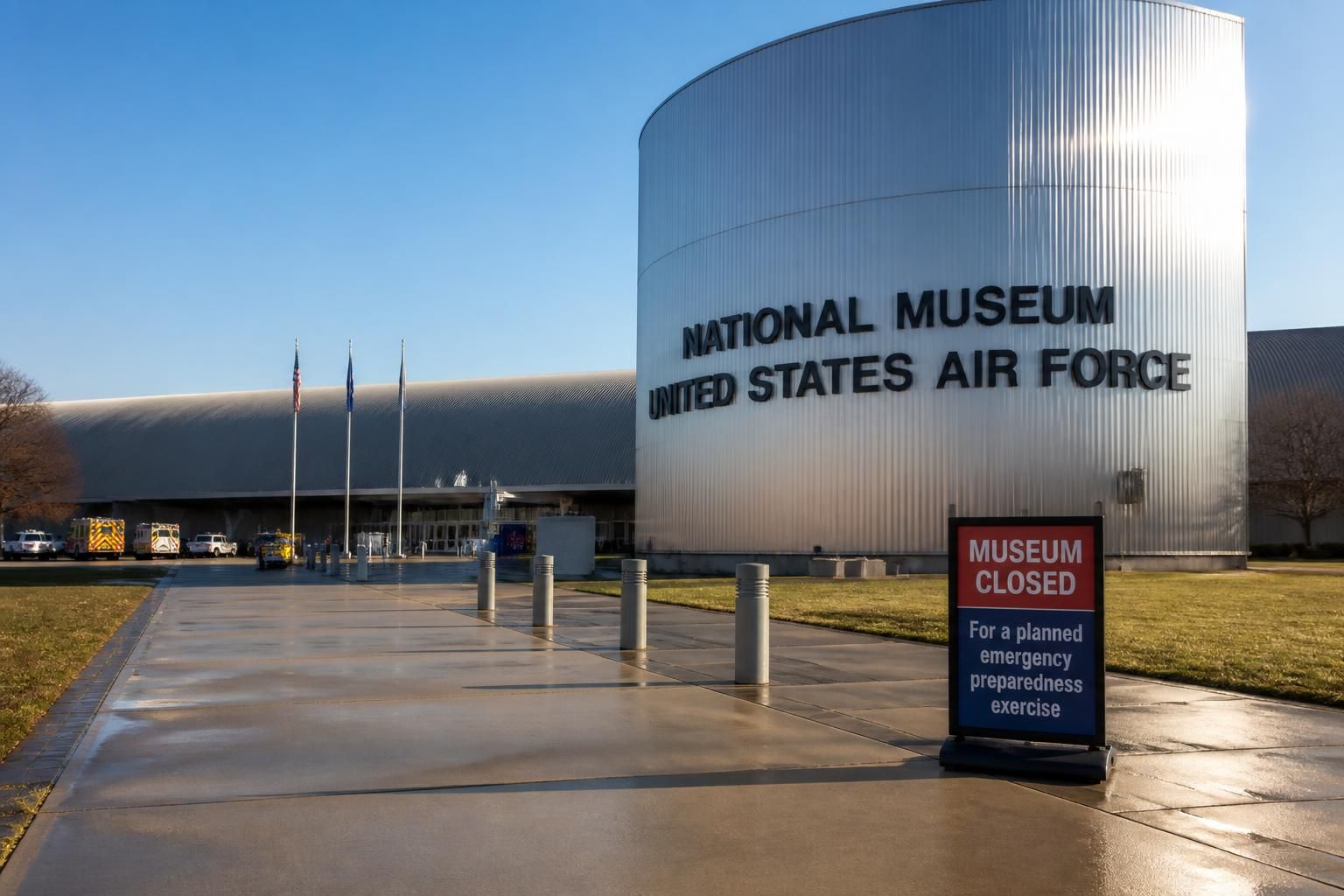
Key takeaway: the National Museum of the U.S. Air Force has planned a temporary public closure to allow a simulated active shooter preparedness exercise. The purpose is operational readiness, not a response to an active incident. 🚨
What visitors should know: the closure affects museum access and visitor activities for the exercise period, while normal public operations are scheduled to resume afterward. For cultural venues, the announcement is also a useful example of how security planning, clear visitor messaging, and coordinated emergency response can work together.
National Museum of the U.S. Air Force Closure Supports Active Shooter Preparedness
The National Museum of the U.S. Air Force, located near Dayton at Wright-Patterson Air Force Base, is among the world’s largest military aviation museums. Its galleries, aircraft displays, research spaces, public programs, and visitor services welcome large and varied audiences throughout the year. That scale makes public safety planning a core operational responsibility rather than a background administrative task.
The announced museum closure has been designed to give personnel and responding agencies a realistic environment for a simulated active shooter exercise. During this type of security drill, teams can rehearse decisions that cannot be improvised safely during a real emergency: how to communicate a threat, how to direct people toward safe exits, how to secure areas, and how to coordinate with external responders.
It is important to distinguish the language clearly. A simulated active shooter exercise does not mean that a threat is occurring at the Air Force Museum. It is a controlled training activity, planned in advance and supported by emergency services. The museum’s decision to close to the public reduces confusion, avoids exposing visitors to disturbing training scenes, and gives participating teams room to test procedures without interrupting a normal museum day.
Official information from Wright-Patterson Air Force Base’s exercise notice explains that the scenario involves both museum personnel and area response agencies. This multi-agency element matters. A museum may have well-written safety procedures, but those procedures only become effective when security staff, managers, dispatchers, medical teams, and law enforcement professionals understand how their roles connect in real time.
For visitors, a temporary closure can seem inconvenient, especially when a family has scheduled a day around the museum’s extensive aviation collection. Yet a one-day disruption is far preferable to attempting intensive law enforcement training around guests, school groups, mobility-device users, or visitors who may not understand why alarms, shouted instructions, and emergency vehicles are present.
The exercise also illustrates an important principle for museums and tourism sites: preparedness must match the physical reality of the venue. The National Museum of the U.S. Air Force includes expansive galleries, long sightlines, multiple entry points, historic objects, large aircraft, and distinct visitor flows. An evacuation route that looks efficient on a floor plan may create bottlenecks in practice. A public-address announcement that sounds clear in one gallery may be difficult to hear near a busy exhibit or inside a large hangar.
- 🛡️ Controlled access: teams can test how quickly public entrances, staff doors, and restricted zones can be secured.
- 📢 Emergency messaging: personnel can evaluate which alerts reach employees, volunteers, contractors, and responders fastest.
- 🚑 Medical coordination: emergency services can practice routes for reaching and treating simulated casualties.
- 🧭 Visitor movement: planners can identify exits, gathering locations, and obstacles that require clearer signage.
- 🤝 Agency interoperability: police, base personnel, and museum leadership can verify that their terminology and command structure align.
In practical terms, a closure for a security drill protects both the training value of the exercise and the visitor experience. It allows people to return on the next operating day knowing that the institution has invested time in readiness. Preparedness is most credible when it is practiced in the actual environment where people will need to act.
How an Emergency Exercise Improves Public Safety at a Major Air Force Museum
A well-run emergency exercise is not a performance for cameras. It is a structured test of people, spaces, communications, and decisions. At a major venue such as the National Museum of the U.S. Air Force, the goal is to find weaknesses while conditions are controlled, documented, and safe to adjust.
For an active shooter preparedness scenario, the first challenge is often information. Staff members may receive reports from different locations, visitors may describe an event inaccurately, and security personnel may need to make immediate choices with incomplete facts. A planned exercise helps teams rehearse how reports are received, who validates them, and how a clear instruction is delivered without delay.
Public-facing institutions must balance urgency with clarity. A vague message can cause hesitation, while an overly technical message can confuse guests who are unfamiliar with the building. The most effective emergency response communication is short, direct, repeated through more than one channel, and designed for people under stress. It should work for visitors who do not speak English fluently, for people with hearing or visual impairments, and for staff in noisy or remote areas.
This is where audio infrastructure becomes especially relevant. Museums often invest in sound for tours, films, interpretation, and events, but emergency communications deserve the same attention. Public-address systems, staff radios, text alerts, digital signage, and visitor-service teams should reinforce one another. If a message is audible but not understandable, the technical system has not met its public safety purpose.
Testing the full visitor journey during a security drill
Consider a fictional visitor named Maria, who arrives with two children and a stroller. She has tickets, has parked some distance from the entrance, and plans to begin in a gallery unfamiliar to her. In an emergency, Maria does not know staff-only routes, command terminology, or the nearest evacuation point. Her experience depends entirely on the quality of directions, visible wayfinding, and staff confidence.
A realistic drill should therefore test more than the initial alert. It should follow the complete journey: how Maria receives instructions, whether she can locate a safe route, whether accessible exits are usable, where she is directed after leaving the building, and how she receives reliable information about the next steps. This approach turns abstract preparedness into a human-centered operating model.
| Exercise area | Operational question | Visitor-focused outcome |
|---|---|---|
| 📣 Alert delivery | Can staff distribute one clear message through several channels? | Visitors receive consistent instructions rather than conflicting rumors. |
| 🚪 Evacuation routes | Do exits remain practical when galleries are crowded or partially blocked? | Guests can move toward safety without avoidable congestion. |
| ♿ Accessibility | Are mobility, sensory, and language needs included in the scenario? | Emergency planning serves the whole audience, not only the fastest movers. |
| 📱 Staff communication | Can supervisors reach guides, volunteers, and front-desk teams immediately? | Visitors receive help from informed personnel at each touchpoint. |
| 🚓 External coordination | Can responders access the right entrance and share accurate location data? | Emergency response time and situational awareness are improved. |
Technology supports this work, but it does not replace training. A mobile alert platform is useful only if contact lists are current. A digital map helps only if employees know which routes should be used. Similarly, an audio-tour system can be a valuable visitor communication channel when it is managed responsibly, but it must never compete with official emergency announcements.
For tour operators and museum teams using smartphones for interpretation, the practical lesson is to define clear operating rules before an incident occurs. Guides should know when to stop commentary, how to direct groups without amplifying confusion, and where to find verified institutional updates. A platform such as Grupem can help organizations deliver structured visitor audio in ordinary conditions; the emergency plan must specify when that normal experience is paused in favor of official instructions.
A security drill succeeds when it reveals how real visitors, real staff roles, and real building constraints interact under pressure. The next operational priority is ensuring that closure information reaches prospective guests before they travel.
Communicating a Museum Closure Clearly Before an Active Shooter Training Exercise
A temporary closure announcement is part of the emergency exercise itself. Visitors need accurate information before they leave home, not after arriving at the museum entrance. This is particularly important for a destination that attracts regional families, aviation enthusiasts, school groups, veterans, and travelers who may have built a wider Dayton itinerary around the Air Force Museum.
The clearest message states four facts early: the facility is closed, the closure is scheduled, the reason is a planned emergency exercise, and normal hours are expected to resume on the stated reopening day. Avoiding ambiguity is essential. Terms such as “emergency activity” without context can prompt unnecessary concern. By contrast, identifying the event as a simulated active shooter training exercise informs the public while making clear that the situation is controlled.
Coverage of the planned closure has appeared through regional outlets, including this report on the emergency response exercise. Travelers should still treat the museum’s official channels as the primary source for same-day operating information, since public schedules can change when weather, base access, or operational requirements affect a visit.
The museum’s communication should be consistent across its website, social media accounts, Google business listing, telephone message, group booking contacts, and partner organizations. A visitor who sees “open” on one platform and “closed for training” on another may proceed with the trip anyway. The result is disappointment for the visitor and additional pressure on front-line staff.
Practical messaging for visitor-facing teams
For tourism professionals, an exercise day is a useful moment to review every channel that can generate a visit. Hotels may recommend the museum to guests. Convention organizers may include it in a delegate itinerary. Schools may have charter buses scheduled. Local guides may plan a stop nearby. Each partner needs a short, reusable statement that does not distort the facts.
A concise operational message could explain that the National Museum of the U.S. Air Force will not admit visitors during the scheduled security drill, that museum campus activities are paused, and that guests should plan for the published reopening time. It should also direct readers toward an official status page rather than asking them to rely on screenshots or posts shared without context.
For international audiences, access limitations create another challenge. Some news websites may display a notice that the site is unavailable outside the United States. That geographic restriction should not prevent a traveler from finding basic closure details. Museums should ensure that their own operational updates remain easy to access globally, with lightweight pages that function on mobile connections and do not depend on a single third-party news source.
- 📅 Update the website first: publish the closure date, affected services, and planned reopening time in a prominent location.
- 📍 Synchronize maps and listings: change operating status wherever visitors check directions and hours.
- ✉️ Contact booked groups: notify schools, tour leaders, accessibility-service users, and event organizers directly.
- 📲 Use social posts for reinforcement: social media should point back to the confirmed operational update.
- ☎️ Prepare staff scripts: reception teams need one consistent answer for calls, emails, and walk-up questions.
There is also a valuable distinction between a security-related closure and a closure caused by funding constraints. The museum has previously faced public attention around operational disruption in the context of a federal government shutdown, as described in coverage of the 2025 funding-related closure. The two circumstances require different messages: one is a planned operational exercise with a known training purpose, while the other depends on federal appropriations and may have an uncertain duration.
That distinction protects trust. Visitors can accept changed plans when the explanation is specific, timely, and practical. What they remember is not merely that a door was closed, but whether the institution helped them make a better decision before wasted travel occurred. Clear closure communication is a service standard, not a last-minute administrative task.
Law Enforcement Training and Museum Operations Must Work as One System
Law enforcement training in a museum setting requires far more than positioning responders inside a building. The value comes from rehearsing the relationship between police procedures and museum operations. Security teams understand access controls and surveillance systems; facilities staff know utility rooms and service corridors; curators understand the sensitivity of objects; visitor-service personnel know crowd behavior. During an emergency exercise, these perspectives must converge quickly.
The National Museum of the U.S. Air Force presents a particularly complex operational environment because its collection includes large aerospace vehicles, enclosed exhibit areas, public amenities, and broad indoor spaces. The institution preserves historical material while functioning as an active public attraction. Any emergency response plan must protect people first, while also accounting for the practical limits created by the museum’s architecture and collection layout.
Exercises allow agencies to practice location language. “Near the aircraft gallery” may be insufficient for a responding officer arriving from outside the site. Teams need shared reference points, numbered entrances, zone names, and mapping that can be communicated clearly over radio. This is a detail that visitors rarely see, yet it can shape how quickly responders understand where they are needed.
Command roles also require practice. A museum director should not need to guess who can authorize a closure. A communications officer should not need to search for pre-approved wording. A tour coordinator should know whether groups should remain in place, move, or await direct instructions. Defined responsibilities reduce duplicated work and make it less likely that staff issue contradictory directions.
Protecting visitor experience without minimizing risk
Some cultural organizations avoid discussing security because they fear making guests uncomfortable. That instinct is understandable, but silence does not create safety. Visitors generally respond well to discreet, visible competence: trained staff, understandable signage, accessible exits, and accurate updates. They do not need theatrical displays of security; they need to know the organization has thought through foreseeable risks.
For example, a guided group using personal smartphones and earbuds may be deeply engaged with an audio narrative. In normal circumstances, this is a positive, accessible format that helps each participant hear clearly at a comfortable volume. During an emergency, however, staff need a protocol for stopping the audio and ensuring visitors can hear official verbal directions. The guide must regain attention immediately, and participants should be instructed not to remain isolated by headphones during movement.
Smart tourism tools can contribute to readiness when they are integrated with governance. Group-management platforms can maintain participant lists, share pre-visit information, and support organized communication. Yet no digital platform should be presented as an emergency command system unless it has been designed, tested, and authorized for that role. The effective approach is modest and practical: use visitor technology to improve organization, while preserving official channels for urgent instructions.
The exercise can also expose overlooked issues. Are temporary contractors included in alerts? Do volunteers understand who gives instructions? Are bilingual staff available during high-tourism periods? Can a guide account for a group if participants have dispersed among galleries? These questions do not imply failure. They are exactly why rehearsal is useful.
A post-exercise review should capture observations quickly. Teams should record what occurred, identify what worked, assign ownership for improvements, and set dates for updates. A finding such as “the radio signal was weak in one gallery” needs a technical response. A finding such as “visitors did not recognize the assembly point” may require revised signage, staff scripts, or a clearer map.
Effective emergency response is not solely a police function; it is a coordinated operational discipline shared by everyone who hosts the public. Once roles are aligned, managers can turn training observations into durable changes rather than isolated lessons.
What Cultural Venues Can Learn From the Air Force Museum Security Drill
The National Museum of the U.S. Air Force closure offers a practical reference point for museums, historic houses, visitor centers, galleries, tourism offices, and event organizers. Not every venue has the same scale or access to base resources, but every public-facing organization can improve its readiness through a proportionate plan. The essential question is simple: if normal operations stop suddenly, does every member of staff know what to do next?
Smaller sites often assume that formal preparation belongs only to large institutions. In reality, limited staffing can make preparation even more important. A small museum may have one person at reception, one guide leading a group, and one manager handling a delivery at the rear of the building. Without a basic plan, a disruption can leave each person acting separately. With a rehearsed plan, they can make faster and more consistent decisions.
The first step is to map the visitor experience. Identify where people enter, queue, collect tickets, use restrooms, gather for tours, and exit. Then identify which areas may become difficult during an emergency: narrow staircases, courtyards with only one gate, storage corridors, or rooms where a guide’s voice competes with ambient sound. This does not require expensive software. A current floor plan, a walkthrough, and honest input from front-line staff are enough to begin.
Next, organizations should create a communication hierarchy. Decide who can issue a closure notice, who contacts emergency services, who communicates with staff, and who updates the public. The hierarchy should be written in plain language and available offline. Cloud documents are useful, but an emergency procedure that can only be viewed after logging into a computer is fragile.
Turning a drill into measurable improvements
Training should produce evidence, not just reassurance. After a security drill, managers can measure practical details: how long it took to notify all staff, whether every participant reached the correct assembly point, how many visitors required assistance, and whether conflicting messages appeared online. Those observations reveal where investment will make a difference.
For a heritage venue, a useful case study might involve a 40-person guided group split between two exhibition rooms. The guide’s original plan assumes everyone is listening through a smartphone audio system. During the drill, the group leader pauses audio, gives a direct instruction, and assigns a second staff member to check the rear of the group. The debrief may reveal that several guests missed the first instruction because their device volume was high. The remedy may be as simple as a pre-visit safety reminder and a standard phrase for pausing devices.
- 🔎 Audit access points: verify doors, gates, staff entrances, and emergency exits with facilities and security colleagues.
- 🗺️ Test wayfinding: ask someone unfamiliar with the venue to locate exits and assembly areas using only available signs.
- 🎧 Plan around audio use: define how guides and visitors pause headphones, audio guides, or mobile content during an alert.
- 🧑🤝🧑 Include all workers: train volunteers, freelancers, café staff, cleaners, and event suppliers alongside permanent employees.
- 📝 Schedule a review: translate every observation from the drill into an owner, action, and completion date.
Tourism organizations should also coordinate beyond their walls. Nearby hotels, transport providers, local authorities, and neighboring attractions may receive questions during a museum closure. A shared contact list and a pre-agreed information process prevent misinformation from spreading. This is especially valuable when visitors are unfamiliar with the area and depend on hospitality staff to interpret local conditions.
For travelers planning a later visit, official reopening and operating guidance remains the most reliable reference. The museum’s visitor reopening information can help guests check current access details before committing to travel plans. Following the museum’s official public updates may also be useful for timely notices, although a website operating-status page should remain the primary point of confirmation.
The key lesson is not that every museum needs identical procedures or equipment. It is that every venue needs a plan suited to its audience, building, staffing model, and local emergency partners. A modern visitor experience is safer when digital tools, trained people, clear audio, and tested procedures support one another.
Active Shooter Preparedness Requires Accessible, Human-Centered Visitor Information
Emergency planning becomes stronger when it recognizes that visitors do not all receive information in the same way. At an aviation museum, guests may include young children, older veterans, international tourists, people with sensory sensitivities, wheelchair users, school groups, and individuals who are unfamiliar with U.S. emergency terminology. An effective active shooter preparedness plan accounts for this diversity before an emergency exercise begins.
Accessibility is not an optional layer added after the main procedure is complete. It is part of the procedure. If an alert is broadcast only through sound, deaf or hard-of-hearing visitors may not receive it. If instructions depend entirely on small text screens, visitors with low vision may miss them. If a safe route includes stairs only, the plan excludes people with mobility needs. Every one of these gaps can be identified and improved through a structured security drill.
At the National Museum of the U.S. Air Force, this means examining the entire alert ecosystem. Visual notifications, staff direction, signage, accessible routes, plain-language messaging, and assistance protocols must work together. The aim is not to provide every visitor with a different process; it is to create layered communication so that critical information reaches people through more than one route.
For example, a short spoken alert may be followed by visual display messaging and direct staff guidance. A group leader may be responsible for checking that all participants have understood the instruction. Staff can be trained to use concise directions, avoid unexplained acronyms, and point rather than merely describe a route. These choices reduce cognitive load at precisely the moment when people may struggle to process information.
Using audio technology responsibly during emergency response
Audio technology offers genuine benefits in museums. Smartphone-based audio tours can improve interpretation without distributing shared equipment. They can support multilingual content, allow visitors to set a comfortable listening level, and help guides manage groups across large spaces. These are practical advantages for contemporary cultural tourism.
However, a visitor listening to an audio tour is not automatically connected to an emergency alert. Museums should tell users what happens during a disruption: pause playback, remove headphones or earbuds, look for staff instructions, and do not rely on a tour app for safety information. This guidance can be included in pre-visit emails, tour welcome briefings, and the opening screen of a digital experience.
For group organizers, the operational rule is straightforward. The guide is responsible for group attention; the institution is responsible for official instructions; emergency services lead the response. When these roles are clear, technology remains helpful instead of becoming a distraction. A system like Grupem can support organized, high-quality guided listening in normal operation, while staff protocols ensure that official safety communication always takes priority.
Communication after the exercise is equally important. Museums should not simply announce that training occurred and move on. A brief public update can explain that the institution conducted a planned preparedness activity with relevant agencies, thank visitors for adjusting plans, and confirm normal operations. It does not need to reveal sensitive tactics or detailed security layouts. It simply demonstrates accountability.
There is a broader trust benefit. Visitors expect cultural venues to preserve objects and stories, but they also expect them to manage contemporary responsibilities professionally. A transparent museum closure for a planned emergency response exercise shows that public access and safety are not competing priorities. The closure temporarily limits access precisely because the institution is preparing to protect that access over the long term.
For managers, the most useful next action is to review one visitor communication channel today: the booking confirmation, tour briefing, audio-guide welcome message, or front-desk script. Add a clear instruction explaining how guests will receive official directions if normal operations are interrupted. When people can hear, understand, and follow instructions, preparedness becomes a real part of the visitor experience.
Why is the National Museum of the U.S. Air Force temporarily closed?
The temporary museum closure allows personnel and partner agencies to conduct a planned simulated active shooter preparedness exercise in a controlled environment. It is a training event, not a response to an active public threat.
Does an active shooter exercise mean there is an incident at the Air Force Museum?
No. A simulated active shooter exercise is a scheduled security drill designed to improve public safety, staff coordination, emergency communication, and law enforcement training.
What should visitors do if a museum closure affects their planned trip?
Check the museum’s official operating-status information before traveling, especially if you have booked group activities or are visiting from outside the Dayton area. Contact the museum or your tour organizer for rescheduling guidance when needed.
How can museums make emergency alerts more accessible?
They should combine spoken announcements, visual messaging, trained staff guidance, accessible evacuation routes, and plain-language instructions. Planning must account for visitors with mobility, hearing, vision, language, and sensory needs.
