
Key point: APS Parents are not asking to remove reading assessment from Schools. They are advocating for an Option to Opt Out of AI Voice Recordings while still receiving a fair, teacher-supported alternative. 🔒
What matters now: meaningful Consent, clear Privacy information, independent checks on assessment quality, and non-invasive paths for families whose children should not have to trade personal voice data for participation in Education Technology.
APS Parents Advocate for an Option to Opt Out of AI Voice Recordings
At Albuquerque Public Schools, the debate around Amira Learning has moved beyond a simple question of whether artificial intelligence can support literacy. Parents are focusing on a more practical issue: whether a child can complete a reading assessment without having their voice captured, processed, and stored through an AI-enabled platform.
This distinction is essential. A family may support reading evaluation, classroom technology, and targeted help for struggling readers, while still declining the recording of a child’s speech. Treating those positions as identical creates an unnecessary conflict between participation in school and control over personal data.
Reports from APS families indicate that a parent requesting to exclude voice capture has been directed toward refusing the entire assessment. That structure presents a binary choice: accept AI Voice Recordings or withdraw from testing altogether. For advocates, the issue is not a rejection of innovation; it is a request for a proportional, workable safeguard.
Voice is not just another classroom data point. It can reflect an accent, a speech pattern, a disability, a language background, age-related characteristics, and emotional state. A reading sample can also document hesitation, decoding errors, fluency, and other learning signals that are meaningful in an educational context but sensitive when collected at scale.
Why voice data requires a different level of care
A worksheet answer can be corrected or replaced. A voice recording is more persistent. It may be copied, retained, analyzed, or exposed in a security incident, even where a vendor and district have policies intended to limit those risks.
Amira states that districts control student information, while data infrastructure may rely on cloud services such as Amazon Web Services. Parents reasonably need more than a general assurance. They need accessible answers about what is recorded, who can access it, whether recordings are used to improve systems, how long files remain available, and how deletion is verified.
- 🔐 Purpose limitation: recordings should be collected only when they are strictly necessary for a defined educational function.
- 📝 Granular Consent: families should be able to agree to assessment while declining the recording component.
- 👩🏫 Comparable alternatives: a teacher-led or non-recorded assessment should measure the same learning objective.
- 🗂️ Retention clarity: APS should explain when voice files are deleted and how families can request confirmation.
- ⚖️ No punitive framing: an opt-out request should not imply that a family is harming a teacher, school, or child.
The wording of a “Parental Refusal Form” can influence whether people feel safe asking questions. When a form requires families to acknowledge potential consequences for the student, teacher, and school, the process can feel less like informed choice and more like a deterrent. A well-designed Consent process should explain implications plainly without pressuring a parent to surrender Privacy.
Families are not the only stakeholders who benefit from clarity. Teachers need reliable ways to assess children who do not use an AI tool. Administrators need documentation that alternatives are operational, equitable, and not dependent on a parent’s persistence in navigating several offices.
Other districts in New Mexico have already demonstrated that different decisions are possible. Reporting on Santa Fe and Los Alamos privacy concerns shows that school systems can question mandated AI reading software when student recordings and data protection remain unresolved.
The central lesson for APS is practical: a technology rollout is stronger when families can choose a secure alternative without losing access to assessment. Innovation earns trust when participation is informed, reversible, and respectful of individual circumstances.
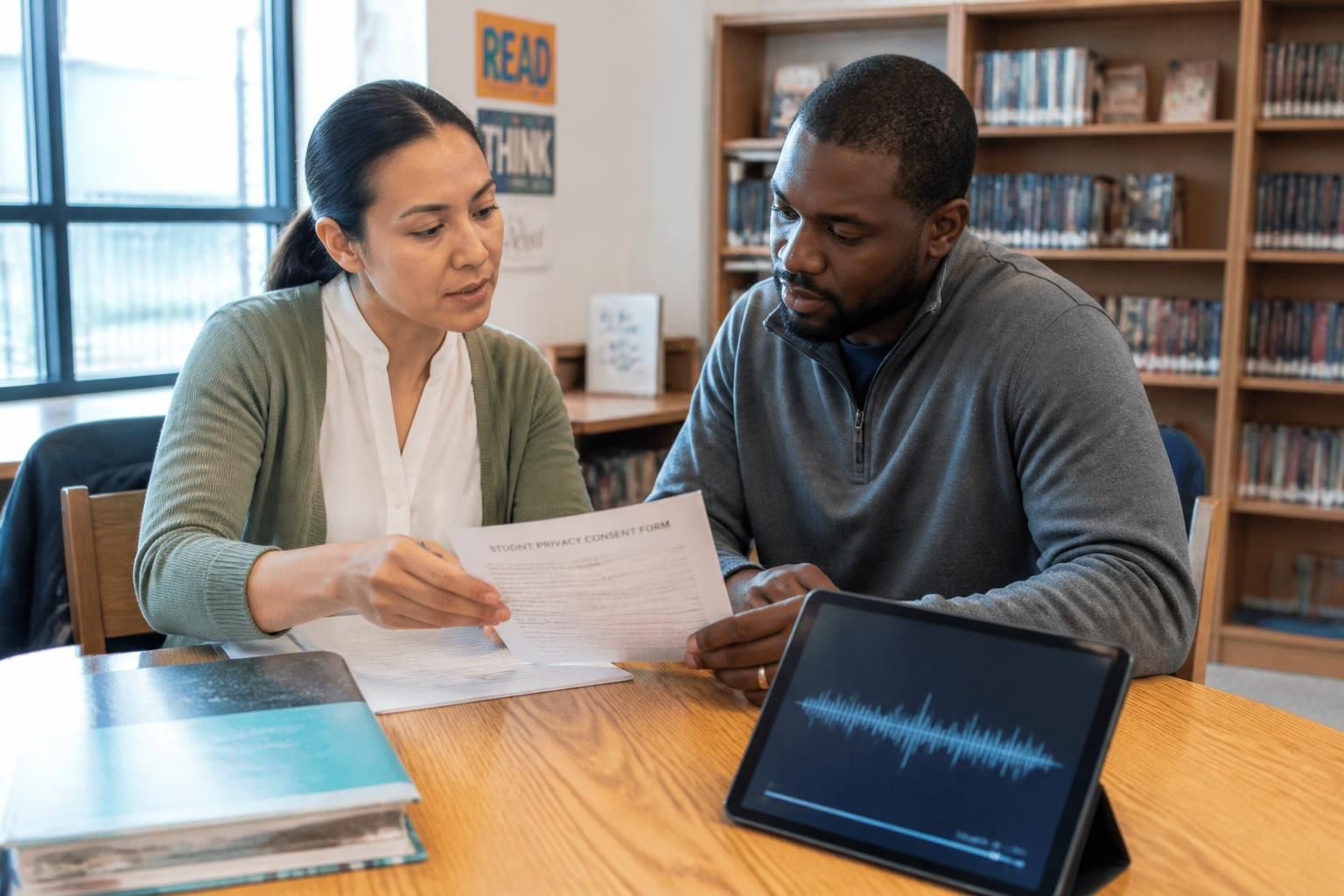
AI Voice Recordings in Schools Need Transparent Privacy and Consent Rules
Privacy policies often exist online, but availability is not the same as understanding. A parent should not need technical expertise, legal training, or multiple calls with district staff to learn whether their child’s spoken reading is recorded and how that recording moves through an Education Technology system.
For APS, clear communication should begin before software is activated. The notice should identify the tool, explain the educational purpose, state whether a microphone is required, distinguish live speech processing from stored audio, and show the exact alternatives available to families.
A practical model for meaningful school Consent
Meaningful Consent is specific rather than bundled. If a platform combines reading assessment, AI feedback, progress reporting, and voice recording, parents should be able to understand each function. The decision to accept classroom assessment should not automatically authorize every related data practice.
Consider a fictional APS parent, Maria, whose second-grade child has a mild speech difference. Maria wants her child’s reading progress tracked, but she does not want repeated recordings retained in an external system. A fair district process would offer her an equivalent oral reading check with a trained educator, record the score in the same progress-monitoring workflow, and avoid requiring her to defend that preference.
| Decision point | What APS families should receive | Why it matters |
|---|---|---|
| 🎙️ Audio collection | A direct statement explaining whether speech is recorded, transcribed, analyzed, or retained. | Parents can distinguish a listening exercise from stored AI Voice Recordings. |
| 🔐 Data storage | Named storage arrangements, access controls, retention periods, and deletion steps. | Privacy commitments become verifiable rather than vague. |
| 👩🏫 Alternative assessment | A written description of the non-recorded option and who provides it. | Opting out does not become educational exclusion. |
| 📊 Data accuracy | Information on how AI outputs are reviewed by educators. | Automated results should not override professional judgment. |
| 📞 Questions and appeals | A single district contact and predictable response timeline. | Families avoid being transferred between multiple administrators. |
Transparency also protects the district. If APS can demonstrate that it has mapped its data flows, reviewed vendor terms, trained staff, and established an alternative path, it is better positioned to respond to legitimate concerns. Clear procedures reduce inconsistency between classrooms and reduce the likelihood that one family receives a different answer from another.
The challenge is especially important for households with limited time, limited English proficiency, or less familiarity with digital systems. Consent cannot be meaningful only for families who know the right terms to search for or who can pursue a question for weeks. Information must be concise, translated where required, and distributed through channels parents actually use.
Technology literacy matters here as much as policy literacy. Families increasingly encounter synthetic speech, voice cloning, and audio impersonation outside school. Resources explaining how AI voice spoofing changes digital safety underline why recorded voice has become a sensitive category for many people, even when a school’s intended purpose is educational.
Schools do not need to present every AI tool as dangerous to communicate responsibly. They should explain both value and limits: a platform may help identify reading patterns quickly, while its output still requires safeguards, context, and adult interpretation.
When parents receive a plain-language notice before collection begins, the conversation shifts from suspicion to governance. Consent works best when APS makes the choice visible, specific, and easy to exercise.
Fair Alternatives Can Protect Reading Assessment Without Excluding Students
The most important operational question is not whether an alternative exists in theory. It is whether an alternative can be offered consistently in a real classroom, within a school day, without making a child feel singled out or depriving a teacher of useful information.
APS Parents Advocate for a model in which the learning goal remains intact. If the goal is to assess oral reading fluency, comprehension, decoding, or vocabulary, a district can use a trained educator, a non-recorded local assessment, or another approved tool that does not retain a child’s audio.
Teacher judgment should remain part of the assessment system
AI-driven reading products can identify patterns at speed, but speed is not the same as accuracy. Speech-recognition systems can struggle with regional accents, multilingual learners, speech differences, background noise, very young voices, and communication-related disabilities. A child may know a word yet pronounce it differently from the model expected by software.
That limitation has practical consequences. If automated results influence intervention groups, instructional plans, or a student’s perceived reading level, errors can affect the support a child receives. Teacher observation offers context that a score alone cannot provide: whether a pupil self-corrected, understood the passage, was anxious, or was distracted by using unfamiliar equipment.
Maria’s child provides a useful example. During a software session, the system may register pauses as difficulty or misclassify words spoken with a speech variation. In a teacher-led reading conference, the educator can ask follow-up questions, recognize decoding strategies, and distinguish a pronunciation pattern from a comprehension gap.
This does not mean that every AI measurement is invalid. It means that APS should validate results locally and across student groups before relying on them for high-impact decisions. Vendor-sponsored studies can offer useful evidence, but districts should also seek independent, peer-reviewed research and compare automated findings with in-person teacher assessments.
- 📌 Define the exact skill being measured, such as oral fluency or comprehension.
- 👩🏫 Select a non-recorded assessment that measures the same skill at a similar level of rigor.
- ⏱️ Schedule the alternative within the normal assessment window so students are not delayed.
- 📈 Document how scores enter progress-monitoring systems and who reviews them.
- 🔎 Audit differences between AI results and teacher results across varied student populations.
A strong alternative should not become a lower-quality substitute. If a student who opts out receives fewer assessments, later feedback, or less individualized instruction, the district has effectively made Privacy costly. The better standard is equivalence: same instructional purpose, timely results, and access to interventions where needed.
School leaders can also reduce workload through predictable planning. Instead of handling each request informally, APS could create a district-approved protocol, designate staff roles, and provide a short guide to principals and teachers. That prevents the burden from falling on classroom educators who may have had little role in selecting the platform.
Guidance from parent resources on school devices and ed-tech opt-outs reflects a wider pattern: families want practical choices, not a confrontation over whether technology itself belongs in learning. An alternative is not an obstacle to modernization; it is part of accessible service design.
The next question is how APS can test and monitor these systems responsibly after alternatives are established. A reading assessment is useful only when it measures learning fairly, not merely when it produces data quickly.
APS Should Evaluate Education Technology for Accuracy, Equity, and Human Oversight
AI in Schools is frequently discussed as a future issue, yet the operational effects are immediate. A reading assistant can shape what teachers see, which students receive extra support, and how progress is communicated to a family. That makes procurement and oversight as important as the app’s interface.
APS should treat AI-enabled assessment as a service that requires periodic evaluation, not as a one-time purchase. The district needs to know whether the tool works across its student population, whether educators can challenge incorrect outputs, and whether the tool’s benefits justify the data collected.
Independent validation should guide high-stakes use
Claims from a provider can be informative, but they are not sufficient on their own. When research is funded, commissioned, or conducted by the same company selling a product, APS should supplement it with independent evidence. Local testing is also necessary because an evaluation conducted elsewhere may not reflect Albuquerque classrooms.
A useful review would compare AI-generated reading results with observations from qualified teachers. It would examine agreement rates across grades, home languages, speech patterns, disability status, and different school environments. It would also record situations where a teacher changes or rejects an automated recommendation.
This review should focus on educational outcomes rather than promotional metrics. How many children received appropriate support sooner? How often did the platform flag a difficulty that teacher assessment did not confirm? Did students using a non-recorded alternative receive comparable instruction and progress monitoring?
These questions are not anti-technology. They represent basic quality assurance, similar to the checks used when schools adopt curriculum materials, transportation systems, or accessibility tools. The difference is that AI systems can make probabilistic judgments that appear authoritative even when they are mistaken.
- 🧪 Run local pilots: test tools before district-wide reliance, with clear success and failure criteria.
- ⚖️ Measure disparate impact: review outcomes for students who may be misread by speech recognition.
- 🧑⚖️ Preserve human review: ensure teachers can override automated interpretations without penalty.
- 📄 Publish plain-language findings: share what APS learned, including limitations and corrective actions.
- 🔁 Review annually: software models, vendor practices, and classroom needs can change quickly.
Human oversight is particularly important when a child’s score may be viewed as objective evidence. Educators understand that a reading performance can vary because of fatigue, anxiety, a noisy room, illness, or a child’s discomfort with speaking into a device. An AI score should open a conversation, not close one.
There is also a broader trust issue. National concern has grown because many families report receiving limited information about AI policy while schools expand AI use. The National Parents Union AI policy tool for families responds to that gap by helping parents ask more informed questions about governance, safeguards, and participation.
For APS, an evidence-based approach can reduce polarization. Rather than asking families to trust a tool categorically, the district can show how it is tested, where it performs well, where it needs limits, and how a teacher remains accountable for the final educational decision.
Effective Education Technology is not defined by automation alone; it is defined by whether the school can explain, verify, and correct its use.
Building an APS Opt-Out Process That Respects Parents and Keeps Learning on Track
An opt-out procedure should be designed as a normal part of service delivery, not as an exception reserved for families willing to persist. When the process is straightforward, APS can protect student Privacy while preserving instructional continuity and reducing confusion for teachers.
The first improvement is to separate decisions. A parent should be able to choose among participation in assessment, participation in AI analysis, and permission for retained audio. A single refusal form that combines all of these decisions may be administratively simple, but it does not reflect how families actually weigh the issues.
What a workable district process could look like
APS could publish a short, accessible request form with a specific checkbox for “no retained voice recordings.” The form should explain the alternative assessment method, expected scheduling, staff contact, and how the family will receive results. It should not suggest that exercising the Option will damage the school community.
Once submitted, the request should move through one defined workflow. The school confirms receipt, assigns an alternative assessment, records the preference in the appropriate student system, and provides a completion notice. This is more reliable than asking parents to repeat their concerns to several administrators.
| APS action | Practical implementation | Family benefit |
|---|---|---|
| 📝 Create a granular form | Offer separate choices for assessment, AI analysis, and stored voice data. | Parents can make an informed, limited request instead of refusing all services. |
| 👥 Assign a district owner | Name one privacy or assessment contact for escalations. | Questions receive consistent answers across Schools. |
| 📚 Train educators | Provide a short workflow for alternative reading checks. | Students avoid delays or classroom stigma. |
| 🔍 Publish vendor safeguards | Explain storage, access, breach response, and deletion practices. | Consent rests on usable facts rather than assumptions. |
| 📅 Report annually | Share opt-out volumes, alternative completion rates, and review findings. | Community oversight becomes measurable and ongoing. |
Communication must be as carefully designed as the form itself. A family should receive information early enough to decide before an assessment window opens. Notices should avoid technical language where possible and use direct phrasing: “This tool may record your child reading aloud,” followed by clear explanation of why, where data goes, and what alternatives are available.
APS can also invite a small parent, teacher, disability-access, and student-privacy advisory group to review materials before each school year. That step does not prevent the district from using technology. It helps identify confusing language and overlooked barriers before they affect thousands of households.
Schools have managed differentiated instruction for decades. They already accommodate varied learning needs, accessibility requirements, language backgrounds, and assessment settings. Offering a non-recorded assessment is therefore not a radical new obligation; it is a logical extension of educational practice into a data-sensitive environment.
The issue also offers a valuable standard for future tools. Before adopting any system that captures speech, images, behavior signals, or other sensitive information, APS can ask one simple question: could a student still receive equitable learning support if a family declines the most invasive data feature?
That standard promotes both trust and resilience. It prevents a vendor configuration from becoming the only route to a basic educational service, and it keeps the district focused on its real objective: helping children learn.
The most immediate action for APS is clear: provide a written, non-punitive way to Opt Out of AI Voice Recordings while guaranteeing an equivalent reading assessment. ✅
Can APS Parents opt out of AI Voice Recordings but still allow reading assessment?
Parents are advocating for exactly this option. A sound district policy should separate participation in reading assessment from permission to record and retain a child’s voice, then provide an equivalent teacher-led or non-recorded assessment.
Why are AI Voice Recordings considered sensitive student data?
A child’s voice can reveal speech patterns, accents, language background, disability-related characteristics, and reading behaviors. Families need clear information about collection, storage, access, retention, deletion, and breach response.
Do AI reading tools replace teacher assessment?
They should not. AI tools may provide rapid indicators, but teachers provide essential context and can recognize factors such as anxiety, self-correction, speech differences, and comprehension that automated speech recognition may misinterpret.
What should an APS AI opt-out form include?
It should identify the tool and data collected, offer separate choices for recording and assessment, explain the alternative method, state the response timeline, name a district contact, and avoid language that pressures families not to exercise their choice.
