
SoundHound AI and MUSC Health: Why the Voice AI Partnership Matters
🔎 Key point: The MUSC Health deployment gives SoundHound AI a practical enterprise use case for its agentic Voice AI strategy, rather than a purely promotional healthcare announcement.
SoundHound AI, traded under the ticker SOUN, has attracted renewed attention because MUSC Health expanded the role of its AI agent, Emily, into retail and specialty pharmacy phone operations. The deployment matters because it moves beyond a basic voice bot that only answers common questions. Emily is designed to support patient access across a complex healthcare environment, where calls may involve appointment requests, care navigation, medication-related questions, insurance-sensitive workflows, and transfers to human staff.
The original announcement of the MUSC Health patient-access deployment described an AI agent powered by Amelia Patient Engagement, a platform acquired by SoundHound AI. Its connection with Epic is central. Epic is widely used in US health systems, and a voice system that can operate in an Epic-connected environment has a more meaningful commercial profile than a standalone chatbot with no secure access to approved operational data.
For patients, the value proposition is straightforward: access should not depend on reaching a call-center employee during limited business hours. A patient seeking a pharmacy refill status at 9 p.m. does not necessarily need a long conversation. They need a clear response, a simple next step, and an option to escalate when the request becomes complicated. This is where Speech Recognition, conversational design, and workflow integration must work together.
For MUSC Health, the objective is more operational. Large health systems face substantial call volumes, seasonal spikes, staffing pressure, and the costly consequence of missed calls. A well-configured voice agent can reduce routine call handling while directing staff toward situations requiring judgment, clinical context, or empathy. The technology does not replace care teams; it can create a more usable first layer of service.
The reported expansion is also noteworthy because it has supported more than 2.2 million patient calls across the health system. That scale changes the discussion. A pilot can demonstrate technical feasibility, but millions of interactions offer evidence about reliability, escalation patterns, patient language, and the real-world limits of automation. The outcome is particularly relevant in Healthcare AI, where systems must handle interruptions, unclear phrasing, varied accents, and privacy-sensitive questions.
Consider a fictional visitor-facing health facility called Harbor Wellness Center. Its reception desk receives calls from patients, caregivers, local residents, and tourists needing immediate directions to a specialty service. If an automated agent can identify the caller’s intent, provide correct opening hours, locate the right department, and hand over urgent cases cleanly, the experience becomes more accessible. If it misunderstands symptoms or sends callers to the wrong service, trust disappears quickly. The MUSC Health case therefore tests execution, not only branding.
SoundHound AI’s advantage is that it has long built products around voice interaction. Voice Technology requires more than converting spoken words into text. A useful system must detect intent, retain context during a multi-turn dialogue, manage follow-up questions, and know when to stop automating. In a medical setting, that final capability is essential. A capable AI agent should never create false confidence when a human professional is needed.
The Partnership also highlights a broader transition in Artificial Intelligence. Enterprises increasingly want task-completing agents rather than systems that merely produce answers. In this model, the agent may authenticate a caller, retrieve authorized information, guide a patient through approved options, log an interaction, and route exceptions. That is a more difficult product to deploy, but it also has stronger potential to become embedded in daily operations.
💡 The essential takeaway is simple: MUSC Health gives SOUN a visible proof point for enterprise voice automation, but the investment relevance depends on whether this model can be repeated across additional health systems without weakening quality, compliance, or margins.
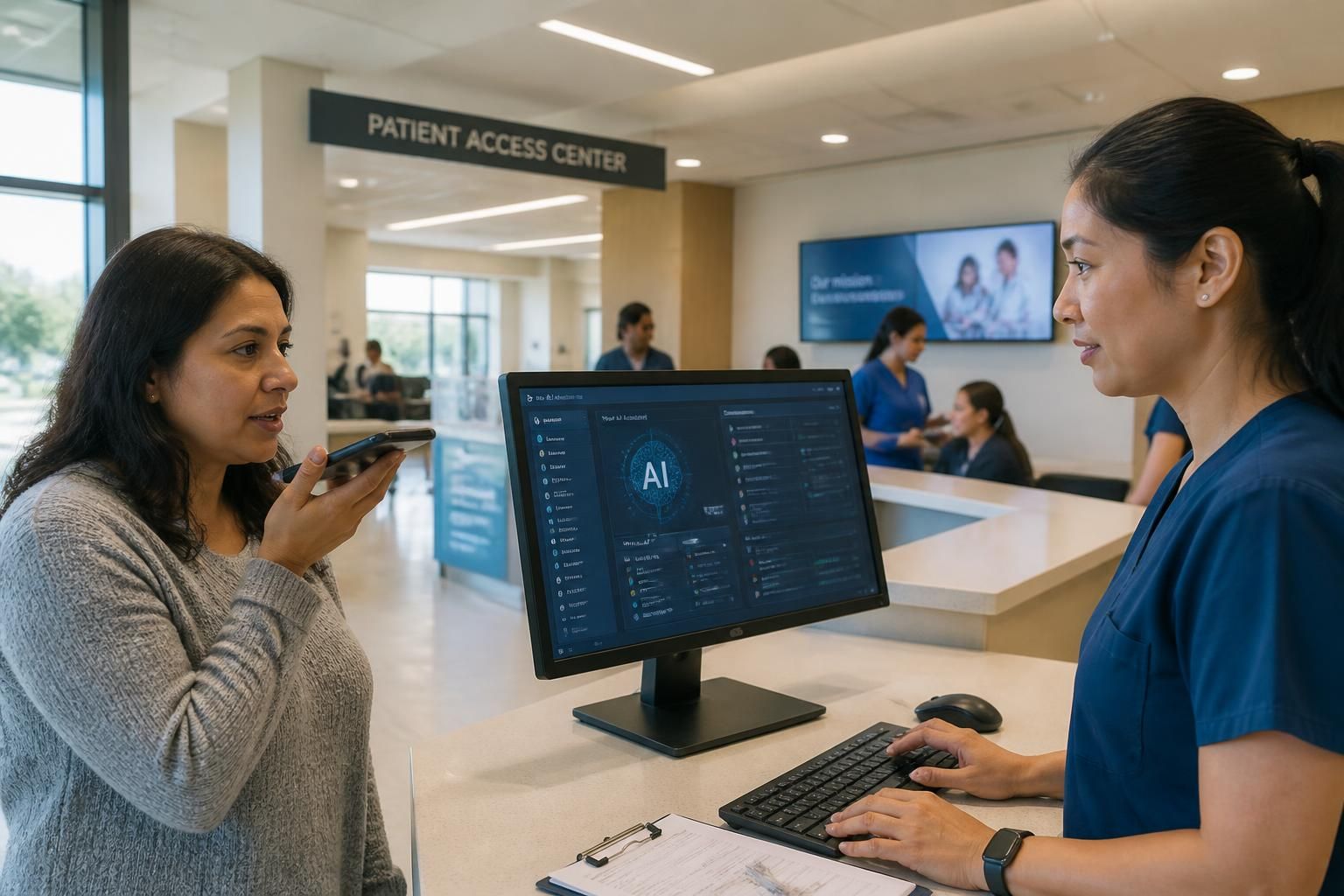
How Emily Shows the Commercial Potential of Healthcare AI and Speech Recognition
Emily’s expansion into pharmacy phone lines is commercially important because pharmacy interactions are frequent, time-sensitive, and often repetitive. Patients may call to ask whether a prescription is ready, whether a location is open, which documents are needed, or how to reach a specialty pharmacy team. These requests are not always clinically complex, yet they can consume significant staff time when volumes grow.
For SoundHound AI, this creates a practical route from conversational capability to recurring enterprise revenue. A health system does not pay for Voice AI merely because the technology sounds impressive. It pays when the platform reduces avoidable friction, improves patient access, supports service consistency, and can be monitored by operational leaders. Each of these outcomes must be measurable.
There is a useful distinction between simple automation and agentic automation. A conventional telephone tree asks users to press numbers, frequently forcing them through rigid menus. A modern agent can let callers speak naturally: “I need to check on my specialty medication,” or “Can someone tell me if my refill is ready?” The system then identifies the request, asks a focused follow-up question, and transfers the caller only if the automated process cannot safely complete the task.
That approach can be especially valuable for people with limited digital confidence. A patient may not use a portal, may struggle to navigate a mobile app, or may simply prefer speaking. Voice channels can therefore support accessibility rather than becoming another barrier. For tourism organizations, museums, and visitor centers, the same lesson applies: useful audio interfaces must respect real user behavior, not force everyone into an idealized digital journey.
Operational outcomes that make a Voice AI deployment credible
A healthcare provider evaluating SoundHound AI should look beyond headline call numbers. The most relevant indicators include containment rate, successful escalation rate, average time to resolution, abandonment rate, patient satisfaction, error rate, and the percentage of calls requiring a human intervention. An agent that contains many calls but fails at important requests is not a success. Similarly, a system that transfers nearly every caller may be safe but delivers limited efficiency.
- ✅ Intent accuracy: Can the system distinguish a refill question from a request for a clinical appointment?
- 📞 Safe routing: Does it transfer urgent or ambiguous situations to the appropriate human team without delay?
- 🔐 Data governance: Are authentication, permissions, records access, and conversation logs aligned with healthcare requirements?
- 🌐 Inclusive design: Does Speech Recognition perform adequately for different accents, speech patterns, and levels of digital literacy?
- 📈 Economic value: Are reduced workload and improved access sufficient to justify deployment and maintenance costs?
The stated Epic integration strengthens the commercial case because health systems do not want disconnected voice experiments. They need tools that fit existing workflows. If a caller provides identification details and the system can securely retrieve the relevant approved information, the experience is faster. If staff must manually repeat the whole process after every automated interaction, the organization has merely shifted work rather than reduced it.
SoundHound AI inherited Amelia as part of its effort to broaden beyond automotive and restaurant voice experiences. That acquisition introduced established enterprise capabilities in sectors including healthcare, financial services, and retail. The strategic question is whether SOUN can integrate these capabilities into its proprietary platform efficiently, retain customers, and build a coherent product portfolio rather than a collection of acquired technologies.
The MUSC Health expansion into retail and specialty pharmacy services suggests that the relationship is progressing from an initial access use case toward a wider operational footprint. This is the pattern investors should watch. Expanding usage within an existing customer is generally more persuasive than winning a small trial, because it can signal satisfaction, trust, and a growing addressable workflow.
🎯 A Voice AI platform becomes commercially meaningful when it solves a specific workflow repeatedly, not when it simply demonstrates that it can hold a conversation.
Is SOUN a Hidden Gem? Reviewing the Valuation Gap Without Ignoring the Risks
The Hidden Gem argument around SOUN rests on a simple valuation contrast. A widely followed analyst narrative has estimated fair value at approximately $13.14 per share, compared with a recently cited closing price of $6.52. That implies an apparent discount of roughly 50.4%. Such a gap may appeal to investors looking for a turnaround or long-term growth opportunity, particularly after the stock’s recent weakness.
However, a fair-value estimate is not a guarantee. It is a model built on assumptions about revenue growth, margins, customer retention, operating expenses, competition, and the timing of profitability. SoundHound AI can only close a valuation gap if it turns its technological position into durable and increasingly predictable business results. The MUSC Health Partnership is relevant precisely because it offers evidence that enterprise adoption may be advancing.
Recent share-price performance shows why caution remains necessary. The cited figures include a 6.89% one-day move and a 4.49% gain over seven days, yet the 90-day return was down 30.42% and the one-year total shareholder return down 41.63%. Over three years, total shareholder return was still more than three times higher. These numbers illustrate a familiar feature of high-growth AI stocks: long-term enthusiasm can coexist with sharp short-term sentiment changes.
That volatility should not be confused with business performance, although it often affects capital access and investor confidence. In 2026, markets are paying closer attention to proof of monetization. Businesses that describe Artificial Intelligence opportunities without demonstrating paid deployments, acceptable gross margins, and manageable cash usage face more skepticism than they did during the earliest wave of generative AI excitement.
| Investor lens | Evidence supporting the opportunity | Risk that needs monitoring |
|---|---|---|
| 📈 Revenue growth | Healthcare expansion can create deeper enterprise usage and recurring contracts. | Large deals may be uneven, delayed, or difficult to replicate across customers. |
| 🧠 Technology differentiation | Polaris AI, voice expertise, and multimodal capabilities may improve speed and accuracy. | Major cloud platforms and established enterprise vendors have substantial resources. |
| 🏥 Healthcare AI adoption | MUSC Health provides a credible, scaled reference deployment. | Compliance, integration, procurement, and clinical safeguards slow sales cycles. |
| 💰 Valuation | The $13.14 narrative suggests material upside from the $6.52 reference level. | Persistent losses can justify a discount if profitability remains distant. |
| 🔄 Customer expansion | Adding pharmacy workflows supports the cross-sell thesis. | Expansion must translate into measurable contract value and retention. |
The bullish case emphasizes SoundHound AI’s proprietary Polaris platform, which the company positions as competitive on latency and accuracy. In voice interactions, latency matters because people do not tolerate long pauses in a phone conversation. A delay of several seconds can make an agent feel unreliable, even when the answer is technically correct. Accuracy matters even more in healthcare, where mistaken routing or incomplete information can have direct consequences.
Another positive element is the potential for operational synergies from migrating acquired products to SoundHound’s stack. If the company can consolidate infrastructure, engineering resources, and product architecture, it may improve gross margins over time. But integrations take time. They can also create disruption if customers experience changes in product performance, support quality, or contract terms.
Investors should examine losses with discipline. SoundHound AI remains a company with sizeable losses, and enterprise revenue can be concentrated in larger contracts that do not necessarily arrive in a smooth quarterly pattern. A promising pipeline is not the same as recognized revenue. A respected client is not automatically proof of broad product-market fit. The question is whether deployments become repeatable, economical, and durable.
For a wider perspective on the company’s competitive positioning, readers can review this comparison of SoundHound and Microsoft in voice AI. It is useful because technology leadership must always be assessed against the resources and distribution advantages of much larger rivals.
⚖️ The stock may be undervalued if enterprise adoption scales faster than current expectations, but the same valuation gap can be rational if losses, concentration, and execution pressure remain high.
What SoundHound AI Must Prove After the MUSC Health Voice Technology Expansion
The most important next step for SoundHound AI is not another broad statement about AI demand. It is proof that the MUSC Health model can be deployed with a repeatable operating playbook. Healthcare organizations vary by region, clinical workflows, software configuration, patient demographics, and governance standards. A solution that performs well in one system still needs adaptation before it can be used widely.
In practical terms, SOUN must demonstrate that implementation time is reasonable, that Epic-connected workflows can be configured without excessive custom development, and that customer teams can manage the system after launch. Enterprise Voice AI creates value when it is operationally manageable. A hospital should not need a large specialist team simply to update opening hours, add a new service line, review failed interactions, or refine escalation rules.
From headline partnership to reproducible enterprise product
A robust sales model usually has three layers. First, a reference customer validates the product in a demanding setting. Second, the supplier converts the learning into templates, integration modules, compliance documentation, and onboarding processes. Third, it sells the resulting package to comparable organizations with lower deployment friction. The MUSC Health case is most valuable if it supports all three stages.
Imagine a regional health network called Northbridge Care that is considering a voice agent for 12 hospitals and several pharmacy locations. Its procurement team will not only ask whether Emily handled millions of calls. It will ask how the agent handles language variations, what happens when an electronic record is temporarily unavailable, whether supervisors can audit conversations, and how the vendor responds to inaccurate outputs.
These questions reveal why the market for Healthcare AI can be attractive but demanding. Buying decisions involve IT, operations, legal, privacy, cybersecurity, patient-experience leaders, and sometimes clinical departments. A winning vendor must make the purchasing process easier by providing clear governance, transparent limitations, and implementation support. In this context, trust is a commercial asset.
SoundHound AI also needs to show that its Voice Technology can serve organizations outside healthcare without diluting its focus. The company operates in several markets, including automotive, restaurants, smart devices, financial services, and retail. Diversification can reduce reliance on one industry, but it can also stretch engineering and sales capacity. The strongest strategy is to reuse a core conversational platform while adapting the final workflow layer to each sector’s requirements.
For example, a guided-tour operator may use audio systems to deliver synchronized multilingual commentary to visitors. Its requirements differ from a hospital’s, yet both environments depend on clear speech, low latency, accessible interaction, and reliable support when a user needs help. The shared lesson is that audio experiences are judged by usability under real conditions: background noise, interruptions, poor connectivity, varied accents, and time pressure.
Monitoring is equally important. Responsible voice agents should be reviewed through real conversation data, not only pre-launch scripts. Teams need to identify where callers abandon the process, which phrases trigger misunderstandings, and when transfers occur. Improvements should be documented and tested, especially in a health environment where a poorly designed change can affect access to care.
The company’s financial reporting must connect product activity to economic progress. Investors should look for details such as customer expansion, recurring revenue mix, gross-margin development, backlog quality, and operating expense discipline. Broad adoption claims are less useful than evidence showing that a customer moved from a limited pilot to a broader contract, then to additional functions.
Readers following the financial side can also consult this analysis of SoundHound AI’s Q4 2025 revenue context. Revenue trends matter because the market will ultimately assess whether Voice AI deployments generate sustainable business performance rather than isolated publicity.
🛠️ The next proof point is repeatability: SoundHound AI must show that a complex deployment can become a scalable product, with controlled implementation costs and a dependable customer experience.
How Investors and Enterprise Buyers Can Evaluate the SOUN Healthcare AI Opportunity
SoundHound AI should be assessed through two different but connected perspectives. Investors need to evaluate risk, valuation, balance-sheet resilience, and the chance of future profitability. Enterprise buyers need to assess workflow fit, security, accessibility, accuracy, and operational ownership. A system can be exciting for investors but unsuitable for a hospital. Conversely, a valuable hospital deployment may take time to become material in a public company’s revenue base.
For investors, the first discipline is separating a compelling story from measurable traction. The MUSC Health Partnership is a positive data point because it involves an established health system, an Epic-related environment, and an expansion into pharmacy operations. Yet the investment case should not rest on one customer. Concentration risk can be significant when companies rely on large enterprise agreements, especially if contract timing is uneven.
The second discipline is understanding what the market may already be pricing in. The apparent difference between the $13.14 fair-value narrative and the $6.52 share price could indicate a Hidden Gem. It could also reflect the market’s view that forecasts require unusually strong execution. Investors should test the assumptions behind any model: What growth rate is required? When do margins improve? What level of dilution or cash use is expected? How many major deployments must be won?
For enterprise buyers, the decision framework begins with a narrower question: which calls should be automated first? The answer is rarely “all of them.” High-volume, low-risk, clearly defined tasks are often the best starting point. Examples include hours, locations, general service information, basic appointment navigation, pharmacy status checks, and secure routing. Clinical triage, emotionally sensitive complaints, or unclear urgent needs require stricter safeguards and immediate human pathways.
- 🔍 Map the call journey: Identify the most common intents, peak periods, abandonment points, and reasons for transfers.
- 🧪 Run controlled testing: Test the agent with real language variation, interruptions, multiple accents, and incomplete requests.
- 🧑⚕️ Define escalation rules: Make human handoff visible, rapid, and appropriate for high-risk or unresolved interactions.
- 📊 Measure outcomes: Track resolution, transfers, satisfaction, staff workload, and error patterns from the first week.
- 🔄 Improve continuously: Use monitored conversations to refine intent models, scripts, prompts, and service information.
This approach also applies to cultural venues, tourism offices, and group-visit organizers that want to deploy voice-based assistance. Visitors may ask for directions, mobility information, language options, or schedule changes. The technology should remove friction without making people feel trapped in a machine-led experience. Clear fallback to a human remains an important part of accessible service design.
SoundHound AI’s opportunity is tied to a wider shift from app-only self-service to conversational access. People are comfortable speaking to phones, in-car assistants, and connected devices, but their expectations are rising. They want immediate responses that are relevant, understandable, and secure. That makes the quality of Speech Recognition, dialogue management, and backend integration more important than a flashy demo.
There are meaningful risks. Large technology companies can bundle AI functions into broader cloud or productivity contracts. Healthcare procurement can move slowly. Regulations and privacy obligations can increase cost. A flawed interaction can harm patient trust. SoundHound AI must therefore compete on focused implementation, domain-aware workflow design, measurable results, and customer support—not on generic claims about Artificial Intelligence.
The most balanced interpretation is that MUSC Health provides a credible signal of demand for agentic voice systems in healthcare. It does not erase SOUN’s financial and competitive risks. Investors who treat the company as a high-risk growth position should monitor execution indicators over time, while health organizations should require clear performance and governance standards before expanding deployment.
📌 The durable value of Voice AI will be determined by dependable service outcomes: fewer abandoned calls, better access, safe escalation, and workflows that genuinely help both users and staff.
Why is the MUSC Health partnership important for SoundHound AI?
MUSC Health provides SoundHound AI with a large-scale enterprise reference for its Amelia-powered voice agent. The expansion into retail and specialty pharmacy calls suggests the platform is being used beyond an initial patient-access deployment, which can support the company’s enterprise growth narrative.
What is Emily in the SoundHound AI and MUSC Health deployment?
Emily is an AI agent used by MUSC Health to support patient access and voice-based self-service. It is powered by SoundHound AI’s Amelia Patient Engagement solution and is designed to handle approved requests, provide information, and route more complex needs to staff.
Is SOUN a Hidden Gem based on the analyst fair-value estimate?
The cited fair-value estimate of about $13.14 versus a recent $6.52 share price suggests potential upside, but it is not a certainty. The estimate depends on assumptions about revenue growth, margins, customer adoption, and the path to profitability, while SoundHound AI still faces losses and enterprise execution risk.
What should healthcare organizations measure when deploying Voice AI?
Organizations should measure intent accuracy, successful resolution, safe human escalation, abandonment rates, patient satisfaction, error patterns, privacy compliance, and staff workload changes. High automation rates alone do not prove that a voice agent is delivering useful or safe service.
