
Verus Voice AI Brings Voice Recognition to Corrections Communication
LEO Technologies introduced Verus Voice AI on July 27, 2026 as a new capability inside its Verus AI platform. The product is designed for corrections agencies that need to turn monitored inmate calls into operational signals without asking staff to manually review an unmanageable volume of recordings.
The central use case is Personal Identification Number, or PIN, abuse. A PIN may be lent, stolen, exchanged, or used under pressure, while the person speaking on a call may not be the account holder. Verus Voice AI shifts the verification point from the numeric credential to the acoustic identity of the speaker.
This distinction matters in a correctional environment. A conventional communication system can log the number used, call duration, destination, and facility location. Yet those details alone may not establish whether the authorized person was actually present. Voice recognition adds an evidentiary layer that examines who appears to be speaking rather than simply which PIN opened the session.
LEO Technologies describes the capability as an agentic artificial intelligence workflow that develops and monitors voice identities across large communication datasets. Instead of relying on an investigator to find anomalies after the fact, the system is intended to identify potential discrepancies as calls occur and route alerts to qualified personnel for review.
For a practical illustration, consider a fictional county facility called Northgate Correctional Center. An inmate named Jordan has an approved PIN and regularly calls a family number. Over several days, the system detects that calls placed with Jordan’s PIN contain a substantially different speaker profile, including recurring vocal characteristics tied to another monitored caller. That signal does not automatically prove misconduct, but it gives the investigation team a focused reason to compare call history, housing assignments, incident reports, and access records.
That workflow is more useful than a simple alert saying “possible violation.” Facility staff need context: Was there a legitimate explanation? Is the voice pattern consistent across several calls? Was the account holder moved, unavailable, or involved in a documented incident? The wider Verus AI environment is positioned to help teams bring those relevant data points together before a decision is made.
- 🎙️ Voice-based identity checks: evaluates the speaker rather than treating a PIN as definitive proof of identity.
- ⚠️ Near-real-time alerting: surfaces potential misuse while the operational context is still relevant.
- 🔎 Investigative context: allows personnel to review a flagged event against communication history and facility data.
- 👥 Human review: keeps trained staff responsible for validating findings and deciding on any response.
Voice biometrics is not a replacement for policies, trained investigators, or clear due-process procedures. It is a communication technology designed to reduce blind spots in a setting where call data can be valuable but difficult to assess at scale. The stated purpose is not to treat an algorithmic match as a final judgment; it is to make the right conversation easier to find.
Agencies evaluating the product can review the provider’s description of Verus Voice AI capabilities, including its positioning around identifying unauthorized communications and suspected PIN fraud. Procurement teams should distinguish product claims from local validation requirements, especially where facility rules, contracts, and state regulations differ.
The operational value begins with a simple premise: a credential can move between people, but a consistent voice pattern is far harder to exchange.
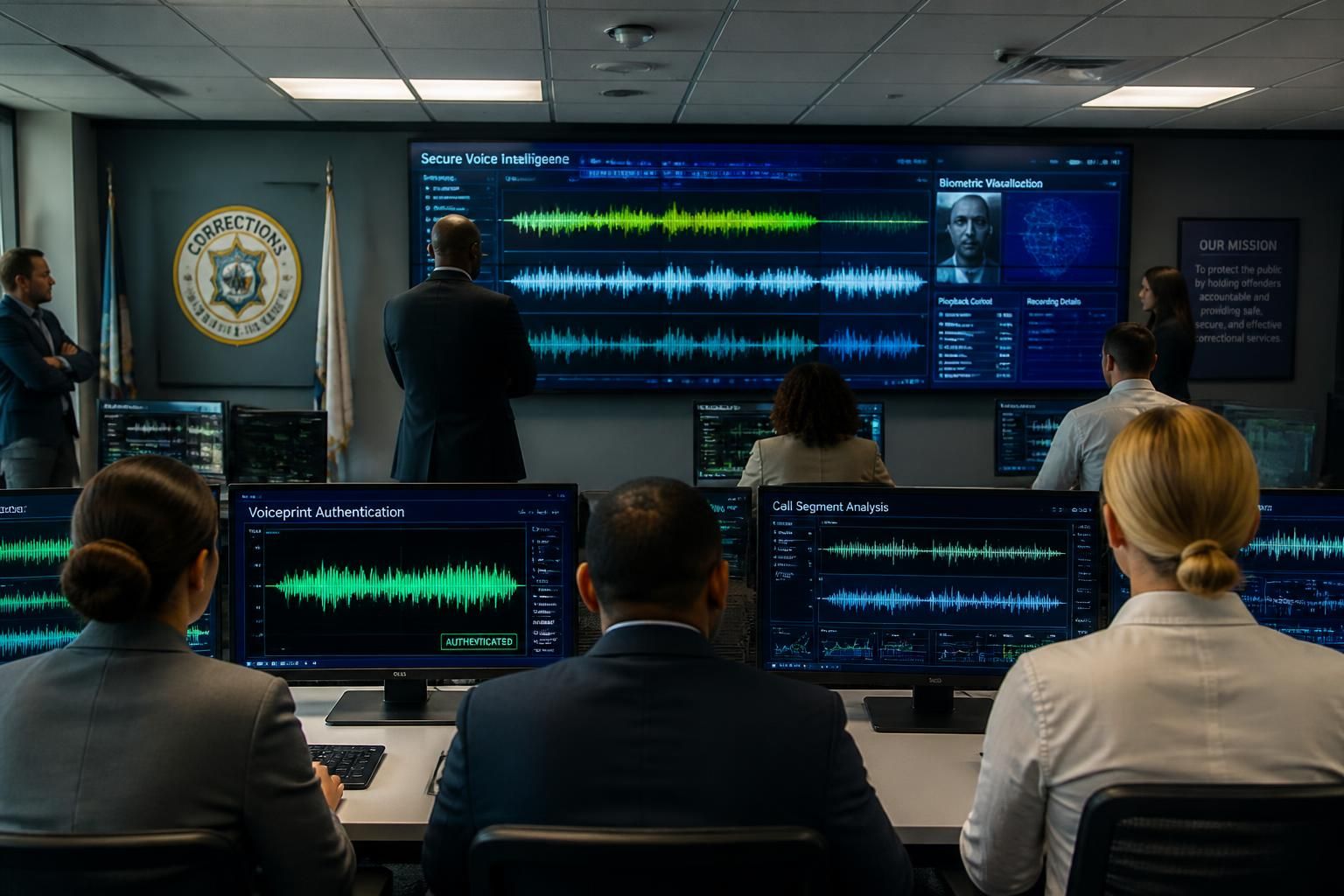
How LEO Technologies Uses Artificial Intelligence to Detect PIN Abuse
PIN abuse is a persistent operational problem because the credential itself is only a key to access a system. In a busy facility, a number can be shared voluntarily, obtained through coercion, or used by an individual other than its assigned owner. Traditional reviews often begin after an incident, when staff must search calls, notes, and records across several systems.
Verus Voice AI is presented as an automation layer for that process. It analyzes recorded communications and compares the voice present on a call with voice patterns established across prior interactions. If the detected speaker appears inconsistent with the identity associated with the PIN, the platform can raise a potential issue for staff rather than requiring someone to discover it through random sampling.
This is where artificial intelligence must be understood as a support mechanism, not an autonomous authority. A voice model works with probabilities and patterns. Audio quality, background noise, accents, medical conditions, stress, illness, and short recordings can all affect the usability of speech data. A sound operational design therefore requires alert thresholds, documented review steps, and a clear route for resolving false positives.
From a call event to a defensible staff review
A defensible workflow starts with a monitored call placed under an approved facility policy. The system processes the available audio and evaluates whether the speaker aligns with the voice profile expected for that account. When an inconsistency reaches the configured threshold, the event is surfaced to an investigator or designated facility employee.
The reviewer should then examine the alert in context. A responsible process may include listening to relevant call excerpts, checking the account owner’s recent activity, comparing prior calls, and verifying whether staff reports or housing changes explain the discrepancy. A potential match is an investigative lead, not a disciplinary decision by itself.
| Workflow stage | What Verus Voice AI can support | Required human control |
|---|---|---|
| 📞 Call processing | Analyzes monitored voice communications at volume | Confirm that monitoring and retention practices follow policy |
| 🧬 Speaker comparison | Flags a possible mismatch between PIN and detected voice | Assess audio quality and the relevance of the signal |
| 🔗 Context review | Connects the event to broader Verus AI information | Review call history, facility records, and alternative explanations |
| 🛡️ Response | Prioritizes events requiring attention | Make and document the final operational decision |
For Northgate Correctional Center, the benefit is not merely faster identification of an irregularity. It is the ability to give an investigator a structured starting point. Instead of searching hundreds of calls to locate one suspected misuse event, the staff member can begin with an alert, review its confidence and history, then apply professional judgment.
The announcement also emphasizes a proprietary large language model system within the broader platform. In practical terms, language-oriented AI can help organize unstructured information, while biometrics focuses on the characteristics of the voice itself. Keeping those functions conceptually separate is important: transcription may reveal what was said, whereas speaker analysis seeks to establish who may have said it.
Corrections agencies should also ask implementation questions early. Which calls are in scope? How long are recordings retained? Who receives alerts at night or during shift changes? What evidence must be saved when a case is escalated? Clear answers improve both security and staff confidence.
Useful automation does not eliminate review; it makes review more targeted, timely, and traceable.
Improving Security Without Removing Human Oversight in Corrections Agencies
Security technology is most credible when it clarifies accountability rather than obscuring it. LEO Technologies states that Verus Voice AI includes safeguards intended to ensure qualified personnel review findings before action is taken. This design principle is essential in corrections, where a false assumption can affect investigations, privileges, safety procedures, and institutional trust.
A well-designed alert should provide enough information for a reviewer to understand why it was generated. If a system simply labels a call “suspicious,” staff may either overreact or ignore alerts after repeated ambiguity. By contrast, an alert that links a detected voice inconsistency to relevant call history gives the reviewer a basis for a proportionate next step.
Human oversight also protects against a common mistake in technology deployment: confusing detection with certainty. Voice recognition can identify patterns that deserve attention, but it cannot by itself explain motive, coercion, authorization, or context. A person might speak on a call using another individual’s PIN because of deliberate fraud, but there may also be a legitimate operational explanation that data alone cannot reveal.
Building a review protocol that staff can actually use
Before deployment, an agency should define who owns each stage of the workflow. Intelligence staff may validate the technical signal, while unit staff can verify local circumstances. Supervisors should determine whether a case warrants additional review, a welfare check, account controls, or referral to an investigative team.
Northgate offers a useful fictional example. An alert indicates that an inmate’s PIN was used by an unfamiliar speaker. The analyst first reviews the audio and discovers the recorded call includes an inmate helping another person navigate a telephone prompt after a documented disability accommodation issue. The alert is closed with a note, and the agency retains a record that the system functioned as intended by surfacing an event for review rather than making an unsupported accusation.
That example demonstrates why auditability matters. Each step should be documented: the alert date, reviewer, evidence examined, disposition, and any follow-up. An audit trail supports internal quality checks and helps an agency explain how it used communication intelligence responsibly.
- ✅ Define alert ownership: assign named teams or roles to receive, review, and close events.
- 🧾 Document decisions: record the rationale behind a closure, escalation, or operational action.
- 🎧 Verify audio conditions: assess whether noise, short speech segments, or poor connections affected the signal.
- ⚖️ Apply proportional responses: match the response to corroborated facts, not to an alert alone.
- 🔄 Review performance regularly: inspect false positives, missed events, response times, and staff feedback.
Privacy and compliance deserve the same operational discipline. Agencies should ensure that the use of voice biometrics fits applicable laws, facility authority, contractual obligations, retention schedules, and notification rules. A technology vendor may provide the platform, but the agency remains responsible for governance in its own environment.
The public-sector context is also relevant. LEO Technologies’ role in correctional communication analysis has expanded alongside broader government interest in AI-enabled monitoring tools. For perspective on its federal footprint, readers can consult reporting on the Federal Bureau of Prisons technology contract, while recognizing that every deployment must be evaluated on its individual scope and safeguards.
In high-stakes environments, the strongest security control is not an alert by itself; it is the documented judgment applied after the alert appears.
Verus AI Connects Communication Technology With Operational Context
Verus Voice AI is not positioned as an isolated speech-analysis tool. It sits within Verus AI, a unified operating environment built for corrections agencies and described by LEO Technologies as bringing together communications analysis, video intelligence, voice biometrics, and operational data. The strategic idea is straightforward: a voice anomaly becomes more useful when staff can evaluate it alongside relevant facility information.
In many institutions, the challenge is fragmentation rather than lack of data. Calls may sit in one application, incident reports in another, video records in a separate system, and operational notes in yet another workflow. Investigators lose time moving between interfaces and may miss connections when the evidence is dispersed.
Integrated communication technology can reduce that friction. If an alert identifies a possible PIN discrepancy, staff can investigate associated patterns: repeated contact with a particular outside number, unusual calling times, recent disciplinary events, relevant housing movements, or separate records that help explain the event. The objective is not to collect data for its own sake; it is to give authorized staff usable context at the moment it matters.
Why a unified view changes investigative prioritization
Consider another Northgate scenario. Several alerts involve calls to the same external number, but each call was placed using a different inmate PIN. A standalone call log may show unrelated events. A platform that organizes voice-level findings and communication history may help an investigator see that the same voice appears across those calls, creating a clearer lead for a targeted review.
This type of correlation can support law enforcement partners when a facility’s established rules and authorized investigative processes require coordination. It may also improve internal safety operations, such as identifying potential coercion, unauthorized access, or activity that should be reviewed by intelligence personnel. The key word is “support”: software can prioritize patterns, while people determine their meaning.
LEO Technologies identifies three components in its broader portfolio: Verus Vision AI, Verus Voice AI, and Verus ION. Their relevance depends on the agency’s existing technology estate and operational objectives. A facility should avoid adopting a unified platform merely because integration sounds modern; it should map each capability to a defined use case, owner, measure of success, and governance control.
| Operational question | Relevant information layer | Potential staff benefit |
|---|---|---|
| 👤 Is the authorized account holder speaking? | Voice biometrics | Identify a potential PIN mismatch for review |
| 🗣️ What communication pattern surrounds the event? | Call history and transcription analysis | Prioritize related conversations or contacts |
| 📹 What was occurring in the facility? | Video intelligence where authorized | Check whether a relevant event has operational context |
| 🧭 What should happen next? | Unified operational data and case workflow | Route the matter to the appropriate reviewer |
The same design logic appears in other sectors that manage high volumes of spoken interactions. Contact centers, banks, travel operators, and public services increasingly use AI to organize calls, detect risk indicators, and guide agents toward the right case. A useful comparison is this overview of voice AI benchmarking and operational evaluation, which highlights why performance measures and real-world testing matter more than broad marketing language.
For corrections, the stakes are different and governance must be stricter. Still, the user-experience principle remains relevant: a system must place the right information in front of the right person without creating another dashboard that staff cannot realistically use during a demanding shift.
Connected intelligence is valuable only when it shortens the path from a signal to informed, accountable action.
Deploying Verus Voice AI With Measurable Security and Workflow Standards
A successful deployment begins before the first alert is generated. Corrections agencies should define the precise operational problem they want Verus Voice AI to address, whether that is suspected PIN sharing, account misuse, unauthorized communications, investigative prioritization, or a combination of these needs. A broad ambition such as “use AI for security” is too vague to guide configuration, training, or evaluation.
The next step is to establish a baseline. How many suspected PIN incidents are currently identified each month? How long does it take an investigator to review a typical call-related lead? How many communications are reviewed manually, and how many produce useful findings? Without baseline data, it is difficult to determine whether automation is improving operational performance or simply producing more notifications.
A phased rollout reduces operational risk
Northgate could begin with one unit or a limited cohort of monitored accounts. During this pilot, analysts would compare Verus Voice AI alerts against established investigative outcomes. The goal would be to understand alert quality, audio constraints, workload impact, and the conditions under which staff find the alerts most useful.
Training should focus on decisions, not only buttons. Personnel need to know what a voice-related alert means, what it does not mean, when to consult another team, and how to document a review. Supervisors should also receive guidance on quality assurance, escalation practices, and periodic reporting.
- 📌 Set a defined use case: state exactly which forms of PIN abuse or communication risk are in scope.
- 📊 Measure the starting point: capture review times, existing detection methods, and verified case volumes.
- 🧪 Pilot before expanding: test the workflow with a controlled group and document outcomes.
- 👩⚖️ Create review rules: specify the evidence needed before any operational action is considered.
- 🔐 Confirm data governance: define access rights, retention, auditing, and escalation requirements.
- 📈 Evaluate continuously: review accuracy indicators, alert volume, staff workload, and closed-case value.
Meaningful metrics should include more than the number of alerts. Agencies can track the percentage of alerts that lead to substantiated findings, median time from alert to review, number of false-positive dispositions, and investigator feedback on whether the information was actionable. These measures help leaders tune thresholds and identify training gaps.
Procurement teams should also assess interoperability. Verus Voice AI is described as available to new and existing LEO Technologies customers, but a facility should still verify how the service connects with its current inmate telephone system, identity processes, data policies, and investigative procedures. Technical integration is only one part of readiness; operational ownership is equally important.
For agencies seeking additional background on the launch, coverage of the Verus Voice AI release outlines its stated focus on detecting PIN abuse in real time. The appropriate next action is a structured demonstration that uses the agency’s own workflow questions, rather than a generic product presentation.
Security innovation earns trust when it is measurable. If a tool helps staff find credible anomalies faster, preserves review records, and reduces avoidable manual searching, it has a clear role. If it overwhelms teams with unexplained alerts, it requires adjustment before expansion.
The most practical deployment standard is simple: every alert should lead to a clearer, faster, and better-documented human decision.
What is Verus Voice AI?
Verus Voice AI is a LEO Technologies capability within the Verus AI platform. It uses voice biometrics and artificial intelligence to help corrections agencies identify potential PIN abuse, identity fraud, and unauthorized communications in monitored inmate call data.
Can voice recognition automatically prove that an inmate committed PIN fraud?
No. A voice-related mismatch is an investigative signal, not final proof. LEO Technologies states that findings are intended to be reviewed by qualified personnel before action is taken, preserving human oversight and accountability.
Why is PIN abuse difficult for correctional facilities to identify?
A PIN confirms that a credential was used, but it does not necessarily confirm who was speaking. PINs may be shared, exchanged, stolen, or used under coercion, making voice biometrics a potentially useful additional verification layer.
What should agencies measure during a Verus Voice AI pilot?
Useful measures include alert volume, substantiated findings, false-positive rates, time from alert to review, investigator workload, documentation quality, and whether alerts produce actionable operational context.
