
Enhancing Inbound Industrial Call Management with AI-Powered Voice Frameworks
In the rapidly evolving landscape of manufacturing, managing inbound industrial calls efficiently is a critical challenge addressed by revolutionary AI-powered voice frameworks. Traditional call centers often face obstacles such as high call volume, long wait times, and inconsistent customer experiences, especially in industrial settings where precision and timely communication are vital. By integrating artificial intelligence with voice recognition technology, companies can automate routine communications, reduce human error, and provide real-time responses tailored specifically to industrial inquiries.
AI-powered voice frameworks utilize natural language processing and machine learning to interpret caller intent accurately. This capability enables immediate routing of calls to appropriate departments or providing automated resolutions for common issues without human intervention. For example, when a manufacturing plant experiences equipment malfunctions, an AI voice system can quickly gather essential information, suggest troubleshooting steps, or escalate urgent problems to maintenance teams.
Moreover, these frameworks are designed to handle noisy industrial environments effectively, thanks to enhanced speech recognition models tuned for such conditions. This significantly improves voice clarity and reduces communication breakdowns, thereby streamlining inbound calls and sustaining operational continuity. Companies leveraging such solutions report notable reductions in customer service costs and lead times for incident resolution.
One implementation worth noting is how Rivion’s AI voice calls integrate seamlessly with multiple communication channels including WhatsApp, Instagram, and traditional phone lines, offering manufacturers a unified call management solution. Their AI adapts dynamically to various interaction mediums, ensuring that inbound calls—regardless of origin—are handled with consistent efficiency and reliability, which reflects the modernization efforts vital for today’s manufacturing competitiveness. (More detail on this at Rivion AI voice calls in manufacturing).
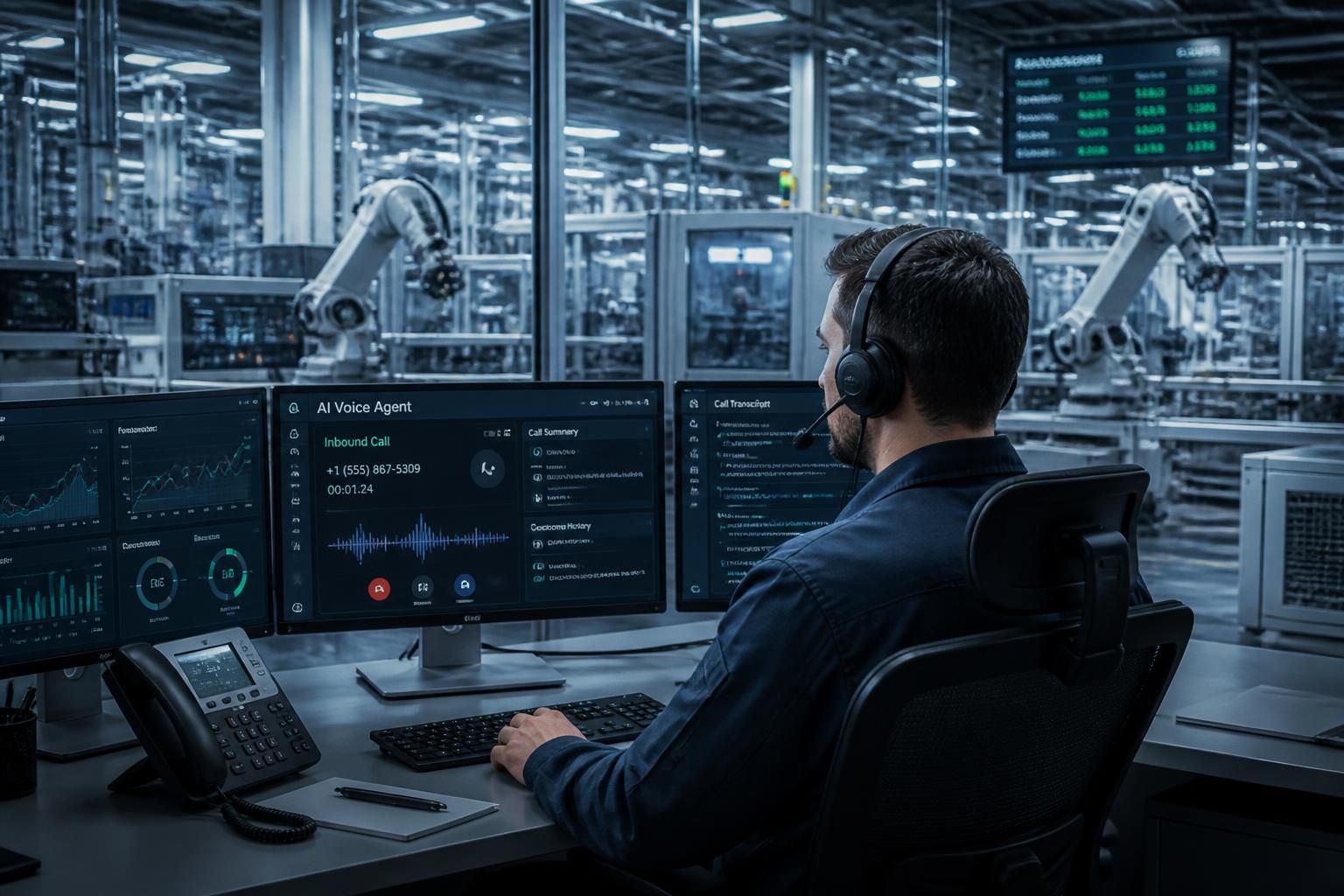
Driving Productivity Through AI-Driven Automation of Industrial Call Processes
Automation in manufacturing operations is no longer limited to the production line; it now extends into communications with the advent of AI-powered voice systems. Streamlining inbound industrial calls through automation enables manufacturers to reduce downtime, decrease response times, and allocate human resources more strategically.
Firstly, AI voice frameworks enable hands-free operation for industrial workers, facilitating multitasking without disrupting safety or productivity. For example, operators can interact with AI assistants vocally while monitoring machines or managing assembly lines, updating reports, requesting part orders, or logging incidents effortlessly.
Secondly, automation enhances quality control by automatically documenting call interactions and generating detailed transcripts. This process mitigates risks of miscommunication, aids regulatory compliance, and provides searchable documentation for later analysis. The continuous improvement cycle benefits greatly from such uninterrupted data streams, allowing proactive maintenance and issue anticipation.
Additionally, AI can intelligently prioritize and escalate inbound calls based on contextual urgency. An AI framework can assess voice signals, keywords, and sentiment analysis to identify emergency situations—such as critical machinery failures—and rapidly direct calls to human experts. This dynamic prioritization significantly reduces operational risks and supports keeping production lines running optimally.
Microsoft’s recent outlook highlights that adopting AI in manufacturing at scale transforms not only production but also communication networks, yielding significant ROI by reducing manual interventions and optimizing resource deployment (Microsoft Cloud Blog on AI ROI in manufacturing). This augmented ecosystem bolsters industry-wide efficiency in a sustainable and scalable manner.
Artificial Intelligence Impact on Streamlining Industrial Communication Channels
Manufacturing demands rapid, accurate communication across diverse teams and departments, often spanning front-line workers, engineers, logistics, and management. Artificial Intelligence fosters seamless integration between these communication layers by automating call management and providing real-time insights tailored to inbound industrial calls.
AI-driven voice systems contribute significantly to reducing response times through predictive analytics that anticipate caller needs before fully understanding their queries. By analyzing historical call data and operational metrics, the AI framework offers personalized assistance and routes calls efficiently.
Furthermore, multilingual support powered by advanced AI models facilitates communication in global manufacturing setups. This capability ensures verbal exchanges can occur smoothly regardless of regional accents or language differences, promoting inclusiveness and operational consistency.
A practical illustration appears in how voice AI technologies manage 24/7 internal communications on production floors. Robotics & Automation News details how these systems automate shift handovers, safety alerts, task assignments, and reporting — all through voice interfaces that minimize manual errors and enhance safety protocols (Voice AI automates manufacturing floor communications).
By streamlining inbound industrial calls with AI-powered voice frameworks, manufacturers reduce operational friction, accelerate problem resolution, and safeguard information accuracy, ultimately improving overall communication efficacy and productivity.
Optimizing Industrial Call Workflows Through AI Enhancement and Integration
Optimizing workflows in industrial call management involves leveraging AI’s ability to not only automate but also intelligently orchestrate complex communication networks. Streamlining these workflows maximizes efficiency and ensures critical industrial issues receive priority attention automatically.
Integration of AI-powered voice frameworks with existing manufacturing systems like ERP, CRM, and predictive maintenance software creates a synchronized platform where call data enriches operational intelligence. For example, calls triggered by equipment alerts can initiate automated service tickets within maintenance platforms, reducing time-to-resolution dramatically.
Table 1 demonstrates key capabilities and impacts of AI-powered voice frameworks on inbound call workflows:
| 🛠️ Feature | ⚙️ Description | 🚀 Operational Benefit |
|---|---|---|
| Real-Time Voice Recognition | Accurately processes caller inquiries even in noisy environments. | Reduces call drop-offs and misunderstandings. |
| Automated Call Routing | Directs calls instantly to the right department or support agent. | Accelerates issue resolution and reduces wait times. |
| Contextual Urgency Detection | Analyzes voice and keyword patterns to prioritize critical calls. | Ensures rapid escalation of emergencies. |
| Multichannel Integration | Supports calls via phone, WhatsApp, and social media platforms. | Centralizes communications into a seamless system. |
| Call Analytics and Reporting | Generates insights on call volumes, common issues, and agent performance. | Informs continuous improvement strategies. |
These capabilities form the backbone of streamlined inbound call workflows, enabling manufacturing leaders to maintain operational resilience while scaling communication efficacy. For implementation insights, consult AI voice automation in manufacturing operations.
Ensuring Scalability and Future-Readiness with Voice AI in Manufacturing Communications
Looking ahead, the adoption of AI-powered voice frameworks for inbound industrial calls aligns with broader trends of digital transformation in manufacturing. Scalability and adaptability remain key considerations as factories evolve into smart, interconnected ecosystems.
Voice AI systems must handle growing call volumes while adapting to emerging needs such as integration with industrial IoT devices and enhanced data security measures. Providers increasingly focus on edge AI models that process voice data locally on the factory floor, minimizing latency and protecting sensitive information.
Scalable AI voice frameworks also emphasize user-friendly interfaces that accommodate workers at different tech competency levels. Training is streamlined, ensuring faster onboarding and sustained worker engagement.
Moreover, sustainable manufacturing benefits from optimized communication systems that reduce resource wastage through better coordination and predictive maintenance scheduling. AI-driven voice frameworks therefore become pivotal in meeting environmental and operational goals simultaneously.
The McKinsey report highlights how accelerating AI adoption at speed and scale empowers manufacturers to innovate and maintain a competitive edge in an increasingly global market (Adopting AI rapidly and effectively in manufacturing).
Manufacturing professionals should consider integrating these advanced voice AI frameworks today to future-proof their communication strategies and operational workflows.
What are the key benefits of using AI-powered voice frameworks for inbound manufacturing calls?
They improve call handling speed, accuracy, and prioritization, reduce operational costs, enable hands-free communication, and enhance documentation and analytics.
How do AI voice systems handle noisy industrial environments effectively?
Advanced speech recognition models are specifically trained to filter out industrial noise and focus on vocal inputs, ensuring accurate understanding despite background sounds.
Can AI-powered voice frameworks integrate with existing manufacturing software?
Yes, they can seamlessly connect with ERP, CRM, and maintenance management systems, facilitating automatic ticket creation, data sharing, and workflow synchronization.
What role does AI play in prioritizing inbound industrial calls?
AI analyzes voice tone, keywords, and contextual data to distinguish urgent issues from routine inquiries, enabling faster escalation of critical problems.
Are AI-powered voice systems scalable for future manufacturing demands?
Modern voice AI is designed for scalability, supporting growing call volumes, new communication channels, and integration with emerging technologies like industrial IoT and edge computing.
