
Peu de temps ? Voici l’essentiel à retenir :
✅ US conservatives are mobilizing a nationwide day of protest to address concerns over unchecked policies related to AI data centers.
✅ The protest is set for July 18th in key states including Georgia, California, Texas, Florida, and Virginia.
✅ This public demonstration reflects deeper political activism rooted in grassroots movements wanting stronger policy opposition.
✅ The unfolding events reveal tensions within conservative factions, highlighting the complexity of AI’s societal impact.
US Conservatives Mobilize Grassroots Movements for a Nationwide Day of Protest Against AI Data Centers
The burgeoning opposition against AI data centers across the United States has galvanized US conservatives into organizing a nationwide day of protest, focusing on what they label the “unchecked and unwanted expansion” of these facilities. The initiative, driven by the Republican-aligned group Humans First, strategically targets 13 locations across states such as Georgia, California, Texas, Florida, and Virginia. The group asserts the necessity for grassroots Americans — particularly conservatives — to have a direct voice in shaping policies that regulate the rapid construction of massive AI data centers.
This mobilization carries the ethos of earlier conservative activism, drawing parallels with movements such as the Tea Party. Amy Kremer, chair of Humans First and an early Tea Party leader, emphasizes the persistent disconnect between political elites and grassroots supporters. She frames the data center expansion as a modern battleground reflecting this divide, underscoring the protest’s origins in deep-seated political activism and policy opposition.
Critically, this movement is not isolated to a narrow political spectrum. Although the organizing body is Republican-aligned, local opposition to AI data centers often transcends party lines, involving largely working-class communities. These groups have successfully delayed or canceled projects worth over $130 billion, indicating the potency of bipartisan grassroots resistance. In this context, the nationwide protests set for July 18th aim to transform scattered local dissent into a coordinated, cohesive public demonstration, amplifying pressure on policymakers.
The strategic mobilization aligns with patterns observed in past US protests noted in recent reports, where grassroots movements increasingly influence national discourse. By orchestrating rallies simultaneously across multiple states, Humans First leverages the power of collective activism, inviting conservative voices to articulate concerns on the policy front regarding AI data centers’ expansion and the broader apprehensions around artificial intelligence systems.
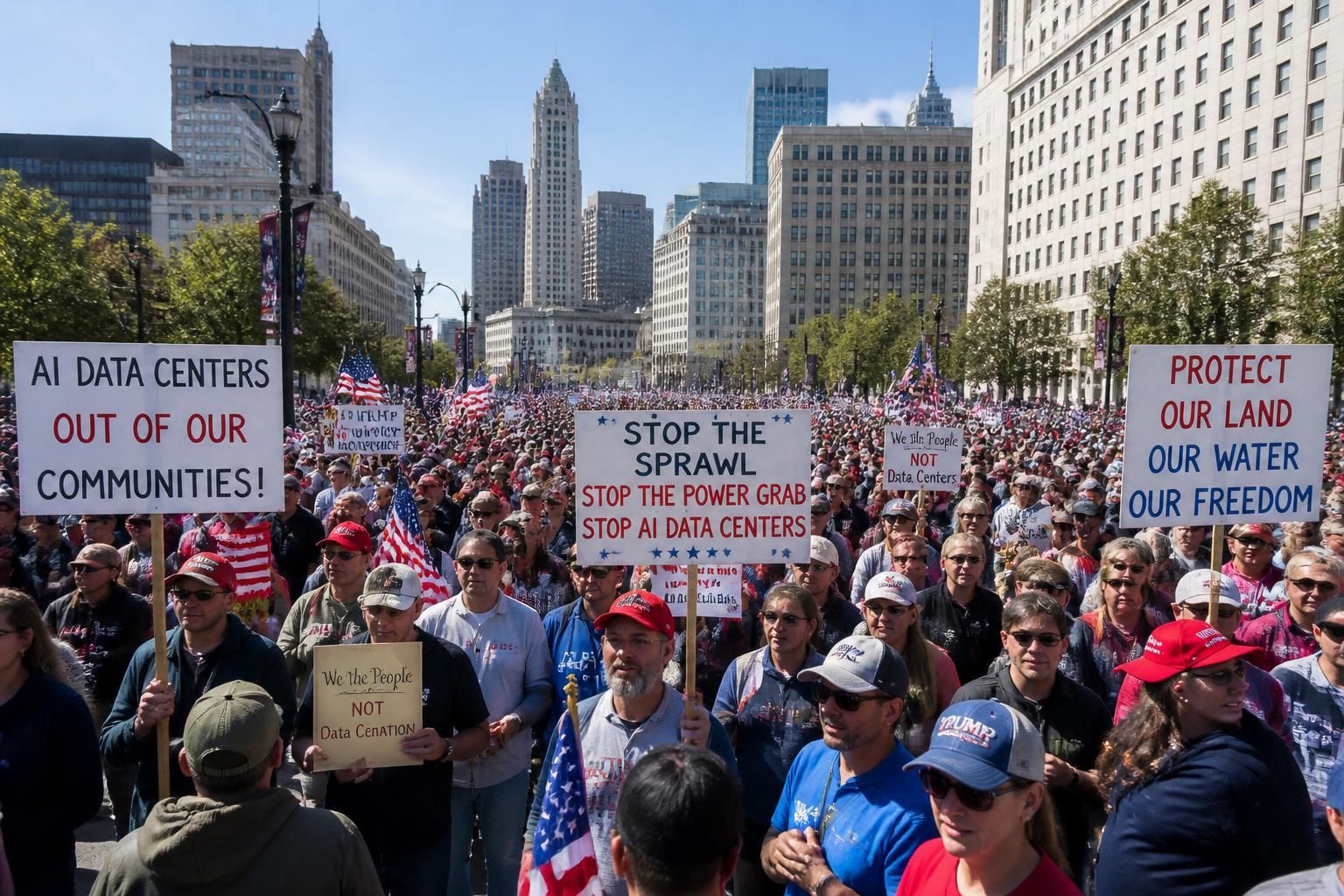
Political Activism Reinvented: The Tea Party Legacy in Addressing Unchecked Policies on AI Infrastructure
The legacy of the Tea Party resonates strongly within the current conservative mobilization against AI data center proliferation. Amy Kremer’s leadership reflects a continuum of political activism that began with grassroots-driven opposition to perceived elite overreach back in 2009. This movement attributes the rapid AI data center expansion as part of a disconnect between policymakers and their constituencies, mirroring earlier frustrations that ignited the Tea Party’s rise.
The parallels manifest in strategy and rhetoric. The activists appeal to the grassroots base by framing these data centers as emblematic of broader issues involving unchecked technological advancements imposed without sufficient community input or regulatory oversight. This tactic channels the energy of conservative political activism, transforming technological policy disputes into emblematic battles of political identity and governance.
However, this renewed activism unfolds amid a politically polarized United States, where protests have become common expressions of dissent. As analyses of protest trends reveal, the US public’s polarization drives increased participation in demonstrations. Humans First’s approach taps into this environment by positioning their protest as a constructive public demonstration that channels conservative concerns in alignment with prior grassroots movements.
Moreover, this protest day aims to spotlight the contentious policy landscape around AI and data centers, reflecting broader anxieties about artificial intelligence’s rapid integration into society without sufficient safeguards. The mobilization illustrates how grassroots political activism continues to evolve, connecting historical political narratives with emerging technological and environmental issues.
State-by-State Impact: Locations at the Heart of the Nationwide Protest and Their Unique Concerns
The selected states for the nationwide day of protest – Georgia, California, Texas, Florida, and Virginia – are not incidental. Each region represents distinct facets of opposition based on local concerns about environmental impact, economic consequences, and regulatory challenges tied to AI data center expansion.
For example, states like Georgia and Texas have seen rapid growth in data center construction, driven by favorable business climates but accompanied by rising worries about electricity consumption and environmental strain. Local communities in these states have experienced conflicts between economic development promises and ecological sustainability challenges. In California and Virginia, broader debates involve legislative attempts to balance technological growth with community welfare and environmental protection.
These localized tensions play into the larger narrative of policy opposition mobilized through public demonstrations nationwide. The protests aim to unify these regional perspectives into a coherent call for stricter oversight and more democratic engagement in decision-making processes concerning AI infrastructure.
| 📍 State | ⚡ Data Center Growth Characteristics | 🌿 Primary Local Concerns | 📅 Protest Strategy |
|---|---|---|---|
| Georgia | Rapid expansion, multiple large-scale projects | High electricity demands, water resource usage | Mass rallies in Atlanta and Savannah |
| California | Legislative pushback, environmental activist involvement | Environmental sustainability, community displacement | Demonstrations near Sacramento and Silicon Valley |
| Texas | Business-friendly policies encourage growth | Energy consumption concerns, urban planning issues | Protests in Dallas and Austin |
| Florida | Increasing investments in data infrastructure | Impact on water supply, local ecosystems | Gatherings in Miami and Tampa |
| Virginia | Hubs for data center operations on the East Coast | Community consultation, zoning challenges | Protests in Richmond and Fairfax |
This state-specific focus allows organizers and participants to tailor their activism to address unique challenges, securing attention from local officials while contributing to the overarching nationwide policy opposition. For organizations within the cultural and tourism sectors interested in civic engagement, understanding these nuances can aid in aligning community outreach and educational efforts with ongoing sociopolitical movements, such as those reflected in the broader spectrum of US protests.
Contested Narratives and Emerging Political Tensions Within Conservative Factions on AI Policy
The growing campaign against AI data center expansion has introduced notable divisions within US conservatives, particularly regarding President Trump’s stance. While the Trump administration historically supports domestic energy production expansion, including fossil fuels, many conservative grassroots activists express unease with the rapid development of data centers and the unchecked advance of AI technologies.
A complicating factor is the accusation of foreign influence. Earlier in June, Republican officials allied with fossil fuel and cryptocurrency groups raised alarms about alleged Chinese-backed propaganda fueling opposition to data centers. They claimed that China sought to harness environmentalist groups to disrupt US AI developments. Although social media analysis showed some coordinated campaigns from foreign sources, these efforts failed to sway broad public opinion.
This tension reflects a broader conflict within conservative circles, balancing technological advancement against national security and economic growth. It also spotlights a critical debate about the consequences of AI, touching upon concerns of energy use, environmental impact, and transparency in policymaking. The widespread resistance to data centers illustrates the complexities of modern political activism, where grassroots movements challenge elite-driven policies while navigating accusations of foreign interference.
Professionals interested in monitoring these dynamics may benefit from following updates on conservative-led national protests, as these developments bear significant implications for regulatory approaches to AI infrastructure and broader US technology policy.
This video explores the grassroots mobilization efforts and policy implications tied to the ongoing nationwide protests, providing detailed insight into the organizational strategies and political context.
Strategic Considerations for Organizing and Engaging in Nationwide Public Demonstrations on Policy Issues
Public demonstrations remain pivotal tools in shaping policy discourse, particularly when mobilizing grassroots movements. The Humans First initiative exemplifies how coordinated nationwide protests can amplify policy opposition, employing local protests to create a unified message. These strategies also serve as relevant case studies for professionals in sectors like smart tourism and cultural mediation, illustrating how technology and community engagement intersect for maximum societal impact.
Key strategic takeaways include:
- 📣 Localized Mobilization: Tailoring protests to address region-specific issues enhances local engagement and media coverage.
- 🔗 Coalition Building: Uniting bipartisan and working-class groups strengthens the sustainability and reach of policy opposition.
- 📊 Data-Driven Messaging: Utilizing empirical evidence of environmental and economic impacts lends credibility to protest claims.
- 📅 Coordinated Timing: Holding simultaneous protests nationwide elevates visibility and political pressure.
- 🛠️ Leveraging Technology: Digital platforms and social media play crucial roles in organizing, amplifying, and sustaining public demonstrations.
These approaches offer clear insights into effective political activism centered on unchecked policies, with emphasis on how grassroots movements can harness both traditional organizing methods and digital innovations. For cultural and tourism professionals, integrating such strategies with technology solutions can enhance engagement with contemporary social issues, supporting community relevance and impact.
This instructional content highlights best practices in organizing large-scale public demonstrations, useful for activists and institutional stakeholders alike.
What are the main concerns of US conservatives regarding AI data centers?
Their concerns revolve around the environmental impact, high energy consumption, lack of democratic oversight, and the rapid expansion of AI infrastructure without adequate regulation.
How does the nationwide day of protest reflect broader political activism?
It embodies grassroots mobilization challenging elite policy decisions, reigniting political debates similar to past movements like the Tea Party.
Which states are central to this protest, and why?
Georgia, California, Texas, Florida, and Virginia are key due to their rapid data center growth and distinct regional concerns such as energy use, environmental sustainability, and community impact.
Are there internal conflicts within conservative groups about AI policy?
Yes, divisions exist regarding prioritizing energy development versus cautious expansion of AI infrastructure, compounded by worries about foreign influence.
What strategies enhance the effectiveness of nationwide protests?
Localized mobilization, coalition building, data-driven messaging, coordinated timing, and technological leverage contribute to successful public demonstrations.
