
SoundHound AI’s LivePerson Partnership Expands the Path to Profitability
SoundHound AI’s acquisition of LivePerson changes the scale of the SOUN story. Rather than operating primarily as a voice AI provider focused on automotive, restaurants, devices, and selected enterprise applications, the combined company now has a broader omnichannel conversational AI footprint. The LivePerson Partnership adds established contact-center capabilities, enterprise relationships, messaging channels, and operational experience that can complement SoundHound’s proprietary voice technology.
The central question is not whether the deal creates a larger business. It clearly does. The more important question is whether that larger platform can create repeatable, high-margin revenue and a credible route to sustainable Profitability. Acquisition-led Business Growth can be valuable, but it can also conceal duplicated costs, inconsistent product roadmaps, and lengthy integration work. Investors, customers, and technology partners should therefore measure the transaction by execution rather than by headline scale alone.
According to SoundHound’s corporate announcement on its completed LivePerson acquisition, the combined operation strengthens its reach across major enterprise customers and creates a more comprehensive conversational AI offering. This matters because modern customer interactions rarely begin and end with a single voice command. A traveler may ask a hotel assistant for late check-out by voice, confirm it in a mobile message, and request nearby recommendations through a chat interface. Enterprises increasingly need consistent answers across every channel.
For tourism, hospitality, and visitor-facing organizations, this integrated model can be particularly relevant. Consider a fictional city museum network called Northgate Culture. It operates a visitor hotline, a ticketing chatbot, a mobile guide, and a front-desk team. A disconnected system forces staff to repeat information and creates gaps between online questions and on-site support. A combined SoundHound and LivePerson platform could theoretically connect voice requests, text exchanges, and agent escalation within one interaction framework.
- 🎙️ Voice entry points: guests can ask natural-language questions through phones, kiosks, cars, or smart devices.
- 💬 Messaging continuity: a request started by voice can be continued through web chat or mobile messaging.
- 👥 Human escalation: complex cases can move to a live employee without forcing visitors to repeat their issue.
- 📊 Operational insight: recurring questions can reveal service bottlenecks, such as unclear opening hours or inaccessible booking instructions.
That logic supports the strategic value of the LivePerson Partnership. SoundHound has already built its reputation around natural, branded voice interactions. LivePerson contributes a deeper contact-center orientation, which can help the company sell more complete customer-experience systems rather than isolated AI features. A larger contract value per client could improve unit economics if software, support, and deployment costs remain controlled.
Still, scale alone does not solve the financial equation. Enterprise AI customers often require integration with customer relationship management systems, booking platforms, payment tools, and internal knowledge bases. Each customization can reduce gross-margin potential if implementation becomes labor-intensive. The opportunity lies in standardizing deployments wherever possible: reusable connectors, clear governance, transparent analytics, and configurable rather than bespoke workflows.
SoundHound’s OASYS platform is relevant in that context because agentic AI is increasingly expected to do more than answer a question. It must identify intent, retrieve approved information, complete an action, and hand off safely when necessary. The closer this workflow gets to a repeatable product rather than a custom project, the more likely it is to support durable margins. Readers examining how the transaction affects product positioning can also review this analysis of SoundHound, LivePerson, and OASYS.
The practical test is straightforward: can SoundHound use LivePerson’s installed base to distribute voice and agentic AI more efficiently than it could on its own? If cross-selling grows while deployment costs decline, the acquisition could become a meaningful Profitability catalyst. The next issue is whether financial leadership can impose the discipline required to turn that strategic potential into measurable results.
John Collins’s CFO Appointment Puts Margin Discipline at the Center of SOUN
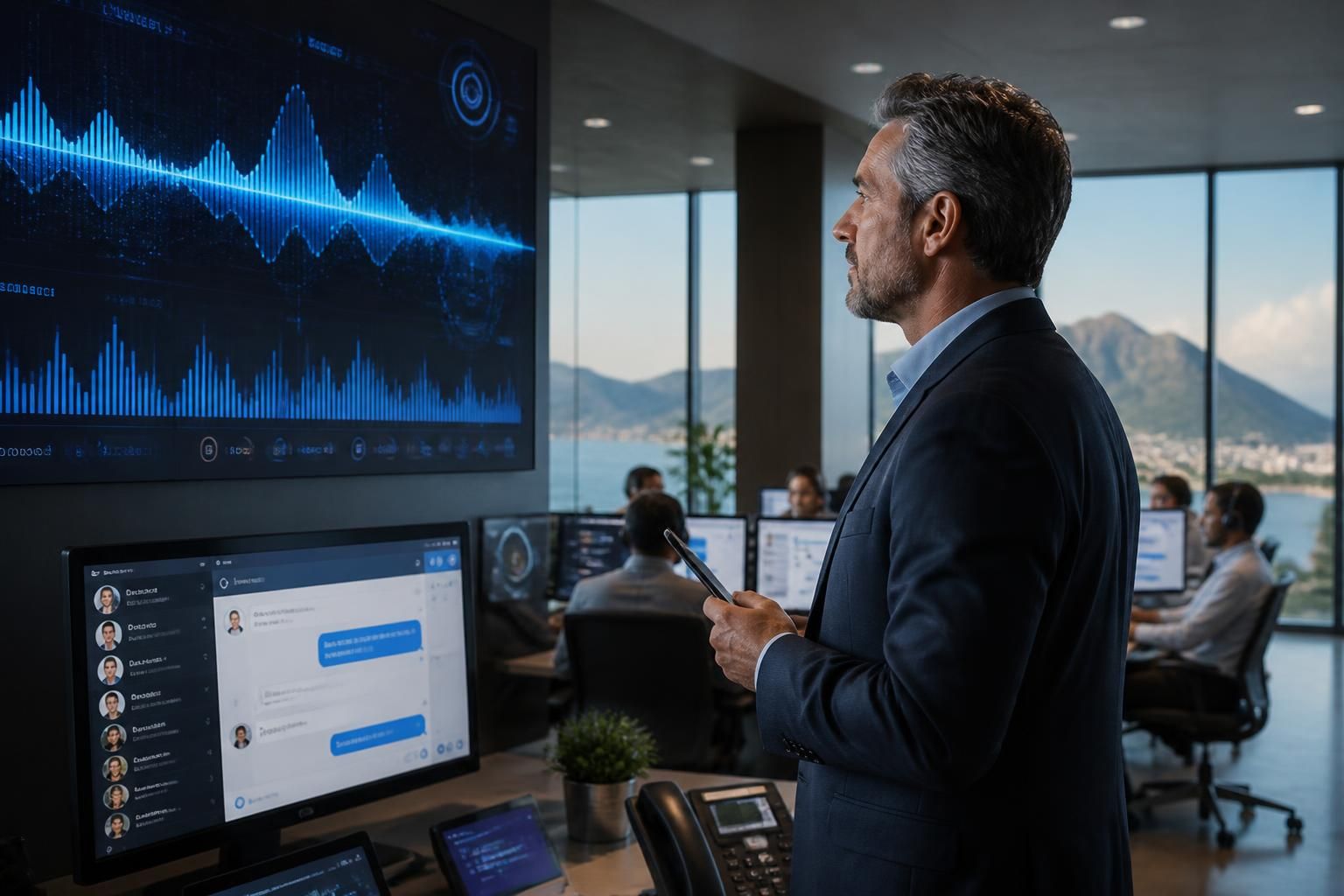
The appointment of John Collins as SoundHound AI’s new CFO is more than an executive transition. It places a former LivePerson finance leader in charge of the combined company’s capital allocation, integration budgets, reporting discipline, and margin-expansion agenda. In a fast-growing AI company, the CFO role is not limited to accounting. It determines which initiatives receive resources, how quickly duplicated expenses are removed, and whether growth is being purchased at an unsustainable cost.
Collins arrives at a sensitive moment. SoundHound has delivered strong revenue momentum and raised its outlook, but it remains judged against a demanding valuation and a history of operating losses. The market narrative depends on the company demonstrating that revenue expansion can produce operating leverage. In plain terms, revenue must grow faster than the cost base. This is especially important after an acquisition, when sales teams, cloud infrastructure, product teams, and administrative functions may overlap.
An effective CFO Appointment can influence outcomes in several ways. First, financial integration must create a common set of performance measures. Legacy SoundHound and LivePerson operations need aligned definitions for recurring revenue, retention, gross margin, customer-acquisition cost, services revenue, and free cash flow. Without common reporting, management can struggle to identify whether a contract is genuinely profitable or simply impressive in headline value.
How the new CFO can turn integration work into financial progress
Cost discipline does not automatically mean indiscriminate cuts. In conversational AI, poorly targeted reductions can damage product reliability, customer support, and data security. The stronger approach is to separate strategic investment from avoidable duplication. For example, maintaining two separate procurement systems, overlapping cloud contracts, or parallel finance workflows may add cost without enhancing Technology Innovation. By contrast, funding secure knowledge retrieval, speech accuracy, and integration tools can directly improve the customer proposition.
| Profitability lever | What Collins can monitor | Why it matters for SOUN |
|---|---|---|
| 📉 Cost rationalization | Duplicated corporate, vendor, and platform expenses | Removes post-acquisition inefficiencies without weakening customer delivery |
| 📈 Gross-margin expansion | Cloud costs, implementation effort, support intensity | Shows whether AI products are becoming more scalable |
| 🤝 Cross-selling efficiency | Revenue generated from shared customers | Tests whether the LivePerson Partnership produces real commercial synergies |
| 💵 Free-cash-flow control | Collections, contract terms, capitalized costs, working capital | Reduces dependence on external funding while the business grows |
A practical example helps clarify the challenge. Imagine that Northgate Culture buys an AI visitor-support package covering call deflection, multilingual chat, and on-site voice guidance. If each installation requires months of custom engineering, the account may create revenue but little margin. If the same deployment uses standardized integrations and reusable intent libraries, then the second and third customers become less expensive to onboard. That is the operating leverage investors want to see.
Collins’s familiarity with LivePerson can also reduce integration friction. He understands the acquired organization’s financial structure, customer contracts, talent base, and prior cost-management decisions. That knowledge may shorten the learning curve compared with appointing an external finance executive after closing a complex transaction. It does not eliminate execution risk, but it improves continuity at a time when management needs accurate visibility.
Independent coverage has emphasized that the LivePerson deal and new CFO appointment tie integration directly to a profitability objective. That framing is appropriate. Investors should not assess the leadership change as a symbolic move. They should look for evidence in future reporting: better expense discipline, clearer segment information, improving gross margin, and a declining cash burn relative to revenue.
The key insight is that a new CFO cannot manufacture demand, but can make each dollar of demand more valuable. The next stage of SOUN’s investment case depends on whether financial rigor and product expansion advance together rather than pulling the company in opposite directions.
Raised 2026 Revenue Guidance Strengthens SoundHound’s Business Growth Case
SoundHound’s recently raised 2026 revenue guidance of US$230 million to US$260 million provides an important reference point for assessing the combined company. It signals management confidence that demand, product adoption, and acquisition-related scale can support stronger top-line performance. The guidance follows reported second-quarter momentum, including substantial year-over-year revenue growth, and places Business Growth at the core of the SOUN narrative.
However, revenue guidance should be interpreted carefully. A company can increase sales while still widening losses if customer acquisition, cloud processing, sales commissions, and implementation costs rise at the same pace. For AI companies, this distinction is essential because usage can carry significant infrastructure costs. Every real-time voice query, transcript, recommendation, and automated action depends on computing resources, data architecture, and quality-control processes.
The LivePerson Partnership potentially improves the revenue opportunity through customer overlap and channel expansion. SoundHound can offer voice AI into LivePerson-oriented customer-service accounts. LivePerson’s enterprise relationships may also provide a distribution route for agentic automation, intelligent routing, and branded voice experiences. Conversely, SoundHound’s automotive, restaurant, and voice-first clients could benefit from messaging and human-agent capabilities when a request becomes too complex for automation.
Why revenue quality matters more than a single growth percentage
For an investor or operator, not all revenue is equal. Recurring software and platform fees generally create a more predictable base than one-off professional-services engagements. Long-term enterprise subscriptions can support planning, but they must be evaluated alongside retention, usage economics, renewal rates, and contract concentration. A few major contracts can accelerate quarterly results, yet they may also make performance uneven if decision cycles are delayed.
SoundHound’s product opportunity is strongest where it solves a visible operational problem. In hospitality, a voice assistant could answer common questions about check-in, breakfast hours, transport, accessibility, or local attractions. In tourism, it could reduce repetitive calls during peak periods while directing visitors toward verified information. In restaurants, AI can manage telephone ordering and reservation requests. These are practical workflows where speed, accuracy, brand tone, and escalation processes matter more than novelty.
There is also a useful lesson for cultural venues and guided-visit operators. A visitor will not value AI merely because it is advanced. They value it when it removes friction: clearer information, better audio access, fewer queues, or faster assistance in their language. Tools such as Grupem demonstrate the broader principle that digital audio should improve the experience without forcing visitors to learn a complicated system. The same standard applies to conversational platforms deployed by SoundHound.
Management’s raised outlook therefore needs to be accompanied by evidence that the mix of business is improving. Investors should watch whether higher-margin subscriptions represent a growing share of revenue and whether the combined sales organization is converting cross-sell opportunities. A larger addressable market is promising, but a larger sales pipeline is not equivalent to completed, profitable contracts.
- 🔎 Review whether reported revenue gains come from recurring platform usage or implementation-heavy projects.
- 📊 Track gross margin alongside revenue, not after it.
- 🧩 Look for disclosed customer wins that use both SoundHound and LivePerson capabilities.
- ⏱️ Monitor sales-cycle length, because complex enterprise deals can move between quarters.
- 💡 Assess whether OASYS and other AI offerings create measurable customer outcomes, not only demonstrations.
Forecasts cited in the market narrative project approximately US$317.0 million in revenue and US$38.4 million in earnings by 2029. Those estimates are useful as an illustration of the bullish case, not as a guarantee. They imply that SoundHound must retain strong growth while making significant progress on margins. A separate, more cautious view anticipates roughly US$282.2 million in revenue and US$32.3 million in earnings by that year, highlighting how sensitive the valuation remains to execution.
Revenue guidance gives SOUN a target; revenue quality determines whether that target strengthens profitability. The following question is whether Technology Innovation can create defensible advantages while remaining economical to deploy at enterprise scale.
Technology Innovation Must Improve Customer Experience Without Raising Delivery Costs
SoundHound’s competitive identity is rooted in voice AI, speech recognition, natural-language understanding, and conversational interfaces. The LivePerson acquisition adds messaging, contact-center workflows, and human-agent engagement. Together, these capabilities support a broader form of Technology Innovation: not simply answering questions, but coordinating an entire conversation across channels and deciding when automation should stop.
That distinction is important for customer-facing industries. A hotel guest asking, “Can I store luggage after checkout?” expects a direct answer. If the guest follows with, “Can you arrange a taxi for a wheelchair user at 6 a.m.?” the request becomes more sensitive. A well-designed AI system should recognize the need for verified availability, accessibility-aware service, and potentially a human handoff. The value comes from context, not from a generic response.
OASYS, SoundHound’s agentic AI platform, sits within this shift toward task completion. Agentic systems are designed to manage multi-step interactions, retrieve information from approved sources, and support actions within defined rules. For enterprises, the opportunity is substantial. A customer-service platform that only produces plausible text can create risk. A platform that uses controlled data, identifies policy boundaries, logs actions, and escalates exceptions can be operationally useful.
Where combined conversational AI can create practical value
A destination marketing organization provides a concrete illustration. During a festival weekend, its contact channels receive questions about road closures, ticket availability, schedules, accessibility, accommodation, and public transport. A voice-enabled assistant can provide immediate answers to standard questions. Messaging can continue the interaction with a route map or booking link. When information is unclear or a visitor has a complex request, an employee can take over with the conversation history available.
This workflow can reduce repetitive workload, but it also creates obligations. Information must be updated frequently. Tourism teams need a reliable knowledge base with current opening times, disruption notices, language options, and accessibility details. The best AI architecture cannot compensate for outdated source content. Operational managers should treat content governance as part of the deployment budget, not as an afterthought.
Privacy and regulation represent another material factor. SoundHound’s expansion into enterprise conversational data increases the importance of consent, data minimization, secure storage, retention policies, and audit trails. Regulations affecting AI systems may limit the way companies access, process, or reuse interaction data. This is not merely a compliance issue. If customers cannot trust how voice and message data are managed, adoption can slow regardless of product quality.
Competition adds further pressure. Large cloud providers, contact-center software vendors, and internal enterprise teams are building their own AI capabilities. SoundHound therefore needs to show that its combined platform offers a practical advantage: fast deployment, reliable voice performance, strong domain controls, and integrated human support. The company does not need to win every AI use case. It needs to win the workflows where its technology is demonstrably more useful than generic alternatives.
For example, a large attraction could use generic text chat for simple website queries. Yet a SoundHound-powered solution may be more compelling when visitors call while driving, ask questions in natural speech, or need an immediate voice response at a kiosk. This is where voice-first design can improve access for users who are walking, carrying luggage, managing children, or unable to navigate complex screens.
Readers interested in the commercial relationship between product growth and financial expectations can consult this overview of SoundHound AI’s quarterly earnings context. The critical metric remains whether innovation reduces cost per resolved interaction while preserving service quality. If the technology requires extensive manual intervention, the margin thesis weakens. If it resolves routine requests accurately and hands off difficult cases responsibly, the economic case becomes stronger.
Useful AI is not defined by how human it sounds; it is defined by how reliably it helps customers complete a task. This operational standard leads directly to the risks that could prevent SoundHound from turning technological capability into lasting returns.
SOUN Investors Should Measure Profitability Against Integration, Regulation, and Valuation Risks
The bullish case for SoundHound is clear enough to articulate. The company has strong revenue momentum, a raised outlook, a more extensive enterprise platform after LivePerson, and a CFO Appointment designed to reinforce cost control. The 2029 forecast often cited in the investment narrative suggests US$317.0 million in revenue and US$38.4 million in earnings. Another valuation framework estimates a fair value of US$13.14, implying substantial upside from the referenced trading level.
Yet these figures should not be treated as outcomes already secured. They are models based on assumptions about growth, margins, market adoption, competition, and execution. SOUN’s valuation can remain sensitive because the company is still in the process of proving sustainable profitability. When a stock is priced for ambitious future performance, even a small delay in enterprise contracts or integration savings can change market expectations rapidly.
The first risk is integration complexity. SoundHound and LivePerson must combine teams, products, customer-success processes, contractual structures, and back-office functions without disrupting service. Customers rarely reward a vendor for internal restructuring; they expect stable support, clear roadmaps, and continued product development. If cross-selling is slower than expected or product overlap creates uncertainty, the expected revenue synergies may take longer to materialize.
The second risk is the cost of growth. AI businesses may face rising infrastructure expenses as usage expands. Speech processing, large-language-model workflows, knowledge retrieval, monitoring, and security all require investment. SoundHound must ensure pricing reflects the real cost of serving customers. A contract that looks attractive in annual recurring revenue can become less compelling if heavy usage generates disproportionate cloud costs.
The third risk is enterprise deal volatility. Large contracts often involve long procurement cycles, technical pilots, security reviews, and budget approvals. A customer may shift a deployment from one quarter to the next for reasons unrelated to product quality. This can create uneven results, especially when a relatively small number of major agreements carries substantial weight. Investors should therefore focus on multi-quarter patterns rather than reacting only to one reporting period.
A disciplined framework for evaluating SOUN after the LivePerson deal
Instead of relying on broad AI enthusiasm, stakeholders can use a structured scorecard. Start with revenue growth, then ask whether gross margin is improving. Next, look for proof of cross-selling between legacy SoundHound and LivePerson customer groups. Review operating expense trends, cash flow, customer retention, and debt levels. Finally, examine whether management provides clear milestones for integration rather than broad language about opportunity.
- ✅ Positive evidence: higher recurring revenue, lower duplicate spending, improving gross margin, and disclosed cross-platform customer wins.
- ⚠️ Warning signal: revenue rises while operating costs accelerate at the same or a faster rate.
- 🔐 Compliance indicator: transparent policies for voice data, customer consent, security, and AI governance.
- 📌 Execution indicator: product roadmaps remain clear for existing LivePerson and SoundHound customers.
- 📉 Valuation discipline: forecasts should be tested against actual cash generation, not repeated without scrutiny.
Regulation must remain part of this assessment. Tighter AI and privacy rules could restrict data access, increase compliance costs, or influence which customers are willing to deploy automated interactions. However, regulation can also favor providers that invest early in governance, traceability, and controlled enterprise workflows. SoundHound’s opportunity is to position trust and operational accountability as product features rather than legal obligations added at the end.
A hypothetical example illustrates the difference. If Northgate Culture deploys conversational AI only to reduce staffing costs, visitors may encounter poor answers and inaccessible support. If it deploys the same system with approved content, multilingual testing, clear escalation routes, and real performance monitoring, it can reduce repetitive workload while protecting visitor satisfaction. The second model costs more to design initially but is far more likely to retain customers and support reliable recurring revenue.
For investors, the same principle applies: the acquisition should be evaluated as a system, not as a single event. The LivePerson Partnership, OASYS momentum, raised guidance, and John Collins’s finance leadership all support a stronger strategic position. But they only become a Profitability story if SoundHound converts those elements into better unit economics, greater free-cash-flow discipline, and steady customer outcomes.
The decisive measure for SOUN is not the size of the combined AI platform, but whether each stage of growth makes the business more efficient, more trusted, and more financially durable.
Why did SoundHound AI appoint John Collins as CFO?
John Collins, previously a LivePerson executive, was appointed to help lead financial integration after the acquisition. His mandate includes cost discipline, margin expansion, reporting alignment, and progress toward sustainable profitability.
Is the LivePerson transaction a partnership or an acquisition?
LivePerson was acquired by SoundHound AI. The term partnership can describe the combined commercial and technology opportunity, but the underlying corporate event is an acquisition that created a larger combined business.
What is SoundHound’s 2026 revenue guidance?
SoundHound raised its 2026 revenue guidance to a range of US$230 million to US$260 million. The key issue for investors is whether this higher revenue base is accompanied by improving margins and controlled operating costs.
What could prevent SOUN from reaching profitability?
Key risks include difficult LivePerson integration, rising cloud and operating expenses, delayed enterprise contracts, stronger competition, data privacy requirements, and AI regulation that could affect data access or deployment costs.
How can tourism organizations use conversational AI responsibly?
They should use verified and regularly updated visitor information, provide clear human escalation, test multilingual and accessibility needs, protect personal data, and measure whether automation genuinely improves the visitor journey.
