
Short on time? Here is what matters:
- ✨ Chicago Collects: Jewelry in Perspective opens at the Oshkosh Public Museum on September 19, 2026 and remains available through March 20, 2027.
- 💎 The display brings together around 200 pieces of jewelry and decorative art, from nineteenth-century design to contemporary work.
- 🎧 The strongest visit combines close looking with clear interpretation: craftsmanship, materials, social history, and artistic movements all deserve equal attention.
- 📱 For museum teams, the event is also a practical example of how concise digital audio can make a visually rich exhibition more accessible without distracting from the objects.
Chicago Collects: Jewelry in Perspective Brings a Major Jewelry Exhibit to Oshkosh
The Oshkosh Public Museum will welcome an important New Exhibition this fall with Chicago Collects: Jewelry in Perspective. Opening on September 19, the exhibition brings jewelry, decorative art, and design history into one focused museum experience. It is scheduled to run through March 20, 2027, giving residents, regional visitors, design enthusiasts, and cultural groups several months to explore its objects at a comfortable pace.
This Jewelry Exhibit is organized by the Richard H. Driehaus Museum and guest-curated by Elyse Zorn Karlin. Rather than treating adornment as a simple display of gemstones and precious metal, the exhibition positions jewelry as evidence of changing tastes, technical innovation, commerce, craftsmanship, and identity. That approach matters because a brooch, pendant, necklace, or small decorative object can often reveal as much about its period as a painting or a piece of furniture.
The show draws from museums and private collections in the Chicago area. Its roughly 200 works range from the nineteenth century to the present day, creating a timeline broad enough to show how jewelry design changed alongside architecture, fashion, manufacturing, and social customs. Visitors can expect examples connected to celebrated names including Fabergé, René Lalique, and Louis Comfort Tiffany, while also encountering objects that place these familiar figures within wider design movements.
For a visitor called Maya, planning a Saturday in Oshkosh with two friends, the appeal is immediate. One person may be interested in gemstones, another in Art Nouveau, and another simply in the experience of seeing finely made objects at close range. The exhibition supports all three viewpoints. No specialist vocabulary is required before entering the gallery, because each work can be appreciated first through color, shape, light, texture, and detail. Context then adds a second layer: who made it, how it was made, and why its style mattered.
The museum’s location at 1331 Algoma Boulevard also makes the event easy to frame as part of a wider Art and Culture outing. The institution is known for connecting the history of the Lake Winnebago region with artistic and educational experiences, and its Historic Sawyer Home provides a distinctive setting for visitors who value architecture as much as collections. Before setting a date, visitors can consult the museum’s current and upcoming exhibition information for practical details and complementary programming.
This is not a Jewelry Collection designed only for collectors. It is a visual route through more than a century of changing ideas: nature-inspired ornament, technical experimentation with enamel and glass, luxury craftsmanship, and the continuing role of personal adornment in everyday life. A visitor might begin by admiring a piece for its sparkle and finish, then leave with a clearer understanding of the design culture that produced it.
Key point: the Exhibit Opening on September 19 offers an opportunity to view jewelry not as isolated luxury goods, but as compact works of art carrying stories about their makers, wearers, and times.
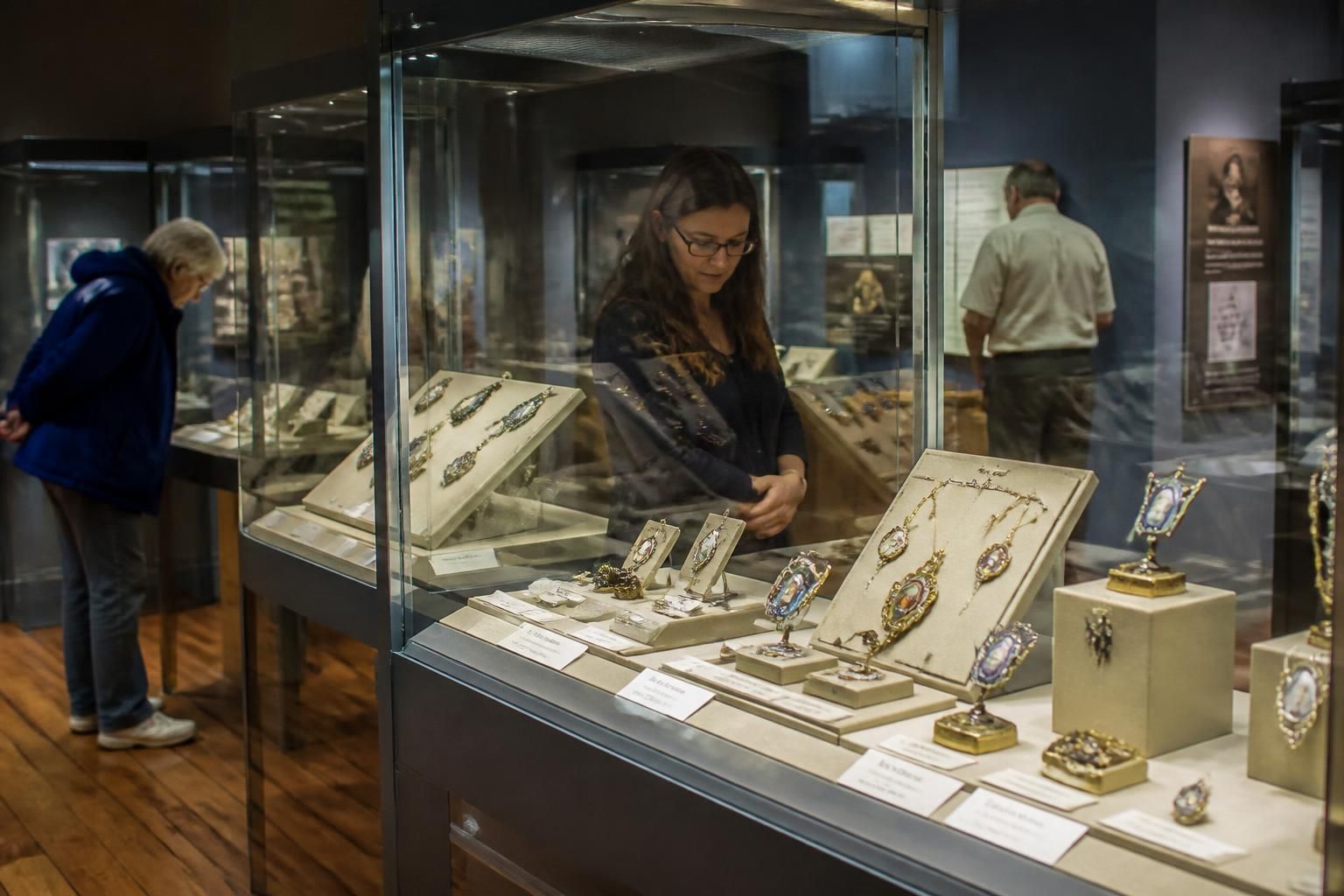
Museum Highlights: Fabergé, René Lalique, Tiffany, and Historic Jewelry Design
The most compelling Museum Highlights in this exhibition come from the relationship between renowned designers and the creative movements around them. Names such as Fabergé, René Lalique, and Louis Comfort Tiffany attract attention because they represent exceptional craft traditions, but their value is not limited to brand recognition. Each name offers a useful entry point into a different set of artistic questions: how can materials be transformed, how can nature become ornament, and how can an object balance beauty with practical use?
Fabergé is widely associated with intricate luxury objects and extraordinary attention to material detail. In a gallery setting, works connected to this tradition encourage visitors to slow down. Tiny surfaces may contain engraving, carefully set stones, or color effects that cannot be absorbed in a quick glance. This is where interpretation becomes important. A label can identify a maker and date, but an audio stop or concise guide can explain why certain materials signaled prestige, why a miniature object demanded advanced skill, and how elite collecting shaped the market for decorative arts.
René Lalique offers another visual language. His work is particularly relevant for audiences curious about the transition from conventional gem-centered jewelry toward expressive forms inspired by plants, insects, and the human figure. Art Nouveau designers often challenged the assumption that the most valuable jewelry had to feature the largest or rarest stones. They emphasized line, translucency, and symbolic motifs. A dragonfly, orchid, or flowing female profile could become the central idea, while horn, glass, enamel, or semi-precious material gained artistic significance.
Louis Comfort Tiffany similarly helps visitors understand the wider conversation between decorative arts and jewelry. Tiffany’s name is closely associated with richly colored glass and American design, yet the exhibition context encourages a broader look at how color, transparency, metalwork, and organic motifs crossed boundaries between different types of objects. Jewelry did not develop separately from interiors, lamps, glassware, or architecture. The same desire for luminous color and hand-crafted detail influenced many areas of artistic production.
Looking closely at materials reveals the real story
One documented object in the exhibition is a circa-1900 pendant by Levinger & Bissenger. Made with silver, plique-à-jour enamel, pearl, and paste, it is a useful example of why material literacy improves a museum visit. Plique-à-jour enamel is created in a way that allows light to pass through the colored enamel, producing an effect often compared with stained glass. The result is visually delicate, but technically demanding.
For a general visitor, the word “paste” may initially sound unremarkable. In jewelry history, however, paste refers to a form of glass used to imitate gemstones. Its presence is not necessarily a sign of inferior design. Instead, it can reveal how designers used accessible or adaptable materials to achieve a specific optical effect. The pendant becomes more interesting once visitors understand that its value lies in the total composition: silver structure, luminous enamel, pearl, and the calculated sparkle of glass.
| Design reference | What to notice | Visitor takeaway |
|---|---|---|
| 💎 Fabergé-associated works | Fine detail, precious materials, small-scale precision | Luxury objects can communicate technical mastery and collecting history. |
| 🦋 René Lalique-associated works | Nature motifs, enamel, fluid forms, symbolic imagery | Art Nouveau expanded the definition of valuable jewelry. |
| 🌈 Louis Comfort Tiffany-associated works | Color, translucency, decorative-art connections | Jewelry evolved alongside wider experiments in art and design. |
| 🔍 Levinger & Bissenger pendant | Plique-à-jour enamel, silver, pearl, paste | Materials tell a story beyond price or rarity. |
The exhibition’s strength is that it makes these distinctions visible without expecting visitors to arrive as experts. Looking for a repeated motif, noting the way light changes across an enamel surface, or comparing a geometric piece with a nature-inspired one are all practical ways to engage. This measured attention is more rewarding than moving rapidly from case to case.
Key point: Historic Jewelry becomes more meaningful when visitors examine not only who made it, but also how color, light, technique, and cultural ideas work together in each object.
How the Oshkosh Public Museum Connects Jewelry to Art and Culture
A strong Museum Event does more than assemble impressive objects. It gives visitors a framework for understanding why those objects matter. Chicago Collects: Jewelry in Perspective is designed around this wider cultural lens, linking jewelry to historical periods and major design movements from the nineteenth century through contemporary practice. That scope gives the Oshkosh Public Museum an opportunity to welcome both people who already collect or study jewelry and those who simply want to understand how styles evolve.
Jewelry is unusually effective as a teaching medium because it is both intimate and public. It is worn close to the body, often received as a gift or family heirloom, yet it also communicates status, affiliation, taste, and occasion. A nineteenth-century mourning jewel, for example, may contain visual symbols of remembrance and personal loss. A modernist brooch might reject decoration in favor of clean geometry, reflecting a different attitude toward design and modern life. Neither object needs a lengthy lecture to create curiosity, but both become richer when their historical setting is made clear.
Consider how an Art Nouveau ornament and a later Art Deco piece may appear side by side in a visitor’s memory. The first may feel curved, botanical, and asymmetrical. The second may seem crisp, structured, and influenced by new urban rhythms, architecture, and global visual sources. The contrast helps audiences recognize that design does not change at random. It responds to technology, fashion, economic conditions, exhibitions, artistic debate, and the materials that craftspeople can access.
This approach aligns naturally with the museum’s broader role as a place for history, art, and culture in the Lake Winnebago region. The institution has served the community since 1924, and its collections encompass far more than decorative objects. A temporary display devoted to jewelry can therefore act as a gateway: someone drawn in by a Tiffany-associated object may also become interested in regional history, architectural preservation, or the stories represented by other galleries.
Turning visual interest into a thoughtful gallery visit
For museum staff and group organizers, the exhibition offers a practical lesson in visitor experience. Objects in display cases can be visually dense. A small pendant may be only a few inches wide, yet it can involve multiple techniques, materials, and references. Interpretation needs to be clear, short, and available at the moment of attention. Dense wall text can leave a visitor standing in a crowded spot, while a well-designed mobile audio guide can support independent viewing without forcing everyone to follow the same route.
A smart audio experience should not replace close observation. It should create space for it. A 60- to 90-second stop can direct a visitor toward one visible detail, such as an enamel panel, a clasp, or a reflected color. It can then provide just enough historical context to explain why the detail is significant. Visitors who want more can access extended material, while families and casual audiences can keep moving without losing the main message.
Accessibility also benefits from this approach. Guests who find printed text difficult to read, who prefer listening while looking, or who visit in a multilingual group may engage more confidently when interpretation is delivered through their own smartphone. Audio must remain optional, easy to launch, and respectful of gallery quiet. The objective is not to add technology for its own sake; it is to remove friction between the visitor and the object.
Organizations considering this model can learn from broader museum examples, including this overview of a museum transformation in Madrid, where visitor-focused digital tools support clearer cultural mediation. For Oshkosh, the principle is equally relevant: the best digital layer is the one that helps a visitor notice more, not look away from the gallery.
Key point: the exhibition succeeds as Art and Culture programming because it turns personal ornaments into accessible evidence of social change, artistic innovation, and human storytelling.
Planning a Better September 19 Exhibit Opening Visit in Oshkosh
The September 19 Exhibit Opening is likely to attract audiences with different expectations: jewelry enthusiasts looking for particular makers, local residents interested in a new cultural outing, students studying design, and visitors discovering the museum for the first time. A thoughtful plan helps each group get more from the experience. The exhibition remains open for months, so there is no need to rush through the entire display on opening day. Still, attending early can be valuable for those who enjoy the energy of a new program and wish to follow related events as they are announced.
Start by checking hours, admission guidance, accessibility information, and any opening-related programming on the official Oshkosh Public Museum website. This simple step avoids common problems, such as arriving near closing time or assuming that a special program is available every day. Visitors traveling from outside Oshkosh should also allow time to experience the Historic Sawyer Home and other museum spaces rather than treating the jewelry galleries as a quick stop.
Maya’s group provides a useful planning example. One visitor selects three things to look for: a piece associated with Lalique, the Levinger & Bissenger pendant, and an object that feels distinctly contemporary. Another chooses to compare materials, paying attention to enamel, metal, pearl, and glass. The third decides to identify one object that connects to a broader style such as Art Nouveau or Art Deco. At the end, they each have a personal route through the same exhibition, and the conversation afterward becomes more specific than “which piece was prettiest?”
Practical steps for visitors, guides, and group coordinators
- 🗓️ Confirm your visit details: review hours and visitor guidance before traveling, particularly if you are coordinating a school, association, or multi-generational group.
- 🔎 Choose a viewing theme: focus on a material, a period, a designer, or a visual motif rather than trying to memorize every label.
- 🎧 Bring headphones if using audio content: personal listening keeps shared galleries comfortable and lets every participant set their own pace.
- 📵 Keep the phone secondary: use it for interpretation, then return attention to the object itself and the details visible in the case.
- 💬 Build in discussion time: ask one concrete question after each room, such as “Which material surprised you?” or “What makes this piece feel modern?”
For professional guides, cultural offices, and educators, the New Exhibition creates an ideal setting for short, modular tours. A 20-minute orientation could introduce the idea that jewelry reflects design history. A 45-minute route could compare Art Nouveau, Art Deco, and contemporary approaches. A longer program might add a materials workshop or a discussion about collecting, conservation, and the ethics of displaying privately held objects.
Group leaders should avoid overloading visitors with dates and designer names. A useful rule is to give one memorable fact per object, then invite looking. For example: “Notice how the enamel lets light pass through this pendant.” This sentence gives a clear task. It also helps visitors see why a technique matters, even if they do not remember its French name later.
Jewelers Mutual, headquartered in nearby Neenah, serves as the presenting sponsor. The company’s support connects the exhibition to a Wisconsin-based organization with more than a century of history. Sponsorship in this context can help bring specialized collections and interpretation to a regional audience, while keeping attention on the works and the cultural knowledge they convey.
Key point: a rewarding opening visit is not about seeing every item quickly; it is about choosing a clear lens, slowing down, and giving each object enough time to reveal its design choices.
What This New Jewelry Collection Shows About Modern Museum Experience
The Oshkosh Public Museum’s Jewelry Collection offers a useful case study for museums and tourism professionals in 2026. Audiences increasingly expect cultural visits to be flexible, informative, and easy to navigate. They do not necessarily expect spectacle. What they value is reliable information, thoughtful design, and the freedom to engage at their own level. An exhibition focused on small-scale objects can meet those expectations particularly well when physical display, readable labels, staff expertise, and optional digital interpretation work together.
Jewelry exhibitions face a specific challenge: the objects are often compact, detailed, and fragile. A visitor may need to lean closer to see a setting or decorative pattern, while the gallery must protect the work through safe distance, lighting, and case design. This makes thoughtful interpretation essential. A high-quality photograph, an enlarged detail, or an audio description can reveal what the eye might otherwise miss. The solution should remain restrained. Screens that dominate the room can compete with the objects, while concise digital content can direct attention back toward craftsmanship.
Audio description is especially relevant. It is not only a tool for blind and low-vision visitors, although it is essential for accessibility. A well-written description can improve everyone’s looking skills. Instead of saying that a brooch is “beautiful,” it might describe its oval outline, blue-green enamel, raised silver veins, pearl accent, and the way light travels through translucent sections. This language gives form to visual observation. It also makes the experience more inclusive for visitors who process information better through sound.
For temporary exhibitions, smartphone-based audio has practical benefits. It can be updated if an object is moved, if a label changes, or if a museum adds a curator’s note. It avoids the logistical burden of distributing and cleaning shared devices, provided the system is clearly signposted and simple to access. Platforms such as Grupem demonstrate how a visitor’s own phone can become a professional audio guide, allowing museums and tour organizers to deliver synchronized, clear, and adaptable commentary without heavy equipment.
Building useful digital interpretation without adding complexity
A practical audio route for this Museum Event could include six to eight short stops. The first could explain the exhibition’s timeline. Two stops might focus on material techniques, including plique-à-jour enamel. Others could compare a nature-inspired Art Nouveau object with a geometric twentieth-century design, examine a Tiffany-associated work, and close with a contemporary piece. Each stop should answer one question rather than attempt to cover an entire era.
For example, an audio prompt near the Levinger & Bissenger pendant might ask: “What changes when light is allowed to pass through jewelry?” It could explain the enamel technique in plain language, then pause. That pause matters. It gives the visitor time to look rather than treating the gallery as a podcast background.
Digital mediation can also help guides manage groups in busy spaces. Instead of raising their voice near display cases, guides can share content through participant phones and reserve spoken conversation for transitions. This supports a calmer environment and reduces the risk that people at the edge of a group miss essential information. Museums exploring this model may also find useful context in this article about a Tudor necklace at the British Museum, where a single jewel becomes a route into broader historical interpretation.
The deeper lesson is simple. Technology should preserve the pleasure of discovery, not standardize it. A visitor may spend two minutes with an object or twenty; both experiences are legitimate. The role of a modern museum is to provide pathways that are clear enough for newcomers and rich enough for returning audiences.
Key point: the most effective digital layer for Historic Jewelry is quiet, optional, and precise—helping visitors observe the object more carefully while keeping the gallery experience human.
When does Chicago Collects: Jewelry in Perspective open at the Oshkosh Public Museum?
The exhibition opens on September 19, 2026, and is scheduled to remain on view through March 20, 2027.
How many objects are included in the Jewelry Exhibit?
The display features approximately 200 pieces of jewelry and decorative art spanning the nineteenth century to contemporary design.
Which notable designers are represented in the exhibition?
Featured works include pieces associated with Fabergé, René Lalique, and Louis Comfort Tiffany, alongside objects representing major design movements.
Do visitors need jewelry or art-history knowledge before attending?
No. The exhibition is designed for general audiences as well as enthusiasts, with an emphasis on visible craftsmanship, materials, and accessible historical context.
Where can visitors verify practical museum information before a trip?
Visitors can check the official Oshkosh Public Museum website for current hours, visitor information, exhibition updates, and any related programming.
