
Louvre Saturday Closure Reports: What Visitors Should Check Before Traveling
Reports of a Saturday closure at the Louvre and other major Paris museums concern precautionary measures linked to planned protests and the risk of violence. Coverage attributed to The Associated Press identifies the Louvre, Musée d’Orsay, and Musée National Picasso-Paris among the institutions affected by the announcement.
The reported instruction from France’s culture ministry centers on three responsibilities: protecting visitors, safeguarding employees, and preserving artworks. These priorities explain why an institution may suspend admission before a demonstration begins, rather than wait for disruption near its entrance.
The Associated Press account of the museum shutdowns connects the decision with concerns following an earlier weekend of fires, damaged storefronts, looting, and clashes with police. Those reported incidents provide context for the precautions; they should not be used to characterize every demonstration or every district of the capital.
Confirm the date behind every Paris museum closure notice
“Saturday” is not a sufficient date for a travel decision. Search results, syndicated articles, and social posts can remain visible long after an announcement stops applying, especially when a widely recognized institution appears in the headline.
For travel planning in 2026, match the notice to the exact calendar date printed on your reservation. Then check the institution’s own visitor information and any message sent by the ticket seller before changing transport or accommodation arrangements.
A closure announcement also has a defined scope. A museum may suspend public admission without canceling every staff activity, while a temporary exhibition, partner venue, or separately operated event may follow another schedule.
Consider a hypothetical tour company, Seine Cultural Visits, organizing a Saturday visit for 18 guests. Its coordinator should record the affected venue, reservation time, announcement date, and source before contacting the group; forwarding an undated headline would leave too many practical questions unanswered.
Distinguish confirmed restrictions from wider security concerns
The same discipline applies to geographic claims. A precaution affecting several Paris museums does not establish that all attractions, neighborhoods, restaurants, or transport services have closed.
Separate three information streams: the museum’s admission decision, official guidance about public safety, and transport operators’ service updates. Each answers a different question, and none should automatically substitute for the others.
For example, an open gallery may still be difficult to reach if a nearby station entrance is restricted. Conversely, normal train service does not prove that a reserved museum session will proceed.
Secondary coverage, including this report on protest-related Paris museum closures, can help explain the announcement. The venue or booking provider remains the appropriate contact for the status of an individual reservation.
For Seine Cultural Visits, this produces a simple operational distinction: the news explains why plans may change, while dated service notices determine what the team tells its guests. A useful closure alert identifies the place, the date, and the action required—not merely the risk.
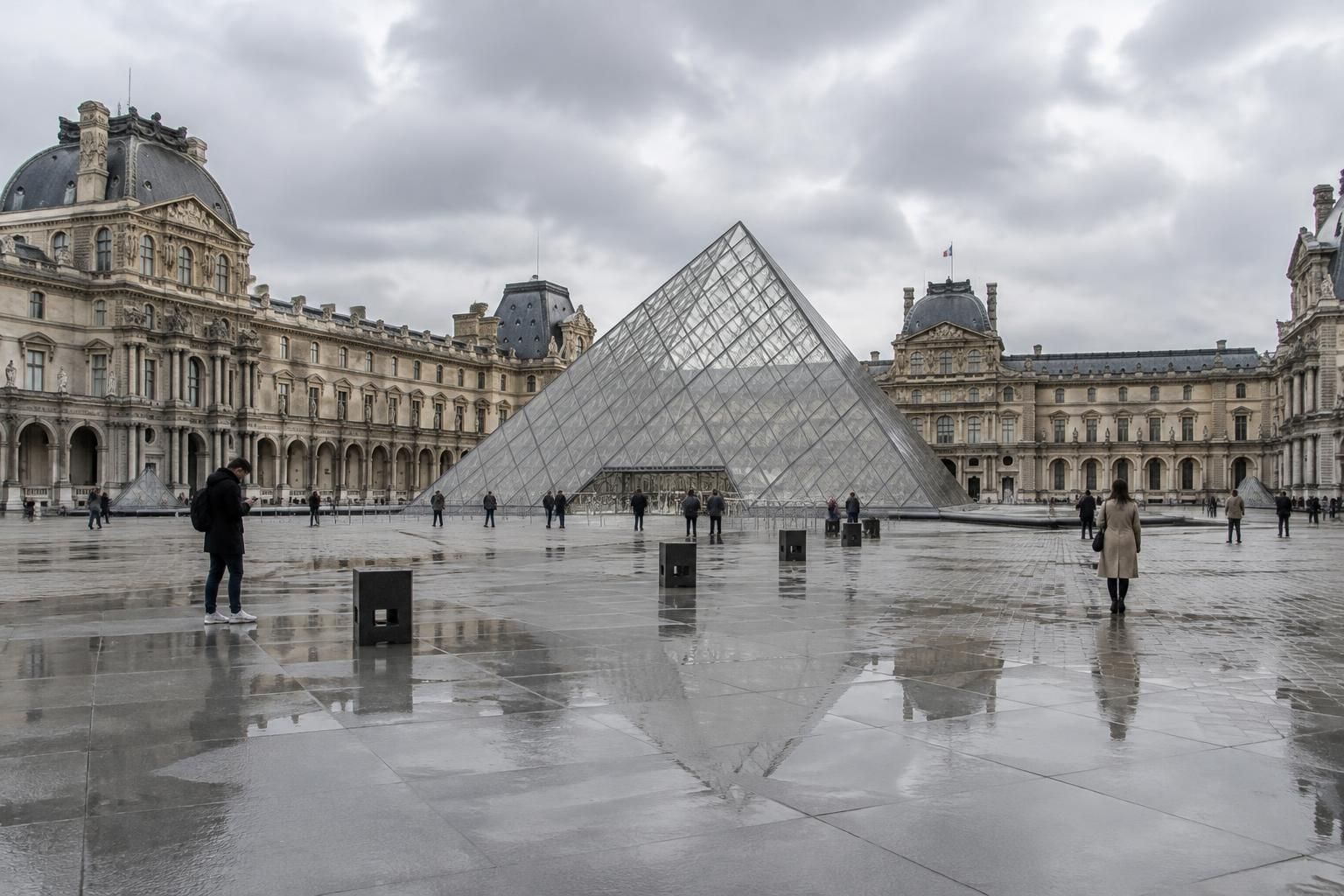
Why Paris Museums May Close Before Planned Protests Begin
A preventive shutdown addresses more than the possibility of damage inside a gallery. Museum operations depend on safe access, available personnel, functioning transport, controlled entrances, and clear evacuation routes. Disruption to any of these can undermine the conditions needed to welcome the public responsibly.
The reporting describes the culture ministry asking institutions under its authority to take necessary protective measures. That leaves an important operational distinction: a shared security concern does not necessarily produce identical decisions at every site.
A large palace, a smaller collection in a dense neighborhood, and an exhibition inside an event venue have different entrances, staffing requirements, and surrounding streets. Their managers must assess how local conditions interact with their own procedures.
Protect access routes as well as artworks
Collection security attracts attention because paintings and historic objects are irreplaceable. Yet the route between a station, an outdoor queue, and the entrance can be equally important when crowds or access restrictions are expected.
Visitors waiting outside may have limited shelter, little room to move, or difficulty understanding announcements. Families with young children and people with mobility requirements may need more time and space to change direction safely.
Why admit a group if its departure cannot be organized under acceptable conditions? That question illustrates why an apparently calm entrance does not, by itself, invalidate a preventive decision.
For Seine Cultural Visits, the relevant response is not to inspect a barrier and make an independent security judgment. The coordinator should follow the institution’s instructions and avoid bringing guests to a closed entrance simply to demonstrate that the scheduled visit is unavailable.
Keep staff protection within the operational decision
Employees also need reliable journeys to and from work. A building can remain physically secure while staffing becomes difficult because transport changes, controlled streets, or other restrictions affect access.
Front-of-house teams, security personnel, contractors, and technical staff perform different but connected roles. Reduced availability can affect queue supervision, accessible assistance, visitor information, and the response to an incident.
This is why public safety and service quality cannot be separated completely. An institution that cannot maintain its required operating conditions should not be judged solely by whether its galleries appear undamaged.
For a broader operational perspective, Grupem’s material on museum security at the Louvre provides related reading. Theft prevention and protest precautions are different subjects, but both make clear why cultural protection involves procedures and people as well as physical equipment.
Communicate restrictions without exaggerating the threat
Tourism professionals should explain a precaution without predicting violence or describing the entire city as unsafe. Accurate wording distinguishes a planned demonstration, previous reported disorder, and the specific measure taken by an institution.
A guest notice might say: “The museum has announced that it will not admit visitors for your scheduled session. Please do not travel to its entrance; your booking contact will explain the available options.”
That message gives an instruction without speculating about police activity, protest participants, or reopening times. The strongest safety communication explains the operational consequence while leaving security assessments to the responsible authorities.
Manage Tickets, Refund Requests, and Group Bookings After Museum Closures
A canceled visit does not automatically mean that every visitor receives the same remedy. Direct museum tickets, third-party reservations, guided packages, membership benefits, and event admission can involve different terms and different customer-service contacts.
Start with the seller named on the confirmation. A guide who arranged the itinerary may be able to help, but may not control the admission payment or have authority to approve a refund.
The most useful administrative step is to separate each purchased service. Museum entry, guiding, coach transport, and accommodation should not be treated as one interchangeable transaction unless they were sold under a package with applicable combined terms.
Create a booking record before contacting visitors
Seine Cultural Visits should prepare one record for each reservation, including the purchaser’s name, booking reference, scheduled session, payment channel, and relevant notification. This prevents duplicate requests and makes it easier to explain which action remains outstanding.
Preserve the original confirmation and any closure message. If the booking platform has a case-reference system, keep that reference with the reservation rather than scattering updates across private messages.
The following checklist assigns practical responsibilities without assuming a particular refund policy:
| Booking situation | First action | What to establish |
|---|---|---|
| 🎟️ Direct museum admission | Read the venue’s dated notice | Whether reimbursement, rebooking, or another procedure applies |
| 📱 Third-party purchase | Contact the seller shown on the receipt | Required evidence and the response process |
| 👥 Organized group visit | Ask the lead coordinator to consolidate requests | Who holds the reservation and who paid |
| 🚌 Combined tour services | Review each component and the package terms | Which services are canceled and which remain available |
| ♿ Prearranged assistance | Notify the relevant provider of any change | Whether assistance can transfer to a replacement visit |
A table like this is useful because it separates a visitor’s immediate question—“What happens to the booking?”—from the financial outcome, which depends on the applicable terms. Do not promise automatic reimbursement unless the responsible provider has announced it.
Give groups a clear decision window
A coordinator should state when the next update will arrive, even if the final remedy is still being processed. “Your next booking update will be sent by 16:00” is more actionable than repeated messages saying that discussions continue.
Offer alternatives only after checking capacity, transport, accessibility, and additional costs. Eighteen people cannot necessarily move into a smaller institution on short notice, even when individual tickets appear available online.
Keep acceptance explicit. If a replacement requires another payment or materially changes the experience, guests should understand that before the organizer confirms it.
For example, a decorative-arts visit may be worthwhile but does not reproduce an itinerary centered on the Louvre’s antiquities. Describe it as a different cultural experience rather than an equivalent substitute.
Finally, update practical documents: meeting instructions, guide assignments, transport schedules, and any reservation reminders. Good disruption management ends the administrative ambiguity as well as changing the itinerary.
Adapt Paris Tourism Itineraries Without Redirecting Visitors Into Disruption
A replacement activity should reduce uncertainty, not move guests toward another congested location. When several high-profile venues announce visitor restrictions, nearby attractions can experience additional demand, and a familiar route may no longer be the easiest option.
For Paris tourism professionals, the first test is operational: can the proposed experience be delivered safely, accessibly, and within its advertised conditions? Cultural appeal matters, but it cannot compensate for an unsuitable meeting point or an unconfirmed reservation.
Seine Cultural Visits should therefore prepare more than a list of famous alternatives. It needs a small set of checked options, each with capacity, travel requirements, cancellation terms, and a clear reason to suit the group.
Choose alternatives by access, not proximity alone
An attraction across the street may be less practical than one farther away if the immediate area is subject to restrictions. Check official transport information and the destination’s admission arrangements before asking guests to move.
Accessibility deserves a separate check rather than a general assurance. Confirm step-free access where needed, available seating, toilet facilities, and whether any changed walking distance is realistic for the people attending.
The group might prefer a reserved indoor discussion in an appropriate venue, a rescheduled collection visit, or a shorter activity in an unaffected area. A self-guided walk should not become the default simply because it requires no museum ticket.
- 📍 Confirm the destination: verify its opening arrangements and group admission rules.
- 🚇 Check the journey: review service changes and accessible routes before departure.
- 👥 Respect capacity: obtain acceptance for the group instead of assuming space is available.
- 🎧 Preserve interpretation: explain how the replacement connects with the original cultural theme.
- 🛑 Set a cancellation threshold: identify conditions that require postponing the alternative too.
This approach protects guests from a common failure: a replacement that exists on paper but collapses at the entrance. It also gives the guide a defensible reason to recommend postponement when no suitable option is available.
Understand why Art Basel requires a different response
The supplied reporting also describes Art Basel Paris canceling its weekend program after opening to the public on Friday. It reports 211 international galleries at the Grand Palais, illustrating how a temporary event can involve a large network of exhibitors, employees, contractors, and traveling collectors.
That figure belongs to the reported edition; it should not be carried forward as the attendance or exhibitor count for another year. Likewise, the fair’s schedule must be checked separately from the general operation of the building hosting it.
A fair cancellation differs from losing one museum session because the event has a limited duration. Visitors cannot assume that postponing by a day or moving to another time slot remains possible.
The accounts of collector Saloni Doshi and gallery owners Antoine Donzeaud and Elisa Rigoulet convey support for the protective decision despite the inconvenience. Their perspective helps distinguish financial or personal disappointment from the legitimacy of precautions.
For organizers, the practical lesson is to avoid marketing a hastily assembled substitute as though it restores access to a unique event. A credible alternative acknowledges what has changed and gives visitors a genuine choice.
Use Clear Digital Updates and Audio Guidance During Museum Disruption
Digital tools are most valuable during disruption when they simplify instructions. A well-designed message, an accessible booking update, or clearly delivered spoken guidance can reduce confusion without adding another complicated process for staff or visitors.
The objective is not to replace official announcements with a tour operator’s interpretation. It is to turn verified information into practical instructions that guests can understand and act on.
For Seine Cultural Visits, one coordinator should maintain the current operational message. Guides, booking staff, and customer-service colleagues can then work from the same version instead of producing slightly different explanations.
Build one reliable visitor update
Each notice should identify the affected booking, the required action, the contact responsible for follow-up, and the next update time. Include a visible date and local time so that recipients can distinguish a current instruction from an earlier message.
A useful example is: “Your scheduled Louvre visit will not take place under the announced closure. Do not travel to the original meeting point. Your coordinator will send the booking options by 16:00 Paris time.”
Only use that wording once the closure has been confirmed for the relevant session. If a decision has not been announced, describe the monitoring process rather than implying that cancellation is established.
Send important changes through the channel guests were told to monitor. A website banner alone may not reach travelers already in transit, while an app notification may fail to help someone who has disabled alerts.
Use layered communication: a direct message for urgent instructions, a stable page or document for details, and a reachable human contact for individual needs. Collect only the contact information necessary for the service and handle it under the organization’s privacy procedures.
Keep audio useful, accessible, and subordinate to safety instructions
Grupem’s smartphone-based approach to professional audio guidance is relevant when an approved replacement visit still takes place. Clear spoken interpretation can help a guide maintain continuity without relying on shouting or repeatedly gathering everyone into a tight cluster.
Audio delivery does not make an unsuitable route safe, remove admission restrictions, or authorize entry into a controlled area. Guests must remain able to hear official announcements and follow instructions from venue staff or emergency services.
Before deploying any mobile audio solution, test the actual phones, listening arrangements, connectivity requirements, and battery needs involved. Provide a workable alternative for participants who cannot or do not wish to use a smartphone.
For a replacement art discussion, the guide could explain how collecting, conservation, and public access shape the museum experience. Any images, recordings, or reproduced materials used alongside the talk should have appropriate permissions.
Review museum operations after the disruption
Once the immediate changes are handled, record where the workflow failed: outdated contact details, unclear seller responsibilities, inaccessible alternatives, or messages received too late. These observations are more useful than a general instruction to “communicate better.”
Related reading on Louvre building damage and collection protection broadens the operational perspective beyond demonstrations. Different incidents require different responses, but each exposes dependencies between buildings, people, information, and the visitor experience.
For the next affected booking, assign the source-checking role, prepare a dated message template, and test the fallback contact channel. Technology earns its place when it helps visitors receive the right instruction at the right moment.
Does a reported Louvre Saturday closure mean all Paris museums are closed?
No. The reporting identifies particular institutions, including the Louvre, Musée d’Orsay, and Musée National Picasso-Paris. Check the dated announcement for each venue rather than extending one decision to the entire city.
How can you check whether a closure affects your reservation?
Match the announcement’s exact date with your ticket, consult the museum’s official visitor information, and check messages from the seller named on your confirmation. An undated headline is not enough to establish your booking status.
Will tickets automatically be refunded after a museum closure?
Do not assume automatic reimbursement. The applicable process depends on the institution, seller, ticket type, and announced arrangements. Keep your confirmation and contact the responsible provider for refund or rebooking instructions.
Can a guided group switch to an outdoor visit instead?
Only after checking official guidance, route access, transport, accessibility, and the group’s needs. An outdoor activity is not automatically a suitable alternative, particularly near restricted streets or expected gatherings.
How can smartphone audio help during a changed itinerary?
It can support clear interpretation during an approved replacement activity. Test the equipment and operating requirements first, provide an alternative for guests who need one, and keep official safety announcements audible.
