
Short on time? Here is what matters:
- ✅ The Hoover Presidential Library and Museum will reopen on Thursday, August 6, 2026, at 1 p.m. with a public ceremony on the east lawn in West Branch.
- 🏛️ A $20 million transformation has redesigned the visitor route, galleries, and learning experience around Herbert Hoover’s humanitarian work, engineering career, public leadership, and Presidential History.
- 🎟️ Admission will be complimentary on reopening day, while timed planning remains advisable for groups, schools, and tourism professionals.
- 📍 The event extends beyond the Hoover Museum, connecting visitors with downtown West Branch, heritage activities, and the wider Hoover National Historic Site.
Hoover Presidential Library Grand Reopening Brings a Renewed Cultural Landmark to West Branch
The Grand Reopening of the Hoover Presidential Library and Museum will take place on Thursday, August 6, 2026, offering West Branch a major moment for heritage tourism, civic education, and regional visitor engagement. The ceremony begins at 1 p.m. on the museum’s east lawn, followed by the official ribbon cutting and the reopening of the galleries to the public.
This date marks the end of an extensive closure that began in January 2025. The facility, originally opened in 1962, has undergone a comprehensive inside-and-out redesign estimated at $20 million. Rather than simply refreshing finishes or replacing display cases, the project has rethought the museum’s floorplan and interpretation strategy from the ground up.
For visitors, this means a clearer route through a complex life story. Herbert Hoover is often reduced to one chapter of American History: his presidency during the Great Depression. The renewed museum is designed to present a wider, more balanced account, including his Iowa childhood, global engineering work, leadership in humanitarian relief, public service, and later legacy.
That broader framing is particularly relevant for a Presidential History museum. A presidential library can become difficult to navigate when its content is organized only by dates, offices, or large quantities of archived material. A visitor-centered approach instead helps people understand why events mattered, who was affected, and how decisions connected to the wider world.
The reopening is hosted by the Hoover Presidential Foundation in partnership with the Herbert Hoover Presidential Library and Museum. The event is free and open to the public, creating a low-barrier opportunity for residents, families, school groups, and visitors travelling through eastern Iowa. Official details and event updates are available through the Grand Reopening and ribbon-cutting event page.
West Branch is well positioned for this type of community-scale heritage event. Located around a quarter mile north of Interstate 80 at Exit 254, the town sits roughly 10 miles east of Iowa City and 50 miles west of the Quad Cities. This accessibility gives the reopening value beyond a local audience: it can support day trips, cultural itineraries, educational travel, and longer stays across Iowa’s historic destinations.
The renovation also gives the Hoover Museum a practical opportunity to serve different visitor needs. A family with young children, for example, may look for short, visual, interactive experiences. A history enthusiast may want detailed Historical Artifacts, original documents, and deeper political context. A school group needs a dependable learning route with clearly paced content. These audiences do not engage in the same way, and a reimagined institution can design for each without diluting the historical substance.
Consider a fictional group coordinator, Maya, planning a coach trip from Cedar Rapids. Before the redesign, she may have been concerned about uneven pacing: some guests moving quickly, others staying behind to read every label. In a better-planned gallery sequence, Maya can brief her group around key themes, arrange a meeting point, and let visitors explore with more independence. That is a simple operational improvement, but it changes the perceived quality of the visit.
For destination managers and cultural organizations, the reopening demonstrates that capital investment works best when it improves the whole experience: arrival, orientation, storytelling, accessibility, dwell time, and post-visit memory. A beautiful renovated building is valuable, but a coherent visitor journey is what turns a site into a living Cultural Landmark.
The key point is clear: the August reopening is not only the return of a museum building; it is the relaunch of a major West Branch heritage experience for contemporary audiences.
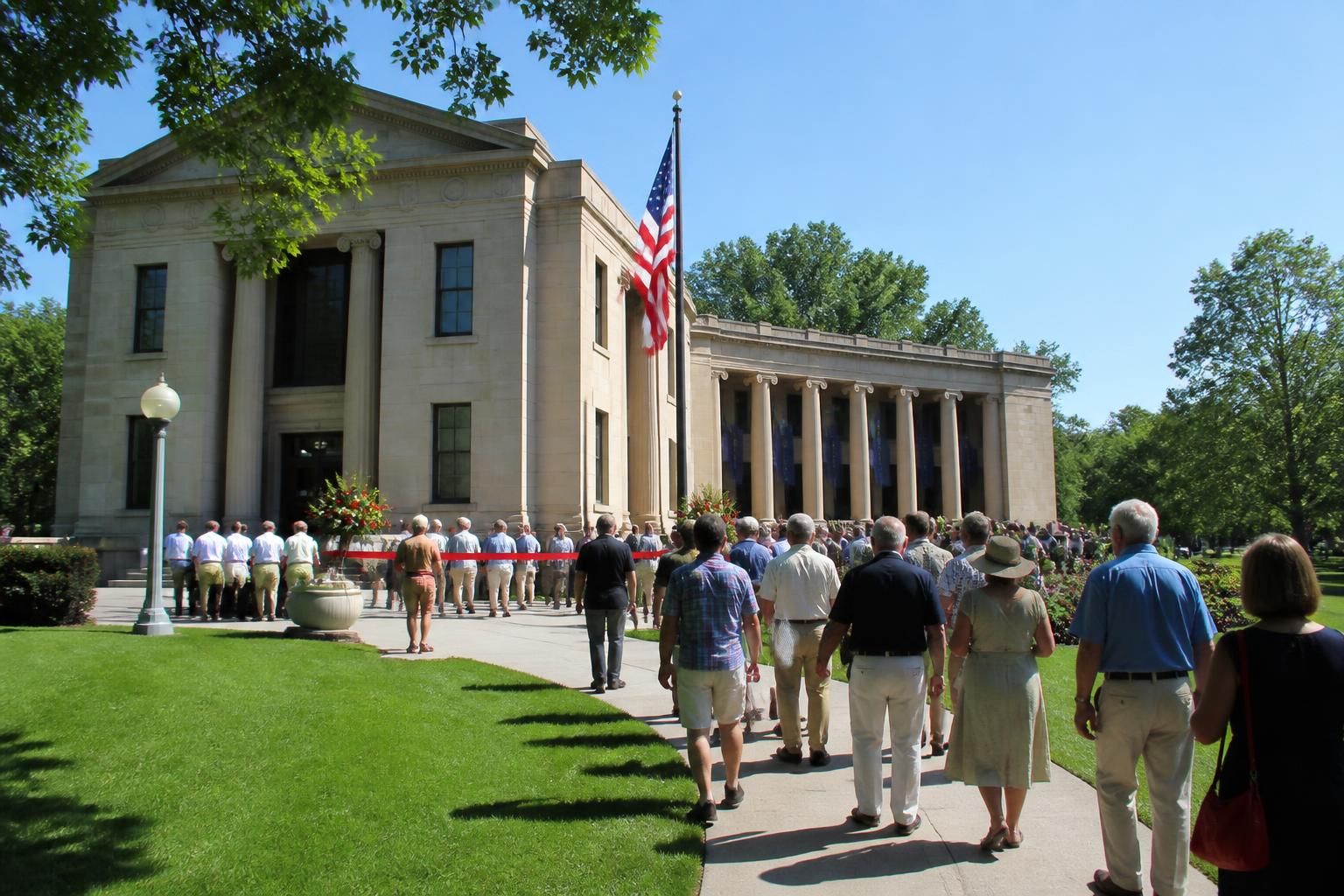
New Hoover Museum Exhibits Create a More Complete View of Herbert Hoover’s Life and Leadership
The redesigned Exhibits are expected to help visitors move beyond a narrow understanding of Herbert Hoover’s presidency. That matters because his story reaches across several fields: geology and engineering, international relief, food administration, commerce, diplomacy, public administration, and national politics. A museum that presents these themes as isolated facts risks losing the human connections between them.
The reimagined galleries aim to offer a deeper and more complete perspective on Hoover as a humanitarian, engineer, and President. This approach is especially useful in a museum environment because it allows visitors to see how earlier experiences influenced later choices. Hoover’s expertise in engineering and management, for example, shaped how he approached large-scale logistics and public service.
His humanitarian legacy deserves particular attention. During and after World War I, Hoover became internationally known for organizing food relief efforts in Europe. This work required coordination across borders, institutions, transport networks, governments, donors, and communities facing severe disruption. It is a story that gives contemporary audiences a concrete way to discuss logistics, ethics, international cooperation, and the realities of emergency response.
The reopening program includes Professor Jan Wouters, an expert in international law and international organizations and director of the Leuven Centre for Global Governance Studies. His participation reinforces the international dimension of Hoover’s legacy. Former Belgian Ambassador Dirk Wouters is expected to introduce him, while Belgium’s Deputy Consul General, Geert Van Dessel, will also take part in the ceremony.
These guests are not decorative additions to a local event. Belgium was central to Hoover’s early humanitarian reputation because of his work assisting civilians during the First World War. Linking West Branch to this international history gives the museum stronger interpretive reach. It shows that a local birthplace and a national presidential institution can tell a story with global consequences.
How immersive interpretation can support historical understanding
Immersive experiences are most effective when they serve evidence rather than spectacle. In a Presidential History setting, a visitor should not leave with only a dramatic visual memory; they should also understand the source material, competing perspectives, and historical stakes. The right use of audio, projected media, tactile interpretation, and carefully selected Historical Artifacts can make difficult topics easier to follow without simplifying them beyond recognition.
For example, an exhibit about food relief can combine maps, shipping records, photographs, quotations, and short narrated moments to show how aid moved from planning to delivery. A visitor does not need specialist knowledge of early twentieth-century geopolitics to understand the essential question: how do people organize assistance at scale when ordinary systems have broken down?
Audio also has a practical role in accessibility. Clear, short recordings can support visitors who prefer listening over reading long panels. They can also help multilingual groups, visitors with visual impairments, and families moving at different speeds. The principle is not to replace curatorial writing with technology, but to offer another route into the content.
For museums considering similar upgrades, the strongest lesson is to create content in layers. A 30-second audio segment can introduce the essential idea. A nearby object label can provide context. A longer archive-based story can reward visitors who want to go further. This layered model respects time constraints while maintaining intellectual depth.
| Visitor need | Useful exhibit response | Practical benefit |
|---|---|---|
| 👨👩👧 Families with limited time | Short thematic stops and clear visual storytelling | ✅ A meaningful visit without information overload |
| 🎓 School groups | Curriculum-linked questions and interactive evidence | ✅ Easier discussion of civic responsibility and history |
| 🌍 International visitors | Global humanitarian context and accessible media | ✅ A stronger connection to Hoover’s worldwide impact |
| 📚 History researchers | Detailed archival interpretation and object context | ✅ More value from primary-source Historical Artifacts |
The renovated Hoover Museum therefore has the potential to model a more useful form of historical mediation: one that is rigorous enough for informed audiences and approachable enough for first-time visitors. Good interpretation does not make history smaller; it makes its complexity easier to enter.
August 6 Ceremony Connects National Guests, Family Legacy, and American History
The August 6 event has been planned as a formal public ceremony as well as a community celebration. Allan Hoover III, chairman of the Hoover Presidential Foundation Board of Directors and great-grandson of President Hoover, will serve as master of ceremonies. His role creates a direct family connection to an institution dedicated to preserving and interpreting a public legacy.
Margaret Hoover, author, political commentator, television host, and another great-grandchild of the president, is scheduled to speak on behalf of the Hoover family. Family participation can be particularly meaningful in a heritage setting when it adds personal perspective while remaining connected to documented historical interpretation. It reminds visitors that the figures presented in a gallery were not abstract names in textbooks but individuals with families, decisions, contradictions, and long-term consequences.
The program is also expected to include Iowa Governor Kim Reynolds, Iowa Representative Bobby Kaufmann, Matthew Whitaker, United States Ambassador to NATO and former U.S. attorney general, and leaders from the National Park Service and National Archives. Stephanie Stephens, acting regional director for the National Park Service, is included among the announced participants.
The formal sequence begins with a presentation of colors by the United States Army. Visitors will hear the National Anthem and other musical selections by the Friends Church Choir. A ceremonial flag raising and music performed by the United States Navy Band Great Lakes Woodwind Quintet will add further structure to the occasion.
These elements place the reopening within a civic tradition, but they also need practical management. Large ceremonies can quickly become difficult for attendees if sound is unclear, seating is poorly marked, or the transition to the museum entrance is not explained. Event teams should ensure that public announcements are intelligible across the lawn, that reserved-access needs are anticipated, and that visitors know where the next activity begins.
Why ceremony design matters for visitor experience
For cultural institutions, a reopening ceremony is the first live test of the renewed visitor experience. It is an opportunity to observe how guests arrive, where they hesitate, what information they request, and how staff or volunteers respond. These observations are more useful when they are treated as operational feedback rather than anecdotal impressions.
A visitor arriving at 12:40 p.m., for instance, should be able to identify parking, the east lawn, accessible routes, restrooms, and the entry process without asking several people for directions. A group leader should know whether their party can gather before the ceremony and how the group can enter after the ribbon cutting. These details are not secondary; they define whether a major public occasion feels welcoming or stressful.
West Branch Mayor Roger Laughlin is expected to present the key to the city to the Hoover family. This gesture carries local significance because it emphasizes the relationship between the institution and the town. The museum is not a stand-alone attraction separated from its surroundings. It is part of a wider Heritage Site environment that includes the Hoover National Historic Site, prairie landscapes, local streets, and community businesses.
For visitors, the ceremony becomes more meaningful when the messages from speakers connect to what they will later see in the galleries. If the program highlights service, leadership, compassion, and innovation, the museum route should give concrete examples of those values rather than leaving them as broad slogans. That continuity between the stage and the Exhibits builds trust in the institution’s storytelling.
Tourism professionals can take a practical lesson from this event. When organizing a high-attendance heritage program, prepare two communication streams: one for ceremonial content and one for visitor logistics. The first explains why the moment matters; the second tells people where to go, what to expect, and how to participate comfortably.
A well-produced ceremony does more than mark an opening time: it prepares visitors to understand the historical experience that follows.
West Branch Heritage Activities Turn the Grand Reopening into a Full-Day Visitor Experience
The reopening day is designed to reach beyond the museum doors. Visitors will be able to explore a series of complementary activities across West Branch, helping the occasion function as a town-wide cultural program rather than a single ribbon-cutting moment. This matters because heritage tourism is stronger when visitors can connect a museum visit with streetscapes, local stories, outdoor sites, and community-led demonstrations.
Among the planned features is the Freedom250 Mobile Museum, which links the event to the United States’ 250th anniversary in 2026. This mobile experience creates an additional entry point into American History and can be useful for visitors who want a broader chronological frame around the Hoover story. It also supports intergenerational participation: a child drawn in by a mobile exhibit may become more interested in the permanent galleries, while an adult visitor may use the experience to discuss national history with family members.
Commemorative keepsake tickets will provide visitors with a tangible memento of the day. Such items can seem minor, but they are effective when integrated thoughtfully. A ticket can indicate the event date, reinforce the institution’s visual identity, and encourage people to retain a physical connection to their visit. For museums, it is also an opportunity to prompt a return visit or direct guests toward future programs.
Blacksmith demonstrations will add a live craft dimension to the festivities. Demonstrations of traditional skills can work well alongside formal museum interpretation because they make processes visible: heat, force, repetition, tools, and material knowledge. A visitor seeing metal shaped in real time may better appreciate the labor history and technological change behind many objects found in historical collections.
Self-guided historic walking tours through downtown West Branch will expand the geography of the experience. These routes are especially valuable for visitors who arrive early, remain after the ceremony, or prefer exploring independently. A good self-guided route does not need excessive signage or a complicated app. It needs accurate orientation, short stopping points, accessible language, and a clear sense of distance.
Hoover Ball demonstrations are also scheduled. This historic game provides a lighter, participatory element that balances the formal nature of a presidential institution. For families, it offers a way to turn historical curiosity into action. For cultural organizers, it shows the value of including an activity that does not require prior knowledge, expensive equipment, or lengthy instructions.
Planning a practical visit around the extended opening hours
The museum is expected to remain open until 6 p.m. on reopening day, giving visitors more flexibility than a standard schedule. Those focused on the ceremony may choose to arrive before 1 p.m., then enter the galleries after the ribbon cutting. Others may wait until later in the afternoon, when the lawn program has concluded, and combine the museum with downtown exploration.
Groups should plan around realistic movement times. Walking from a parking area to the event lawn, queuing for entry, using restrooms, and regrouping after independent exploration all take longer during a major public event. A simple group itinerary should include at least one buffer period rather than attempting to schedule every minute.
- 🕐 Arrive early enough to find parking and reach the east lawn before the 1 p.m. ceremony.
- 🎤 Attend the public program and remain attentive to staff instructions for the ribbon-cutting transition.
- 🏛️ Enter the renovated museum after reopening and choose a paced route through the new galleries.
- 🚶 Explore downtown West Branch through the self-guided historic walking tour.
- 🔨 Visit the blacksmith and Hoover Ball demonstrations before the extended 6 p.m. closing time.
Visitors planning a broader itinerary can consult the West Branch visitor information from the Hoover Presidential Foundation. This is especially useful for tour operators, accessibility coordinators, and families combining the museum with the national historic setting nearby.
For a cultural destination, the objective is not to keep visitors busy at every moment. It is to give them meaningful choices. Someone may prefer a full gallery visit; another may spend longer outside among demonstrations and historic streets. The best reopening-day design gives each person a clear path into the same shared heritage story.
Digital Accessibility and Smart Tourism Opportunities at the Hoover Presidential Library
The transformation of the Hoover Presidential Library also highlights a wider challenge for museums: how can historic interpretation remain accessible without becoming technically complicated? Visitors increasingly expect information to be easy to find before arrival, easy to follow on site, and easy to revisit afterwards. This does not require every institution to build a costly custom platform. It requires a disciplined focus on useful information and clear user journeys.
Before traveling to West Branch, visitors need practical answers: opening hours, directions, admission arrangements, group procedures, accessibility details, event timing, and nearby points of interest. The official museum visitor page is an important starting point for checking current planning information. For reopening-day attendance, travellers should review updates close to departure because public-event logistics can change as attendance estimates become clearer.
Once on site, audio can be one of the most effective tools for enhancing interpretation. A smartphone-based audio route gives visitors the freedom to control their pace while keeping the physical galleries uncluttered. Instead of placing long blocks of text beside every object, curators can offer short listening points that explain context, voices, and historical dilemmas.
For example, a visitor standing near an artifact connected to wartime relief could choose a two-minute audio segment explaining its role in a wider distribution network. A school teacher could select a shorter version with vocabulary suitable for younger learners. A researcher could access a longer account with archive references. The physical artifact remains central, while the digital layer adapts to different needs.
This approach is also relevant to accessibility. Audio content can benefit visitors with visual impairments, reading fatigue, dyslexia, or limited time. It can support people who are more comfortable listening than reading, provided that transcripts and simple controls are also available. Accessibility works best when it is integrated at the content-design stage, not added only after the galleries are complete.
Practical priorities for a modern heritage visit
A strong digital visitor journey starts with reliable basics. Mobile pages should load quickly. Key details should be visible without excessive scrolling. Maps should indicate entrances, parking, accessible routes, and nearby landmarks. Audio content should avoid background noise, overly theatrical delivery, and long introductions that delay the actual historical point.
For a destination such as the Hoover Museum, an audio-guided format could also connect indoor and outdoor interpretation. It could lead visitors from the library and museum to the surrounding Heritage Site, share context during a downtown walking route, and provide a final prompt for reflection before departure. This creates continuity without requiring visitors to follow a guide at a fixed pace.
Imagine Maya’s coach group returning after the Grand Reopening. Instead of trying to keep 35 people close enough to hear a guide in a busy entrance area, each guest can listen through their own smartphone and headphones. The group leader still manages timing and safety, while visitors receive clear commentary at a comfortable volume. This is a practical use of smart tourism technology, not a replacement for human hospitality.
Digital tools should also respect museum priorities. They must not distract from Historical Artifacts, overload visitors with notifications, or force downloads and account creation for basic access. The most effective technology is often quiet: it solves a real problem, works with ordinary devices, and lets the historical setting remain the focus.
The reopening gives the institution a renewed platform to test these methods over time. Visitor feedback can reveal whether people need shorter audio stops, clearer language options, better wayfinding, or additional content for children. Small improvements based on actual use are more valuable than ambitious features with little day-to-day benefit.
A modern museum visit begins with clear information and ends with a story visitors can carry with them, whether through a gallery, a walking route, or a well-designed audio experience.
When is the Hoover Presidential Library and Museum Grand Reopening?
The public Grand Reopening is scheduled for Thursday, August 6, 2026. The ceremony begins at 1 p.m. on the east lawn of the Herbert Hoover Presidential Library and Museum in West Branch, Iowa.
Is admission free on reopening day?
Yes. Complimentary admission will be offered as part of the reopening celebration, allowing visitors to explore the newly transformed museum galleries after the official ribbon cutting.
What activities are planned beyond the museum exhibits?
The day includes the Freedom250 Mobile Museum, blacksmith demonstrations, Hoover Ball demonstrations, commemorative tickets, self-guided historic walking tours in downtown West Branch, and extended museum hours until 6 p.m.
What has changed at the Hoover Museum?
The museum has completed a comprehensive renovation, including a fully redesigned floorplan and reimagined exhibits intended to present a broader view of Herbert Hoover as an engineer, humanitarian, public servant, and President.
Where is the Hoover Presidential Library located?
The museum is located at 210 Parkside Drive in West Branch, Iowa, about one quarter mile north of Interstate 80 at Exit 254, approximately 10 miles east of Iowa City.
