
Capital Campaign Positions Decatur as a Northern Gateway for Civil Rights Tourism
🏛️ The $20 million “Northern Gateway” Capital Campaign gives Decatur an opportunity to build a coherent Civil Rights Museum and Horton Legal Center while connecting North Alabama to the wider Alabama Civil Rights Trail. Led by the nonprofit Celebrating Early Old Town With Art, known as CEOTA, the initiative combines Cultural Preservation, historical education, Legal Advocacy, and practical visitor infrastructure.
The campaign was launched with the stated aim of completing a three-part destination: the restored Ruby Baker Boarding House, a new museum building, and the Judge James E. Horton Jr. Legal Learning Center. Rev. Jerry Baker and retired Decatur Director of Development Wally Terry serve as campaign co-chairs, working alongside tourism director Danielle Gibson and attorney Robert Baugh. Their shared task is not simply Fundraising. It is to help residents, institutions, and future visitors understand why this local history has national significance.
Decatur already sits within reach of destinations associated with the wider struggle for Equality, including Birmingham, Montgomery, Selma, Tuskegee, and Anniston. Yet North Alabama has often been less visible in public itineraries. The proposed complex can address that gap by offering a meaningful northern entry point into the state’s civil rights landscape. Visitors travelling through the Tennessee Valley could begin with the Scottsboro Boys story in Decatur, then continue toward other landmark cities with a stronger understanding of how courtrooms, communities, railways, and public opinion shaped the era.
The campaign’s public framing also matters. A museum project becomes more sustainable when it is presented as an experience that serves several audiences: local families, school groups, legal professionals, university researchers, heritage travelers, and cultural organizations. This is where a modern approach to visitor experience can make a measurable difference. Clear routes, accessible interpretation, multilingual-ready audio, and flexible programming help transform a historic site from a one-time stop into a place people recommend and revisit.
For background on the launch and the campaign’s leadership, readers can consult coverage of the Decatur campaign kickoff. The core message is practical: the project needs broad Community Support because capital projects require more than enthusiasm. They require construction funding, exhibit planning, collections stewardship, technology, staffing preparation, and a long-term operating model.
Why the Northern Gateway concept has value for visitors and residents
A “gateway” is valuable only if it helps people navigate a story. In this case, Decatur can introduce visitors to the Scottsboro Boys trials and the actions of Judge Horton before they encounter other locations along Alabama’s Civil Rights Trail. The site can give context to questions that remain urgent: What does due process look like when public pressure is intense? Who takes personal risk to protect fairness? How do ordinary neighbors become witnesses to history?
Consider a family arriving for a weekend in North Alabama. They may first search for local heritage experiences, then decide whether a stop merits time in their itinerary. A well-designed Civil Rights Museum can provide a clear answer through timed tours, compelling stories, comfortable gathering spaces, and audio content that works on a visitor’s own smartphone. These details are not cosmetic. They improve access for seniors, schoolchildren, international travelers, and visitors who may need to move at their own pace.
- 📍 Local relevance: tell the story of Decatur residents and historic buildings with clarity.
- ⚖️ Educational depth: connect the Scottsboro Boys case to constitutional rights and courtroom procedure.
- 🎧 Visitor accessibility: offer guided audio in a format that can be used without expensive receivers.
- 🤝 Economic benefit: encourage longer stays, nearby dining, lodging, and cultural spending.
- 🧭 Regional continuity: position Decatur within a wider civil rights travel route rather than in isolation.
The strongest cultural destinations do not reduce difficult history to a photo opportunity. They give visitors enough structure to learn, reflect, and discuss what they have seen. The Northern Gateway vision is most effective when history, access, and respectful visitor design advance together.
Civil Rights Museum Development Preserves the Scottsboro Boys Story
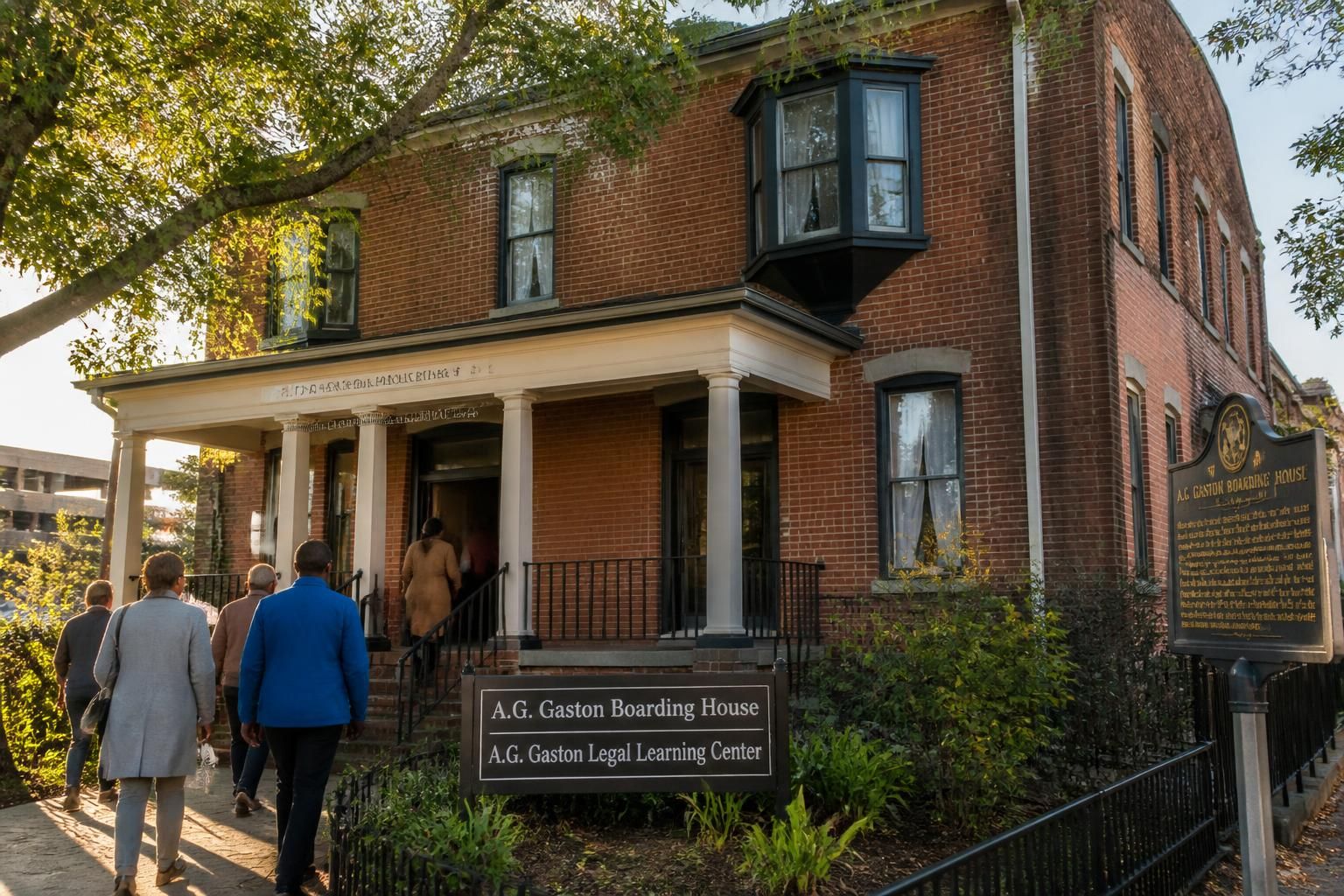
The Civil Rights Museum project began with a highly specific preservation need. In 2019, CEOTA focused on saving the former Ruby Baker Boarding House at 818 Sycamore Street Northwest, a property in serious disrepair. The building is associated with Victoria Price, one of the two accusers in the Scottsboro Boys case, who is believed to have stayed there during the proceedings. Rather than treating the house as a standalone artifact, the nonprofit used it as the foundation for a larger educational district.
This approach is important because historic buildings carry meaning beyond their walls. A preserved structure can help visitors understand scale, geography, and daily life in ways that text panels alone cannot. At the same time, buildings need careful interpretation. The aim is not to sensationalize traumatic events or simplify people into fixed roles. It is to make clear how a legal crisis affected real individuals, families, neighborhoods, and institutions.
Restoration work has already moved the Baker home substantially forward. CEOTA reported that the property was about 75% complete after improvements including air conditioning, insulation, and new drywall. Planned work includes vaulted ceilings, flooring, and an additional area with a bathroom, kitchenette, and store. These upgrades are practical as well as historical. They make it possible to receive visitors safely, host small programs, and support day-to-day operations without compromising the site’s character.
The second phase broadens the experience through a purpose-built museum adjacent to the boarding house. Current plans include larger gallery areas, interactive exhibits, oral-history resources, archival capacity, and gathering spaces. A museum built around this material should give visitors multiple ways to engage. Some will want a concise overview. Others will need primary sources, judicial context, family histories, or detailed explanations of how the case moved through Alabama courts and the United States legal system.
Interpretation should make difficult history understandable, not distant
The Scottsboro Boys case involved nine Black teenagers accused of raping two white women in 1931. The proceedings became emblematic of racial injustice, inadequate legal representation, hostile public pressure, and the prolonged struggle for fair trials. Judge James E. Horton Jr. set aside a guilty verdict in one case and postponed the remaining trials indefinitely after determining that the defendants could not receive a fair trial under the circumstances.
That history should be communicated with precision. Visitors benefit when an exhibit separates confirmed records from interpretation, explains legal vocabulary in plain language, and acknowledges the human stakes of each decision. An interactive timeline, for example, could let a school group follow key hearings, appeals, public reactions, and later legal developments. An oral-history station could introduce the voices of Old Town residents whose willingness to testify also required courage.
Digital layers can extend this work without overwhelming the physical galleries. A smartphone audio guide can provide optional deeper explanation at each stop, allowing visitors to select a 25-minute route, a family-friendly route, or a detailed legal-history route. Cultural sites exploring mobile guidance can also draw useful ideas from a museum revamp focused on visitor experience, especially when planning content that remains easy to access for mixed audiences.
Imagine a student named Maya arriving with her class. Her teacher may need a guided route that fits a 45-minute visit, while Maya may later want to revisit a particular testimony or courtroom decision. Layered interpretation serves both needs. It gives educators control over time while giving individual learners a path to explore further.
🧩 Cultural Preservation works best when a site preserves both the physical place and the evidence needed to understand why that place matters. The museum phase can therefore become a durable learning environment rather than a static collection of objects.
Horton Legal Center Can Turn Legal Advocacy Into Practical Learning
The Judge James E. Horton Jr. Legal Learning Center is designed to add a distinct dimension to the overall project. While the museum will interpret history, the Horton Legal Center can help visitors examine how legal decisions are made, challenged, and remembered. This difference is essential. A civil rights destination becomes more useful when it does not stop at describing injustice but also explains the legal mechanisms through which people sought remedies.
The project gained momentum when the Horton family donated Judge Horton’s Greenbrier home to CEOTA in February 2023. In the following fall, support from more than 18 organizations helped relocate the 3,960-square-foot, eight-bedroom house to Decatur. Moving a historic house is a complex act of preservation. It requires engineering, public coordination, transport planning, site preparation, and a clear plan for reuse. In this case, the relocation created a physical centerpiece for legal education in the planned district.
Phase three calls for an annex with classrooms and a courtroom. The expected cost has been estimated at roughly $5 million to $6 million. State support has already contributed approximately $3 million toward the Horton House component, demonstrating that public investment can play a meaningful role alongside private donations, foundation grants, and institutional partnerships. A report on state funding for the legal learning center illustrates the importance of combining funding sources for a project of this scale.
| Project element | Primary purpose | Visitor and community value |
|---|---|---|
| 🏠 Ruby Baker Boarding House | Historic-site interpretation | Connects visitors with a physical setting tied to the Scottsboro Boys story |
| 🏛️ Civil Rights Museum | Exhibitions, archives, oral history | Builds context around Social Justice, race, community, and public memory |
| ⚖️ Horton Legal Center | Classrooms and mock courtroom | Supports Legal Advocacy education, civic programs, and student learning |
| 🎧 Digital interpretation | Accessible guided content | Allows visitors to choose pace, language, and level of detail |
A mock courtroom can make constitutional principles concrete
A mock courtroom is not merely an architectural feature. It can host student hearings, legal ethics workshops, public lectures, and re-enactment-based learning. A group of high-school students could review a simplified case file, identify questions of evidence and bias, then discuss what fair process requires. Law students could use the setting to explore how judicial independence operates when a ruling is unpopular.
Judge Horton’s example is particularly suited to this kind of education. His decision came with significant personal and political consequences. He served one term and was not reelected. That reality helps visitors understand that courage in the legal system is not abstract. It may involve professional loss, criticism, and isolation. The learning center can encourage a careful question: what responsibilities do public officials have when justice and political convenience conflict?
⚖️ The Horton Legal Center has the potential to connect historical accountability with the skills communities need for informed civic participation today.
Fundraising Strategy Requires Transparent Community Support and Partnerships
The campaign has reported approximately $5 million raised so far, while the overall mission is described as requiring about $20 million. The three-year Capital Campaign should therefore be understood as a structured effort to secure major gifts, public support, grants, in-kind services, and broad-based local participation. A large cultural project rarely succeeds through one source alone. It needs a funding mix that protects the project from delays and makes the finished destination more accountable to its community.
Transparency is central to that work. Donors want to know what a contribution supports: restoration, construction, exhibition design, classroom equipment, accessibility features, archival storage, or operations planning. Community members also need visible evidence that the project reflects local priorities. Public updates, construction milestones, donor recognition policies, and clear descriptions of governance can turn interest into sustained trust.
Wally Terry has emphasized that people should find a personal connection to the story. This is a useful fundraising principle when handled responsibly. A person may connect through family history, a commitment to Equality, a legal career, a school relationship, or a desire to preserve Old Town. These connections are different, but each can support the same shared objective: ensuring that future generations have access to accurate, well-maintained, and thoughtfully interpreted history.
Building a donor pathway beyond one-time gifts
The most durable Nonprofit campaigns create several ways to participate. A regional business may sponsor a gallery or classroom. A law firm may support legal education programming. A family may fund a memorial bench, preservation feature, or oral-history initiative. A local resident may contribute a smaller recurring amount. These options should be communicated plainly, with clear outcomes and without overstating what individual gifts can accomplish.
- 💼 Major gifts: approach foundations, corporations, and philanthropic families with project-specific proposals.
- 🏛️ Public funding: coordinate municipal, county, state, and heritage-related opportunities.
- ⚖️ Professional partnerships: involve bar associations, law schools, and legal organizations in the learning center.
- 🎓 Education alliances: build programs with schools, colleges, and teacher networks before opening day.
- 📣 Community giving: create accessible ways for residents to contribute and receive regular progress updates.
The potential for collegiate partnerships is notable, including connections with institutions such as Cumberland School of Law. Such relationships can support curriculum design, visiting speakers, internships, research projects, and mock trial programming. They also give the center a practical role between major events, helping avoid the common problem of cultural facilities that are active only during opening season.
Modern communication tools can support fundraising without replacing face-to-face relationships. A short audio message from a historian, a virtual preview of an exhibit, or a well-produced project update can make the campaign easier to follow for people who cannot attend a public meeting. Voice technology is increasingly useful in visitor-facing services as well, as shown in this overview of voice AI and local search for destination discovery. The key is to use technology to make participation easier, not to make the campaign feel impersonal.
🤝 Effective Fundraising is not a request for attention; it is a clear agreement between a project and the people who want to help it endure.
Accessible Audio and Smart Tourism Can Strengthen the Civil Rights Museum Experience
A successful Civil Rights Museum must be accessible in more than one sense. Physical accessibility, readable exhibit text, seating, and clear visitor flow are essential. So are intellectual accessibility and emotional pacing. Visitors arrive with different knowledge levels, ages, languages, learning preferences, and personal connections to the subject. A strong interpretation plan gives them options without diluting the history.
Smart tourism tools can support this goal when they are chosen for real use. A smartphone-based audio guide allows a museum or historic district to provide professionally structured narration without distributing and maintaining large quantities of dedicated receivers. Visitors can listen through their own headphones, follow a map, pause when needed, and select additional content. For school groups, educators can guide students through a shared route while preserving room for independent reflection.
The Decatur complex is especially suited to an audio-led route because it includes more than one building and multiple themes. A visitor could start at the Ruby Baker Boarding House, continue through galleries focused on the Scottsboro Boys case, then enter the Horton Legal Center for a courtroom-based learning activity. Audio can provide transitions that explain why each location matters. It can also signal moments where visitors should slow down, examine a document, or consider a question before moving forward.
Designing audio content for respect, clarity, and choice
Audio interpretation should not be a long recording played at every stop. The most effective approach uses concise tracks, clear titles, and meaningful choices. A general visitor may choose “The Scottsboro Boys in 20 Minutes.” A teacher may select “Classroom Route: Fair Trial and Evidence.” A legal professional may prefer “Judge Horton’s Decision and Judicial Independence.” The physical exhibits remain central, while audio offers depth on demand.
Content should be written in direct, respectful language. It should identify sources, distinguish testimony from established fact, and avoid dramatic sound effects that could trivialize suffering. Where testimony or period reporting contains racist language, contextual warnings and careful editorial decisions are necessary. Accessibility also means offering transcripts, captioned video, readable maps, and versions designed for visitors with visual or hearing impairments.
Operationally, staff should test routes outdoors and indoors, verify Wi-Fi or mobile coverage where needed, and provide a simple fallback option such as QR codes linked to lightweight web pages. A guide or museum educator should be able to assist a visitor in under a minute. If a tool requires a complicated account setup, it creates friction at the exact moment a guest is ready to learn.
Picture a visitor named Daniel, travelling from another state with his parents and teenage daughter. His parents may prefer larger print and a slower pace. His daughter may engage more deeply with a short interactive legal question. Daniel may want a detailed account of the court rulings. One flexible audio system can support all three, without forcing the family to split into separate experiences.
The project can also use digital content after the visit. Teachers may share a recap route with students. Visitors may revisit selected oral histories. Donors may receive an update explaining how a restored room or new classroom supports the wider mission. This continuity makes the destination more useful while keeping the historic site at the center of the experience.
🎧 A clear voice, a reliable route, and thoughtful interpretation can help the Civil Rights Museum and Horton Legal Center welcome more people without simplifying the truth they came to understand.
What is the purpose of the $20 million Capital Campaign?
The campaign supports a three-part Decatur heritage project: restoration of the Ruby Baker Boarding House, construction of a Civil Rights Museum, and development of the Judge James E. Horton Jr. Legal Learning Center.
Why is Judge James E. Horton Jr. important to the project?
Judge Horton set aside a guilty verdict in a Scottsboro Boys case and halted further trials after determining the defendants could not receive a fair trial. His actions provide a powerful basis for legal education and civic discussion.
How can the Horton Legal Center be used beyond museum visits?
Plans include classrooms and a mock courtroom that can support school programs, legal ethics events, university partnerships, public talks, and community learning activities.
How can digital audio improve the visitor experience?
Smartphone audio can provide self-paced tours, optional deeper context, accessible transcripts, and tailored routes for families, schools, legal professionals, and heritage travelers.
